Summary
- Fervo and Google Energy signed a 15-year PPA for 396 MW from Cape Station, divided into four successive 99 MW sub-tranches with target commercial operation beginning in the third quarter of 2028.
- A further approximately 600 MW is an obligation to make an offer, not contracted capacity. Google must accept it and the parties must execute a mutually acceptable definitive agreement.
- Failure by Fervo to make the required offer can trigger a reimbursement linked to earlier deemed-delivery payments and the spread between the market price and the undisclosed PPA price. Fervo cannot yet estimate the amount.
- Cape Station still has to convert permits, construction and firm deliverability into financeable and operating output. The correct dashboard keeps every state separate.
The most consequential word in Fervo Energy’s newest power contract is not “megawatt.” It is “offer.”
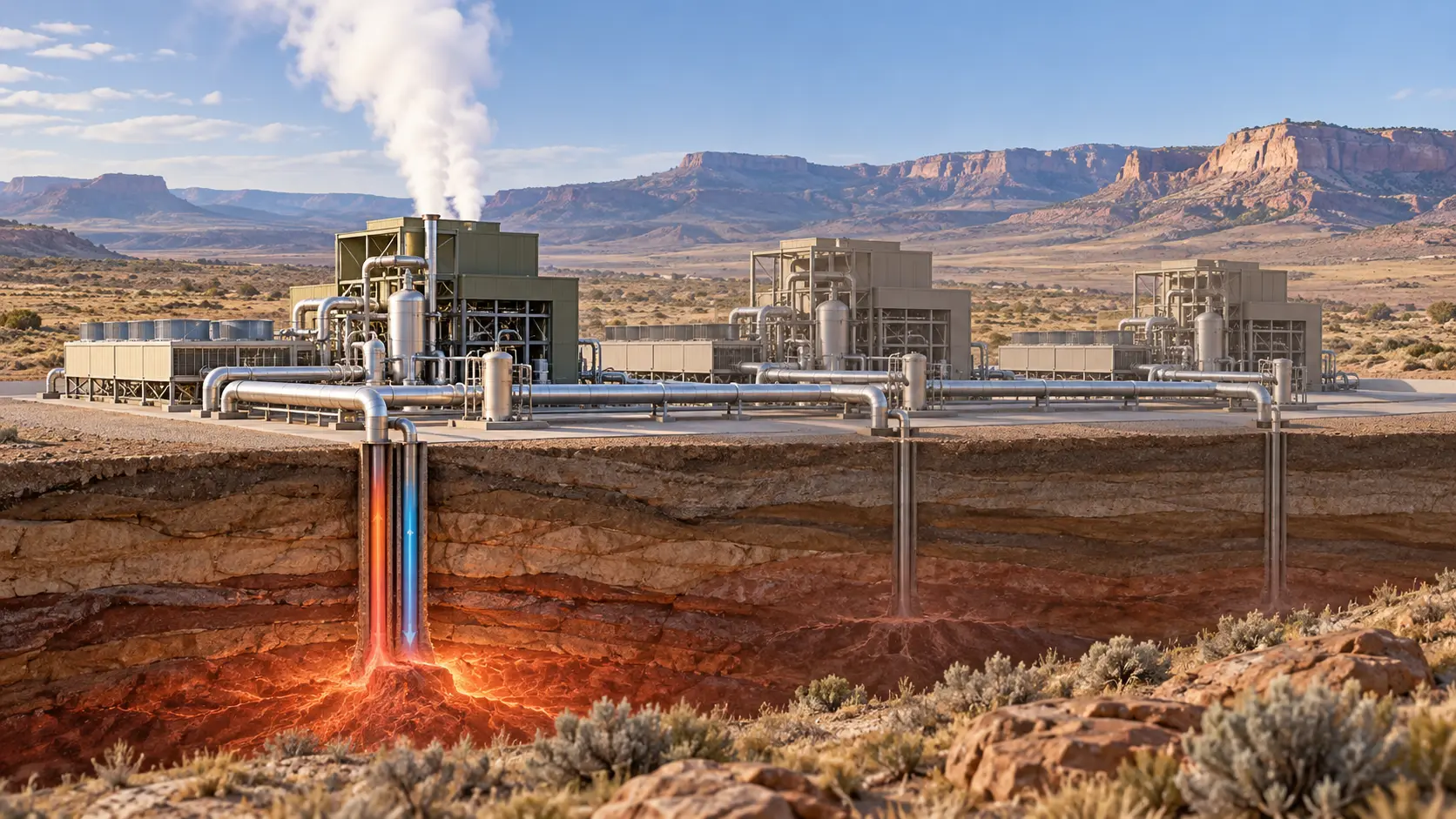
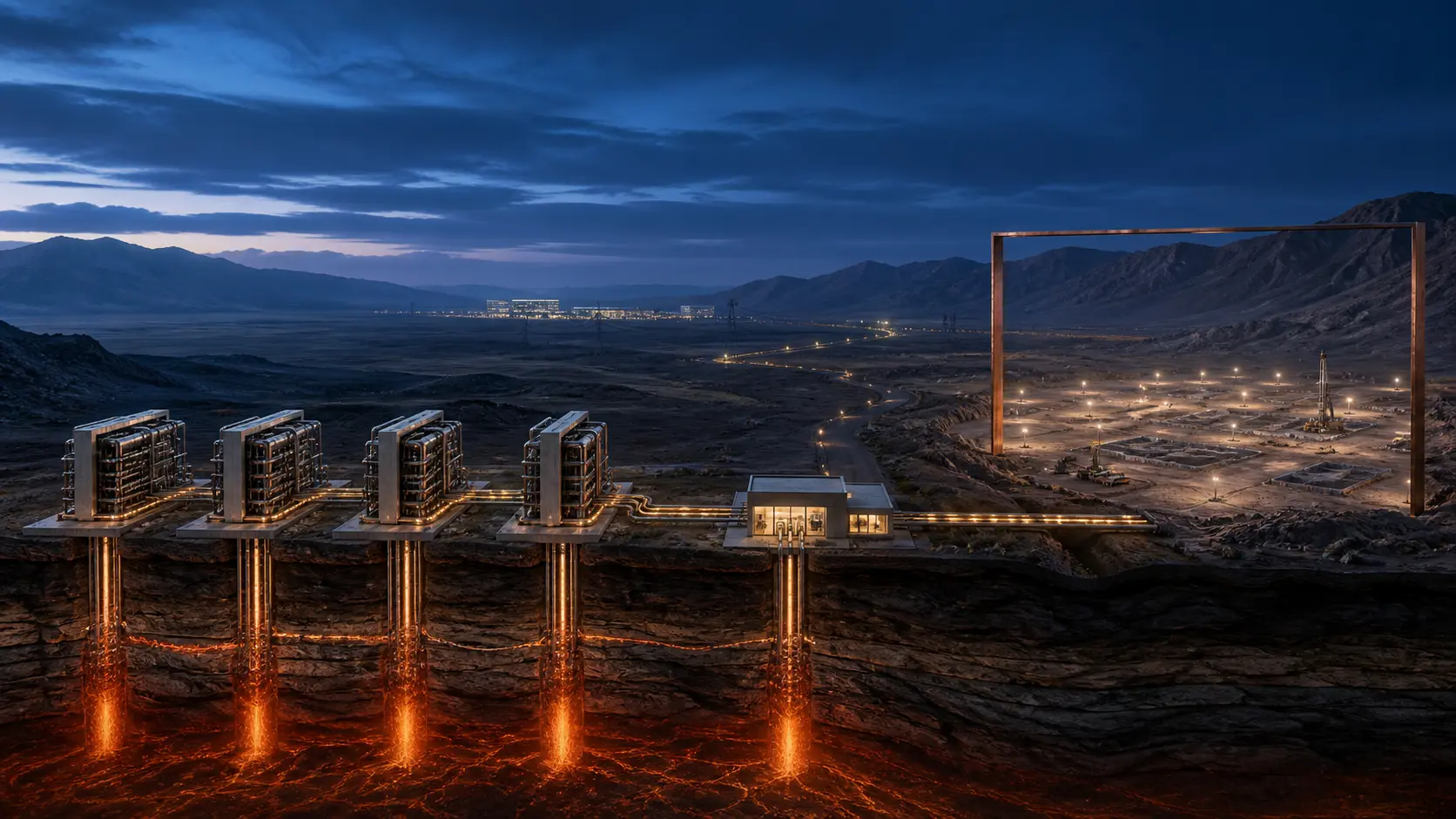
On 26 August, a Fervo subsidiary and Google Energy signed a power-purchase agreement for 396 MW from Cape Station in Utah. That part is binding. Delivery is divided into four successive tranches of 99 MW, commercial operation is targeted to begin in the third quarter of 2028, and the delivery term runs for 15 years.
The same filing describes approximately 600 MW of additional capacity. Fervo is required to offer it to Google. Yet the expansion is expressly subject to Google’s acceptance and to a mutually acceptable definitive agreement. The difference is elementary and easy to lose: 396 MW sits in a signed PPA; roughly 600 MW sits behind a decision gate.
If that gate eventually opens, the parties say their contracted enhanced-geothermal relationship would reach not less than about 950 MW. If it does not, the reason matters. Fervo might fail to make the required offer. Google might decline. The parties might accept the commercial idea but fail to settle definitive terms. These are not interchangeable outcomes, and only the first activates the reimbursement mechanism disclosed in the filing.
The contract therefore gives the market something more useful than a large capacity number. It supplies a state machine.
Four 99 MW receipts come before the headline total
The signed 396 MW is itself not one delivery event. It arrives through four successive 99 MW sub-tranches. The structure creates at least four opportunities to compare schedule, construction cost, well performance and actual electricity delivery with the original plan.
A target commercial-operation date is not output. Before a tranche reaches that state, Fervo has to complete drilling and surface works, secure the relevant approvals, establish firm deliverability, energise the connection and satisfy the PPA’s conditions. Only then can contracted capacity become delivered energy and, later, cash.
This distinction is particularly important for geothermal development. A data-centre operator can sign a long-duration power contract before the associated generation and delivery system is finished. The contract may make financing easier by establishing a customer and term, but it cannot substitute for resource performance or physical completion.
Parent guarantees narrow one part of the exposure. Fervo Energy guarantees the obligations of Cape Geothermal Supply 6; Alphabet guarantees Google’s. That improves support at the corporate boundary. It does not guarantee a well’s flow, an agency decision, a construction schedule or a transmission path.
The first clean measurement is therefore not “396 MW announced.” It is the status of each 99 MW block: permits, drilling, surface equipment, firm delivery, mechanical completion, commercial operation, availability and invoicing.
The 600 MW path begins with a duty to speak
The expansion provision is unusual because it is neither a simple purchase option nor a conventional capacity award. Fervo must make an offer covering approximately 600 MW. Google then decides whether to accept, and any accepted concept must still be converted into a mutually acceptable definitive agreement.
That arrangement can have value before a sale occurs. Google obtains an organised route to evaluate a much larger block of firm clean power. Fervo can plan development with a named potential customer and a defined negotiation path. Each side gains information about load timing, price, project design and delivery architecture.
But none of that turns the offer into contracted revenue. The PPA price is not public. The commercial terms for the expansion are not public because they do not yet exist in definitive form. Even the capacity is described as approximate.
The filed press release calls the 396 MW agreement the world’s largest enhanced-geothermal PPA and frames the additional capacity as a route towards nearly 1 GW. That is a legitimate description of scale and ambition. The 8-K provides the accounting discipline: signed volume, required offer, acceptance and definitive agreement are four separate columns.
The resulting language should remain precise. Google has signed for 396 MW. Fervo owes Google an offer of roughly 600 MW. Google has not yet contracted that additional capacity on the evidence disclosed.
A reimbursement tail gives the offer economic weight
The offer obligation is not merely ceremonial. If Fervo fails to make the required offer, it may have to reimburse Google for amounts the customer previously paid for deemed delivered energy.
The formula described in the filing depends on the relevant volume and the difference between the market price and the PPA price. Both inputs make the exposure path-dependent. The PPA price is undisclosed, future market prices are unknown, and the relevant deemed-delivery payments depend on earlier contract performance. Fervo says it cannot estimate the possible amount.
That is not the same as saying the exposure is immaterial. It means the public evidence does not support a number.
The trigger also needs careful treatment. The disclosed mechanism addresses failure to make the required offer. It should not automatically be applied to a Google rejection or to negotiations that fail after an offer has been made. Monitoring requires the actual offer notice, its timing, its terms, Google’s response and any definitive agreement—not a guess derived from the final capacity total.
Economically, the clause links the optional future expansion to the performance history of the signed PPA. Earlier deemed-delivery payments can remain relevant when the later capacity decision arrives. The 600 MW gate thus has a tail reaching back into the 396 MW contract.
Utah’s delivery architecture remains unsettled
The filing connects the agreement to a potential Google data-centre development in Utah and to the state’s Senate Bill 132 framework for closed private generation. Power may be delivered through a structure in front of the meter or behind it.
Those two paths can redistribute responsibility for interconnection, utility interfaces, metering, reliability and regulatory treatment. They do not eliminate those responsibilities. Fervo says the plans remain subject to engineering, agency and other approvals as well as commercial conditions.
“Potential” must do work here. The cited material does not establish a completed Google data centre, a final electrical design or approval of every relevant permit. Nor does behind-the-meter delivery mean power reaches the load without a delivery system. It changes the boundary at which that system is organised.
The financing boundary is equally important. In its June-quarter Form 10-Q, Fervo said project debt requires firm deliverability through transmission or behind-the-meter structures. A PPA can improve the revenue case, but lenders still need evidence that the electricity can reach the contracted point on reliable terms.
This makes the Utah approval path part of the capital stack. A delayed or uncertain delivery structure can delay debt, which can alter the funding mix, which can alter the economics of construction. Permitting is not paperwork outside the market story; it is one of the mechanisms that decides when contracted capacity becomes financeable.
Cape Station’s earlier milestones expose the conversion risk
Cape Station was already under construction before the Google agreement. At 30 June, Fervo was targeting first power from Phase I in late 2026, approximately 100 MW in early 2027 and all 500 MW operating by the end of 2028.
The permit ledger was incomplete. Fervo reported 79 of 80 Phase I permits and 82 of 179 Phase II permits, leaving 97 Phase II permits in process as of the filing date. Counts are useful but blunt: one unresolved critical-path approval can matter more than dozens of routine permits. The correct test is not just how many have been obtained, but which approvals govern drilling, surface works, interconnection and commercial operation.
Capital intensity is already visible. Fervo estimated approximately US$2.2 billion of cumulative Cape Station Phase II capital expenditure through 2028. First-half company capex was US$399.3 million, with another US$850 million to US$900 million expected in the second half and roughly US$1.3 billion projected for 2026 as a whole.
The company held about US$2.1 billion of cash at 30 June after its initial public offering. That is a substantial development runway. It is not proof that every remaining project cost is funded, nor that future equity or debt will arrive without changing returns. With only US$174,000 of revenue reported for the first half, the operating cash engine had not yet caught up with the construction programme.
The PPA helps connect those ledgers. A creditworthy buyer, long term and defined capacity can support financing. Yet the largest funding need occurs before most contracted electricity can be delivered. That timing gap is where execution risk accumulates.
The old portfolio total cannot simply absorb the new contract
As of 30 June, Fervo reported 658 MW of binding PPAs and US$7.2 billion of potential revenue backlog. Both figures predate the 26 August agreement.
It is tempting to add 396 MW and report 1,054 MW. The filing does not supply the reconciliation needed to do that. Later contracts can supplement, replace, resize or overlap with earlier project arrangements. Until Fervo publishes a new portfolio bridge, the honest presentation keeps the two dates separate.
The backlog deserves the same restraint. It is potential future revenue over long contract periods, conditional on development and performance. It is neither current revenue nor cash. The new PPA may expand the company’s commercial base, but its monetary contribution cannot be inferred without price and portfolio reconciliation.
This is more than accounting caution. A clean reconciliation would reveal whether contract growth is keeping pace with the construction plan, whether old agreements have changed and how much of Cape Station’s intended output has a durable route to a customer.
Sources
Member Briefing
Deeper Profile Context
Sign in with the right membership level to unlock the full briefing and source notes.
Only for Strategic Circle
Strategic Circle
Open to all readers. Unlock profile briefings after joining and signing in.
Join Strategic CircleOnly for Leadership Alliance
Leadership Alliance
For qualified IP-asset owners and management; sign in to unlock alliance briefings.
Join Leadership Alliance