
Topic
Software Lifecycle and Lock-in
Within the Topic facet, Software Lifecycle and Lock-in topic intelligence connects articles that share a specific subject, signal focus, or monitoring theme. The page gives readers a richer path through related reporting, source evidence, market actors, and infrastructure implications, with enough context to understand why the topic matters across company movements, governance decisions, regional exposure, and operational risk. Readers can compare recurring signals, affected organisations, public evidence, market context, service continuity, procurement, competition, compliance, and strategic planning questions behind the subject instead of stopping at a thin list of matching articles. It explains what the topic covers, which infrastructure actors or policies are involved, what evidence supports the coverage, and why the subject may matter for operators, customers, investors, and policy readers.

CASE FILE
The Capability Was Advertised. The Protocol Was Not Authorized: RFC 9885
A zero-length IS-IS capability can be visible on every change-board screen and still be limited public evidence to authorize one configuration command. RFC 9885 makes that limit explicit: the advertisement is management information, not a protocol trigger, while safe MP-TLV…

History
The Interim Fix Bought Time. It Could Spend the Future: RFC 1380
The Internet of 1992 had more than one deadline. Router tables and Class B allocations were under immediate pressure; a larger address space and a richer Internet layer demanded slower architectural work. RFC 1380 refused to hide that mismatch inside one programme. It recommended…

History
The Network Found the Book. It Could Not Keep the Shelf Current: RFC 1432
In March 1993, a bibliography about the Internet carried an unusually revealing provenance: much of its detail had arrived through the Internet itself. The network could help a reader discover a book, yet RFC 1432 also preserved the reasons discovery could never certify the…

CASE FILE
The Path Label Reached the Egress. The Transit Route Stayed Unseen: RFC 9884
One green LSP Ping result can answer a narrow and valuable question: the egress processed a Path Segment Identifier in the control-plane context named by the probe. It cannot reveal the transit route that delivered it. RFC 9884 makes that boundary operationally useful—provided…

IETF
IETF Separates Training Scripts From Slides. Now Test the Handover.
The IETF's latest training-procurement answers make captions, transcripts and narration scripts separate source assets. That is a useful move toward maintainable course material. Its value will become visible when someone other than the original producer has to correct a module.

History
The Transport Opened a Connection. SNMP Still Owned the Retry: RFC 1283
A connection is an enticing piece of evidence. It has a beginning, a lifetime and an end. In 1991, RFC 1283 placed SNMP on an OSI connection-oriented transport and then warned implementers not to read too much into that new structure. The connection could carry one or more…

CASE FILE
The Request Was Signed. The Other Private Key Was Still Only Asserted: RFC 9883
A certificate request can carry a valid signature and still offer no technical proof that the requester holds the private key named by its new public key. RFC 9883 does this deliberately. It turns the gap into an explicit policy choice—and a revocation dependency that operators…

History
The Client Found the Person. The Score Still Belonged to One Directory: RFC 1431
A successful search can be the beginning of an evaluation rather than its conclusion. In February 1993, RFC 1431 asked what an X.500 directory client had actually accomplished when a person's entry appeared—and what the answer had cost inside one particular directory.

CASE FILE
RFC 9882 Put SHA-512 in the Field. It Did Not Always Use It
A CMS record can truthfully name SHA-512 while that algorithm contributes nothing to the signature being checked. RFC 9882 requires exactly that combination on one of its two ML-DSA paths. The apparent contradiction disappears only when an auditor follows the bytes rather than…

IETF
The Newer Packet Arrived First: How TCP RACK Used Time to Find Loss
RACK changes the evidence TCP can use when looking for loss: not only sequence-space gaps, but also the transmission times of data known to have arrived.

CASE FILE
RFC 9879 Modernised the MAC. It Did Not Retire the Legacy Reader
Two applications can open the same PKCS #12 file and report success for different reasons. One may verify its new PBMAC1 envelope. Another may fail to understand that envelope, ignore the failed check and continue to the encrypted key material. RFC 9879 makes the first path…

History
The Gateway Rewrote the Message. It Could Not Invent the Charset: RFC 1428
The old message arrived as eight-bit octets and a social fact. Somewhere, sender and reader knew what those bytes meant. The message itself did not say. In 1993, a gateway standing between that installed mail world and MIME could add structure, recode headers and leave a trace of…

CASE FILE
The Header Was Allowed in the ACK. It Did Not Validate the Bill: RFC 9878
RFC 9878 fixes where several 3GPP SIP P-Headers may appear, including a narrow exception for ACK after a successful response. That permission solves an interoperability problem; it does not turn a signalling field into proof of location, route, entitlement or charge.

CASE FILE
W3C's ARIA Implementation Report Says March. Its File Changed in May.
W3C's updated *ARIA in HTML* Recommendation points readers to an implementation report whose visible date is 22 March 2026. The public file history shows a large revision on 20 May and another change on 27 May. Both can be true: March may be the evidence cutoff and May the…

History
The Fallback Was Written Down. Running Servers Still Broke the Session: RFC 1425
The old server was supposed to say that it did not understand `EHLO`, remain connected and let the client try `HELO`. That was the elegant transition drawn in RFC 1425. Seventeen months later, its successor had to record what running systems actually did: some dropped the…

History
The Shortcut Was for Display. The Stored Address Had to Outlive It: RFC 1278
The sharpest sentence in RFC 1278 comes after the convenient machinery. Macros could shorten a long presentation address, nest inside one another and choose the longest available substitution for display. Then the memo drew the line: no macro should ever be relied on. In 1991…

CASE FILE
The Number Was Registered. The Device Had Not Agreed to Run It: RFC 9876
A compact identifier can cross a constrained network faster than the evidence needed to trust it. RFC 9876 makes the CoAP Content-Formats registry more reliable, but its successful review remains a coordination event—not a production verdict.
CASE FILE
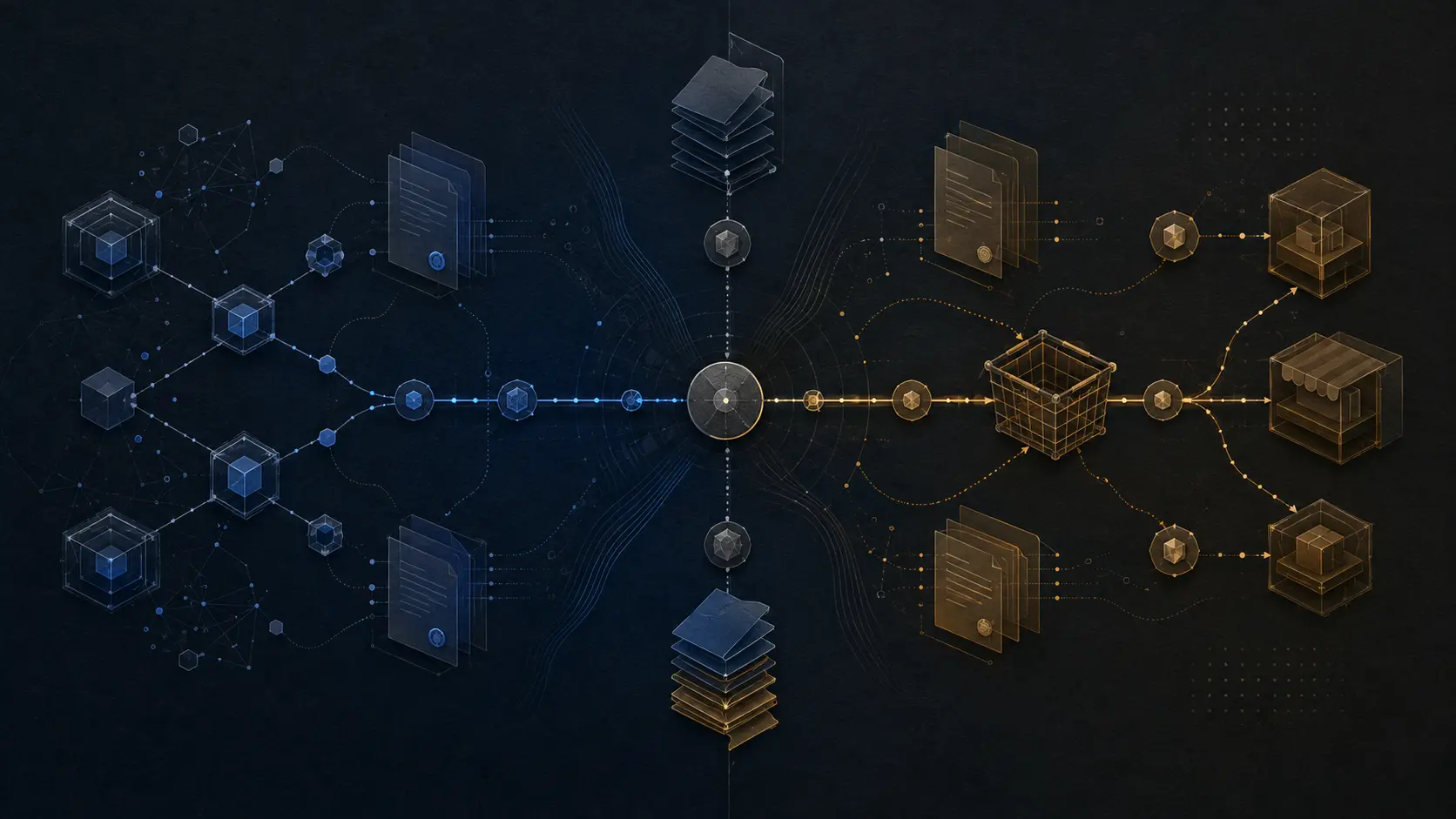
W3C’s Commerce Workshop Has Two ACPs. Its Record Needs Protocol Keys
The W3C and GS1 workshop on e-commerce for humans and AI agents will bring several emerging protocols into one room. Its public pages already expose a small but consequential recordkeeping problem: ACP names two different public artifacts. Before the event turns presentations…

History
The Mail Stayed Readable. Every Rewrite Became the Verifier's Problem: RFC 1421
The words were already on the screen. A recipient could read the paragraphs, understand the request and even act on them. Yet the machine still had a different question: were these the same canonical lines that the sender had signed? In RFC 1421's `MIC-CLEAR` format, human access…

CASE FILE
The Reply Proved One Probe Arrived. It Did Not Certify the Next Datagram: RFC 9869
A matching token can turn silence into a positive measurement. RFC 9869 lets a UDP sender learn that one padded probe reached a UDP Options receiver. Its discipline lies in the boundary: the reply belongs to one packet, one path and one moment, not to every datagram that follows.