Summary
- The W3C workshop overview expands ACP as Agent Communication Protocol, while an OpenAI agenda item refers to ACP without expansion. OpenAI’s own commerce materials make Agentic Commerce Protocol the evidence-backed reading of that second reference, but the agenda itself does not say so.
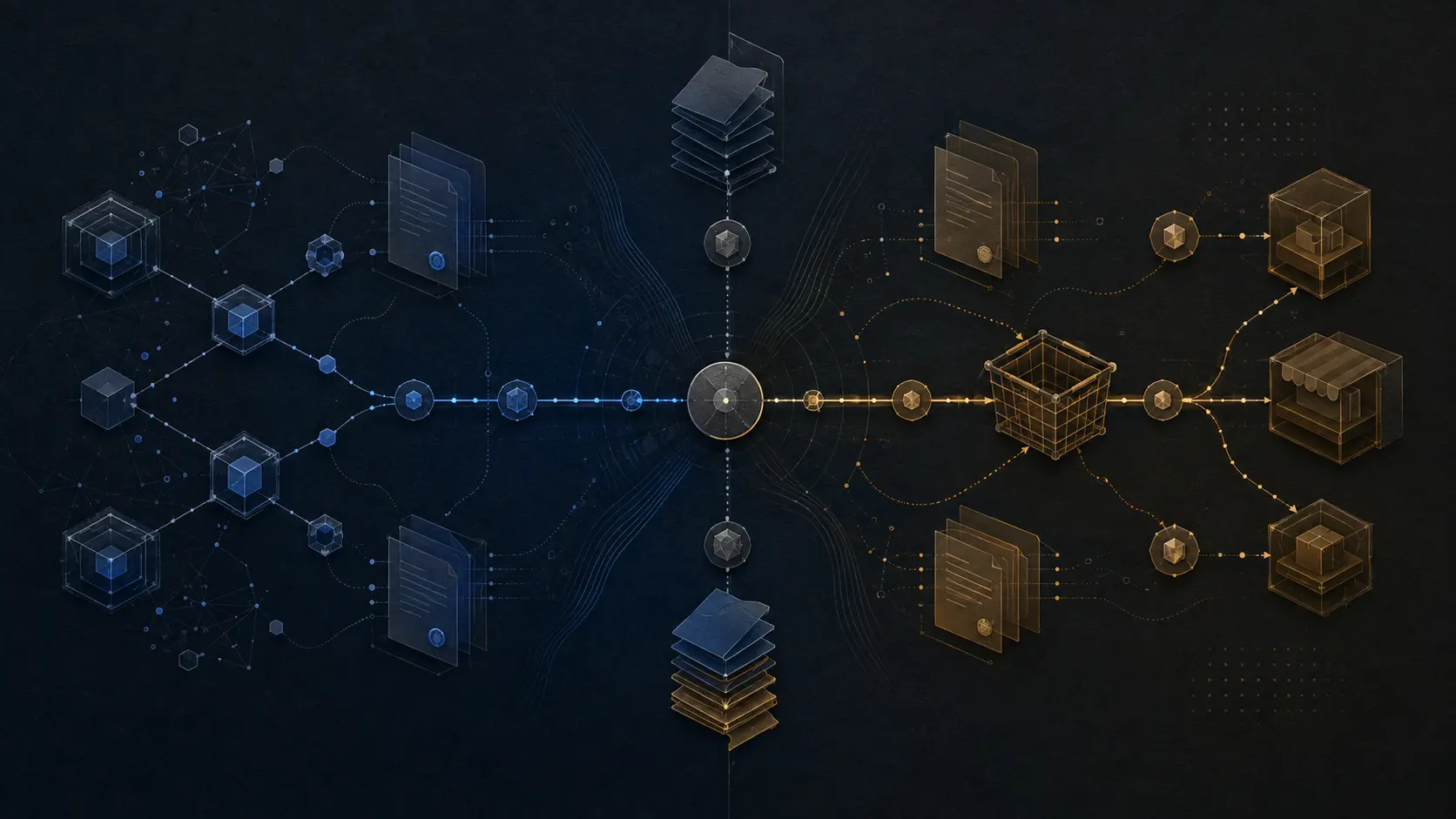
- These are distinct public artifacts with different functions, maintainers and lifecycle states. Their shared acronym is not a durable identifier.
- A workshop protocol key should record the canonical name, specification URI, observed version, steward, contribution route, lifecycle state, precise claim and explicit non-conclusions about endorsement, equivalence or adoption.
One programme, two referents
W3C and GS1 are due to hold their hybrid workshop, E-commerce for Humans and AI Agents, in Zurich on 8 and 9 September 2026. The published participation material describes an exploratory event: participants will share implementation experience, identify common questions, consider standardization opportunities and discuss possible next steps. That makes the programme a map of inputs, not a catalogue of W3C-approved technologies.
On the workshop overview, one list names MCP, UCP and ACP (Agent Communication Protocol). The ACP label links to the Agent Communication Protocol website. That reference is unambiguous because the long name and destination travel together.
The detailed agenda contains another reference. A session by Riley Strong of OpenAI, “Progressive Enhancement: Evolving the Web for Agents and Commerce,” says it draws on “our experience with ACP.” The agenda does not expand ACP or attach a link. OpenAI’s public commerce announcement and the project it maintains with Stripe use ACP to mean Agentic Commerce Protocol. In the context of an OpenAI presentation about agents and commerce, those sources support that reading. It is still an inference from the speaker, subject and OpenAI’s own materials—not a quotation or definition supplied by the W3C agenda.
Nothing in this evidence shows that an organizer or speaker confused the two projects. It shows something narrower: the letters alone do not preserve the referent.
The artifacts differ before any technical comparison begins
Agent Communication Protocol describes a REST-based interface for interaction among agents, applications and humans. Its public documentation says that the project is now part of A2A under the Linux Foundation. Its repository exposes an OpenAPI description and an Apache-2.0 licence. The important governance facts are the artifact, the migration statement and the project venue in which changes can now be understood.
Agentic Commerce Protocol addresses programmatic commerce flows among buyers, AI agents and businesses. Its repository identifies OpenAI and Stripe as maintainers, labels the specification beta, uses dated versions and, at the evidence cutoff, identifies 2026-04-17 as the latest stable snapshot. It too uses Apache 2.0, but a shared licence does not collapse the projects into one authority or one technical object.
This article does not rank the protocols. Nor does it claim that they are compatible, incompatible or competing substitutes. Their scopes are sufficient to establish the recordkeeping point: a reader cannot recover purpose, steward or version from the token “ACP.” Even the same expanded name may become insufficient when a project migrates, a repository moves or a specification changes over time.
An acronym is a label, not provenance
Acronyms work well in live conversation because people supply missing context. A durable workshop record is different. It may later be read by a standards participant, implementer, procurement team, regulator or researcher who was not in the room. A presentation title may be copied into minutes; minutes may inform a charter discussion; a breakout phrase may be cited as evidence that “the workshop considered ACP.” Every reuse increases the cost of recovering the original referent.
That cost is not merely bibliographic. The two ACPs have different maintainers and change channels. A date on one specification can identify a stable snapshot; a migration notice on another can redirect the locus of future work. If a report preserves only the acronym, later readers may attach a claim to the wrong repository, treat a beta document as a settled interface, or mistake a speaker’s implementation experience for an institutional position.
The W3C Process supplies the crucial boundary. Workshops gather interest. If sufficient interest exists, a charter may be drafted, Members review it, and an approved group may then conduct work under a defined scope. A workshop appearance therefore does not itself charter a group, place an external protocol on the Recommendation track, or certify adoption. Good provenance should make that boundary easier to see, not require readers to infer it.
The protocol key
The remedy can stay small. For every protocol mentioned in the final agenda, presentation index, breakout record or workshop synthesis, preserve eight fields:
- the canonical name used by the project;
- the canonical specification or repository URI;
- the version, release date or immutable commit actually examined;
- the steward and the venue where changes are decided;
- the licence and public contribution route;
- the lifecycle state—beta, released, migrated, superseded or another project-defined term;
- the exact claim made about that artifact; and
- a non-conclusion stating what the reference does not establish, including endorsement, equivalence and adoption.
Call this a protocol key, not a registry. It should not allocate acronyms, decide which project is legitimate or require anyone to seek central approval. Its function is narrower: join a human label to an inspectable artifact at a particular time.
Applied to the workshop’s two references, the key would preserve that the overview expressly linked Agent Communication Protocol, while the OpenAI agenda item left ACP unresolved in the page itself. An editor could then add the supported Agentic Commerce Protocol referent with an inference label and the public sources used to resolve it. If the agenda is updated with an expansion or link, the record can state when that happened rather than silently overwriting the earlier ambiguity.
Preserve claims at their actual authority level
The key also separates four kinds of statement that workshop records often compress. A speaker may report an implementation. A project may describe its own protocol. Workshop participants may identify a question worth pursuing. A later W3C group, if chartered, may make decisions within its approved scope. These statements have different authors and different authority.
For example, “OpenAI presented experience using Agentic Commerce Protocol” would be a claim about a speaker and an artifact, provided the referent is confirmed. “The workshop endorsed Agentic Commerce Protocol” would be a much stronger institutional claim and is not supported by the current record. Likewise, the presence of Agent Communication Protocol on the overview does not show that GS1 adopted it or that W3C selected it over another approach.
A protocol key makes modest language operational. The record can cite what was presented without inflating it into consensus; identify a repository without endorsing its contents; and record a possible standardization path without pretending the path has already been chosen.
Sources
- W3C/GS1 workshop overview
- Workshop agenda
- Participation and objectives
- W3C workshop announcement
- W3C Process Document
- Agent Communication Protocol documentation and repository
- Agentic Commerce Protocol site and repository
- OpenAI’s Agentic Commerce Protocol announcement
- Lu Heng, “The Policy Mirror”
- Lu Heng, “Minimum Initial Specification, Localized Future Decision, and Voluntary Adoption”
Member Briefing
Deeper Profile Context
Sign in with the right membership level to unlock the full briefing and source notes.
Only for Strategic Circle
Strategic Circle
Open to all readers. Unlock profile briefings after joining and signing in.
Join Strategic CircleOnly for Leadership Alliance
Leadership Alliance
For qualified IP-asset owners and management; sign in to unlock alliance briefings.
Join Leadership Alliance