
Topic
Software Lifecycle and Lock-in
Within the Topic facet, Software Lifecycle and Lock-in topic intelligence connects articles that share a specific subject, signal focus, or monitoring theme. The page gives readers a richer path through related reporting, source evidence, market actors, and infrastructure implications, with enough context to understand why the topic matters across company movements, governance decisions, regional exposure, and operational risk. Readers can compare recurring signals, affected organisations, public evidence, market context, service continuity, procurement, competition, compliance, and strategic planning questions behind the subject instead of stopping at a thin list of matching articles. It explains what the topic covers, which infrastructure actors or policies are involved, what evidence supports the coverage, and why the subject may matter for operators, customers, investors, and policy readers.

IETF
The Empty Registry Row Was Not Permission to Use It
An engineer opens the DNS parameter table and finds a number marked unassigned. The field accepts it. A laboratory server answers it. A packet trace shows the value crossing the network. None of those facts says the Internet has granted that number a stable public meaning. RFC…

IETF
Both Sides Compiled. They Still Did Not Speak the Standard: RFC 5381
Automation can make two systems agree with each other while separating them from everyone else. RFC 5381 described a NETCONF client and server generated from the same Web Services description. The code worked as a pair. Its cookie-based session binding nevertheless did not…

History
The Universal Client Was a Lure. RFC 3981 Kept the Core Incomplete on Purpose
The IRIS core specification made an unusual virtue of being limited public evidence. It could identify registry types, carry lookups and follow references, but it refused to pretend that one query language or one data model could understand every Internet registry. RFC 3981…

IETF
The Address Never Moved. Everything Beneath It Did: RFC 5380
A stable endpoint can be the most misleading entity on an operations screen. RFC 5380 kept a Regional Care-of Address visible while local movement changed the address, binding and tunnel that made it reachable. The design reduced signaling. It also made continuity depend on state…

History
The Name Crossed Three Storage Transports. It Still Did Not Name an Address: RFC 3980
A storage array could expose Fibre Channel, SAS and iSCSI ports without becoming three different devices. RFC 3980 let one NAA identifier cross those transport boundaries as the basis of an iSCSI name. The gain was continuity of identity, not a shortcut to an IP address, a live…

IETF
A Privacy Token Was Not a Global Rewrite Warrant: RFC 5379
The most dangerous privacy control is sometimes the one that works too broadly. A SIP intermediary can see a field that appears to reveal identity, erase it in the name of protection, and still leave the caller worse off because the call transfer, route, signature, or return…

IETF
The Consensus Finished. No Licence Clause Changed That Minute.
The IETF community could reach rough consensus about the rights it wanted readers and implementers to receive. That consensus mattered, but it did not itself typeset a licence, identify the rights already held by the Trust, or switch a new policy into effect. RFC 5377 placed…

IETF
The Header ID Returned to One. The Header Did Not Return With It.
A JPEG 2000 receiver had saved a complete main header under identifier one. Six unseen parameter changes later, the sender’s three-bit counter returned to the same value. The comparison passed. The state did not. RFC 5372 made main-header recovery practical by reusing recent…

IETF
The Submit Button Bound the Contributor. It Did Not Manufacture Ownership.
RFC 5378 made an unusually consequential design choice: the act of submitting an IETF Contribution is enough to bind the submitter and named co-Contributors to the incoming-rights terms. No later signature is required. That speed keeps an open standards process workable, but it…

IETF
Every Fragment Had an Exact Address. The Picture Still Had No Receipt.
A JPEG 2000 fragment arrived with a precise byte offset from the start of its frame. Operations could say exactly where it belonged. They still could not say that the bytes before it had arrived, that the main header was usable, that every parallel layer had ended, or that any…

Global Cloud Services Trends
Progress’s Domo price is a bet on revenue after planned churn
Progress Software paid $400 million cash for Domo’s AI and data platform, then valued the deal at roughly 1.4 times “steady-state” revenue. That denominator is not Domo’s last reported revenue: Progress expects it to fall after planned seat-based churn and lower…

History
The Peer Could Invalidate the STag. The Local Layer Still Had to Check: RFC 7145
An RDMA storage task can be complete while the memory permission it exposed is not. RFC 7145 makes that gap an endpoint responsibility: a response from the other side may help revoke access, but the initiator must know that its own STag is no longer valid.

Asia-Pacific National Telecom Trends
VEON’s 10-year Amdocs deal is an operating bet, not an AI revenue bridge
VEON has announced a decade-long agreement under which Amdocs is to run and modernize core technology operations across Eurasia, while using certain QazCode intellectual-property rights in its aOS platform. The public case rests on operating scope and future execution—not on a…

History
The Cipher's Ceiling Came Before the Session Ended: RFC 7146
In block storage, a cryptographic key can outlive its safe operating envelope even while the storage session is still doing useful work. RFC 7146 made that mismatch part of the interoperability contract: a cipher that had once been mandatory to implement could become optional…

IETF
The Parameter Had an IANA Row. The Call Still Had No Route.
RFC 5341 gives `tel` URI extensions a controlled namespace and a durable reference. That is vital coordination. It is not a runtime receipt for the URI, the number, the network or the call.

Leaders
Grace Hopper Turned Portability into a Test—and Credited the Team
A language standard can describe what a compiler should do without showing whether different vendors’ compilers actually do it. When Grace Hopper returned to Navy service in 1967, the problem was no longer only how to write a common language. It was how to test the…

IETF
The Relay Lost One Capability. The Recipient Changed.
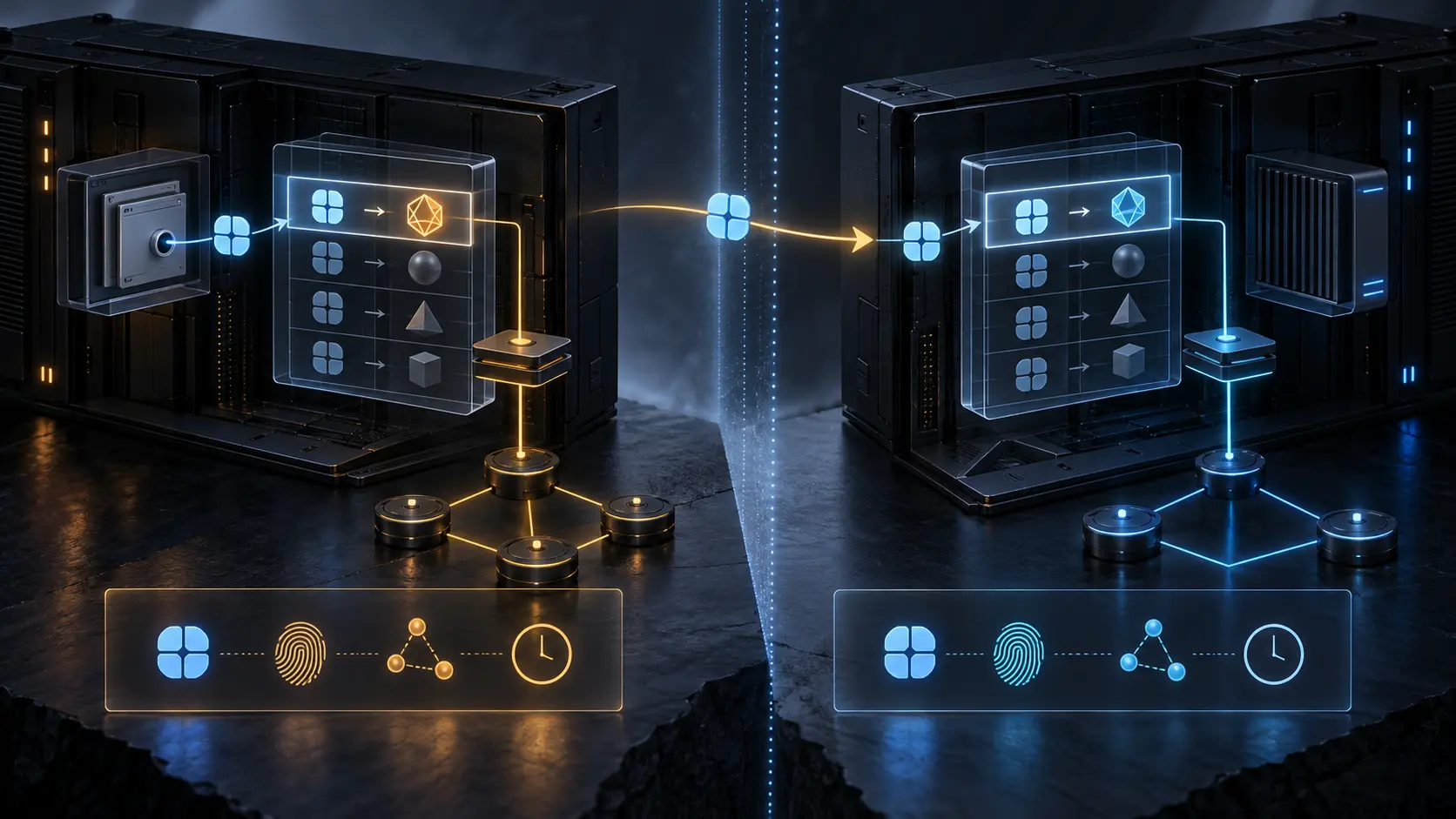
An internationalized address entered a mail transaction with an ASCII alternative attached. When a later relay could not carry the original, the experimental downgrade design selected the alternative. The message did not merely change encoding. It could arrive at another…
IETF
The Address Worked Here. On the Next Host, It Named Someone Else.
A legacy program saw an IPv4-shaped value and did what programs have done for decades: cached it, logged it, and handed it to a peer. The value was a HIP Local Scope Identifier. Its meaning ended at the machine that created it.

IETF
A Phone Number Found Two Calendar Doors. It Scheduled Nothing.
One ENUM lookup can return an HTTPS calendar resource and a mail address for scheduling. Both are useful discoveries. Neither says that the caller may enter the calendar, that an invitation reached the intended person, or that a meeting now exists. RFC 5333 is valuable precisely…

History
A Name Was Reserved. The Mailbox Was Not Ready: RFC 3656
In a distributed mail service, preventing two servers from claiming one mailbox name is only half the job. RFC 3656 separated that namespace claim from the later state in which clients could actually use the mailbox.