
Summary
- RFC 7146 replaced RFC 3723's 3DES-CBC implementation requirement with AES-CBC as the mandatory interoperability baseline for IPsec protecting block-storage protocols.
- Its 3 GiB figure illustrates a tenfold margin below a 32 GiB birthday bound for a 64-bit block cipher; it is not a universal rekey rule or a report of an attack.
When data volume outran the session
An IPsec security association could be carrying a healthy storage session and still approach a cryptographic limit that mattered before the session ended. RFC 7146, published in April 2014, addressed a narrow but consequential mismatch: block-storage protocols were expected to run at multiple gigabits per second, while 3DES processes data in 64-bit blocks. The relevant unit was not merely elapsed time or key age. It was how much data had passed under one key.
The document updated the IPsec requirements that RFC 3723 had set for protocols using the IPsec framework. Under the earlier baseline, implementations had to support 3DES in CBC mode; AES in Counter mode was recommended for implementation. RFC 7146 changed both to optional implementation choices and required AES-CBC instead. It left the requirement to support NULL encryption unchanged; that transform can be used in security associations that provide authentication and integrity without confidentiality. These are implementation requirements, not a command that every deployment use a particular cipher.
A bound is not a timer
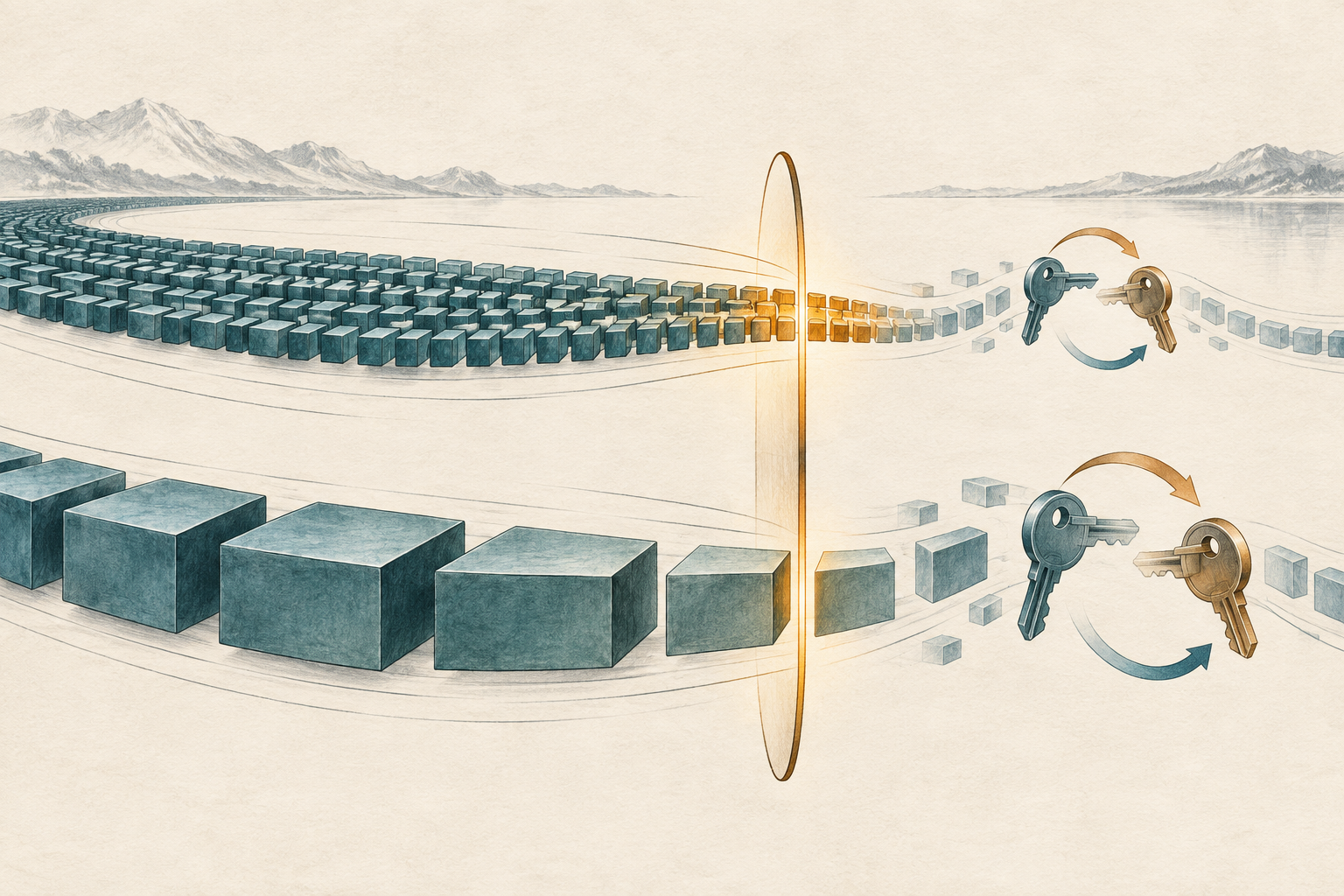
RFC 7146 explains why 3DES became awkward for high-rate storage traffic. For a cipher with a 64-bit block size, the birthday-bound scale is 32 GiB. The RFC advises rekeying well before that point because security weaknesses emerge as data under one key approaches the bound. It then gives an illustrative calculation: rekeying after 3 GiB would supply an order-of-magnitude margin on a multi-gigabit-per-second link. That is an example of the operational cost, not a protocol-mandated threshold for every system.
The distinction matters. A storage transfer can move a few gigabytes quickly, so a policy based only on a familiar session lifetime may fail to track data volume. Frequent rekeying also has operational consequences: peers must negotiate and install new security associations reliably while data traffic continues. The RFC's example makes that pressure legible without claiming that every 3DES session reached the bound or that a successful attack had occurred.
AES offered a different scale. Its 128-bit block size gives a much larger birthday-bound scale, stated in the RFC as 2^68 bytes. AES-CBC was selected as the primary mandatory-to-implement replacement for interoperability. That did not make every AES mode interchangeable: RFC 7146 separately said implementations supporting IKEv2 should also implement AES-GCM. The change to AES-CTR was different again. The RFC says CTR was no longer the transform most amenable to hardware implementation as hardware considerations favored GCM; it does not describe a security failure in CTR.
What the standards change did—and did not—prove
RFC 7146 is an update to a requirements baseline, not a census of installed devices, a measurement of storage-network deployments, or a current universal cipher recommendation. It also retained room for lower-speed cases: 3DES-CBC could still be implemented where its rekey frequency was acceptable. The standard shifted what implementations needed to share for interoperability in the stated block-storage context; it did not erase every legacy use.
Its historical lesson is less “replace old encryption” than “implementation baselines encode operating assumptions.” A transform can remain technically available while the data rate changes the cost of keeping it within its intended envelope. The important control surface is therefore joint: algorithm support, negotiated association lifetime, bytes transferred, sequence-number capacity, and the ability to rekey without interrupting service. RFC 7146 makes that coupling explicit, but leaves actual policy and deployment evidence to operators.
Sources: RFC 7146; RFC 7146 information; RFC 7146 errata; RFC 3723; RFC 4106; RFC 3602; RFC 4303; RFC 4301; RFC 8221; RFC 6071; RFC 6176.
Member Briefing
Deeper Profile Context
Sign in with the right membership level to unlock the full briefing and source notes.
Only for Strategic Circle
Strategic Circle
Open to all readers. Unlock profile briefings after joining and signing in.
Join Strategic CircleOnly for Leadership Alliance
Leadership Alliance
For qualified IP-asset owners and management; sign in to unlock alliance briefings.
Join Leadership Alliance