
Topic
Registry Governance
Within the Topic facet, Registry Governance topic intelligence connects articles that share a specific subject, signal focus, or monitoring theme. The page gives readers a richer path through related reporting, source evidence, market actors, and infrastructure implications, with enough context to understand why the topic matters across company movements, governance decisions, regional exposure, and operational risk. Readers can compare recurring signals, affected organisations, public evidence, market context, service continuity, procurement, competition, compliance, and strategic planning questions behind the subject instead of stopping at a thin list of matching articles. It explains what the topic covers, which infrastructure actors or policies are involved, what evidence supports the coverage, and why the subject may matter for operators, customers, investors, and policy readers.

Story
RIPE NCC’s New IPv6 Exam Lasts 60 Minutes. Its Badge Will Last Three Years
A short private assessment is being asked to support a long public claim. Before RIPE NCC launches its IPv6 Advanced certificate, it should make the badge’s changing technical scope visible without exposing a single exam question.

Story
One Recusal and One No Would Block AFRINIC GovCom Advice
AFRINIC’s five voting members do not approve formal advice through an ordinary supermajority. If one member recuses, a 3–1 vote clears the approval floor and still fails the separate dissent test.

Story
LACNIC Budgets a $390,000 Operating Gap. Financial Results Close All but $87,000 on Paper
A budget can show a small loss while concealing three different movements: the recurring cost of running the registry, the accounting result of a portfolio and the cash that actually entered or left the institution. LACNIC’s 2025 accounts show why its 2026 plan needs those…

Story
ARIN Put Three Candidate Pools on One Slate. Only Two Go to Members
ARIN's 2026 slate is a single page with three sets of candidates and two different decision makers. General Members choose the Board and Advisory Council. Trustees choose this year's NRO Number Council representative.

Story
AFRINIC’s Draft Says Slides Must Match the Proposal. A Mismatch Creates a Version That Cannot Count
A policy meeting can be perfectly public and still leave its decisive entity obscure. AFRINIC’s proposed working-group rules require presentation slides to match the submitted proposal; if they differ, an updated version must go to the mailing list even when its changes will not…

Story
RIPE Atlas Counts Probe Farming by a BGP Prefix. The Cohort Can Move Without the Probe
A probe can stay on the same shelf, under the same account and on the same access line, yet acquire different neighbours for an admission rule. RIPE Atlas limits software probes partly by the IP prefix “as seen in BGP”. That is a defensible way to protect a shared measurement…

ICANN
ICANN’s Accountability Channels: Three Review Paths, Three Different Control Surfaces
ICANN’s accountability architecture is often described as a system of checks and balances. In practice, it is better understood as three distinct routes with different triggers, eligible users, reviewers and possible effects. The difference matters when a decision affects an…

Story
DAOport’s RIPE NCC Membership Shows Governance Access, Not Yet an Operating Network
DAOport’s RIPE NCC Membership Shows Governance Access, Not Yet an Operating Network intelligence summary explains the development, the public evidence available to readers, the organisations involved, the regional context, market exposure, and the infrastructure consequences that…

CASE FILE
Internet Society’s Authority Has a Documented Structure, but Its Remedies Remain Conditional
The Internet Society’s public governance record points to a layered institution rather than a single source of power. Its articles of incorporation, bylaws, Board of Trustees and the District of Columbia nonprofit statute occupy different positions in that structure. The…

Story
LACNIC’s ASPA Explainer Cites a Moving Percentage Without a Snapshot
LACNIC’s ASPA Explainer Cites a Moving Percentage Without a Snapshot intelligence summary explains the development, the public evidence available to readers, the organisations involved, the regional context, market exposure, and the infrastructure consequences that may follow.…

IETF
Joyce Reynolds and the Assigned-Numbers RFC That Stopped Being the Registry
In 2002, Joyce Reynolds gave an old standards document a more honest job. RFC 1700 would remain a durable record of what the Assigned Numbers tables looked like in 1994, but it would no longer impersonate the changing registry that engineers actually needed.

Story
AFRINIC's IPv4 Summary Rose by Two. One Reserved Block Split into Three
AFRINIC's daily file gained two IPv4 records on 9 September. The tempting story is two new allocations. The rows tell a more useful one: a conserved block changed shape.

Afrinic SAGA
AFRINIC’s continuity controls remain harder to prove than its public machinery
AFRINIC can keep a registry visible while the evidence needed to establish lawful authority, privileged access, detection and recovery remains incomplete. The practical test is not whether the machinery appears to run, but whether high-impact changes can be authorised, observed…

Story
ARIN’s Board Slate Has One Candidate Beyond Three Seats
Three seats. Four candidates. ARIN’s 2026 Board slate satisfies the rule that there must be more names than vacancies, but it does so at the narrowest possible margin. That fourth name is not decorative competition. It is the point at which an elected choice remains a contest and…

Number Resource Society
DFINFRA and AS210860: The Evidence Chain Still Stops at the Registry
A public-record investigation can identify where a network-control question begins. It cannot answer that question by treating a registry name as proof of ownership, authority or active service delivery.

Story
APNIC’s Electoral-Committee Recusal Safeguard Lives in a Blog Comment
APNIC has a sensible answer to an awkward governance question: Executive Council members who may seek re-election do not help choose the committee that polices the election. The trouble is not the answer. It is where the answer lives—and how little of the annual record shows the…
Global Institutional
DFINFRA and AS210860: What Routing Evidence Can—and Cannot—Prove
DFINFRA and AS210860: What Routing Evidence Can—and Cannot—Prove intelligence summary explains the development, the public evidence available to readers, the organisations involved, the regional context, market exposure, and the infrastructure consequences that may follow. The…

Story
LACNIC 46's Attendee List Has Consent. It Still Needs a Retention Clock
LACNIC tells registrants that their names will appear on the event website. That clarity settles the easy argument; the harder one is how a public list shows the scope, duration and outcome of the permission it already has.
Europe and Middle East Institutional
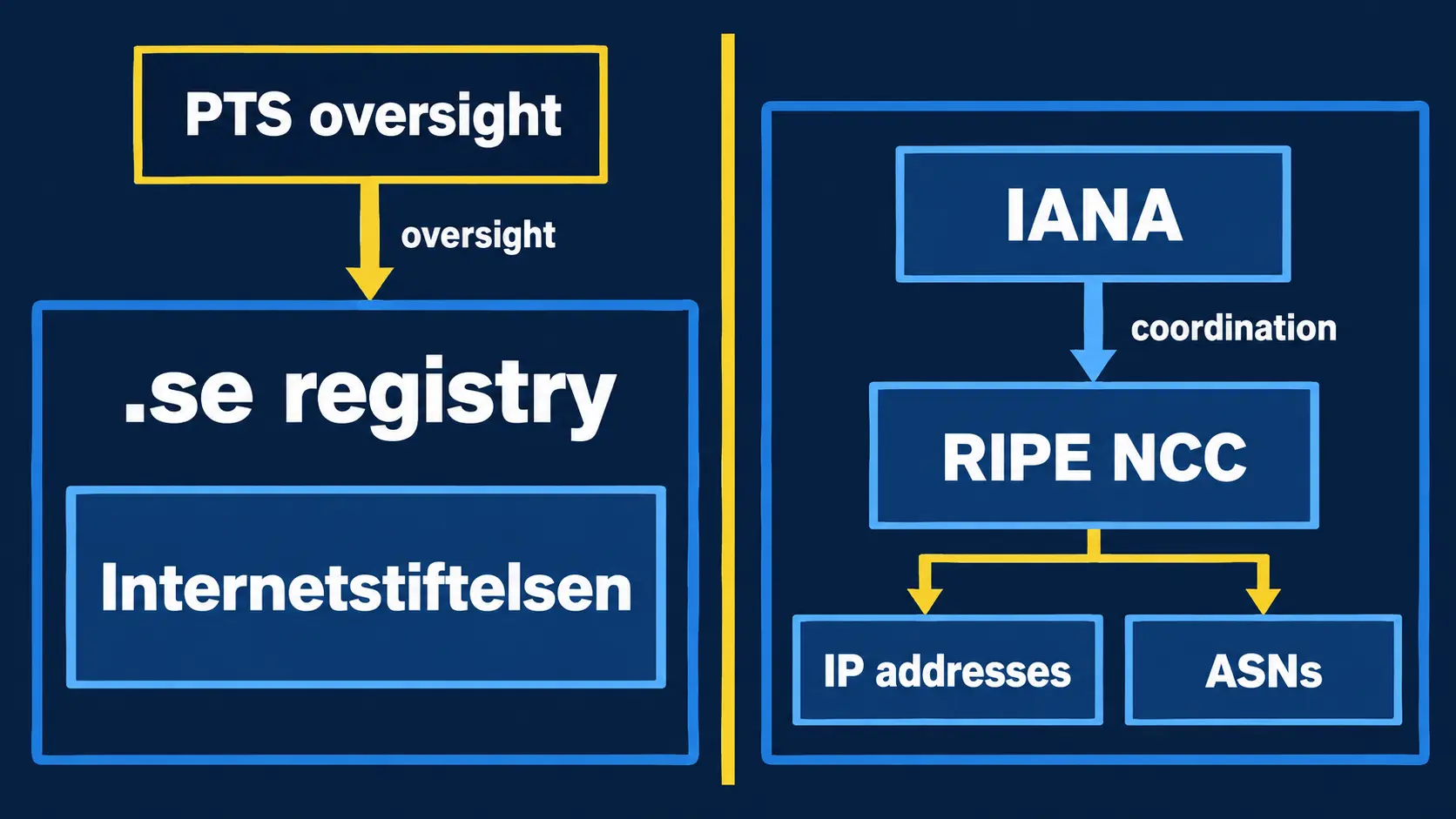
What Internetstiftelsen Controls—and What It Does Not
A sparse directory label points toward Sweden’s .se registry, but the evidence separates domain-name stewardship from the Internet’s IP-address and autonomous-system infrastructure.

Story
AFRINIC Calls Its NS2 Dashboard ‘Real-time.’ All Twelve Linked Measurements Are Stopped One-Offs
A page can refresh on demand without measuring the present. AFRINIC’s public NS2 dashboard illustrates the distinction: it advertises “Real-time Anycast Node Monitoring”, yet every RIPE Atlas measurement wired into the interface is a stopped one-off. The result is useful evidence…