
Topic
Network-resource Evidence
Within the Topic facet, Network-resource Evidence topic intelligence connects articles that share a specific subject, signal focus, or monitoring theme. The page gives readers a richer path through related reporting, source evidence, market actors, and infrastructure implications, with enough context to understand why the topic matters across company movements, governance decisions, regional exposure, and operational risk. Readers can compare recurring signals, affected organisations, public evidence, market context, service continuity, procurement, competition, compliance, and strategic planning questions behind the subject instead of stopping at a thin list of matching articles. It explains what the topic covers, which infrastructure actors or policies are involved, what evidence supports the coverage, and why the subject may matter for operators, customers, investors, and policy readers.

History
IETF Humming Was a Start, Not a Vote: RFC 7282, 2014
The IETF’s “hum” could make a room’s direction audible, but it was never meant to settle a technical question by volume. RFC 7282 turned that distinction into a practical account of rough consensus: surface objections, examine them, and explain the chair’s judgment before work…
History
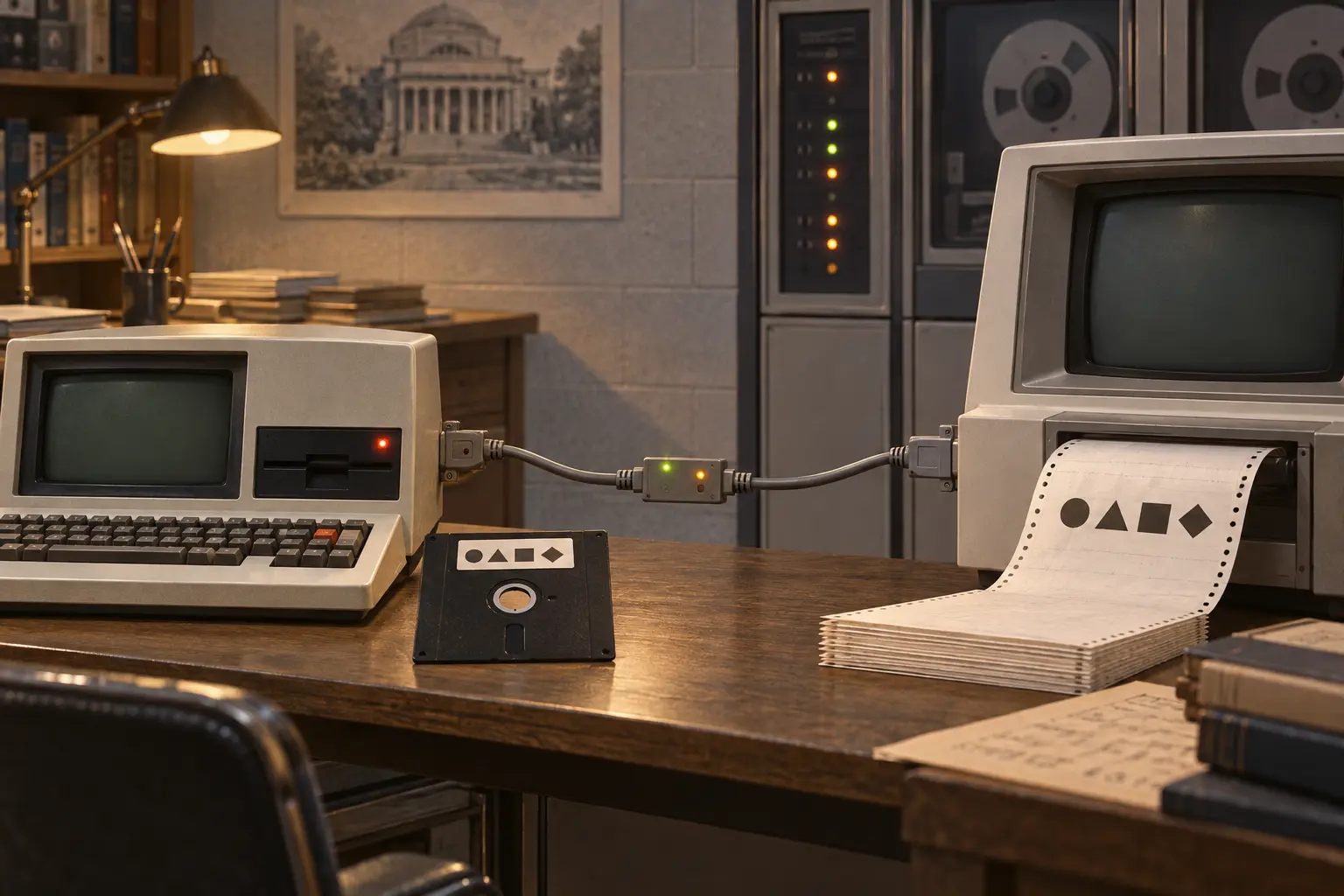
Kermit Made the File Portable Before the Computers Matched
The first Kermit transfer joined two copies on one DEC-20. The harder test came weeks later, when a CP/M microcomputer and a mainframe had to agree on what a file was as well as how to send it.

History
The Usenet Approved Header Marked a Decision, but Left Identity Open
Usenet needed a compact way to distinguish a moderator’s decision from an ordinary reader’s submission. The `Approved:` header supplied that signal; it did not authenticate the person named in it. The difference mattered because the same marker sat at the boundary between…

History
The Approved Line Could Not Prove Who Cleared a Usenet Post
Usenet needed a compact way to distinguish a moderator’s decision from an ordinary reader’s submission. The `Approved:` header supplied that signal; it did not authenticate the person named in it. The difference mattered because the same marker sat at the boundary between…

History
The UUCP Map Stayed Useful Because Its Users Maintained It
A volunteer-maintained directory helped UUCP sites find neighbors, contacts and mail routes. Its value depended on operators reporting changes: the shared map described the network, while each site still assembled its own routing view.

Story
APNIC’s July route-filtering reading came before Timor-Leste’s cable service
APNIC’s new country profile sets a July route-origin validation reading beside an October IPv6 estimate. Timor-Leste’s submarine cable began commercial service between those two observations, but the dates do not amount to a before-and-after test.

History
The Ping Arrived Before the Service Date: Sudan’s Internet, 1996–99
A university email relay, a test packet answered from abroad, and a government report’s launch date describe different stages of Sudan’s first Internet connections. The record does not collapse them into one national “first.”

Story
AS36049: A Virtela Identifier That Outlived Its Routing
AS36049: A Virtela Identifier That Outlived Its Routing intelligence summary explains the development, the public evidence available to readers, the organisations involved, the regional context, market exposure, and the infrastructure consequences that may follow. The Story…

History
Singapore’s First BITNET Email Arrived Before Its Internet Link, 1987
A 1987 message connected the National University of Singapore to an academic network across the world. It was an international email milestone, but not yet a TCP/IP Internet connection.

Europe and Middle East National Telecom Trends
France’s public fibre gap lands in the wholesale contract
France’s telecom regulator says more than half of its public-initiative fibre networks charge recurring wholesale tariffs below a new estimate of operating costs. Its draft offers a way to reopen the conversation between network owners and service providers, but it does not set a…

History
Hurricane Andrew Hit Costa Rica’s Internet Route Before It Opened
Costa Rica’s first Internet connection depended on a receiving site in Homestead, Florida. Hurricane Andrew damaged that end of the route; the University of Costa Rica connected on 26 January 1993.

History
Slovenia’s X.400 Mail Server Went to the Basement During the 1991 War
Before Slovenia had a direct IP link to the Internet, its research community already moved messages across older networks. In 1991, keeping that mail service available meant changing both the machine and the room it occupied.

History
Croatia Connected to the Internet on a 9.6 kbps Academic Link, 1992
CARNET’s 1992 Zagreb–Vienna connection joined an academic network project to the global Internet. Its first institutions and one public terminal show why a national connection did not mean universal access.

Story
RIPE RIS Plans a Finer MRT Clock. The Records Need Provenance.
RIPE NCC’s Q4 plan would add subsecond timestamps to MRT files. That can distinguish records now stamped to the same second; it cannot, by itself, tell researchers how accurate a collector’s clock was or whether two collectors agreed.

History
CyIX Was on the 1999 IXP Map. The Entry Says Little About Its Network.
A 1999 Cisco inventory listed Cyprus’s exchange point among sites said to be operating. CYNET dates its founding to that same year, but neither source tells us who peered there, how the network was built or what local users gained.

IETF
Tomek Mrugalski and the DHCPv6 name that points an IPv4 tunnel upstream
A DHCPv6 Reply can carry one fully qualified domain name for a Dual-Stack Lite endpoint. That name tells a customer edge device where it may try to send IPv4 through an IPv6 network; it does not show that DNS resolved, a tunnel formed, translation state exists, or a service…

History
The IP Timestamp Option Kept a Route Diary, Not a Stopwatch, 1981
In 1981, IPv4 gained a small field for recording where a packet had been processed and when. Its design resembles a route diary, but it cannot be read as a synchronized stopwatch for network delay.

History
UDP’s Zero Was a Status Flag, Not a Checksum, 1980
A 16-bit field made room for two different zeros: one was a computed checksum, the other a signal that no checksum had been sent. The distinction began in UDP’s 1980 specification and later met stricter rules in IPv6.

Story
AFRINIC pairs Johannesburg IPv6 Deployathon with five travel awards
AFRINIC, ISPA and ZANOG have scheduled a three-day, in-person IPv6 Deployathon in Sandton for 20–22 October. The event listing says INX-ZA will cover travel and accommodation for five fellows, or ZAR 50,000 in total; applications closed on 12 October, and no award recipients or…

Number Resource Society
The Number Resource Organization: How Five Registries Coordinate the Internet's Address Space
The Number Resource Organization: How Five Registries Coordinate the Internet's Address Space intelligence summary explains the development, the public evidence available to readers, the organisations involved, the regional context, market exposure, and the infrastructure…