
Topic
Network-resource Evidence
Within the Topic facet, Network-resource Evidence topic intelligence connects articles that share a specific subject, signal focus, or monitoring theme. The page gives readers a richer path through related reporting, source evidence, market actors, and infrastructure implications, with enough context to understand why the topic matters across company movements, governance decisions, regional exposure, and operational risk. Readers can compare recurring signals, affected organisations, public evidence, market context, service continuity, procurement, competition, compliance, and strategic planning questions behind the subject instead of stopping at a thin list of matching articles. It explains what the topic covers, which infrastructure actors or policies are involved, what evidence supports the coverage, and why the subject may matter for operators, customers, investors, and policy readers.

IETF
Every Fragment Had an Exact Address. The Picture Still Had No Receipt.
A JPEG 2000 fragment arrived with a precise byte offset from the start of its frame. Operations could say exactly where it belonged. They still could not say that the bytes before it had arrived, that the main header was usable, that every parallel layer had ended, or that any…
History
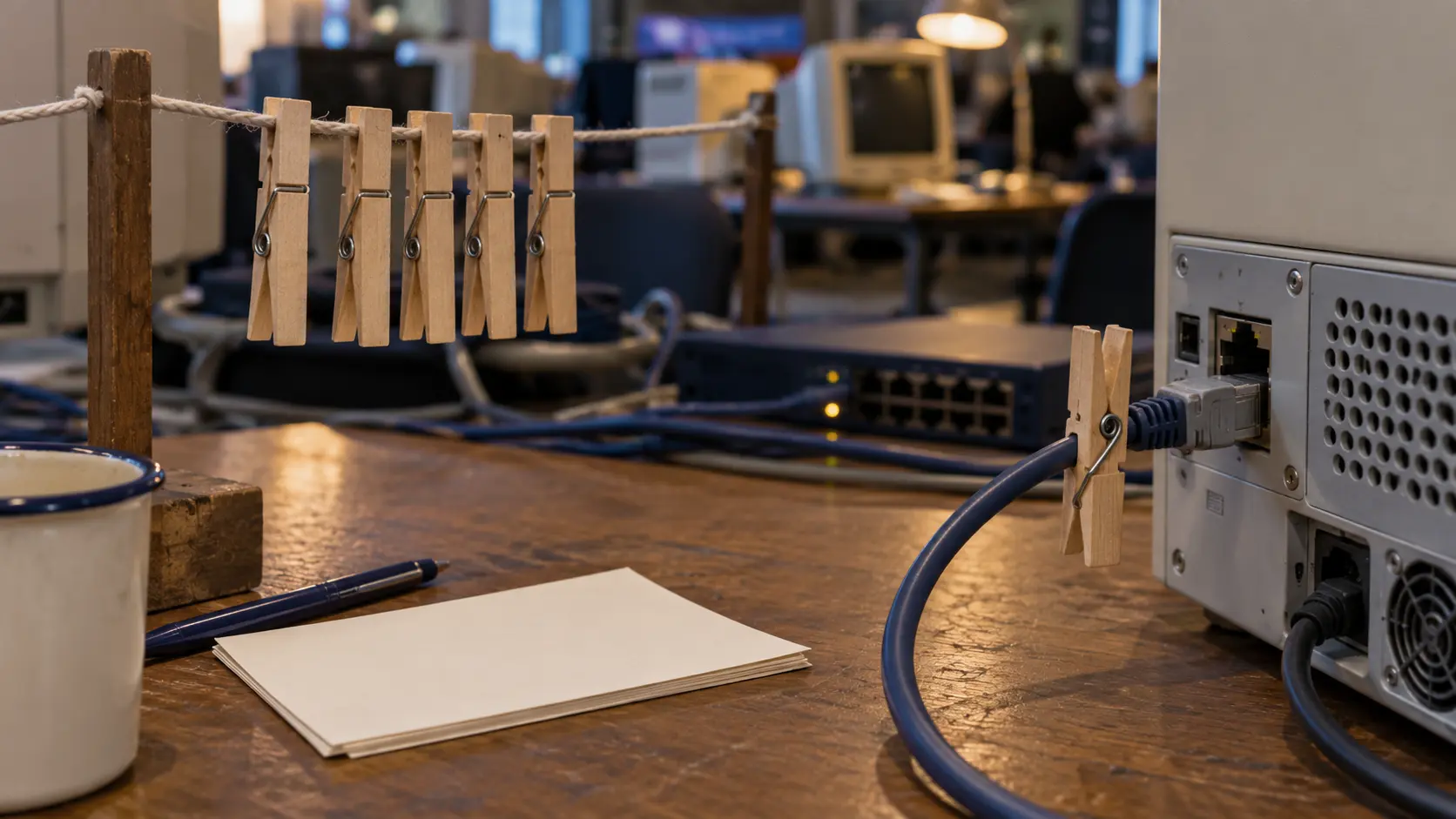
An IP Address Hung on a Clothesline: RFC 2322’s Peg-DHCP
At a 1997 technology gathering, a wooden peg made address allocation visible without asking every computer to speak the same setup protocol. The human handoff solved one problem—and became another point where the network could go wrong.

History
One Binding Moved a Whole Network. It Did Not Prove Every Node Was Reachable: RFC 3963
The remarkable thing about NEMO was not that a router could move. It was that machines behind it did not have to know. RFC 3963 compressed the change of location of an entire network into one protected binding—but it also drew a boundary that operations teams still blur: a Home…

Story
RIPE Recovered RRC12’s Files; Its Restart Bug Still Needs a Structural Fix
RIPE NCC says it has regenerated RRC12’s missing BGP files since 2 October. The same incident update says the configuration has been corrected, but the latent restart bug behind the repeated timeouts still awaits a structural fix.

IETF
The Packet Had a Valid Group MAC. Any Admitted Member Could Have Made It.
A receiver accepted the integrity tag, the selector and the active security association. That result proved something useful but smaller than the audit record claimed: the packet came from someone holding the group's shared authentication key. RFC 5374 made the missing step…

IETF
The Status Code Survived the Bridge. The Transaction That Produced It Did Not.
The caller received `603 Decline`. It still could not say who had declined. A transcoding bridge had created a second INVITE, received a response on that new transaction, and generated another response upstream. RFC 5370 preserved the three digits while exposing why identical…

History
The Address Could Bind a Key. The Router Still Needed a Trust Anchor: RFC 3971
In 2005, SEND separated a claim about who could sign for an IPv6 address from the different claim that a router was authorized to direct a host. Its cryptography did not remove trust; it made the two trust questions visible.

IETF
The Caller Required Answer-Mode Support. It Could Not Require the Phone to Answer Automatically.
`Require: answermode` sounds like a command. RFC 5373 made it a narrower test: the receiving user agent must understand the answering-mode extension or reject the INVITE. Whether it may open a loudspeaker—and whether it must keep its microphone shut—still belongs to authenticated…

History
The Same Kerberos Key Needed a Number for Every Job: RFC 3961
Kerberos already knew who held a key. RFC 3961 asked a subtler question: what was that key being asked to do? Its answer was a small integer that turned protocol context into cryptographic separation—and made a successful decryption a narrower fact than many systems still assume.

History
The IETF Made a Lower-Level Reference Visible Before It Made It Easier: RFC 3967
A standard can depend on a document that has not reached the same maturity. The IETF’s answer was not a blanket ban: it made that dependency a question for community review, then gradually shifted the burden from waiting to disclosure and accountable discretion.

IETF
The Codec Mismatch Was Real. The Answering Endpoint Was Still Unknown.
The caller had evidence that Bob’s desk phone could not decode the offered video. It did not have evidence that the desk phone would answer. Parallel forking could still send the next attempt to voicemail, a soft client, or another terminal. RFC 5369 made the incompatibility…

IETF
The Server Accepted the REFER. It Also Removed the Usual Way to Report the Results.
A single-target REFER normally leaves a trail of NOTIFY messages. RFC 5368 asked one recipient to act on a list instead—and recommended switching that trail off. The resulting silence was not an implementation gap. It was a deliberate statement that one subscription could not…

History
The Tunnel Accepted the Packet. Decapsulation Erased Its Nearest Trace: RFC 3964
6to4 made IPv6 cross an IPv4 Internet by wrapping one address story inside another. At the receiving edge, the wrapper was normally thrown away. RFC 3964 is the history of what vanished with it: not proof of the attacker, but the closest observable clue to the tunnel entrance.

History
Reply-All Could Reuse the Fax Sender’s Permission: RFC 3965
Email made a fax gateway look like another recipient on a message. RFC 3965 noticed the catch: the gateway could turn that message into a paid telephone call, and an innocent reply-all could carry an old sender’s authorization into a new fax.

IETF
The List Created the Subscription. It Did Not Govern Every Renewal.
The first SUBSCRIBE carried three resource URIs and created one dialog. The renewal carried the same list again and received 415 Unsupported Media Type. Nothing had become inconsistent. RFC 5367 gave the list authority at creation time, then deliberately changed the surface…

IETF
The Factory Returned a Room. It Did Not Admit the Guest List.
The 200 response looked decisive: the conference had been created, the caller was inside it, and the server had understood the list of people to invite. But RFC 5366 draws the line there. The address of the new conference identified a different resource from the factory that…

History
The Draft Became a Reference. The Standard Was Different: RFC 7142
RFC 1142 made an ISO draft easy for Internet readers to cite. A quarter-century later, RFC 7142 tried to redirect those citations: the copied text and the finalized standard were not the same authority.

History
The Phone Said Ringing. The Caller Still Had to Listen for Packets: RFC 3960
SIP could report that the far-end phone was alerting while the caller heard only locally generated ringback—or an announcement, silence, comfort noise, or nothing yet. RFC 3960 made that uncertainty an operational fact rather than a signalling bug.

IETF
The Payload Was the Same. The Transaction Was New.
Alice submitted one group message. Bob received the same instant-message payload, but not the same SIP transaction: the list service had created a new Request-URI, To, Call-ID, CSeq sequence, Max-Forwards value and Via. Preserved content did not make the intermediary transparent.…

History
The Group Address Named Its Rendezvous Point. It Did Not Prove It Existed: RFC 3956
RFC 3956 let an IPv6 multicast group address carry the recipe for its own rendezvous point. Every compliant router could derive the same candidate, but the arithmetic could not prove that a router was there, reachable, trusted or ready to deliver a packet.