
Topic
Network-resource Evidence
Within the Topic facet, Network-resource Evidence topic intelligence connects articles that share a specific subject, signal focus, or monitoring theme. The page gives readers a richer path through related reporting, source evidence, market actors, and infrastructure implications, with enough context to understand why the topic matters across company movements, governance decisions, regional exposure, and operational risk. Readers can compare recurring signals, affected organisations, public evidence, market context, service continuity, procurement, competition, compliance, and strategic planning questions behind the subject instead of stopping at a thin list of matching articles. It explains what the topic covers, which infrastructure actors or policies are involved, what evidence supports the coverage, and why the subject may matter for operators, customers, investors, and policy readers.

History
The Name Was Registered. The Endpoint Still Might Not Understand It: RFC 3968
A SIP trace showed a familiar parameter name beside an IANA reference. That settled who had defined the token and where its meaning lived. It did not settle whether the receiving endpoint implemented the feature, recognized every permitted value, accepted the request, or acted…

History
The Blocks Got 16× Bigger. The Transfer Did Not Get 16× Faster.
RFC 2348’s TFTP experiment is striking for two numbers that should not be confused: an eight-kilobyte block cut one measured transfer by roughly 80%, while the block itself was sixteen times the old size. The distinction is where the engineering story begins.

IETF
The Header ID Returned to One. The Header Did Not Return With It.
A JPEG 2000 receiver had saved a complete main header under identifier one. Six unseen parameter changes later, the sender’s three-bit counter returned to the same value. The comparison passed. The state did not. RFC 5372 made main-header recovery practical by reusing recent…

History
The Tunnel Was Up. Its Primary Path Might Not Be: RFC 3970
A green tunnel state looked decisive until the tunnel was opened into its paths. One alternate route could keep the aggregate alive while the primary path carried nothing. RFC 3970 made that compression visible—and also separated the route an operator requested, the route an…

Story
EDEKA's organisation object stays live while the AS210860 aut-num record returns no entries
EDEKA's organisation entity stays live while the AS210860 aut-num record returns no entries intelligence summary explains the development, the public evidence available to readers, the organisations involved, the regional context, market exposure, and the infrastructure…

History
The Strings Were Different. The Telephone Resource Could Still Be the Same: RFC 3966
One string had parentheses and dashes. Another did not. Their letters differed in case and their parameters arrived in a different order. A byte-for-byte database would call them different; RFC 3966 could call them equivalent. That did not make the person, device, route or call…

History
The Probe Was Part of the Metric: RFC 2330’s Measurement Frame
A latency figure looks objective until the packet, path, clock and sampling procedure disappear from the report. RFC 2330 made those conditions part of the measurement story—and its later updates show that the reference packet itself had to evolve.

IETF
The Path Key Came Back. The Circuit Still Did Not Exist.
An inter-domain path computer returned an opaque identifier instead of the hops inside a provider network. The requester gained something operationally valuable: a route could be composed without forcing the provider to disclose its internal topology. But the returned token was…

IETF
Every Fragment Had an Exact Address. The Picture Still Had No Receipt.
A JPEG 2000 fragment arrived with a precise byte offset from the start of its frame. Operations could say exactly where it belonged. They still could not say that the bytes before it had arrived, that the main header was usable, that every parallel layer had ended, or that any…
History
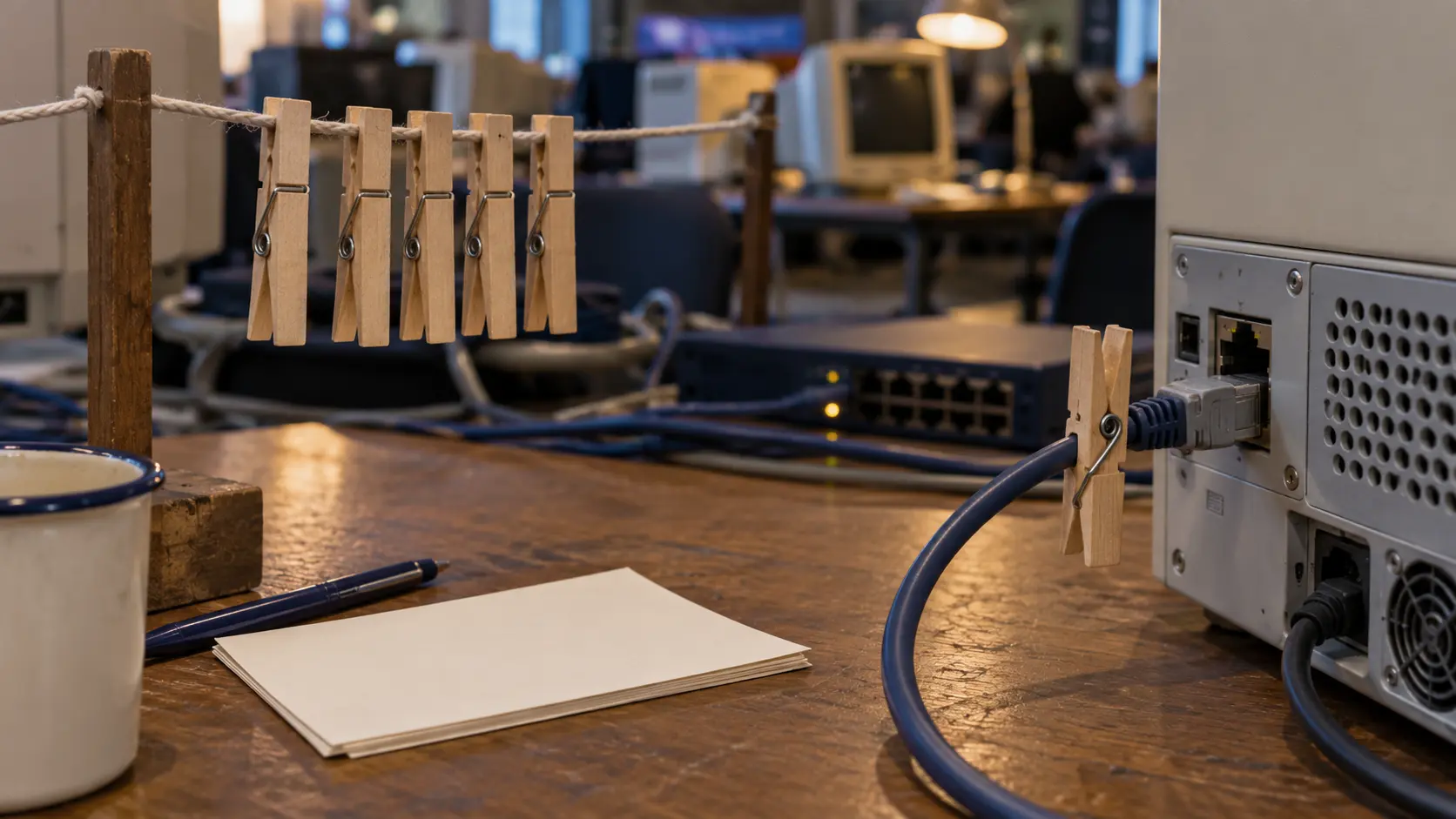
An IP Address Hung on a Clothesline: RFC 2322’s Peg-DHCP
At a 1997 technology gathering, a wooden peg made address allocation visible without asking every computer to speak the same setup protocol. The human handoff solved one problem—and became another point where the network could go wrong.

History
One Binding Moved a Whole Network. It Did Not Prove Every Node Was Reachable: RFC 3963
The remarkable thing about NEMO was not that a router could move. It was that machines behind it did not have to know. RFC 3963 compressed the change of location of an entire network into one protected binding—but it also drew a boundary that operations teams still blur: a Home…

Story
RIPE Recovered RRC12’s Files; Its Restart Bug Still Needs a Structural Fix
RIPE NCC says it has regenerated RRC12’s missing BGP files since 2 October. The same incident update says the configuration has been corrected, but the latent restart bug behind the repeated timeouts still awaits a structural fix.

IETF
The Packet Had a Valid Group MAC. Any Admitted Member Could Have Made It.
A receiver accepted the integrity tag, the selector and the active security association. That result proved something useful but smaller than the audit record claimed: the packet came from someone holding the group's shared authentication key. RFC 5374 made the missing step…

IETF
The Status Code Survived the Bridge. The Transaction That Produced It Did Not.
The caller received `603 Decline`. It still could not say who had declined. A transcoding bridge had created a second INVITE, received a response on that new transaction, and generated another response upstream. RFC 5370 preserved the three digits while exposing why identical…

History
The Address Could Bind a Key. The Router Still Needed a Trust Anchor: RFC 3971
In 2005, SEND separated a claim about who could sign for an IPv6 address from the different claim that a router was authorized to direct a host. Its cryptography did not remove trust; it made the two trust questions visible.

IETF
The Caller Required Answer-Mode Support. It Could Not Require the Phone to Answer Automatically.
`Require: answermode` sounds like a command. RFC 5373 made it a narrower test: the receiving user agent must understand the answering-mode extension or reject the INVITE. Whether it may open a loudspeaker—and whether it must keep its microphone shut—still belongs to authenticated…

History
The Same Kerberos Key Needed a Number for Every Job: RFC 3961
Kerberos already knew who held a key. RFC 3961 asked a subtler question: what was that key being asked to do? Its answer was a small integer that turned protocol context into cryptographic separation—and made a successful decryption a narrower fact than many systems still assume.

History
The IETF Made a Lower-Level Reference Visible Before It Made It Easier: RFC 3967
A standard can depend on a document that has not reached the same maturity. The IETF’s answer was not a blanket ban: it made that dependency a question for community review, then gradually shifted the burden from waiting to disclosure and accountable discretion.

IETF
The Codec Mismatch Was Real. The Answering Endpoint Was Still Unknown.
The caller had evidence that Bob’s desk phone could not decode the offered video. It did not have evidence that the desk phone would answer. Parallel forking could still send the next attempt to voicemail, a soft client, or another terminal. RFC 5369 made the incompatibility…

IETF
The Server Accepted the REFER. It Also Removed the Usual Way to Report the Results.
A single-target REFER normally leaves a trail of NOTIFY messages. RFC 5368 asked one recipient to act on a list instead—and recommended switching that trail off. The resulting silence was not an implementation gap. It was a deliberate statement that one subscription could not…