
Topic
Network-resource Evidence
Within the Topic facet, Network-resource Evidence topic intelligence connects articles that share a specific subject, signal focus, or monitoring theme. The page gives readers a richer path through related reporting, source evidence, market actors, and infrastructure implications, with enough context to understand why the topic matters across company movements, governance decisions, regional exposure, and operational risk. Readers can compare recurring signals, affected organisations, public evidence, market context, service continuity, procurement, competition, compliance, and strategic planning questions behind the subject instead of stopping at a thin list of matching articles. It explains what the topic covers, which infrastructure actors or policies are involved, what evidence supports the coverage, and why the subject may matter for operators, customers, investors, and policy readers.

History
The Two Flags That Took Up Space: Why TCP Counts SYN and FIN
TCP numbers bytes, yet two control events also advance its sequence space. SYN stands before the first data octet and FIN stands after the last, giving connection opening and closing the same acknowledgment and retransmission protection as the stream without turning either flag…

Story
RIPE NCC Counted 1,799 Registry Checks. Its Public Target Has No Cohort Ledger
Seven RIPE NCC member updates report 1,799 Assisted Registry Checks completed from January through July 2026. That is nearly three-quarters of the annual 2,400-check commitment. It is a clear production count. It is not yet a coverage account: the public series does not say how…

Global Regional ISP Trends
Temporary IPv6 Addresses Are Not an Anonymity Guarantee
An IPv6 address can change while the observer’s conclusion does not. Temporary interface identifiers shorten one obvious tracking window, but a stable prefix, packet timing, DNS name or signed-in session can still join the old address to the new one.

IETF
QUIC CONNECTION_CLOSE Ends Transport State, Not the Business Process
A transport shutdown is a precise network event, but it is not a receipt for every business action still moving through the connection.

History
The Push That Was Never a Message Boundary: TCP's PSH Flag
An application asks TCP to push a buffer because waiting for later data could stall the exchange. TCP marks the last segment it creates from that buffer with PSH. Yet the mark does not turn that segment into a message: the sender's write, the packets on the wire, the receiver's…

Europe and Middle East Regional ISP Trends
QuickSoft: peering breadth is not the same as service accountability
QuickSoft LLC presents a compact but geographically varied public network footprint. Six operator-maintained exchange records and six prefixes visible to RIPEstat are useful evidence of reachability options. They are not, by themselves, evidence of how a customer service is…

History
The Connection One Side Forgot: TCP's Half-Open Reset
A TCP connection can look alive from one endpoint and already be gone from the other. The classic specifications called that split a half-open connection. Their recovery examples turn the next packet into a test of shared memory: sequence expectations collide, a reset makes the…

IETF
QUIC DATAGRAM Keeps Message Boundaries, Not Delivery Guarantees
A QUIC DATAGRAM frame can carry a complete application datagram without retransmission or ordering relative to other DATAGRAM messages. That makes it useful for time-sensitive information, but it does not turn local submission or packet acknowledgment into a receipt for the…

Global Regional ISP Trends
An RPKI-Signed Geofeed Is Not a Location-Accuracy Proof
A valid geofeed signature can prove who was entitled to speak for an address range and which bytes they signed. It cannot prove that the stated city is correct, that a consumer loaded the latest file, or that a service acted on it.

Story
ARIN’s 4.10 Regional Boundary Needs a Grandfathering Ledger
ARIN’s proposed geographic clarification is brief, but its durable test is temporal: every Section 4.10 decision should be traceable to the policy version and effective date that governed it.

History
When Both Sides Knocked at Once: TCP's Simultaneous Open
The standard picture of TCP begins with a client knocking and a server listening. The protocol itself has never required that casting. Its original 1981 specification described what happens when two endpoints knock at once: their SYN segments cross, each side becomes both…

IETF
QUIC PTO Is a Progress Probe, Not a Packet-Loss Verdict
A Probe Timeout asks QUIC to seek acknowledgment progress; it does not turn an unanswered packet into a proven loss.

History
The Host That Had to Wait Before Speaking: TCP's Quiet Time After Restart
A restarted machine may look clean precisely because it has forgotten too much. TCP's original quiet-time rule addressed that paradox: if a host lost the sequence numbers used before a crash, it was told to emit nothing for one maximum segment lifetime. Silence was not a repair…

Story
ARIN’s IPv6 draft separates the /48 starting point from the scale-up formula
Recommended Draft Policy ARIN-2025-7 is a narrow wording change with a practical test: whether every justified site count produces one predictable, nibble-aligned IPv6 allocation without changing eligibility.

Europe and Middle East Institutional Trends
WTC Moscow: convenience can hide a shared digital failure domain
A multifunctional business complex is designed to make many services feel like one. That convenience has value. It can also blur who controls connectivity, power, recovery and customer remedies when a tenant’s digital work stops.

Story
The New RIR Draft Says Enforceability Does Not Wait for the Procedure
Article 1.3 of the new RIR Governance Document draft says a missing common implementation procedure does not stop the document from being enforced. The next clause, added in Version 3, says a decision must still follow the procedure relevant to the entity making it, including any…

IETF
QUIC ACK Delay Is Not Network Latency
ACK Delay is a receiver’s report of intentional waiting for one acknowledged packet. It is useful to RTT estimation, but subtraction alone cannot turn it into a network-only measurement.
History
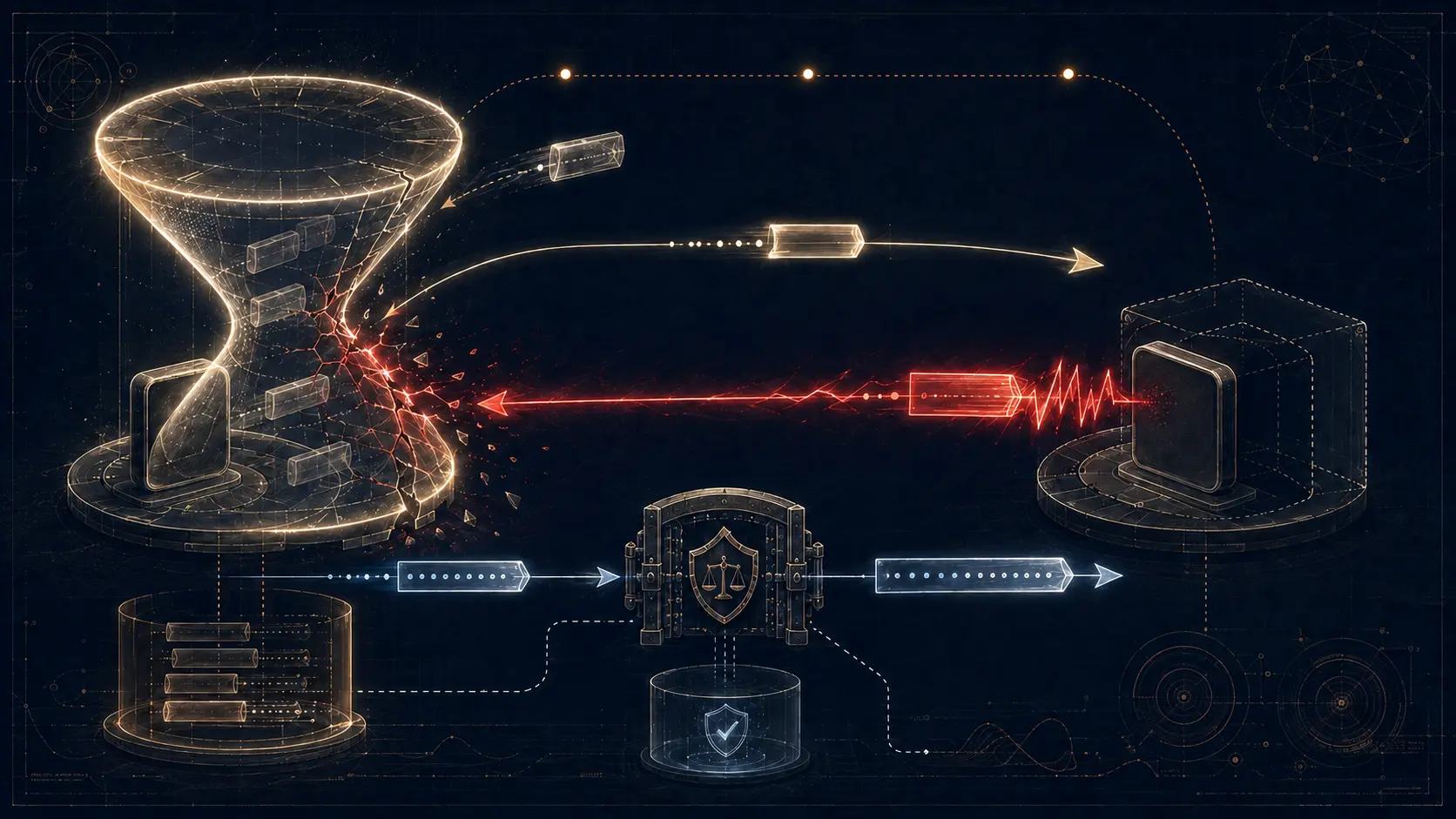
The Reset That Ended Waiting Too Soon: TCP's TIME-WAIT Assassination Hazard
TIME-WAIT looks passive: a closed connection remains in a table while a clock runs down. In 1992, RFC 1337 showed that the state could be destroyed by active protocol behavior. One old segment provoked an acknowledgment; that acknowledgment provoked a reset; the reset erased the…

Europe and Middle East Regional ISP Trends
RUTELEKOM: eighteen routes are not eighteen independent networks
RUTELEKOM: eighteen routes are not eighteen independent networks intelligence summary explains the development, the public evidence available to readers, the organisations involved, the regional context, market exposure, and the infrastructure consequences that may follow. The…

IETF
QUIC Coalescing: Efficient Wire Use, Separate Delivery
Putting several complete QUIC packets into one UDP datagram can reduce carriage overhead during the handshake. It does not turn those packets into one protected entity, one acknowledgment event, or one application result.