
Topic
Network-resource Evidence
Within the Topic facet, Network-resource Evidence topic intelligence connects articles that share a specific subject, signal focus, or monitoring theme. The page gives readers a richer path through related reporting, source evidence, market actors, and infrastructure implications, with enough context to understand why the topic matters across company movements, governance decisions, regional exposure, and operational risk. Readers can compare recurring signals, affected organisations, public evidence, market context, service continuity, procurement, competition, compliance, and strategic planning questions behind the subject instead of stopping at a thin list of matching articles. It explains what the topic covers, which infrastructure actors or policies are involved, what evidence supports the coverage, and why the subject may matter for operators, customers, investors, and policy readers.

IETF
The Message Reassembled. The Telemetry May Still Be Incomplete
`draft-ietf-netconf-udp-notif-26` makes high-frequency YANG notifications cheaper to move across a controlled network. It also makes an important distinction unavoidable: transport evidence can show what a receiver assembled, but only a wider chain can show what the network…

History
Deborah Estrin and the Interest That Was Never a Destination Address
A destination address answers where a message should go. An interest in directed diffusion asked a stranger question: what information is wanted, for how long, and from what part of the physical world? Deborah Estrin and her collaborators made that distinction the centre of an…

History
The Address Was Borrowed. The Route Was Never Included: RFC 2008
The Address Was Borrowed. The Route Was Never Included: RFC 2008 intelligence summary explains the development, the public evidence available to readers, the organisations involved, the regional context, market exposure, and the infrastructure consequences that may follow. The…

IETF
ALLDISPATCH Is a Routing Forum, Not a Standards Authority
The IETF-Wide Dispatch session can influence where emerging protocol proposals go next, but its leverage lies in routing and coordination—not in independently approving standards.

Global Regional ISP
AS210837: What ROYA’s network record establishes — and what it does not
AS210837: What ROYA’s network record establishes — and what it does not intelligence summary explains the development, the public evidence available to readers, the organisations involved, the regional context, market exposure, and the infrastructure consequences that may follow.…

Story
APNIC's Honeynet Logged 1.27 Million Events. That Is Not 1.27 Million Attacks
An APNIC 62 presentation turns one deliberately exposed server into a useful security instrument. Its headline, however, moves between attacks, attack events and events—three labels that cannot safely share one number.

Story
RIPE Atlas Counts Probe Farming by a BGP Prefix. The Cohort Can Move Without the Probe
A probe can stay on the same shelf, under the same account and on the same access line, yet acquire different neighbours for an admission rule. RIPE Atlas limits software probes partly by the IP prefix “as seen in BGP”. That is a defensible way to protect a shared measurement…

IETF
The First Packet Left Before the Image Existed. It Still Did Not Prove Low Latency: RFC 9828
A sender can now begin carrying a JPEG 2000 image while that image is still being encoded. That is a useful reduction in one waiting stage. It is not a receipt for the time at which a receiver recovered, decoded and displayed a usable picture.

Creators
Ivan Pepelnjak and the discipline of testing network automation
Ivan Pepelnjak’s career runs from Slovenia’s early internet and exchange infrastructure to ipSpace.net and the open-source netlab project. His recurring argument is practical: automation becomes trustworthy only when intended state is modelled explicitly, vendor claims are…

IETF
The Merge Was Clean. The Baseline May Not Be: NETCONF Private Candidates
`draft-ietf-netconf-privcand-10` gives each client a private place to prepare configuration and a defined way to detect and resolve overlap before commit. The operational mistake would be to let isolation, an empty comparison or a successful merge inherit authority over…

Story
DAOport’s RIPE NCC Membership Shows Governance Access, Not Yet an Operating Network
DAOport’s RIPE NCC Membership Shows Governance Access, Not Yet an Operating Network intelligence summary explains the development, the public evidence available to readers, the organisations involved, the regional context, market exposure, and the infrastructure consequences that…

Global Cloud Services
AlmazCloud’s AS210328: What the Public Record Can—and Cannot—Verify
A fresh review of the available registry, routing, DNS, web, certificate and PeeringDB sources finds a useful monitoring baseline, but not a verified operating or customer-service footprint. The central distinction is between a recorded network identity, an independently observed…
Global Cloud Services
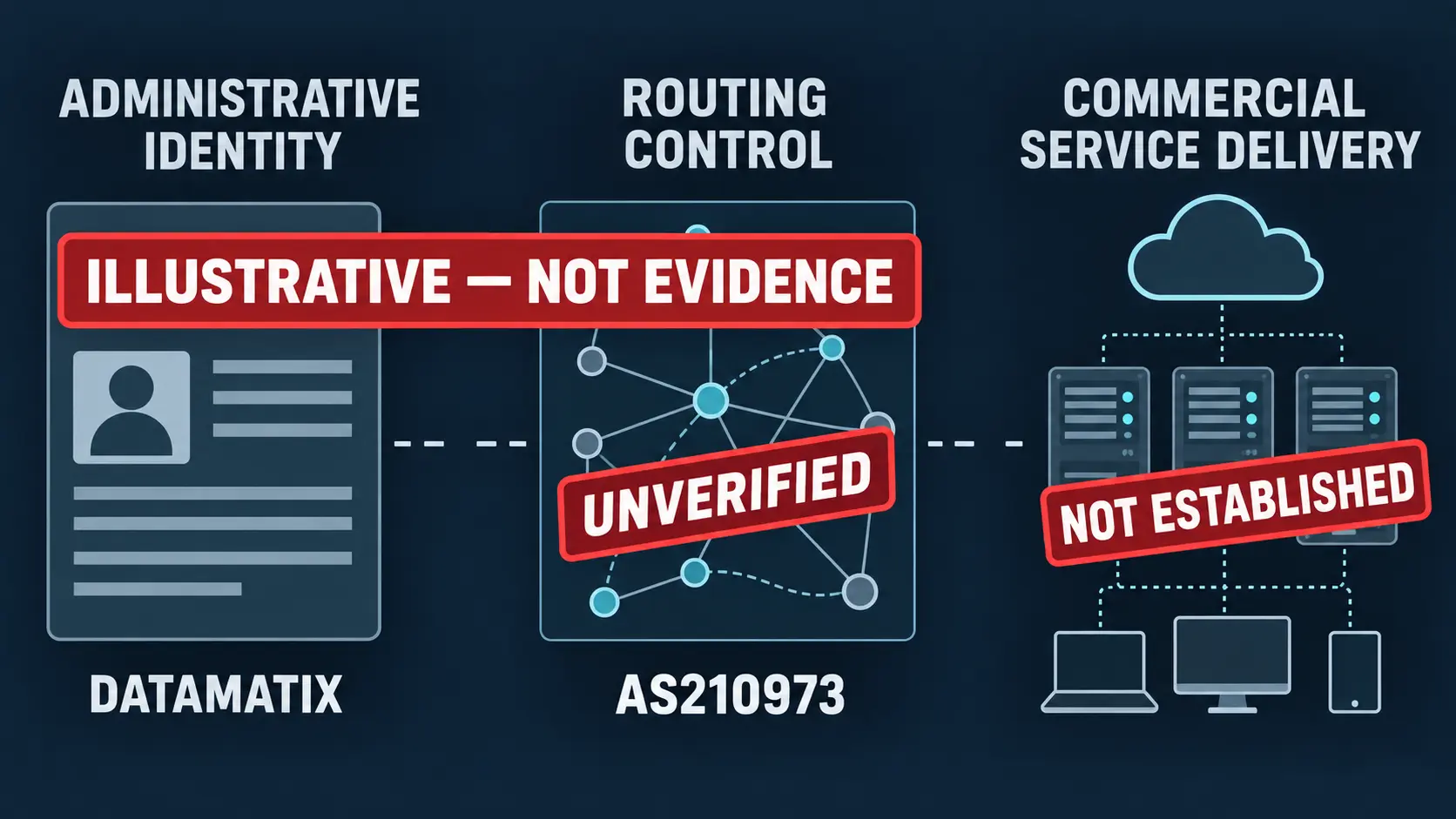
DATAMATIX and AS210973: The Operating Business Still Has to Be Proven
DATAMATIX and AS210973: The Operating Business Still Has to Be Proven intelligence summary explains the development, the public evidence available to readers, the organisations involved, the regional context, market exposure, and the infrastructure consequences that may follow.…

History
One Router Drew the Path. No Router Needed the Whole Map: RFC 1992
Nimrod’s sharpest scaling decision was to abandon the comforting fiction of a single, complete map: knowledge could be partial, private and stale, provided that a chosen path did not depend on every router improvising from a different picture.

IETF
The Transform Was Agreed. The Replay Was Not Yet Rejected: RFC 9827
RFC 9827 gives IKEv2 a broader and more honest contract for packet sequence numbers. The selected Transform ID describes what should be true when an SA's packets enter the network; it does not certify sender coordination, receiver anti-replay policy, the packet stream that…

Story
LACNIC’s ASPA Explainer Cites a Moving Percentage Without a Snapshot
LACNIC’s ASPA Explainer Cites a Moving Percentage Without a Snapshot intelligence summary explains the development, the public evidence available to readers, the organisations involved, the regional context, market exposure, and the infrastructure consequences that may follow.…

History
The Byte That Sent PPP Back to the Beginning: RFC 1973
RFC 1973 did not make Frame Relay trustworthy. It made a point-to-point conversation legible enough for two peers to notice when the conversation had changed shape—and to begin again before silence became a black hole.

Story
AFRINIC's IPv4 Summary Rose by Two. One Reserved Block Split into Three
AFRINIC's daily file gained two IPv4 records on 9 September. The tempting story is two new allocations. The rows tell a more useful one: a conserved block changed shape.

IETF
A Diagnostic Plan Is Not a Root Cause: Eight Receipts for Scheduled OAM
`draft-ietf-opsawg-scheduling-oam-tests-07` makes network diagnosis programmable as timed, ordered test sequences. The discipline begins when operators refuse to let a stored plan, a green status or a returned metric stand in for the execution, causality, authority and outcome…

Global Institutional
DFINFRA and AS210860: The Evidence Chain Still Stops Short of Operational Control
A cross-layer investigation can show how to test whether a registry identity is connected to a working network. In this case, the public evidence identifies the test but does not yet identify the actor able to cause or reverse a routing change.