
Summary
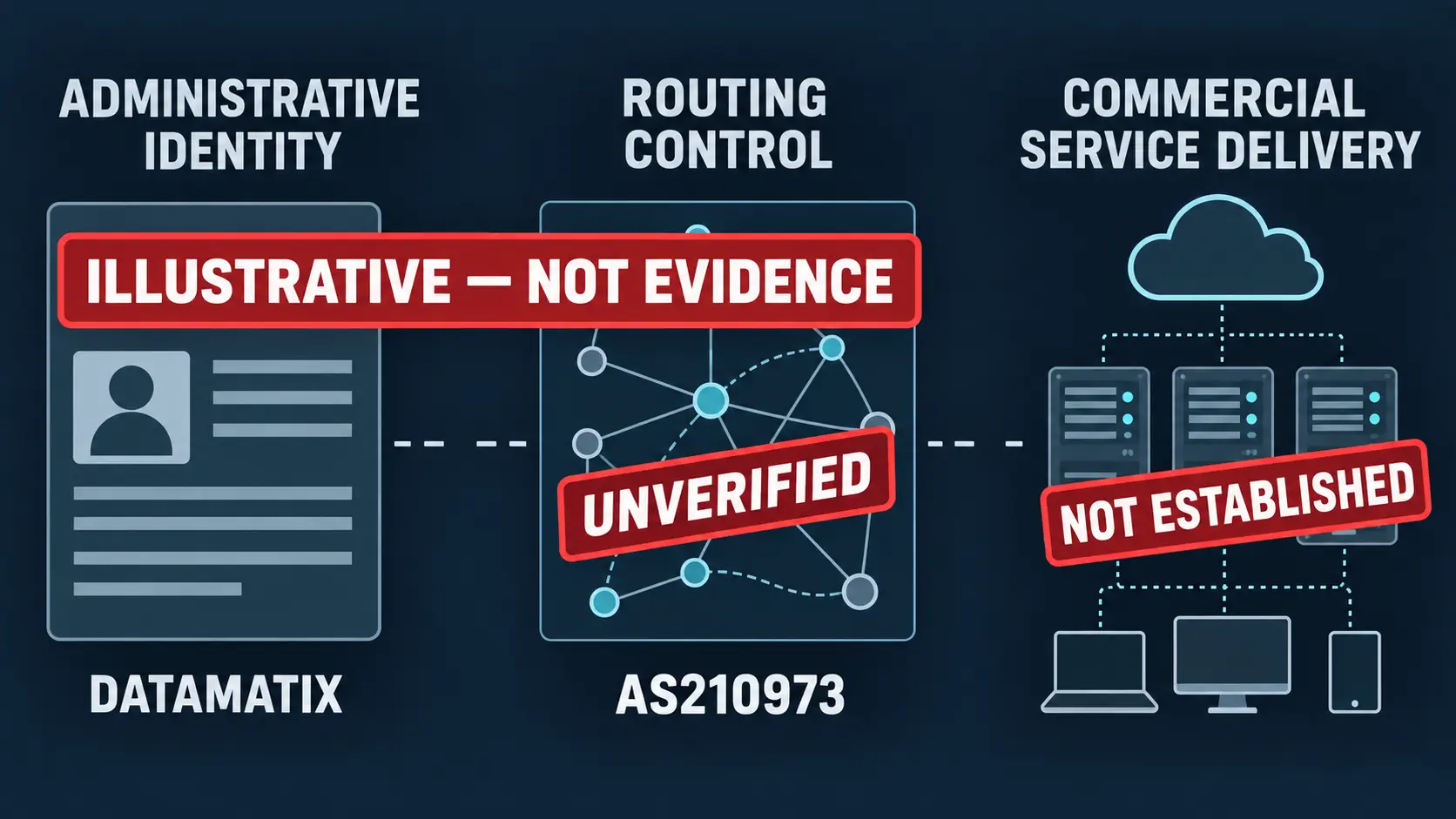
- DATAMATIX’s association with AS210973 is an administrative fact to be checked against current RIPE records; it does not, by itself, establish active routing, physical infrastructure control, customer relationships or commercial scale.
- The missing link is causal: a registered resource must be shown to be repeatedly routed, operationally controlled, tied to identifiable services and attributable to an accountable legal entity before it can support claims about capacity, continuity, dependency or cash flow.
The state difference is narrower than the name suggests
A company name attached to an autonomous system can look like the outline of a network business. In practice, it may describe several different states: a registration maintained in a regional internet registry, a routing policy object, an ASN that is occasionally visible to collectors, infrastructure operated by a third party, or a customer-facing service that uses addresses associated with the ASN. Those states overlap, but none can safely substitute for another.
That distinction matters for DATAMATIX because the prior public coverage already separated administrative visibility from claims about control and continuity. The next useful investigation is therefore not another inventory of records. It is a test of whether the records form an operating chain strong enough to explain economic consequences.
The first layer is registration. The RIPE Database aut-num record for AS210973 is the primary candidate for the registered AS name, organisation reference, maintainers, contacts and declared routing policy (RIPE Database aut-num record). RDAP provides a standardized corroborating view of the autonomous system’s registration events and linked entities (RIPE RDAP record). Delegated statistics can independently indicate the resource’s registry status and delegation date (RIPE delegated statistics).
These records can establish that a resource is registered and can show administrative continuity or change. They cannot establish that DATAMATIX currently operates routers, leases transit, hosts customers or controls the underlying addresses. Even a modification to the registry object would initially prove only that database information changed. It would not prove that the operating business changed at the same time.
Routing is the first operational test, not the final one
The next layer is external visibility. RIPEstat’s routing-status endpoint can indicate whether prefixes originated by AS210973 are currently observed, while the announced-prefixes endpoint can enumerate the prefixes visible at a particular observation time (routing status; announced prefixes). Routing history can show when those prefixes appeared and disappeared from RIPE RIS collectors (routing history). BGP state and update data can help distinguish origin announcements, path changes, withdrawals and periods of silence (BGP state; BGP updates).
The correct standard is repeated observation, not a single positive result. A route seen once may represent a test, migration, leak or short-lived configuration. A route seen repeatedly across multiple collectors over a meaningful interval would support a stronger conclusion: AS210973 had an externally visible routing presence during that interval. It would still not identify who operated the equipment or who paid for the connectivity.
The neighbour view can identify autonomous systems appearing adjacent to AS210973 in observed paths (RIPEstat ASN neighbours). Persistent adjacency may indicate continuity of connectivity, but AS-path adjacency is not a transit contract. It does not prove a commercial relationship, colocation, peering agreement or common corporate control.
Independent collector families are important because every routing dataset has a vantage-point limitation. BGP.tools offers an additional presentation of prefixes, upstreams, peers, IRR and RPKI information (BGP.tools AS210973 profile). The RIPE RIS archive and RouteViews archive permit reproducible analysis of raw routing records (RIPE RIS archive; RouteViews archive). Cloudflare Radar supplies another view of routing activity and route changes (Cloudflare Radar). Agreement across these sources would reduce the risk of mistaking one collector’s limited view for a global operating footprint.
The current research run did not retrieve or parse these dynamic records. It therefore cannot responsibly claim that AS210973 is routed today, that it has been continuously routed through 2025 and 2026, or that its observed paths expanded. Those are open findings, not implied conclusions.
Control requires more than an origin announcement
A network can be visible without the named organisation controlling the relevant infrastructure. An ASN may be used by a hosting provider, a customer, a reseller, a managed-services firm or another operator under an arrangement not visible in public routing data. RPKI can strengthen the control analysis, but only within limits. RIPEstat’s RPKI history can indicate whether a resource certificate holder authorized AS210973 to originate a prefix (RPKI history). A matching route-origin authorization would support the conclusion that the origin was authorized for that prefix. It would not prove ownership of servers, routers, facilities, customer traffic or the DATAMATIX legal entity.
The same caution applies to IRR. The RIPE inverse search can identify route and route6 objects that declare AS210973 as origin (RIPE inverse search). Such objects are useful administrative evidence, especially when their maintainers and prefixes can be compared with observed announcements. They remain declarative records. A route object may survive after an announcement disappears, while a live route may exist without a corresponding object in the queried database.
The defensible control chain therefore has several links: a current registry identity; prefixes associated with that identity; repeated external origination; matching authorization where available; persistent upstream or peer relationships; and operational services tied to the same addresses and time interval. The chain becomes stronger when those identifiers converge on one accountable company rather than on a generic name.
A service is an economic fact only when it can be tied to the network
The commercial question begins after technical visibility, not before it. Censys may identify exposed protocols, certificates, software and hostnames on addresses attributed to AS210973 (Censys host search). urlscan.io may provide dated evidence of websites resolving to those addresses (urlscan search). RIPE Atlas may show probes associated with addresses originated by the ASN (RIPE Atlas probes). PeeringDB may contain participant-maintained information about a network name, website, policy, facilities, exchanges and contacts (PeeringDB network record).
None of these sources alone proves a customer-facing business. A scanned host may belong to a tenant. A domain may sit behind a CDN or reverse proxy. A probe may be operated by a volunteer or customer. A PeeringDB entry may be incomplete or aspirational. The required test is temporal and relational: was a domain, service, certificate or protocol associated with an address attributed to AS210973 while the ASN was demonstrably routing, and can that service be tied to DATAMATIX rather than merely to a hosting or connectivity intermediary?
Without that link, it is not possible to quantify customer dependency, capacity, pricing power or cash flow. The name DATAMATIX may describe a real business, but the identified evidence does not yet establish its scale or operating model.
Legal accountability is a separate unresolved layer
The final link is corporate identity. Searches of UK Companies House and OpenCorporates can help determine whether the RIPE organisation reference matches an exact company name, company number and jurisdiction (Companies House search; OpenCorporates search). A name match is not enough. Corporate names can be duplicated, abbreviated, traded under different brands or associated with entities that have no control over the network resource.
A defensible attribution requires the exact legal entity in the registry data to match official filings or another authoritative corporate record. Even then, corporate accountability would identify the party responsible for the organisation, not necessarily the party operating every server or paying every upstream. The distinction is important when assigning liability for outages, abuse handling, service commitments or customer losses.
The economic mechanism remains conditional
If the evidence eventually shows that DATAMATIX repeatedly originates identifiable prefixes, maintains stable connectivity, operates reachable services and is legally accountable for the relevant resource, the economic mechanism becomes intelligible. Control of a routable resource can support service delivery; service delivery can create customer reliance; reliance can make continuity, upstream redundancy and abuse response commercially material; and those operating obligations can affect costs, retention, pricing and cash flow.
But the mechanism runs in the opposite direction as well. If the ASN is dormant, intermittently routed, operated by a third party or disconnected from identifiable services, the apparent infrastructure footprint may have little economic leverage. A registered resource can persist while the business behind it changes, pauses or disappears. That is why administrative continuity should not be reported as operating continuity.
The next observable condition is therefore specific: a time-stamped, cross-collector routing series for AS210973, linked to identified prefixes, matching authorization and at least one service or corporate identifier attributable to the same accountable entity. Until that condition is met, the appropriate conclusion is bounded. DATAMATIX is publicly associated with a network resource; the available package does not yet prove the scale, continuity, control or commercial significance of the operation.
Evidence boundary
This investigation’s search package identified the following public records for verification. The package itself states that it did not retrieve them live; they are evidence candidates, not automatic proof: RIPE aut-num, RDAP, version history, delegated statistics, IRR inverse search, routing status, announced prefixes, routing history, BGP state, BGP updates, ASN neighbours, RPKI history, BGP.tools, PeeringDB, Cloudflare Radar, RIPE RIS, RouteViews, RIPE Atlas, Censys, urlscan.io, Companies House and OpenCorporates.
The directory entry for the subject is DATAMATIX. Its presence in the directory is a navigation reference, not independent evidence of network operation or legal ownership.
Member Briefing
Deeper Profile Context
Sign in with the right membership level to unlock the full briefing and source notes.
Only for Strategic Circle
Strategic Circle
Open to all readers. Unlock profile briefings after joining and signing in.
Join Strategic CircleOnly for Leadership Alliance
Leadership Alliance
For qualified IP-asset owners and management; sign in to unlock alliance briefings.
Join Leadership Alliance