
Topic
Cross-border Connectivity
Within the Topic facet, Cross-border Connectivity topic intelligence connects articles that share a specific subject, signal focus, or monitoring theme. The page gives readers a richer path through related reporting, source evidence, market actors, and infrastructure implications, with enough context to understand why the topic matters across company movements, governance decisions, regional exposure, and operational risk. Readers can compare recurring signals, affected organisations, public evidence, market context, service continuity, procurement, competition, compliance, and strategic planning questions behind the subject instead of stopping at a thin list of matching articles. It explains what the topic covers, which infrastructure actors or policies are involved, what evidence supports the coverage, and why the subject may matter for operators, customers, investors, and policy readers.

History
Olga Cavalli and the Capacity Work of Internet Governance
Olga Cavalli's public record is easy to misread if it is treated as a ladder of titles. The more useful profile is operational: an Argentine internet governance specialist whose durable influence sits in the less theatrical work of education, participation, forum literacy, and…

History
Ermanno Pietrosemoli And The Practice Of Wireless Scarcity
Ermanno Pietrosemoli's public record is not only a Latin American internet-history story. It is an operating case in how connectivity can be made practical when geography, cost, spectrum rules, maintenance skills, and institutional capacity are the real constraints.

Latin America and Caribbean Cloud Services
EdgeUno Brazil is judged by the edge state it can accept
EdgeUno's Brazilian company is not just another way to describe a Latin American network map. For Brazilian ISPs, cloud buyers, content platforms and regional engineering teams, the harder question is whether Edgeuno Servicos de Infra Estrutura em Nuvem LTDA can turn a workload…

Europe and Middle East Regional ISP
AZNET Technologies and the margin risk below cloud scale
AZNET TECHNOLOGIES LLC has a clear incentive to stay relevant in Azerbaijan's broadband market: it must convert a visible access brand, a RIPE NCC member footprint and a regional service promise into durable cash flow before larger fixed, mobile and wholesale networks make the…

Europe and Middle East Regional ISP
Buzachi Operating Ltd. and the margin risk below cloud scale
Buzachi Operating Ltd. has a real public resource-holder footprint, but the economics that matter are not proven by membership status alone. The question is whether a small Kazakh operating company can turn registry standing, address administration and site-specific connectivity…

Europe and Middle East Cloud Services
Eseye sells IoT continuity across the carrier boundary
A connected product fleet becomes expensive when its cellular plan is treated as a one-country purchase. Eseye Ltd sits in the harder middle of that market: it sells managed IoT connectivity, eSIM orchestration, support and platform control for devices that must keep working as…

North America Cloud Services
BeeksFX turns low-latency VPS into a trading-infrastructure dependency
A trader paying for hosted infrastructure near a venue is buying less than execution certainty and more than ordinary hosting: a place in a stack of compute, connectivity, support, account configuration and operational dependency. BeeksFX VPS USA Inc. matters because public…

Latin America and Caribbean Regional ISP
360NET makes Miami interconnection part of a Venezuelan fibre bill
360NET makes Miami interconnection part of a Venezuelan fibre bill intelligence summary explains the development, the public evidence available to readers, the organisations involved, the regional context, market exposure, and the infrastructure consequences that may follow. The…
Latin America and Caribbean Regional ISP
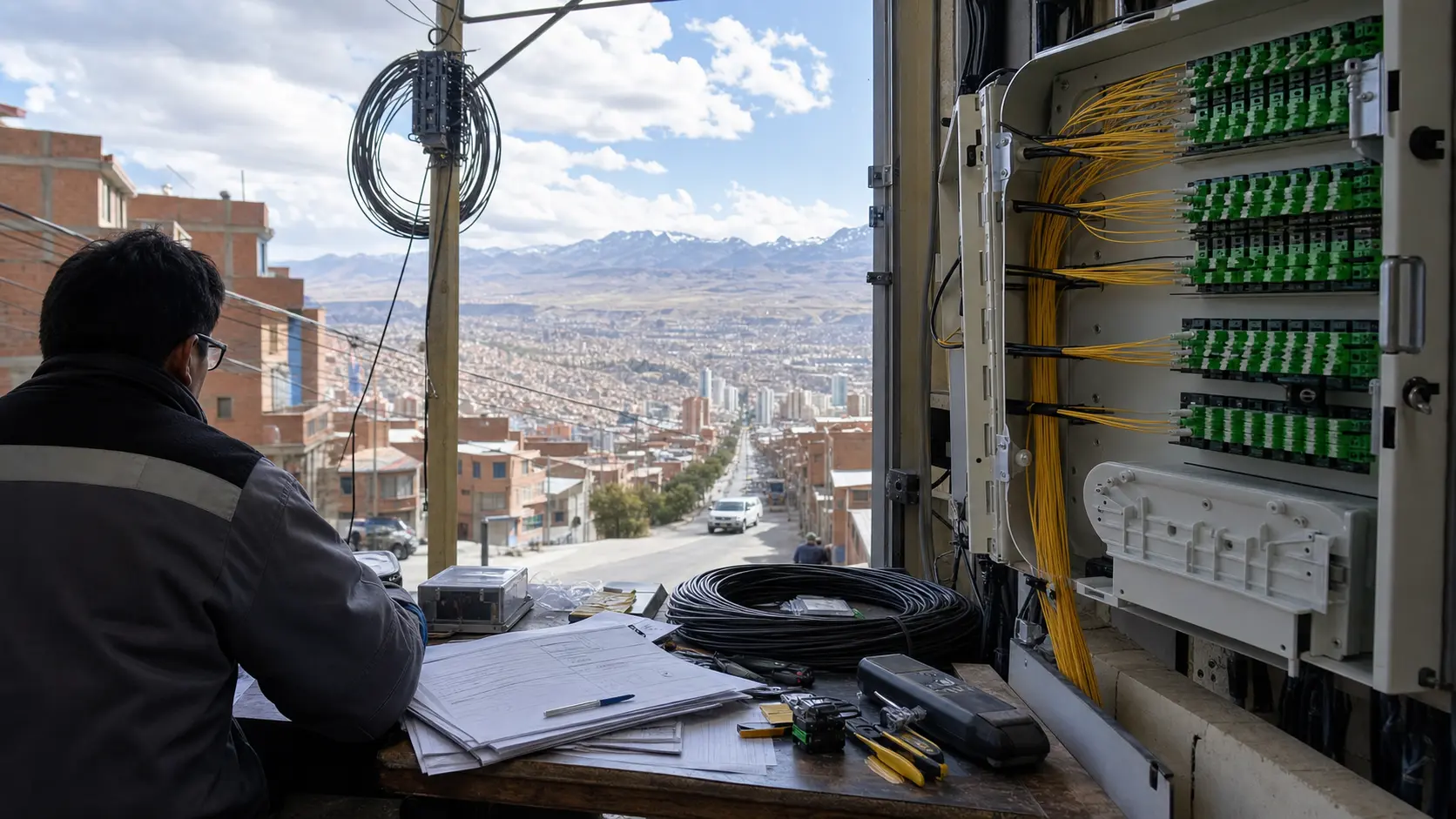
AXS Bolivia prices backbone reach against a single international upstream
A Bolivian enterprise buying internet across La Paz, El Alto, Cochabamba and Santa Cruz is not only comparing headline megabits. It is buying a promise that the local fiber route, the installation crew, the account manager, the domestic exchange port and the international carrier…

Europe and Middle East Regional ISP
FNE-Finland sells route choice before the wholesale circuit is lit
FNE-Finland sells route choice before the wholesale circuit is lit intelligence summary explains the development, the public evidence available to readers, the organisations involved, the regional context, market exposure, and the infrastructure consequences that may follow. The…

North America Cloud Services
CloudBlast sells hourly VPS capacity across a Wyoming-Dubai divide
A developer looking for a temporary VPS sees CloudBlast as an unusually simple proposition: AMD EPYC cores, NVMe storage, 10 Gbps ports, DDoS protection and hourly billing from a few euros a month. The harder question is whether that low-priced account is just a disposable test…

Europe and Middle East Cloud Services
Scalaxy turns a long peer list into a bare-metal price test
A buyer comparing Scalaxy B.V. with OVHcloud, Hetzner, Leaseweb, servers.com, Scaleway, hyperscale reserved capacity and owned colocated hardware is not only comparing monthly server rent. The real test is whether Scalaxy's public bare-metal and managed private-cloud offer can…

Europe and Middle East Regional ISP
ASTEL's capital recovery test across Kazakhstan's connectivity edge
Kazakhstan's sparse geography makes a remote connection expensive before a customer sends the first byte. ASTEL's case now turns on whether enterprise and public-sector contracts can recover satellite capacity, terrestrial backhaul, field support and a new investment cycle…

Europe and Middle East Regional ISP
AZ-EVRO TEL and the hard price of local network independence
A Baku household can buy 100 Mbit/s broadband for roughly the price of a modest monthly utility bill, but the apparent simplicity hides a harder bargain: customers fund the access account, the operator funds enough fibre, electronics, support and external capacity to keep it…

Europe and Middle East Regional ISP
DIGITAIN LLC and the capital-recovery test behind local network control
Armenia gives DIGITAIN LLC a useful software cost base and an awkward connectivity problem: a small, landlocked home market can export code, but every service-level promise ultimately depends on routes, facilities and suppliers beyond the country's borders. DIGITAIN's own…

Europe and Middle East Regional ISP
EDGEAM LLC and the Margin Risk Below Cloud Scale
EDGEAM LLC has a simple management problem: it must remain useful to customers who can buy compute, connectivity and protection from much larger suppliers, without carrying a larger supplier's purchasing power, utilisation or balance sheet. Its Armenian registration, RIPE…

Europe and Middle East Regional ISP
ElCat Ltd. and the Cost of Turning Network Independence into Paid Reliability
ElCat Ltd. and the Cost of Turning Network Independence into Paid Reliability intelligence summary explains the development, the public evidence available to readers, the organisations involved, the regional context, market exposure, and the infrastructure consequences that may…

Europe and Middle East Regional ISP
EUROTELE-PLUS LLC: Network Independence Has to Pay for Itself
Owning an autonomous routing identity and choosing several paths to the internet can keep a telecom company from becoming a pure reseller, but independence is valuable only when customers pay more for the reliability it creates than the company spends on upstream capacity…

Europe and Middle East Regional ISP
Intelekt Group and the Margin Risk Beneath Cloud Scale
Intelekt Group has the assets, local presence and Internet-number governance needed to remain relevant in western Ukraine, but relevance is not the same as pricing power: flat 2025 revenue, a 3.21% net margin, a retail price grid matched by a nearby rival and a newly complicated…

Europe and Middle East Regional ISP
IST TELEKOM and the price of network independence
The economic reason to control a network is simple: stop paying another operator for every essential layer of the product, keep more of the customer's monthly bill, and make reliability something the company can engineer rather than merely promise. For IST TELEKOM in Uzbekistan…