
Summary
- Ascania Group LLC is best understood first as the management and holding company behind a diversified Ukrainian group, not as a proven retail ISP: official group materials describe food distribution, logistics, roses, beverages, energy supply, lighting, skiing facilities and the City24 payment brand, while public company records identify a Kyiv limited liability company whose main registered activity is management consultancy.
- The network evidence is real but narrow: RIPE NCC lists Ascania Group LLC as a Ukrainian member, AS202026 is active under RIPE, and public BGP sources show three routed IPv4 /24s with large Ukrainian carriers around it, but those records do not by themselves prove sold transit, broadband, hosting or cloud revenue.
- The economic test is whether any internal or external account attached to Ascania's network footprint pays enough to cover carrier dependence, equipment replacement, power backup, support labour, RIPE membership obligations, cyber and payment-system compliance, customer churn and the renewal capital required to keep services available during wartime disruption.
- The judgment improves if Ascania can show diversified paying users, priced support, documented failover, power-cost recovery and direct service contracts; it worsens if the AS exists mainly as an internal convenience with thin cost recovery, concentrated demand and supplier terms set by larger carriers.
One monthly fee has to carry the whole reliability burden
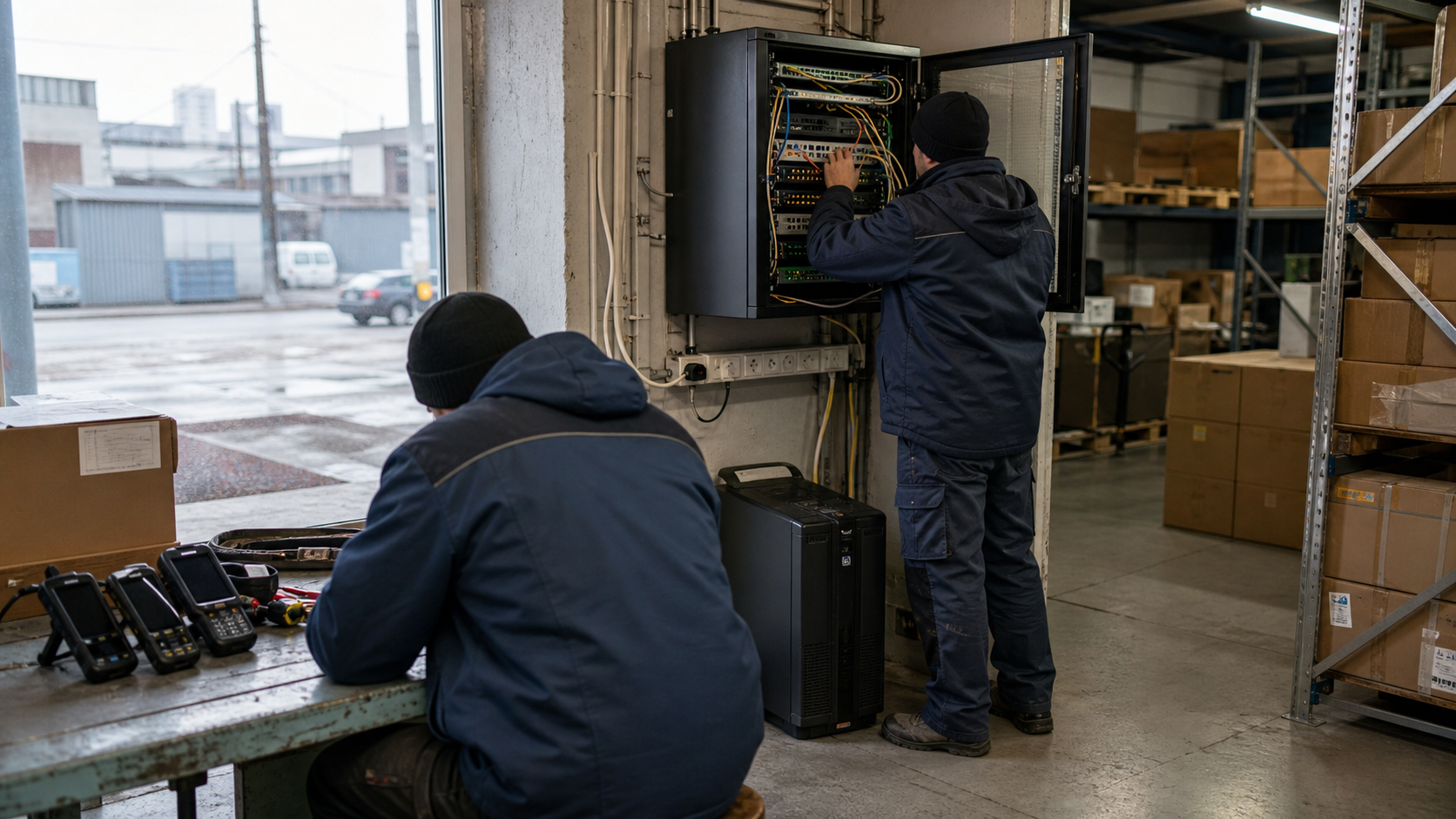
Start with a single paying account. It might be a warehouse that needs handheld scanners, route planning, cameras and accounting systems to stay online. It might be a group office that needs private connectivity between finance, procurement and distribution teams. It might be a payment-service counterparty whose terminal estate or online acceptance flow depends on stable links. It might be a tenant or affiliate using a small block of addresses for systems that cannot be casually moved. Whatever the exact account, the fee cannot pay only for bandwidth.
It has to carry supplier contracts, support time, address stewardship, router replacement, cyber hygiene, power backup, regulatory coordination and the capital needed to renew the network when hardware ages or the security environment changes.
That is the cash-flow test behind Ascania Group LLC. Public evidence does not show Ascania selling mass-market broadband, wholesale IP transit, cloud servers or managed network services in the way a telecom operator normally markets them. It does show a Ukrainian group with real operating businesses and a separately visible internet-number footprint. The analytical question is therefore not whether an AS number exists. It clearly does. The question is whether the resource footprint is attached to a service model with paying users and cost recovery, or whether it is better treated as an internal reliability tool for a broader commercial group.
The distinction matters because local network reliability is never free. A small autonomous system can look tidy from a registry page and still be economically weak. It may need upstream links from larger carriers. It may need someone who understands RIPE objects, routing policy, abuse contacts, address assignments and change control. It may need backup power if Kyiv offices, terminal sites, warehouses or data cabinets face outages. It may need security monitoring because payment, distribution and management systems attract fraud and disruption risk.
It may need hardware spares even when the visible address footprint is only a few routed blocks. A small footprint can be cheap compared with a national network, but it is not costless.
The payer benefits if that local control reduces downtime, bargaining dependence or compliance friction. If Ascania can run a small but resilient resource base for critical group systems, the value sits in avoided failure. A warehouse that does not stop, a payment process that does not lose status visibility, a finance function that can keep communicating during power stress and a group that can choose between multiple Ukrainian carriers all have economic value. The downside risk sits with whoever absorbs underpriced resilience.
If the business units treat connectivity as a shared overhead while suppliers raise prices and outages increase support work, the group may carry the cost without a clear revenue line to fund renewal.
This is why Ascania should not be analysed as a generic regional ISP simply because a public directory classifies it around number-resource governance. The route table is evidence, but it is not the business model. The business model is determined by who pays, how often they renew, how much support they consume, what suppliers can charge, how quickly failures are repaired and whether the operator can pass through cost increases. The network may be small; the economic discipline still has to be real.
The proven company is a diversified Ukrainian group, not a telecom pure play
The strongest identity evidence points to a diversified Ukrainian holding. Ascania's official English materials describe a group of companies spanning twelve businesses and several operating lines: food import, production and distribution; logistics; rose cultivation; honey processing and export; electricity and natural gas supply; beverages; lighting; tire distribution; and a ski complex in central Kyiv. The same site identifies City24 as a payment system with a terminal network across more than two thousand locations.
It describes Ascania FMCG as a food-trade and distribution business with long experience in Ukraine, Ascania Flora as a major rose producer, Ascania Auto as a tire distributor, Via Trans Expedition as a logistics company, Ascania Beverages as a grain-based kvass producer and Ascania Energy as an electricity and gas supplier.
Public corporate records narrow the legal identity. OpenDataBot and other Ukrainian company-data sources identify the Ukrainian limited liability company with USREOU code 33598068, registered in 2005, located at Novopechersky Lane 5 in Kyiv. The main registered economic activity is business and other management consultancy. Public extracts name Serhiy Zhyla as manager and show large authorized capital for the company. The official management page also describes Serhiy Zhyla as chief executive of Ascania Group and Anna Vashchenko as chief financial officer of Ascania Group.
These details support a management-company reading more than a stand-alone telecom-operator reading.
That operating boundary is important. A diversified holding can have serious connectivity needs without selling connectivity to the public. Food distribution needs order systems, supplier portals, inventory data, financial reporting and route coordination. Logistics needs dispatching, tracking and communication. Energy supply needs customer, settlement and regulatory systems. Payment services need status checking, fraud controls, bank links, customer support and data security. Greenhouse production, beverage manufacturing and tire distribution all depend on administrative and operational software.
A group with those businesses may reasonably want its own address resources, routing policy and carrier optionality even if it never markets itself as an ISP.
The same boundary prevents overclaiming. Official group descriptions do not present Ascania Group LLC as a broadband access provider. The corporate registry does not list telecom service provision as the main activity. The public RIPE member page says the service area is Ukraine, but a service area in a RIR membership context is not the same as a retail service catalogue. BGP pages show a live AS, but they do not show customer contracts, service plans, help-desk volumes, monthly recurring revenue, data-centre racks or wholesale traffic commitments.
The right public conclusion is therefore conditional. Ascania has enough operating complexity to make controlled connectivity valuable. It has enough official and registry evidence to be treated as a real Ukrainian corporate actor. It has enough number-resource evidence to be monitored by BTW as a network-resource holder. But it does not have enough public telecom evidence to be described as a proven ISP, transit seller, cloud platform or managed-network provider. The article has to keep those facts separate.
The group context explains why reliability may matter
Ascania's non-telecom businesses are not a distraction from the network question. They are the reason the network question is economically plausible. A diversified operating group with distribution, energy, payments and manufacturing has a different reliability problem from a small office with ordinary broadband. Its cost of failure is not only the monthly access bill. The cost can include missed deliveries, payment exceptions, idle warehouse workers, customer-support backlogs, data reconciliation work, supplier penalties, delayed invoices and reputational damage when service windows are missed.
City24 is the clearest example of a digital dependency signal. The official Ascania group site presents City24 as part of the group and describes it as a payment system with broad territorial reach. City24's own public pages describe thousands of services, a large terminal footprint, support contacts, payment-status functionality, regulatory licensing through the Swift Garant legal entity and security processes around card data. That does not prove Ascania Group LLC itself operates City24's network, nor does it prove that AS202026 carries City24 traffic.
It does show why a group linked to payment infrastructure would care about uptime, monitoring and redundancy.
The same logic applies to distribution. Ascania FMCG's English site says its distribution network covers the whole country and that direct deliveries reach more than eighteen thousand stores and outlets. A nationwide distribution operation needs dependable data exchange with warehouses, carriers, retailers and finance systems. Even if those services are outsourced to carriers or cloud providers, the buyer still needs coordination, incident response and local accountability.
A network resource holder inside the group could reduce dependence on one provider, give the group cleaner addressing for internal systems, or support more controlled failover arrangements.
Energy supply raises another angle. Ascania Energy is described by the group as a supplier of electricity and natural gas and as a provider of electrical installation services for commercial clients. Energy markets depend on billing, metering, contracts and regulated settlement processes. Public evidence does not show the network architecture behind those systems, but it does make clear that Ascania's operating environment is not purely consumer retail. Reliability in this context is a business-control function. The network has to support paperwork, settlement, customer communication and continuity.
The group also operates physical businesses: roses, beverages, packaging, lighting, logistics and a ski complex. Physical businesses create many small network edges rather than one elegant central system. Each edge can be modest, but the aggregate support burden is real. Someone must maintain provider relationships, access devices, backups, user support, security updates and remote access. If those responsibilities are under one management company, the economics resemble an internal shared-service provider. The payer may be an affiliate rather than an outside customer, but the cash still needs to cover costs.
This is why the article opens with one paying account. In a diversified group, the account may be internal. Internal accounts can still be economically demanding. They often expect service without treating it as a market purchase. They may resist price allocation when costs rise, because the network team is "inside the group." That creates a hidden subsidy risk. Reliability is valuable, but if no business unit is charged for the labour, carrier bills and renewal capital it consumes, the group may delay investment until a failure makes the cost visible.
Number-resource evidence is real and narrow
The internet-number evidence is specific. RIPE NCC lists Ascania Group LLC as a Ukrainian member with a Kyiv address and a Ukrainian service area. RIPE-derived records identify the organisation object ORG-AGL15-RIPE, tied to Ascania Group LLC, country Ukraine and LIR status. AS202026 was created in 2014, carries the as-name "ascania" in the RIPE record and is associated with the Ascania organisation. BGP tools and IP intelligence sites show the AS as active and identify three live IPv4 /24 announcements: the blocks commonly described as Ascania Net 16, Ascania Net 17 and Ascania Net 18.
Those are meaningful facts. An autonomous system is not a marketing slogan. It implies routing policy, registry administration and some level of operational stewardship. A routed IPv4 footprint, even a small one, can support servers, VPN gateways, office systems, payment-adjacent services, security appliances, monitoring, mail infrastructure, interconnection with suppliers or other applications that benefit from stable addressing. RIPE membership also imposes governance responsibilities. The member has to maintain records, contacts and fees.
It has to manage abuse handling and routing objects well enough not to create avoidable operational risk.
The evidence is also narrow. Public BGP sources show three announced IPv4 /24s and no visible IPv6 announcements for AS202026 in the main routing summaries used here. Some allocation directories also point to a broader registered IPv4 allocation and an IPv6 allocation, which is normal in the difference between registry allocation and live BGP origination. The important distinction is that assigned or allocated resources do not automatically equal routed, used or monetized resources. Live route observation shows what is being announced. Registry data shows what has been assigned or allocated. Neither source proves revenue.
Public BGP aggregators identify large Ukrainian networks around Ascania's AS. The observed upstream or peer set includes names such as Ukrtelecom, Datagroup, Inter-Telecom and Kyivstar, depending on the source and observation method. RIPE routing policy also lists several import and export relationships. That surrounding carrier set can be read positively: Ascania appears to have more than one route path in the public record. It can also be read as dependence: the AS sits under larger Ukrainian operators whose commercial terms, outage performance and routing practices shape the reliability Ascania can deliver.
There are no public signs that AS202026 is a large transit network. IPinfo lists no downstreams. BGP.tools describes the network type as unknown, not as a clearly classified access or hosting network. The originated address count is compact. Hurricane Electric's Ukraine network list places Ascania far below the large carriers in route and adjacency scale. Those comparisons should not be used to dismiss the footprint, but they do frame it. This is a small resource holder in a large, competitive and stressed connectivity market.
For economic analysis, the number-resource footprint is a starting point. It says Ascania has control over a small piece of the routing system. It does not say why the company keeps that control, how much traffic it carries, whether the traffic is internal, whether external customers pay for it, whether there are service-level commitments or how replacement investment is funded. The registry facts are reliable. The business inference must stay modest.
Supplier dependence sits underneath the pricing question
A compact AS does not escape supplier economics. It depends on bigger networks for reachability, backhaul, physical circuits, route diversity and fault response. Public data around AS202026 shows relationships with Ukrainian carriers that also appear as major market actors or network service providers. That is useful, because relying on multiple suppliers can improve resilience. It also makes Ascania a price taker in several respects. The group cannot replicate national fibre, international paths, peering density, support teams and last-mile coverage at the scale of Kyivstar, Datagroup, Ukrtelecom or other large providers.
The supplier bill is not just bandwidth. It can include access circuits, cross-connects, installation fees, CPE, routing support, DDoS mitigation, replacement routers, firewall subscriptions, monitoring tools, maintenance contracts and staff time spent coordinating faults. In Ukraine, power continuity adds another layer. Carrier equipment, group offices and local server rooms may need UPS units, batteries, generators or redundant sites. A small network can become expensive quickly if every service promise requires physical resilience.
That is why pricing power matters even when the user is internal. If Ascania allocates network cost to group businesses, it needs enough discipline to charge for supplier pass-throughs and renewal capital. A logistics affiliate that wants a redundant circuit should see the cost of that redundancy. A payment-related affiliate that needs high availability should pay for monitoring, security and emergency support. A warehouse that wants failover during outages should pay for backup equipment and testing. If all of these requests are absorbed by the holding company, reliability becomes an unfunded promise.
External customers would make the question sharper. If Ascania sells any resource-backed service outside the group, the fee has to cover supplier risk plus margin. A small customer may value a local provider because it gets faster support and Ukrainian-language operational help. A larger customer may bargain hard because it can buy from major carriers, cloud providers, hosting companies or system integrators. Without clear product differentiation, Ascania would struggle to charge above the cost of carrier resale. Local support can be valuable, but only if it is priced rather than gifted.
The carrier set also affects operational control. If a route issue arises, Ascania's engineer or support vendor may understand the problem before an upstream carrier acts on it. The customer sees Ascania as responsible, but Ascania may depend on a larger supplier's repair window. That is a classic small-provider squeeze: the small provider owns the customer relationship while the larger supplier controls a material part of the fix. Strong contracts, multiple suppliers and tested failover reduce that squeeze. Weak terms turn the small provider into a complaint desk for faults it cannot directly repair.
The public record does not disclose supplier contracts. It does not show committed data rates, circuit geography, diversity, DDoS arrangements, service credits, incident history or renewal terms. The correct reading is not that supplier dependence is fatal. It is that supplier dependence must be paid for. The fee charged to an account should reflect the cost of being the accountable party between a Ukrainian business process and the larger networks that carry its traffic.
Unit economics are a recovery test, not a route-table count
The visible route table is too small to answer the economic question alone. Three routed IPv4 /24s can be valuable for continuity, but the value depends on how they are used. If the addresses support high-importance systems with many users and disciplined cost allocation, they can earn their keep even without a public telecom catalogue. If they support lightly used internal services while still requiring staff attention, RIPE fees, hardware and supplier bills, they may be a governance cost more than an economic asset.
Public financial records complicate the reading. Company-data sources show Ascania Group LLC as a substantial asset holder with high liabilities relative to reported revenue in recent periods. OpenDataBot's figures show modest annual revenue for the legal entity compared with large assets and obligations. That likely reflects the role of the management or holding company rather than the economic scale of all group operations. The public figures should therefore not be treated as a telecom P&L. They do, however, reinforce the importance of cost allocation.
A holding vehicle can carry assets and obligations while the operating businesses generate the practical demand.
Unit economics in this case start with the cost per useful dependency protected. A group-managed network is valuable if it protects systems that would otherwise cost more to operate, recover or replace. If the AS helps avoid downtime at payment, logistics, distribution or energy operations, its economic contribution may be measured in avoided disruption, not third-party revenue. But avoided disruption still needs a budget. Someone must choose the level of redundancy, approve supplier contracts, replace devices, pay membership fees and audit security settings.
The major recurring costs are predictable. Carrier service is one. Labour is another. Even if Ascania does not employ a large network team, it needs internal staff, outsourced engineers or carrier support. Governance is another: maintaining RIPE records, route objects, contacts and abuse handling takes discipline. Equipment is another: routers, firewalls, switches, UPS units and monitoring systems age. Compliance is another, especially if payment-adjacent services and personal data touch the same operational environment. Cyber exposure is another, because public addresses invite scanning, abuse complaints and incident response.
Revenue quality depends on whether these costs are explicitly recovered. A mature model charges business units or customers according to service level, failover, address use, support intensity and change frequency. A weak model spreads the cost across central overhead and then discovers during a crisis that no one budgeted for replacement. That is not a technology issue. It is a governance issue. The route table can be stable while the economics decay.
Pricing power is limited by substitutes. If an internal user can buy a service from Kyivstar, Datagroup, Ukrtelecom, a Ukrainian cloud provider or a hyperscaler, Ascania's internal network team must show why its service is worth the allocation. The answer may be control, local accountability, data locality, custom fit or resilience under Ukrainian operating conditions. It cannot be "because the group already owns the address space." Address space helps only when it supports a service level that a buyer values.
Customer concentration is more likely to be internal than retail
In a public ISP analysis, customer concentration usually means a few business accounts or wholesale buyers dominate revenue. For Ascania, the more plausible public risk is internal concentration. The visible group structure suggests that demand could come from a small number of affiliates: payments, FMCG distribution, energy, logistics, manufacturing or central administration. If one or two affiliates drive most network needs, the network function's economics depend on those affiliates' budgets and priorities.
Internal concentration is easy to underestimate. An affiliate may not threaten to leave like an outside customer, but it can defer payment, resist cost allocation, demand urgent support, ask for custom work or delay decisions on renewals. It can also create lumpy demand. A payment platform migration, warehouse rollout, cyber event or office move can consume months of support effort. If the central network budget does not charge for that effort, the apparent service remains cheap only because the cost is hidden.
External concentration is also possible, but the public record does not prove it. No source used here shows a customer list for AS202026, a managed-hosting service catalogue, a transit customer roster or downstream AS relationships. IPinfo reports no downstreams. That does not rule out customers using services without their own AS numbers, but it does weaken any claim that Ascania is a material external network supplier. The safer reading is that customer concentration should be tested, not asserted.
The risk profile depends on contract shape. If group affiliates pay a predictable monthly charge for defined services, Ascania can plan supplier renewals and equipment replacement. If affiliates pay only when projects arise, the network function may lack recurring cash. If external customers exist but receive bespoke pricing, concentration risk rises. A few customers can absorb support labour, create high incident expectations and still bargain down price because the provider wants to keep the account.
Customer concentration also affects repair burden. The hardest users are often those whose systems are critical but poorly standardised. They may need after-hours changes, unusual firewall exceptions, legacy equipment, repeated incident calls or manual reconciliation after outages. A small network team can carry that load for a while, but it weakens margins if not charged. In the Ascania context, payment, logistics and energy-linked systems could all create high urgency. That makes service definition important.
The economically healthy version is straightforward: many internal and possibly external accounts pay for standardised, measurable services, with exceptions priced. The weak version is also straightforward: a few powerful internal users absorb most support capacity, suppliers raise costs, and central management treats network reliability as background overhead. Public evidence cannot tell which version is true. It can only define the question.
Competition is broad because substitutes do not have to look like Ascania
Ascania's substitutes are not only companies with the same number-resource profile. A warehouse can buy business internet from a large carrier. A payment platform can colocate servers in a professional data centre, use a Ukrainian cloud, spread workloads across a foreign hyperscaler and a local backup site, or contract with a managed service provider. A small office can take fibre, mobile failover or satellite service. A group with multiple locations can combine carrier VPN, SD-WAN, cloud networking and local support. The buyer wants continuity, not a matching AS.
Kyivstar offers business connectivity across different technologies and markets internet that can work without local power in some circumstances where technical conditions allow. Datagroup describes itself as a national communications provider with business, home, cloud and data services, and its business materials include data-centre capacity and links to major Ukrainian exchange points. Ukrtelecom presents business internet and IT solutions at national scale with long experience in corporate connectivity and data-centre work. These providers have scale Ascania cannot match.
Cloud and hosting substitutes widen the field. Ukrainian cloud providers such as GigaCloud, De Novo and other local data-centre operators can offer domestic infrastructure, backup, disaster-recovery and managed services. Foreign hyperscalers can offer enormous service breadth, global resilience and engineering familiarity, though with different data-location, currency and support tradeoffs. A group such as Ascania may choose a hybrid model: local connectivity and addressing for certain systems, Ukrainian cloud for resilience, and foreign cloud for selected applications.
That substitute set caps pricing power. If Ascania offers a service that looks like generic connectivity, large operators will often be cheaper or more credible. If Ascania offers a service that is tightly integrated with group operations, local support and address continuity, it can justify internal allocation or selective external pricing. The value proposition has to be specific: fewer handoffs, faster support, known business processes, Ukrainian locality, multi-carrier control or better recovery from local disruption.
Substitutes also discipline capital investment. If a capability can be bought cheaply from a carrier or cloud provider, Ascania should avoid building it unless control is strategically important. If a capability is unique to the group, such as a private design for payment-related uptime or affiliate connectivity, the group may rationally invest. The hard part is avoiding vanity infrastructure. Owning number resources can feel strategic, but value appears only when the resources solve a reliability or bargaining problem better than alternatives.
This is the core competitive lesson. Ascania does not need to be a telecom pure play to make a local network footprint worthwhile. It does need to prove that its footprint does something cheaper, safer or more controllably than the substitutes. Otherwise, the route table is an overhead line with a technical explanation.
Wartime Ukraine turns redundancy from option into operating cost
Ukraine's operating environment changes the reliability threshold. Public reports on Ukrainian connectivity describe a market that has remained competitive and resilient under severe pressure, but also one affected by attacks on energy and telecommunications infrastructure, regional outages, cyber incidents and shifting user behaviour during blackouts. Businesses regularly need backup power, alternate access paths and practical recovery procedures. For a group with physical locations, distribution systems and payment-adjacent activities, this is not theoretical risk.
Power stress is the first cost. Connectivity equipment needs electricity at both ends of a link. A fibre path may exist, but office routers, switches, access gear, terminals and carrier nodes still need power. A business that expects service during outages has to invest in batteries, UPS units, generators, monitoring and maintenance. These costs age and recur. Batteries degrade. Generator fuel needs management. Equipment has to be tested. Staff need procedures. A monthly fee that ignores these costs is underpriced.
Cyber risk is the second cost. Public addresses and payment-linked systems invite scanning and abuse. Large Ukrainian operators have faced high-profile cyber incidents, and smaller operators often have fewer resources to respond. Ascania's group context includes payments, distribution, energy and management systems, all of which can create sensitive operational data. Security is therefore part of reliability. Firewalls, logs, access control, backup discipline, vendor management and incident response cannot be treated as optional support extras.
Regulatory exposure is the third cost. Electronic communications providers in Ukraine operate under a general authorization framework and a public register. Payment services operate under National Bank rules when they involve licensed payment institutions. Data protection, financial monitoring, tax reporting and sector-specific obligations all shape the systems behind the business. Ascania Group LLC's exact telecom regulatory status is not established by public evidence in this article, but the group's payment and energy-adjacent context makes compliance costs relevant to any shared infrastructure that touches those operations.
Geopolitical risk also affects supplier choice. A Ukrainian group may prefer local control for certain systems because local support, language, legal jurisdiction and physical access matter during crisis. It may also prefer foreign cloud or foreign backup for survivability. Neither choice is always right. Locality improves control and latency; foreign capacity can improve geographic resilience. The best model is deliberate segmentation: know which systems require Ukrainian locality, which require cross-border backup, which can tolerate carrier outages and which need immediate recovery.
This environment can strengthen Ascania's case for a small controlled network footprint. It can also expose weak economics. If redundancy is genuinely necessary, it must be paid for before the outage. If it is treated as an unfunded expectation, the group will discover the gap at the worst moment. Reliability is not a narrative. It is a budgeted, tested and renewed operating commitment.
Unofficial market signals support caution rather than hype
Secondary signals help fill context, but they should not be mistaken for proof. LinkedIn describes Ascania Group as a multi-sector Ukrainian holding with more than twelve companies and thousands of employees. Ukrainian registry aggregators show legal status, capital, activities, ownership, financial figures, court references and tax/VAT indicators. BGP aggregators show route visibility, upstreams, AS-set membership and prefix descriptions. Payment-brand pages show City24's service categories, regulatory disclosures and terminal claims. These signals point to a real operating group with meaningful digital dependencies.
They also contain limits and inconsistencies. Corporate-data pages may update on different dates and may present estimates, summaries or paywalled checks. A registry aggregator's financial figures for the holding company may not represent consolidated group performance. BGP tools may differ on whether they describe allocation, live origination, peers or upstreams. A company page may describe group brands that sit in separate legal entities. A payment-brand disclosure may describe Swift Garant rather than Ascania Group LLC directly. Each signal is useful only if kept in its lane.
The unofficial signal that matters most is absence. There is no obvious public Ascania telecom price list. There is no discovered retail broadband page for Ascania Group LLC. There is no public data-centre product sheet tied to AS202026. There is no visible downstream AS customer base. There is no public traffic, revenue or contract disclosure. There is no public customer concentration schedule. In economics, absence of evidence is not proof of absence, but it is a reason to avoid promotional language.
Another signal is the mismatch between group complexity and AS scale. Ascania's business footprint is broad, but the routed public footprint is compact. That can be perfectly rational. A diversified group does not need a large AS to support selected systems. It can outsource most connectivity and keep only what it needs to control. But the mismatch means the AS should be read as targeted infrastructure, not as a standalone growth platform.
The ownership and management signals also suggest centralization. Ascania Group LLC appears as a holding or management center with ownership stakes in multiple companies. Centralized ownership can make shared services efficient, because one governance layer can set standards and allocate cost. It can also make accountability blurred, because affiliates may expect central support without treating it as a market purchase. The public record cannot determine which tendency dominates.
The cautious reading is the strongest one. Ascania is not a paper entity in the public record. It is a real Ukrainian group with visible businesses, corporate filings and number resources. But the network evidence supports a resource-holder and reliability thesis, not a telecom sales thesis. The difference is essential for any fair valuation of the risk.
What would change the judgment
The judgment would improve first with service evidence. A public or private service schedule showing what AS202026 supports, who pays for it and how costs are recovered would clarify the business model. If the account base includes many internal affiliates or external users paying recurring fees for defined uptime, routing, address use, support and failover, the network footprint becomes a cash-flow asset. If it is mostly uncharged internal overhead, it remains useful but economically weaker.
The second improvement would be customer and affiliate diversity. A breakdown of users by business unit, contract term, monthly charge, support hours, incident count and renewal pattern would show whether Ascania is diversified or dependent. The ideal evidence would show no single affiliate or customer consuming a dominant share of capacity or support without paying for it. It would also show that urgent systems are classified and priced according to their recovery needs.
The third improvement would be supplier documentation. Carrier contracts, circuit maps, upstream diversity, DDoS arrangements, route policy, failover tests and support escalation rights would reveal whether the network is genuinely resilient or merely multi-homed on paper. Public BGP evidence suggests more than one surrounding carrier, but commercial resilience depends on physical diversity, contract terms and tested procedures. Two routes that share a weak local power point are less diverse than they look.
The fourth improvement would be power and site evidence. A small network serving critical group systems needs documented backup power, spares and maintenance schedules. If Ascania can show tested power continuity for routers, firewalls, office equipment, terminal-related systems, server rooms or cloud access points, the reliability thesis strengthens. If backup exists only as general intent, the downside remains high.
The fifth improvement would be financial allocation. The group should be able to show the cost of RIPE membership, carrier service, equipment, security, labour and renewal capital, and then show how those costs are recovered from users. Public company data does not provide this. A cost-allocation schedule would matter more than a simple revenue figure because the network may exist to protect other businesses rather than to sell services publicly.
The judgment would worsen if the AS is attached to a narrow set of unpaid internal users, if upstream contracts are concentrated, if IPv6 resources remain unused without a transition plan, if support is dependent on one individual, if payment or distribution systems rely on informal fixes, if power backup is untested, or if the group delays hardware replacement because no affiliate owns the budget. It would also worsen if external customers exist but receive custom service without matching term, price or support limits.
The most important unknown is not technical. It is managerial. Does Ascania treat local network reliability as a priced service with owners, budgets and renewal plans, or as a background convenience? The same AS number can support either model. Only one model compounds value.
The economic view is useful, but only if claims stay bounded
Ascania Group LLC deserves attention because its public record combines a diversified Ukrainian operating group, a visible management-company identity, payment and distribution dependencies, RIPE membership and a small active autonomous system. That combination is enough to make the local network reliability question real. It is not enough to describe the company as a proven ISP or cloud provider.
The constructive case is that Ascania uses number resources to reduce dependence on single suppliers, support critical group systems and improve bargaining power with large Ukrainian carriers. In that case, the cash-flow benefit sits in avoided downtime, better continuity, cleaner addressing, route control and faster support for internal businesses. The network does not need to be large to be valuable. It needs to be paid for by the systems that rely on it.
The cautious case is that the footprint is small, supplier-dependent and under-monetized. If the three routed IPv4 blocks support only a few internal systems, if there are no external contracts, if affiliates resist cost allocation and if renewal spending is deferred, the AS may be operationally useful but economically fragile. The group may still need it, but need is not the same as pricing power.
The downside risk is carried by the budget owner. If supplier costs rise, if power backup needs replacement, if a cyber incident creates urgent work, if a carrier outage exposes weak failover or if a payment-related process suffers downtime, someone inside the group pays. If the fee charged to users has not anticipated those costs, the loss appears as emergency spending, delayed service or management distraction. Reliability bought after failure is always more expensive than reliability funded before failure.
The upside belongs to disciplined governance. A small resource holder can punch above its scale when it standardizes services, prices exceptions, documents failover, keeps carrier options open and links every reliability promise to a renewing account. Ascania's group structure gives it many reasons to value that discipline. Its public network footprint gives it a tool. The open question is whether the tool is funded like infrastructure or treated like a technical artifact.
That is the cash-flow test. An account that pays Ascania for reliable local connectivity, address continuity or resource-backed service should be paying for the full system behind the monthly bill: carriers, support, compliance, power, security, governance and renewal capital. If the price covers that system, Ascania's small AS can be a rational piece of Ukrainian operating resilience. If the price does not, the route table is only a visible sign of hidden cost.