
Region
Latin America and the Caribbean
Latin America and the Caribbean regional intelligence explains how companies, people, policy moves, network operations, investment signals, data centre demand, telecom execution, and market constraints shape infrastructure delivery in the same geographic market or governance area. The page connects published coverage with evidence, regional actors, operating dependencies, market context, and customer or regulatory exposure that may otherwise sit across separate topic or company pages. Readers can compare who is active, which signals are backed by public evidence, how local execution risk connects to broader internet infrastructure strategy, and what changes may affect customers, partners, regulators, or capital planning. Readers can understand the geography, the relevant infrastructure sectors, the public evidence base, and the practical questions that make the regional page more useful than a short listing of articles.

Story
LACNIC Whois created Dates the Registry Record, Not the Network's Launch
A timestamp precise to the second can look like a birth certificate. In LACNIC registration data, however, `created` dates the record for an address block. It does not reveal when the holder was founded, when engineers switched on a network, when the addresses were first used, or…

Story
LACNIC Made Merger Transfer Fees Equal. It Did Not Make the Payment Rules Equal
A price list can make two transactions look alike long before their obligations are alike. LACNIC has put merger, acquisition and name-change transfers on the same published fee bands as ordinary IPv4 transfers and has attached both to an annual inflation clock. Yet the public…

Story
LACNIC Whois routing-c Can Register Routing Policy, Not Prove Who Operates BGP
LACNIC Whois routing-c Can Register Routing Policy, Not Prove Who Operates BGP intelligence summary explains the development, the public evidence available to readers, the organisations involved, the regional context, market exposure, and the infrastructure consequences that may…

Story
Barry’s README Uses the IPv6 Prefix Its Lexer Rejects
`::/0` and `0::/0` name the same IPv6 address space. In LACNIC’s experimental Barry generator, the first spelling is documented as a default yet an open issue says it stops at the descriptor lexer; adding one zero lets the token proceed. That is not an RPKI validation failure. It…

Story
LACNIC’s PAI Client Documents Java 8. Its Latest JAR Requires Java 17
The public instructions offer a familiar promise: Java 8 or later. The latest downloadable library makes a different, equally precise statement in its own bytes. Every class in the observed 1.5.1 JAR is version 61—the class-file level for Java 17. The code and the documentation…

Story
LACNIC Whois owner-c Marks Administrative Authority, Not Network Operation
LACNIC Whois owner-c Marks Administrative Authority, Not Network Operation intelligence summary explains the development, the public evidence available to readers, the organisations involved, the regional context, market exposure, and the infrastructure consequences that may…

Story
A Splice Is Not a Recovery. Venezuela’s Atlas Study Needs the Events in Order
On 22 July, Cirion said the two ends of a Venezuelan submarine cable had been fused and end-to-end tests had passed, while pre-immersion work still lay ahead. On 23 July, the operator called the country completely reconnected. A later account uses 24 July for confirmation of full…

Story
LACNIC WHOIS nslastaa Records the Last Successful Check, Not Current DNS Health
A date in a registry response can look like a present-tense assurance. LACNIC gives `nslastaa` a narrower meaning: it is the last date on which a correct reverse-DNS configuration was observed on a listed server. That historical success is useful evidence, but it is not a promise…

Story
LACNIC’s IRR turns route filters into a derived registry view
A route filter can look like a policy decision even when several of its inputs were generated from other registry systems. LACNIC’s Internet Routing Registry makes that provenance part of the operating question.

Story
LACNIC Geofeeds makes IP location a maintained claim, not a registry fact
An address holder’s legal domicile is not necessarily where its packets meet users. LACNIC Geofeeds creates a public path for member administrators to state where address blocks are actually used—and makes maintenance part of the claim.

Story
LACNIC’s RDAP shift turns registry data into an automation contract
Registry data stops being merely a lookup result when production systems depend on it. LACNIC’s account of RDAP shows why the transition from port 43 WHOIS is an operational redesign, not a cosmetic protocol swap.

Story
The root KSK rollover makes resolver readiness the real continuity test
A DNS service can be healthy while users behind a stale validating resolver see failure. That is the operational paradox of a root key-signing-key rollover: the cryptography changes centrally, but continuity is decided across distributed resolver fleets.
Story
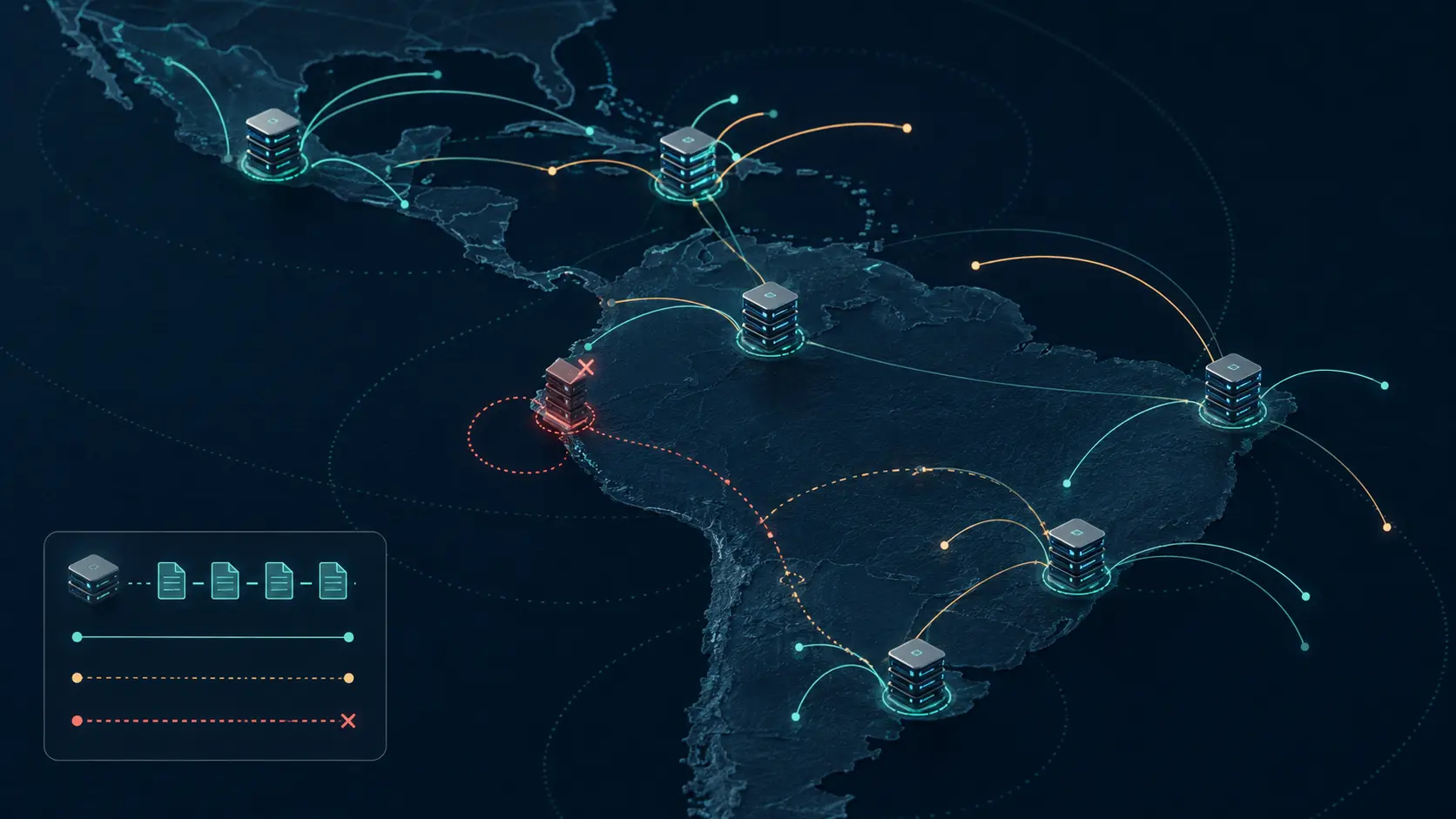
LACNIC’s reverse-DNS anycast turns registry continuity into a distributed control
Reverse DNS is easy to overlook until it stops answering. LACNIC’s use of anycast for delegated reverse zones shows why registry continuity is not a single-server property, but an operating discipline built from placement, routing, synchronization and observation.

Story
LACNIC’s measurement commons turns regional latency into operating evidence
A latency chart is not a verdict on a country’s Internet. It becomes useful when operators can see the probes, time window and comparison behind it—and when the result leads to a question that can be tested again.

Story
LACNIC’s RPKI controls make route origin authority operable
LACNIC’s RPKI controls make route origin authority operable intelligence summary explains the development, the public evidence available to readers, the organisations involved, the regional context, market exposure, and the infrastructure consequences that may follow. The Story…

Story
LACNIC’s IPv6 allocation rules make scale plannable
**BTW analysis:** IPv6 offers a vast address space, but abundance alone does not tell a network operator what it may request, how need will be assessed, or what obligations follow an allocation. In Latin America and the Caribbean, those practical questions meet LACNIC’s published…

Story
LACNIC’s 2025 Path Study Does Not Date Its Measurements
A year in a report title tells readers when an edition belongs on the shelf. It does not tell a network operator when the packets behind its charts crossed the wire. LACNIC’s regional path study offers a useful view of routes and latency, but leaves that second clock unstated.

Story
LACNIC 46's Machine Records Still Say LACNIC 39 and LACNIC 45
The closing entry in LACNIC 46's current agenda belongs to the right event when read through its canonical taxonomy and presentation title. Three other fields still name LACNIC 45. A separate homepage field goes further back, to LACNIC 39. This is a small data-integrity problem…

Story
LACNIC’s RDAP Conformance List Identifies Response Specifications, Not Network Authority
An RDAP response can look like a compact certificate of power: it carries a registry name, a range, a handle, a hierarchy link and a row of terse technical tokens. But the tokens in `rdapConformance` answer a narrower question. They describe the specifications used to build the…

Story
LACNIC’s IPv4 transfer market and the price of scarcity
IPv4 exhaustion does not end allocation politics. It changes the place where they happen: from the distribution of a free pool to the rules governing transfers of resources that are already held.