
Profile
Research
Research profile intelligence connects person, company, institution, and other entity coverage for readers comparing the subjects behind BTW.MEDIA reporting. The page helps compare public profiles, related events, evidence packs, role changes, operating footprints, governance exposure, organisational links, and market relevance while keeping organisation and people records distinct from ordinary news chronology. Readers can understand the subject behind the headline, the evidence supporting that profile, and the infrastructure or market relationships that make the profile relevant. They can see who or what the profile represents, which public sources support it, how it connects to companies, markets, governance bodies, or events, and what changes may deserve continued attention as the subject evolves.

History
The Relay Added a Header. The Message Lost Its Ending: RFC 3164
In the older BSD syslog format, a relay could make a bare event easier to read by adding a timestamp and hostname. RFC 3164 also gave the whole packet a hard 1,024-byte ceiling—so that helpful header could consume the space reserved for the message itself.

IETF
The Domain Said You May Ask. It Did Not Authorize You to Act.
`dialogue.txt` proposes a public door through which an unfamiliar machine may ask one question. Its most valuable design choice is also the easiest to lose in automation: finding the door is not entering the building, delivering a message is not opening a conversation, and a…

History
The Receiver Offered Multiplexing. The Sender Still Chose Whether to Use It: RFC 3153
In August 2001, RFC 3153 offered a way to make small PPP packets spend fewer bytes on envelopes. Several packets could travel as subframes inside one multiplexed frame. Yet the standard drew an unusually useful line: a receiver could negotiate the ability to understand that…

History
The Server Needed a Third Challenge: RFC 3163
The extra random value in RFC 3163 was not decorative. In its mutual-authentication mode, it addressed an asymmetry created by the order of the exchange: the client chose its own nonce only after it had already seen the server's first challenge. The fix was narrow, and so were…

History
The New Reverse Tree Existed Before the Old One Disappeared: RFC 3152
In August 2001, the Internet moved IPv6 reverse naming from `IP6.INT` toward `IP6.ARPA` without pretending that a sentence in an RFC could move every resolver at once. RFC 3152 chose the infrastructure root, requested its delegation and aligned the hierarchy with address…

IETF
The Mapping System Did Not Know the Destination. It Still Returned an Exit.
A new LISP proposal turns an unknown or unregistered destination into an actionable gateway choice. That can remove static configuration and speed failover. It can also make an authoritative-looking map conceal its most important fact: the system selected where to send the packet…

History
IPv6 Had to Wait for Authentication: RFC 3162
The access server had to authorize the session before it knew which Internet protocol the host would use. RFC 3162 let one RADIUS exchange carry both possibilities, then left the final applicability decision at the network edge.

History
The Old Name Became a URN. It Still Did Not Resolve Itself: RFC 3151
XML inherited public identifiers that could outlive a machine but could not enter every URI-only interface. RFC 3151 gave those strings a precise `urn:publicid:` transcription. The bridge preserved a name's visible structure and made normalized outputs comparable. It did not…

IETF
The DHCP Reply Said 1 Gbit/s. The Bottleneck Had Not Moved.
A proposed DHCP option can tell a router which service rate an operator wants it to use. That is a valuable coordination signal. It is not a measurement of the access path, a receipt from the shaper, or proof that the queue carrying the next packet sits where the policy assumes.

History
A Packet Could Hold Up Everyone Else: RFC 3150
On a very slow link, packet size also determines how long everyone sharing the interface must wait. RFC 3150 turned that interval into a design constraint rather than treating MTU as a matter of byte efficiency alone.

History
The Call Agent Controlled the Features. The Mute Button Stayed Local: RFC 3149
MGCP placed call-control intelligence outside the phone, yet RFC 3149 refused to send every touch across the network. A numbered feature key could acquire its meaning from a remote Call Agent, and an XML display could become a separately addressed endpoint. But volume, the…
History
One Path Could Yield Two Valid Capacity Numbers: RFC 3148
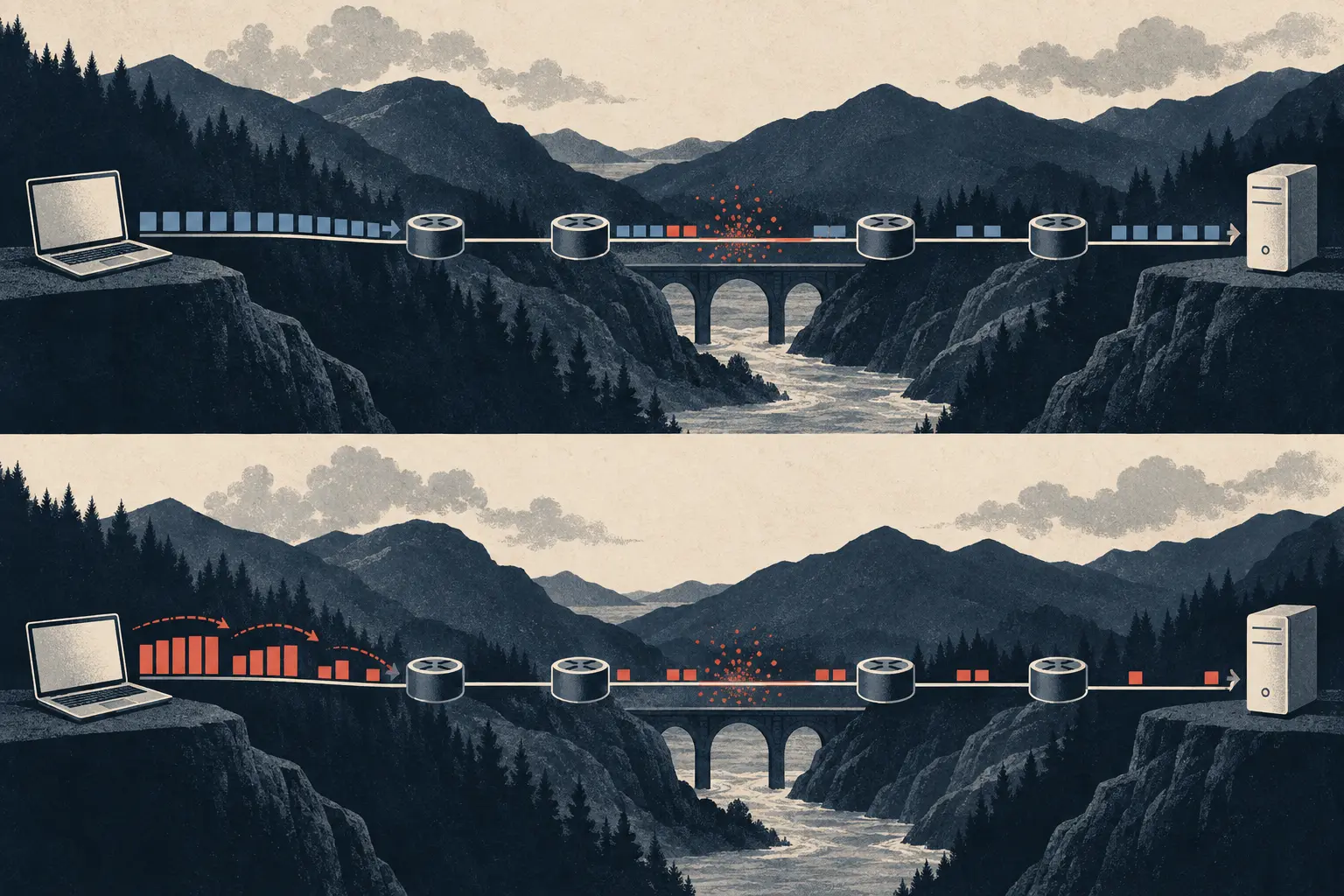
A single-flow bulk-transfer measurement looked like one number. RFC 3148 showed why transport choices could make that number method-dependent—and why the trace beside it mattered.

History
The New Management Network Had to Cross the Old One: RFC 3147
A network migration is usually drawn as an arrow from old to new. RFC 3147 captured the harder topology hidden beneath that arrow: a newly IP-managed device could stand on the far side of a CLNS network that operations could not yet remove. The proposed bridge—GRE carried inside…

IETF
The Link Was Listed as Sleeping. No One Had Proved It Could Wake.
An IS-IS database can retain a link that is unavailable for forwarding and describe the power that might be saved while it sleeps. That is useful control-plane memory. It is not evidence that two endpoints completed a physical transition, preserved a separate wake path, restored…

History
The Tunnel Closed. The Cause Code Still Could Not Decide Why: RFC 3145
In 2001, L2TP could announce that a tunneled call had ended while remaining nearly silent about the PPP failure inside it. RFC 3145 carried a more precise reason across that boundary. Its lasting lesson was not that a number could settle the incident, but that a useful diagnostic…

IETF
The Header Came Back in the Reply. It Was Not the Header on the Return Path.
A STAMP reply can carry two different kinds of evidence at once: a copy of the header received on the forward test packet, and a newly constructed header used on the reverse packet. Revision 15 makes their separation explicit. Operators who report both as “the header was…

History
The Subscriber Chose the Call Treatment. The Network Still Had to Execute It: RFC 3136
A caller reached a busy telephone line while its owner was online. A window appeared on the owner's computer: accept, reject, forward, or send to voice mail. The click felt like the decision. RFC 3136 showed why it was only the beginning of an execution chain that crossed the…

History
The Network Policy Said Gold. Only One Translator Could Write Each Device: RFC 3139
“Give these customers gold service” sounded like one configuration. Across a heterogeneous network it became topology inputs, capability tests, many vendor-specific commands, synchronized changes and feedback from every device. RFC 3139 made the translation visible—and warned…

Europe and Middle East Institutional Trends
Britain’s Information Commission Has a New Legal Form, but an Old Delegation Map
On 30 September, the United Kingdom’s data-protection regulator became a body corporate governed through a Commission board. Two days later, its live delegation page still explains authority through the former office of the Information Commissioner. That mismatch is a…

Latin America and Caribbean Datacenter
One Brand, Two CNPJs, One /22: What the Public Record Actually Says About AI Brazil's "AI Datacenter"
One Brand, Two CNPJs, One /22: What the Public Record Actually Says About AI Brazil's "AI Datacenter" intelligence summary explains the development, the public evidence available to readers, the organisations involved, the regional context, market exposure, and the infrastructure…