
Profile
Analysis
Analysis profile intelligence connects person, company, institution, and other entity coverage for readers comparing the subjects behind BTW.MEDIA reporting. The page helps compare public profiles, related events, evidence packs, role changes, operating footprints, governance exposure, organisational links, and market relevance while keeping organisation and people records distinct from ordinary news chronology. Readers can understand the subject behind the headline, the evidence supporting that profile, and the infrastructure or market relationships that make the profile relevant. They can see who or what the profile represents, which public sources support it, how it connects to companies, markets, governance bodies, or events, and what changes may deserve continued attention as the subject evolves.

History
The Save That Left the Page Intact: HTTP 204
HTTP 204 says an action finished without replacing its active view. Status marks completion, while headers carry post-action identity without response content.

History
The Connection That Was Not Authority: Why HTTP Needed 421
HTTP learned to save time by letting several named origins share one authenticated connection. Status 421 preserved the limit of that bargain: a channel can be reachable, secured and reusable in principle without being the connection context through which a particular origin is…

History
The Copy That Arrived as a Difference: HTTP 226
HTTP 226 lets a changed representation travel as instructions for a cached base. Base, delta message and reconstructed result retain separate identities.

History
The Alias That Did Not Need a Second Walk: HTTP 208
WebDAV could expose one collection through two paths. HTTP 208 keeps the second path visible while omitting descendants already reported through the first.

History
The Preference Allowed to Lose: How Happy Eyeballs Races Paths
A valid IPv6 answer can still lead nowhere. Happy Eyeballs lets IPv6 start first, then allows observed reachability to win before the user pays a long timeout.

History
The Connection Beyond Its Address: Why QUIC Uses Connection IDs
Addresses and UDP ports can change while work remains. A QUIC Connection ID preserves continuity, but path validation and fresh identifiers bound trust.

History
The Name Created by a Question: How DNS Wildcards Stay Bounded
A DNS wildcard can synthesize a name never stored in the zone. Exact nodes, empty non-terminals and delegation still decide when that default may answer.

History
The Name the Connection Could Not Carry: Why HTTP Needed Host
TCP reached an address and HTTP named a path, but a shared server still lacked the site name the user chose. HTTP/1.1 made that authority explicit in `Host`.
History
The Header That Disappeared Between Packets
RFC 1144 made a 40-byte TCP/IP header nearly vanish on slow serial links by letting adjacent endpoints remember shared state and send only changes.

History
The Line That Looked Like the End in SMTP
SMTP ended unknown-length mail with a one-period line. Dot stuffing made that sentinel reversible; CHUNKING later moved the boundary to exact octet counts.

History
Permission Was Not Acceptance: Why HTTP Added 100 Continue
HTTP 100 Continue let a server reject from headers before a large body crossed the network, while keeping interim permission separate from final acceptance.

History
The Silence That Wasn't a Failure: Why TCP Keepalive Stayed Optional
An established TCP connection can say nothing for hours and still be correct. Keepalive was the attempt to question that silence without pretending to understand it: send a probe likely to provoke an ACK, collect bounded evidence, and leave the application responsible for…

History
Who Opened TCP's Window Too Soon? The Cost of Immediate Permission
An early TCP receiver could publish every byte of newly freed capacity, and a sender could consume each offer at once. That openness looked exact and cooperative. Repeated quickly, it made the connection spend most of its effort on tiny packets. The historical repair assigned…
Global Institutional
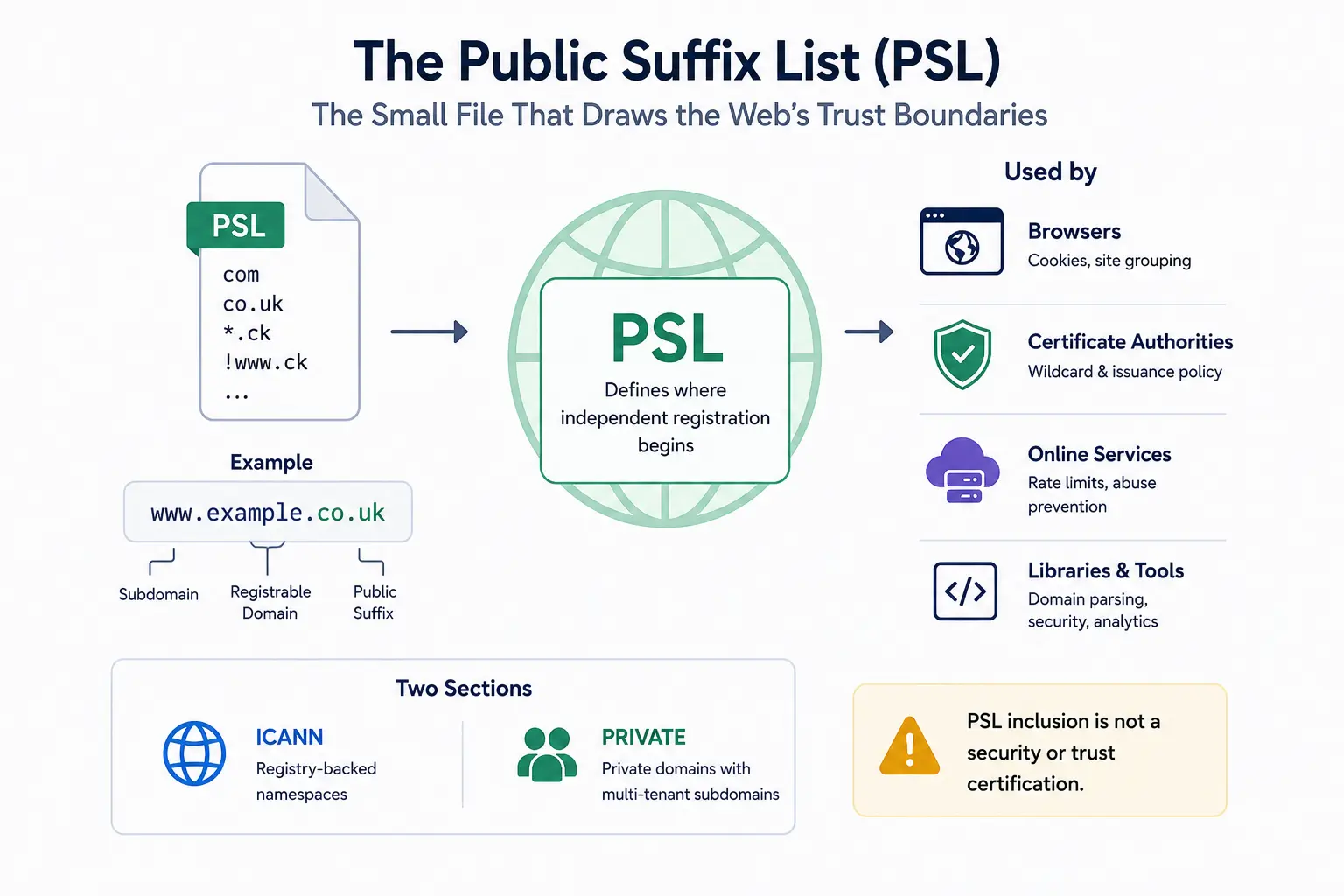
Public Suffix List: The File That Draws Web Trust Boundaries
DNS can show that shop.example.co.uk sits beneath co.uk; it cannot tell a browser where independent registration begins. The Public Suffix List supplies that missing policy map. A volunteer-maintained text file now informs cookies, site grouping, certificates and service limits…

History
The Window Update That Could Vanish: Why TCP Learned to Persist at Zero
A TCP receiver can say “send nothing” and remain healthy. The harder problem begins when it later says “continue” in an ACK that may disappear. TCP's persist mechanism turned that fragile permission into a recoverable conversation, while leaving the application—not a transport…

History
The Verdict UDP Withheld: Who Owned the Risk Behind Zero?
In UDP, zero was not a favourable checksum result. It was a notice that the sender had withheld the verdict. The history from IPv4 to IPv6 is therefore about more than arithmetic: it asks who may remove shared evidence, and when the party saving the work must also own the…

History
When Both Ends Called at Once: Why TCP Simultaneous Open Was Not a Collision
The familiar TCP handshake casts one endpoint as caller and the other as listener. TCP's original design was less hierarchical. If two processes called each other at once, their SYNs could cross, both stacks could change role without asking a coordinator, and one connection would…

History
The Price of Tolerance: How Receiver Leniency Turned Bugs into Protocol Law
The Internet's most famous rule for imperfect software began as a way to keep unlike implementations talking. Its receiver absorbed ambiguity so the network could start. Kept forever, the same bargain hid defects, made quirks contractual and charged every future implementation…

History
The Pointer That Was Never Out of Band: How TCP Urgent Split from Its Own Stream
TCP offered applications a way to interrupt ordinary processing without creating another connection. The wire carried one ordered stream and a pointer into it; decades of software turned that boundary into a mythical side channel, then made the myth too widespread simply to…

History
The Message the Internet Learned to Ignore: Why ICMP Source Quench Lost Its Authority
The early Internet allowed an overloaded gateway to send a separate command telling a distant source to slow down. Three decades of operational evidence reversed that bargain: congestion still required feedback, but a bare ICMP order no longer deserved the power to change a…