
Summary
- The Public Suffix List records administrative boundaries that DNS syntax cannot reveal, allowing software to separate a shared suffix such as
co.ukfrom the registrable domain immediately beneath it. - Exact rules, wildcards and exceptions make the list compact enough to maintain, while the ICANN and PRIVATE sections distinguish registry-backed boundaries from private multi-tenant platform policy.
- Maintainers review evidence and merge upstream data, but browsers, libraries, certificate authorities and online services decide when to update it and what policy to attach to each boundary.
- That split is the PSL’s central strength and weakness: a small volunteer project supplies shared boundary data, while the security, commercial and operational consequences are distributed across a much larger downstream system.
The cookie that could have crossed co.uk
A browser that allowed one registrant beneath co.uk to set a cookie for all of co.uk would collapse unrelated sites into one security boundary. Nothing in the number of dots tells the browser that co.uk is a place beneath which independent registrations occur. The Domain Name System records names and delegations; it does not encode the commercial and administrative rule that says where one registrant’s control ends and another’s can begin.
That gap is the reason the Public Suffix List exists. Registration policy varies across top-level domains, public-sector namespaces and private platforms. Some names are registered directly beneath a top-level domain. Others sit below second- or deeper-level labels such as co.uk or pvt.k12.ma.us. Private platforms can also give different customers subdomains beneath one privately registered domain even though those customers should not share browser state. A browser therefore needs policy data from outside DNS if it wants to decide whether two hostnames belong inside the same registrable boundary.
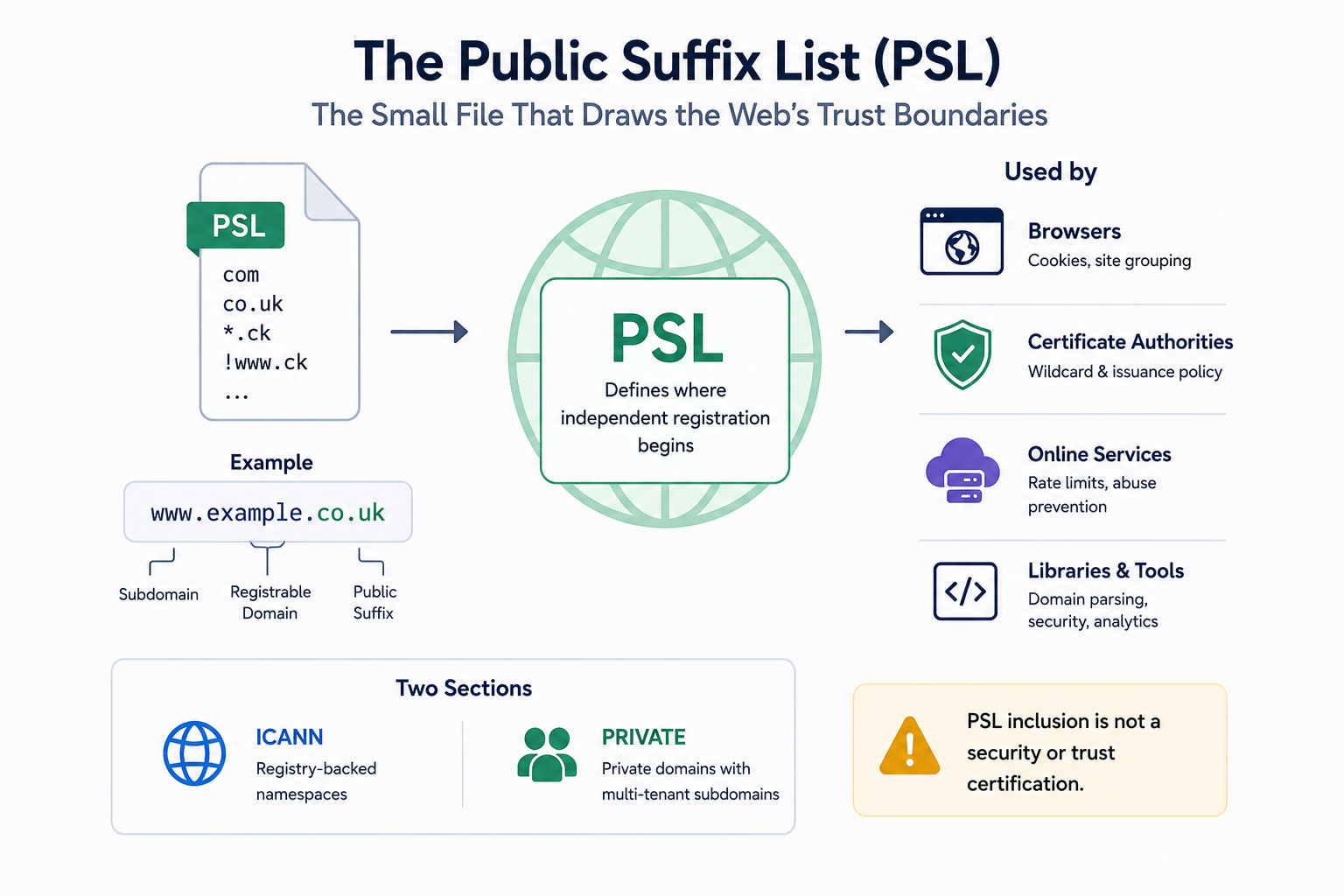
The PSL turns that policy into a form software can use. For www.example.co.uk, the list allows an implementation to identify co.uk as the public suffix and example.co.uk as the registrable domain immediately above it, often described as eTLD+1. That distinction helps user agents stop one registrant from setting a cookie at a shared registry level while still allowing related subdomains inside example.co.uk to share state where browser rules permit it.
The distinction is useful precisely because it is narrow. A registrable domain is not the same thing as a web origin, a legal entity, an account, a corporate group or a proof of common ownership. Modern browsers also use concepts such as schemeful site, host-only cookies, SameSite and partitioned storage that do not reduce to one eTLD+1 calculation. The PSL supplies one boundary. The consumer decides how that boundary fits into a larger security model.
That difference in responsibility runs through the entire project. The list does not execute cookie rules, issue certificates, throttle accounts or decide what a browser should display. It provides boundary data that other systems turn into decisions. Its influence is therefore larger than its formal authority.
DNS can resolve a name without telling software who shares it
DNS is authoritative about resolution and delegation within its own model. It can tell a resolver where to ask for example.co.uk, but it cannot reliably answer the separate question of whether co.uk itself is registrable by an ordinary user or whether registration begins one label lower. That information belongs to registry policy, public administration or the operating model of a private platform.
The PSL should therefore be treated as boundary data rather than as a second DNS authority. A line in the file can tell a consumer that a known administrative boundary is expected at a particular label. It cannot prove that the name currently resolves, that the registrant still exists, that a service is trustworthy or that two domains map to different legal owners. Project guidance explicitly warns against treating a static PSL copy as a definitive domain-validity database because TLDs and registration policies can change before a bundled snapshot is refreshed.
This matters because the file is convenient. A product that already has a PSL parser can be tempted to ask the list questions it was not designed to answer: whether a domain is valid, whether a platform deserves trust, whether two accounts share an owner or whether a customer should receive an exemption from a product limit. Each of those questions requires evidence beyond the public-suffix boundary.
The same restraint applies in the other direction. The PSL is not merely a browser implementation detail. It has become infrastructure because a browser or service can consult it before deciding who may share state. The file carries no user traffic, yet it can influence whether a cookie, wildcard certificate rule, rate limit or privacy control applies to one site or to many unrelated sites. Its physical size understates its operational reach.
The strongest way to understand the project is therefore to separate three layers. Registries and authorised domain owners supply the underlying policy. PSL maintainers decide whether the evidence and proposed rule belong in the canonical list. Downstream software owners decide what behaviour follows from the rule. No single layer owns the whole result.
Three rule forms carry a surprising amount of policy
The list stays manageable because it is not an exhaustive catalogue of hostnames. Its rule language is deliberately small: exact matches, leftmost wildcards and exceptions. A normal line such as co.uk describes an exact suffix. A wildcard such as *.ck can cover one varying label at the left of a shared suffix. An exception beginning with ! carves out a name that would otherwise be captured by a broader rule.
That compact language matters operationally. A registry may have a regular structure with a small number of unusual cases. Without wildcards and exceptions, the file would need many more lines and maintenance would become harder. With them, a few rules can represent a policy that is simple for a registry but irregular from the perspective of a generic browser.
The matching process is deterministic but only if an implementation follows the same conventions. Hostnames and rules are normalised for comparison, including lower-case and Punycode handling. Software looks for all matching rules. An exception takes precedence; otherwise the rule with the greatest number of labels wins. If nothing matches, the documented default rule is *. The public suffix is then derived from the prevailing rule, and the registrable domain is normally one label above it.
Each of those steps has edges that can create real differences. Unicode processing can diverge before the PSL algorithm sees the name. Some libraries handle trailing dots or malformed labels differently. Products may make different choices for unknown suffixes. A consumer may include both the ICANN and PRIVATE sections, only one section, or a transformed subset. A correct upstream file can therefore produce inconsistent behaviour when different libraries make different assumptions around it.
That is why parser conformance matters as much as the data itself. The list gives implementations a common source, but common source text does not guarantee common interpretation. A browser, certificate service and server-side library can all claim to use the PSL while returning different results for an edge case if their canonicalisation, fallback or section policy differs.
The project mitigates that risk through documented format rules, examples and automated tests. Those controls make syntax and selected semantics reproducible. They cannot model every downstream product consequence. The list’s simplicity reduces the number of ways the policy can be expressed; it does not eliminate the number of ways consumers can misuse or misread it.
ICANN and PRIVATE describe similar boundaries with different authority
The file’s two main sections solve related but institutionally different problems. The ICANN section records registry-backed boundaries associated with delegated namespaces and their registration structures. Changes are expected to come from a registry, ICANN or IANA, or to be supported by official documentation and other evidence that establishes the policy. The label is a practical project convention, not a statement that ICANN itself governs the PSL repository.
The PRIVATE section exists because formal DNS registries are not the only organisations that create registry-like boundaries. A hosting or cloud platform may own one domain and allocate subdomains beneath it to customers who do not trust each other. If browsers treat the whole parent domain as one site, those customers can be grouped too broadly for cookies and related policies. An authorised domain owner can therefore ask the PSL to record a private boundary beneath which independent tenants operate.
The browser consequence can look similar in both sections: software may treat the label as a public suffix and the next label as the registrable domain. The source of authority is not similar. One side reflects registry or root-zone-adjacent policy; the other reflects a private domain holder’s decision about how it delegates service to customers.
That is why PRIVATE inclusion must not be turned into a trust badge. The project’s own guidance is explicit that inclusion carries no general security assurance. It does not certify the platform, audit tenant isolation, establish financial legitimacy or confirm that every customer is independent. It records a boundary the authorised domain holder says software should know about.
The distinction also gives downstream consumers a legitimate choice. A browser concerned with cookie isolation may need PRIVATE entries because mutually untrusting tenants matter regardless of who owns the parent domain. A certificate authority or online service may choose a different policy depending on its threat model and rules. Using the same file does not require every consumer to attach the same meaning to both sections.
Authority checks help protect that distinction. Submission guidance can rely on registry documentation, organisational contacts and, in some cases, a _psl DNS TXT record as evidence that the party controlling the namespace supports a proposed boundary. Such evidence reduces the risk that an unauthorised third party changes policy for a domain it does not control. It still does not make the policy permanent. Corporate ownership, registry rules and service models can change, which is why stale entries eventually become a maintenance problem of their own.
A browser-local fix became cross-vendor infrastructure
The PSL’s history explains why its governance looks lighter than its present influence. The problem began in browser security, not as a plan to create a global institution. Earlier cookie logic could use crude assumptions about top-level labels, but those assumptions break for structures such as co.uk, where independent registrations occur one level deeper. Mozilla developed effective-TLD data during the 2000s to give browser code a maintainable answer to a question syntax alone could not solve.
Publicsuffix.org and the project’s public identity emerged from that lineage. Copyright and project identity date from 2007, while Mozilla bugs and browser updates through the late 2000s repeatedly refreshed effective-TLD data. Those updates showed that the dataset was living policy rather than a standard that could be written once and forgotten.
During the 2010s, the data and the concept spread beyond one browser source tree. Chromium, Opera, Qt and other software adopted PSL data or equivalent mechanisms. The project established a canonical public distribution endpoint around 2013-2014 and published update-frequency guidance so consumers did not need to hot-link to a browser repository. The PRIVATE section also became more important as hosting and application platforms created tenant boundaries below privately owned domains.
The maintenance model matured as reuse widened. Submission guidance in 2018 placed greater emphasis on testing, authority and follow-up. Security guidance in 2021 clarified the relationship between the list, ICANN, IANA and TLD administrators. Format and algorithm documentation was consolidated in the GitHub wiki in 2022. By 2023, project notices were explicitly warning third-party vendors not to treat the volunteer project as a customer-support desk for problems those vendors had created in their own products.
That pressure continued. In July 2024, maintainers began very low-volume manual outreach to confirm whether selected entries were still needed, a cautious attempt to deal with stale data without deleting a boundary that could still matter. Guidance updated in October that year stressed third-party diffusion and the danger of treating PRIVATE entries as trust signals. In April 2025, format documentation further clarified canonicalisation, prevailing rules and section semantics. A May 2025 repository notice told Cloudflare users not to seek PSL additions simply to bypass a product’s subdomain limits.
The most revealing process change arrived on 6 May 2026. The project made its automated pull-request template mandatory for additions and instructed submitters not to paste the form into a GPT system, alter it or summarise it. The reason is not hostility to software assistance in general. The required checkboxes are attestations in a public change record. Maintainers want the authorised party to make those representations directly and in a consistent form rather than receiving a rewritten version whose provenance is harder to judge.
At the research cutoff, the canonical file observed on 6 August 2026 carried version 2026-07-25_14-20-03_UTC and commit e1b8015c3b2f0f4f8c18659c2480fc1a22c07b20. The repository, distribution endpoint and submission workflow remained active. The chronology matters because it shows a project repeatedly strengthening process around a dataset whose downstream consequences grew faster than its original organisational design.
The Public Suffix List is a project, not a conventional company
Calling the PSL a company would imply an organisational structure the evidence does not support. It has maintainers, contributors, repository permissions, Mozilla-associated infrastructure, public guidelines and a community process. It does not have a disclosed standalone board, executive team, shareholder structure, customer contract or conventional corporate operating account.
Authority is instead distributed through specific functions. Registries define registration policy for their namespaces. Private domain owners define how they delegate subdomains to independent customers. Submitters provide evidence and attestations. Repository maintainers can request changes, reject proposals or merge accepted rules. Automated tests validate syntax and selected behaviour. Browser, library and certificate teams then decide how the resulting data enters their products.
Mozilla is important historically and operationally, but its role should not be exaggerated. Mozilla browser work helped create the effective-TLD approach, and Mozilla-associated infrastructure supports the project’s identity and history. That does not make every PSL consumer decision a Mozilla decision or turn the repository into a Mozilla-only product. Chromium, WebKit-based systems, certificate authorities, language libraries and online services can all consume the data on their own terms.
The same caution applies to contribution. A visible company logo in repository history does not confer project ownership. A maintainer’s employer may supply engineering time and shape what expertise is available, but formal authority is exercised through project roles and public process. Conversely, public roles do not reveal every informal influence or the amount of paid time behind each contribution.
The project therefore has a governance structure without having a corporate one. That structure is lightweight because the subject is a data file and maintenance workflow. Its consequences are not lightweight because other organisations have made the data part of their own security and commercial logic.
The absence of a formal executive hierarchy can be a strength. No single product vendor owns the canonical boundary map. Changes are reviewable in public, rule syntax is constrained and history is inspectable. It is also a limitation. There is no obvious executive budget to expand staffing when review pressure rises, no enterprise support desk to absorb vendor referrals and no central operator that can force a stale downstream copy to update.
Volunteer capacity is part of the security model
The PSL is often described as a small volunteer project, but volunteer status is not just an organisational footnote. It affects what the project can safely promise. Maintainers review evidence, validate authority, check syntax, consider cookie and certificate consequences and remain available for corrections. They do this without publishing a commercial service-level agreement or guaranteed inclusion time.
That is a rational boundary. A fast but weak review process could let an unauthorised or poorly understood rule alter behaviour for many products. A thorough process can frustrate a legitimate domain owner waiting for an entry. The project cannot remove that trade-off by pretending reviewer capacity is unlimited.
The submission template is one response. It forces applicants to provide a consistent record of authority, intended use and acknowledged consequences before maintainers spend time on the details. Automated linting and tests remove some mechanical work. DNS-based evidence can help prove control. None of those measures can fully automate the judgement about whether the requested rule matches the real registration or tenancy policy and whether the submitter is accountable for the change.
The project has also had to defend its attention from uses it did not choose. When a cloud, SaaS or analytics vendor tells a customer to seek a PSL entry merely to bypass an account limit, the vendor shifts a product-support problem into a shared volunteer queue. The maintainer now has to evaluate a globally visible boundary change even though the commercial rule that created the problem sits elsewhere.
That asymmetry matters because a PSL entry is not a harmless configuration flag. It can affect cookies, certificate treatment and site grouping in products far beyond the vendor that sent the customer to the repository. A company solving one local support case can externalise risk to users and maintainers who never participated in its product decision.
Project guidance that rejects those referrals therefore serves two purposes. It protects scarce reviewer time, and it protects the semantic meaning of the list. If PRIVATE entries became a generic route around rate limits, product quotas or tracking systems, the dataset would drift away from administrative-boundary evidence and towards a patchwork of unrelated commercial requests.
The economics are those of a shared dependency, not a product
The PSL publishes no standalone revenue, profit, valuation or audited project account. There is no evidence base for assigning one. That does not mean the project has no economics. Its cost is distributed among volunteer labour, Mozilla-associated infrastructure, registry and domain-owner effort, downstream parser maintenance, test systems and product-release work.
The benefit is distributed in the same way. A browser vendor avoids maintaining an entirely private boundary database. A certificate authority gains a shared input for registry-controlled-domain logic. A language library can package a known algorithm rather than inventing another heuristic. A SaaS platform can group names using data that many other systems already understand. Much of the economic value appears as duplication avoided across organisations rather than revenue collected by the PSL itself.
That public-good structure creates a familiar sustainability problem. Organisations can depend heavily on the list without contributing reviewer time, test infrastructure or support capacity in proportion to the benefit they receive. The marginal cost of copying the file is almost zero; the cost of keeping policy accurate is concentrated among a much smaller group of people.
Several risks follow. Volunteer burnout can lengthen review. Limited staffing can constrain proactive stale-entry work. Emergency rollback can demand rapid attention across time zones. Cross-vendor compatibility testing has no obvious central budget. Large downstream users can maintain private transformations that reduce visibility into how the canonical file behaves in practice.
None of this proves the project is unsustainable. It identifies what would make sustainability observable. A healthy shared dependency needs active maintainers, working CI, reproducible releases, responsive correction mechanisms and downstream organisations willing to own their part of the system. Professional funding could help some of those functions, but funding alone would not solve the question of influence or make downstream implementations uniform.
The more immediate reform opportunity sits with consumers. They can contribute tests, expose the PSL version they ship, update boundary data independently of a full product release where appropriate, support their own customers and avoid designing commercial policy that makes a volunteer merge the only escape route.
Geography matters through policy and release paths, not offices
The PSL has no meaningful physical footprint in the way a network operator or data-centre company does. Its geography is the global namespace it describes, the jurisdictions in which registries set policy, the locations of private platforms that request entries, the places where maintainers and contributors work and the software-release channels that carry derivative copies to users.
A country-code section can contain policy shaped by national registries and public institutions. Generic namespaces can reflect different registration structures. Educational or municipal hierarchies can be deeper than the familiar commercial examples. Private platform entries can represent globally distributed services whose tenants have no relationship to the jurisdiction of the parent domain’s registrant.
That diversity is precisely why one syntactic heuristic fails. The list translates heterogeneous administrative arrangements into one narrow rule language. The common syntax improves interoperability while preserving the fact that policy originates elsewhere.
It would therefore be wrong to treat a line’s presence in the file as project control over that namespace. The registry remains responsible for its registration rules. The private domain owner remains responsible for its tenancy model. Applicable law remains outside the PSL. The list records the boundary for consumers; it does not acquire regulatory authority over the names it describes.
The same is true downstream. A security fix or corrected entry can be public globally while users in different products still run different snapshots. Geography and organisational boundaries intersect in the release path: canonical merge, derivative transformation, package or browser release, operating-system distribution and eventual client update.
The canonical file is only the first copy in a long supply chain
The project publishes a canonical copy at publicsuffix.org/list/public_suffix_list.dat, generated from the GitHub repository on a daily basis. Guidance recommends that consumers fetch no more than once per day, while the upstream list itself may change a few times in a typical week. That gives software teams a stable distribution point without encouraging wasteful polling.
A daily canonical copy does not mean the web moves to one version every day. Browsers can preprocess the text into tries or compact binary forms. Libraries can package a snapshot into language releases. Operating systems can bundle another copy. Cloud services can maintain internal transformations. Some products may update boundary data independently; others may wait for a wider release train.
The result is a family of valid but differently aged PSL-derived datasets in production at the same time. After an upstream addition, one browser may recognise the new boundary before another. A server-side library may lag both. A certificate service may use only the ICANN section while a browser includes PRIVATE entries. Each system can be internally consistent and still disagree with another product.
That becomes especially important during correction. If a harmful or mistaken rule is reverted upstream, the rollback must travel through the same supply chain as the original change. A corrected canonical file does not recall an old browser binary or force a cloud service to rebuild its data. For some period, the bad rule and its correction can coexist across the installed base.
Version awareness is therefore part of incident analysis. A report that says only that a product “uses the Public Suffix List” is incomplete. Investigators need the exact canonical commit or derivative build, section policy, parser behaviour and update date in each affected component. Without that information, teams can argue about one hostname while actually comparing different datasets.
The observed canonical version and commit at the August 2026 cutoff illustrate the value of reproducible identifiers. They do not imply that every downstream product had already ingested that exact state. Upstream freshness and deployed freshness are separate facts.
Cookies were the beginning, not the end of the dependency
Cookie inheritance is the clearest origin story because the failure is easy to see: a browser should not let one registrant attach state to unrelated registrants under a shared public suffix. As the web platform evolved, the same registrable-domain concept became useful in other places.
Browser engines can use the boundary in site grouping, history, URL presentation, document.domain restrictions and privacy mechanisms. Certificate systems can use registry-controlled-domain concepts to prevent overly broad wildcard issuance or to group names for issuance policy. Crawlers and security tools can use registrable domains when grouping hosts. Online services can use the boundary in rate limits or account policy. Anti-tracking systems can rely on it as one input when deciding which names belong together.
Those uses share a need to distinguish one administrative domain from another, but they do not share an identical threat model. A browser protecting cookies is concerned with cross-site state. A certificate authority is concerned with issuance boundaries. A SaaS vendor enforcing a quota is making a commercial policy choice. A privacy system may be trying to prevent tracking relationships that are not equivalent to registration ownership.
That difference is the reason a single PSL line should not carry one universal meaning. The list can be a common input while every consumer remains responsible for the policy it attaches. A vendor that says “the PSL made us do it” is obscuring the actual chain of control. The PSL supplied a boundary; the vendor’s code decided what happened next.
Certificate policy is a useful example. A certificate authority should not issue a wildcard immediately below a registry-controlled suffix such as *.com. PSL-derived ICANN data can help define that boundary. PRIVATE entries may or may not be relevant depending on the policy being implemented. The correct choice belongs in the CA’s documented rules rather than in an assumption that all PSL consumers behave alike.
Rate limits show the same problem from the opposite direction. A service can group names by registered domain so one registrant cannot evade a quota by generating endless subdomains. That can be sensible. It does not make the PSL responsible for the quota, and it does not justify changing the global boundary file simply because one customer dislikes the vendor’s commercial limit.
A pull request is a policy change, not a clerical edit
The repository workflow looks familiar to software engineers: open a pull request, fill a template, run automated checks, receive review and merge the change. The consequence is less ordinary. A one-line edit can change how browsers, certificate systems and services group names once the new data propagates.
The submission process therefore asks more than whether the syntax is valid. Maintainers need to know who is requesting the change, whether that person or organisation is authorised, what registration or tenancy policy the rule represents and whether the submitter understands the downstream effects. Tests can catch ordering, duplication and expected-match problems; they cannot certify organisational authority by themselves.
The 2026 template rule makes that accountability explicit. The form must be used without being rewritten or summarised by a GPT system. The public checkboxes are attestations. Requiring the authorised submitter to make them directly preserves a cleaner record of who represented what when a high-consequence rule entered review.
That is also why a completed template cannot create a service-level guarantee. Evidence may be incomplete. A maintainer may ask for official registry documentation. A private platform may need to prove domain control. The proposal may reveal cookie or certificate consequences the submitter had not considered. A legitimate review can therefore take time even when the underlying request seems small.
The project’s limited capacity makes the quality of submissions part of system reliability. A low-context or vendor-deflected request consumes attention that could be used for policy maintenance, testing or urgent corrections. The template is not bureaucracy around a trivial file; it is part of the mechanism that lets a volunteer process change data copied into high-consequence software.
Stale entries are harder to remove than they look
Adding a rule is not the only maintenance problem. Registration and platform policies change. A private service can shut down, stop offering subdomains or move customers to another structure. A registry can alter its registration model. The canonical list then risks preserving a boundary whose original reason has disappeared.
Deletion is not automatically safer than staleness. A downstream consumer may still have users, cookies, certificates or policy assumptions built around the old boundary. Removing a line can merge sites that were previously separate from the perspective of software. A maintainer therefore needs evidence that the policy has changed and a reasonable view of what removal will do after propagation.
The low-volume outreach begun in July 2024 reflects that caution. Rather than treating stale data as a bulk-cleanup problem, maintainers contacted selected registrants to confirm whether entries remained necessary. The scale was deliberately limited because each answer can require context and because silence is ambiguous: an unresponsive contact is not proof that a production boundary is safe to delete.
This is another place where downstream transparency would help. If major browsers and services exposed which PSL version they were using and provided better telemetry around changes, maintainers and domain owners would have more evidence when considering removal or rollback. Today, the project can inspect public source and release history for some consumers but has no complete inventory of where each rule is deployed.
The absence of that inventory is not a failure of the PSL alone. It is a consequence of open reuse. MPL 2.0 permits broad use under its terms, and consumers can transform the data in many ways. Open distribution lowers integration cost while making complete downstream visibility unrealistic.
Alternatives either lose accuracy, freshness or shared governance
The PSL persists because there is no universal protocol that yields the same answer cheaply and consistently for every hostname. A simple “last two labels” heuristic fails immediately on structures such as co.uk and on deeper public-sector namespaces. A browser could maintain its own private list, but then cross-vendor behaviour would diverge and every vendor would have to duplicate policy work.
The IANA Root Zone Database solves a different problem. It is authoritative for top-level delegations, not for every deeper boundary under which registrants can obtain names. Registry websites and RDAP can provide more authoritative local information, but policies differ and querying them live for every browser decision would be slow, fragmented and potentially privacy-sensitive.
Commercial domain-intelligence services can add richer classification, ownership and reputation data. They can be useful where those attributes matter, but they introduce cost, opacity and vendor dependence and still do not turn one private database into a web-wide standard. First-Party Sets and related site mechanisms express declared relationships among already identified sites; they do not replace the initial task of determining the registrable boundary.
The PSL therefore makes a deliberate trade. It gives up perfect real-time freshness in exchange for a small, cacheable, inspectable and cross-vendor snapshot of known administrative policy. That trade works only when consumers remember what was sacrificed. The list is not a live registry query and should not be treated as one.
Its competitive advantage, if that term can be used for a community dataset, is institutional as much as technical. The syntax is simple, the file is public, changes are reviewable and several independent product ecosystems already understand it. Replacing the format would be easier than replacing the accumulated policy history, tooling and operational knowledge around it.
That installed knowledge creates path dependence. Consumers have parsers, tests, update jobs and incident procedures built around the PSL. Domain owners know where to propose a boundary. Certificate and browser teams have product logic based on eTLD+1. A new system would need not only a better technical model but also a credible migration path for all of those participants.
Vendor support pressure is the clearest governance asymmetry
The PSL’s most important institutional tension is not between two competing maintainers. It is between a small upstream project and large downstream products that can attach commercial consequences to its data. A vendor can decide that a rate limit, account boundary or tracking control depends on PSL classification, then tell a customer that the solution is to obtain a PSL entry.
That instruction sounds operationally simple because the vendor is not the one reviewing the request. For the project, the proposed line must still satisfy the same authority and policy criteria as any other addition. If it does not represent a genuine registration or mutually untrusting tenancy boundary, accepting it can distort browser and certificate behaviour merely to fix one company’s product model.
Repository warnings against such referrals are therefore a form of governance defence. They keep responsibility with the organisation that designed the customer-facing rule. A cloud or SaaS provider can change its own quota model, build an override, improve account identification or support the customer directly. It should not require an external volunteer project to alter shared web boundary data unless the underlying domain policy itself justifies the change.
There is a second-order effect here. Once vendors learn that PSL inclusion influences valuable features, they can create incentives for customers to seek entries for reasons unrelated to the original security boundary. Enough such pressure could change the composition of the PRIVATE section and make the list harder to interpret as evidence of genuine multi-tenant separation.
The maintainers’ insistence on authority, evidence and use-case boundaries helps resist that drift. Downstream organisations can reinforce it by publishing exactly how they use PSL data, offering product-specific appeals and supporting customers without making a repository merge the default remedy.
What inclusion proves — and what it does not
A PSL entry is evidence of one narrow thing: the canonical list currently records a public-suffix boundary at that label under the rules and process of the project. The evidence behind an ICANN-section entry and a PRIVATE-section entry differs, but neither grants a general certificate of legitimacy.
Inclusion does not prove that a domain is secure. It does not prove that a private platform isolates tenants correctly. It does not prove legal ownership, beneficial ownership, business solvency, customer quality or absence of abuse. It does not mean the project endorses a company or its service. It does not make a name exist in DNS forever.
It also does not create rights against third-party products. A customer cannot point to a PSL entry and infer entitlement to a particular rate limit, certificate product or browser treatment beyond what that product’s own rules specify. Conversely, a product cannot treat lack of PRIVATE inclusion as proof that a platform is untrustworthy.
These limits are easy to lose because the list sits near security controls. A dataset used in certificate issuance and browser isolation can look like a security authority even when the project repeatedly says otherwise. Good downstream design should preserve the distinction by naming the exact decision the PSL informs rather than describing inclusion as approval.
The same care is required in research. Mozilla association should not be turned into a claim that Mozilla controls every entry or downstream use. Repository maintainers should not be presented as regulators of the DNS. Domain owners who submit PRIVATE entries should not be described as receiving certification. The public record supports a more interesting conclusion: control is intentionally distributed, and that distribution is both the basis of interoperability and the source of accountability gaps.
The ecosystem is a chain of adjacent authorities, not one organisation
The organisations around the PSL are easy to collapse into one mental picture because they all touch domain policy. In practice, they occupy different layers. IANA and ICANN provide authoritative root-zone and registry context. TLD registries define registration policy within their delegated namespaces. Private domain owners decide whether they operate multi-tenant subdomain services. PSL maintainers decide whether the evidence supports a rule in the canonical file. Browser and library teams decide how to parse and ship that file. Certificate authorities and online services decide what policy they attach to the resulting boundary.
That separation is more than organisational tidiness. It determines who can correct which failure. If a registry changes its registration model, the registry is the source of the underlying fact, but it cannot update a browser directly. If a browser mishandles Unicode before applying PSL rules, a correct upstream line will not repair the parser. If a certificate authority uses the PRIVATE section differently from a browser, the discrepancy may be intentional rather than a bug. Incident attribution has to preserve those layers.
Mozilla sits in this chain as the historical home of effective-TLD work and as part of the project’s infrastructure context. GitHub hosts the public repository, review discussion, tests and history. Neither relationship makes those platforms owners of every domain policy represented in the list. Likewise, an entry submitted by a TLD registry does not give that registry authority over the project as a whole. It supplies evidence for the namespace it operates.
The downstream consumer set is broad. Firefox and Gecko have the historical relationship most closely associated with the project’s origin. Chromium and Chrome preprocess and use public-suffix data for site and cookie decisions. WebKit-based products use public-suffix concepts in web-platform behaviour. Certificate authorities and CA/Browser Forum rules use registry-controlled-domain concepts around wildcard issuance and related policy. Let’s Encrypt is one visible example of a CA that uses registered-domain concepts in operational limits and issuance systems.
Language libraries, crawlers, operating systems and server applications package their own parsers or snapshots. Cloud, social and advertising platforms can attach account, rate-limit or privacy behaviour to the same boundary.
None of those integrations transfers governance authority back to the consumer. A browser vendor does not acquire the right to redefine registry policy because it ships the list. A certificate authority does not become a PSL maintainer because it relies on a registered-domain calculation. A cloud platform does not gain a security endorsement because its PRIVATE entry is present. Integration proves dependency, not ownership.
This is why the PSL resembles a data supply chain more than a software product with one release train. Policy originates with registries or authorised domain owners. A submission packages that evidence into the project’s change process. Review and tests produce a canonical merge. Publicsuffix.org distributes the result. Consumers transform and release it. End-user behaviour emerges only after the final product applies its own rules. Each hand-off can introduce delay or interpretation.
The chain also explains why a public repository cannot provide a complete deployment map. Open-source consumers are visible when their code and data transformations are public. Proprietary services can use the list internally without disclosing every parser choice or refresh schedule. A broad adoption claim can therefore be well supported at the category level while still lacking an audited census of installed copies or versions.
The project exposes evidence well upstream and much less downstream
The strongest evidence around the Public Suffix List concerns its own identity, rule format and change process. The canonical file is directly downloadable. The matching algorithm and examples are public. Git history records changes. The submission template documents current attestations. Repository discussion shows how maintainers ask for authority and clarify consequences. These are unusually inspectable foundations for a piece of infrastructure that most users never see.
Evidence becomes weaker as the analysis moves away from upstream mechanics. There is no complete inventory of every browser, library, cloud service, crawler or certificate system using the file, nor one common schedule showing how quickly each consumer updates. Public products can be examined individually, but the project does not operate telemetry across the installed base. A canonical commit therefore proves the state of upstream data, not the state of every device.
Governance evidence has a similar boundary. Public repository roles and review activity show who can act in the project at a given time, but the evidence does not establish a conventional legal organisation chart, paid headcount or complete measure of employer influence. It would be unsafe to infer that every visible contributor is a volunteer in the same sense, or that an employer appearing frequently in commits controls the project. Formal project permissions, employment and informal influence are different facts.
Financial evidence is thinner still. The PSL is not a conventional operating company with disclosed revenue, profit or valuation. Mozilla-associated infrastructure and downstream engineering clearly have costs, but the source base does not allocate those costs into a project income statement. Commercial value created by browsers, certificate authorities or cloud services cannot be attributed to the PSL as revenue. Any attempt to invent a market value for the list would confuse dependence with ownership.
The same discipline applies to controversy. The project has documented support pressure, stale-data risk, third-party diffusion and misuse of PRIVATE entries as trust signals. Those are structural problems, not evidence of misconduct by maintainers. The right analysis asks whether incentives and resources fit the consequences of the dependency; it should not manufacture a scandal from the fact that volunteers have limited capacity.
A stronger evidence base would require information the public record does not fully provide: a current interview with principal maintainers, an independent census of major downstream deployments, measured propagation times after selected changes, and more systematic data on review backlog and staffing. Those gaps do not prevent a defensible profile. They set the boundary around what can be claimed with confidence.
The article can therefore be firm about mechanism and cautious about scale. It is well supported that the PSL supplies a shared domain-boundary dataset, that major software categories rely on it, that maintainers use a public review process and that downstream consumers control their own update and policy choices. It is not well supported to claim a universal market share, a single global version, a precise economic valuation or one organisation with command over the whole system.
Error handling is part of interoperability, not an afterthought
Most explanations of the PSL focus on the successful path: canonicalise a hostname, find a prevailing rule and return the registrable domain. Production systems spend significant time in less tidy cases. A hostname may be malformed. A consumer may encounter an unknown suffix. A library may run a snapshot that predates a registry change. A PRIVATE entry may have been removed upstream but remain inside an older application.
Those conditions turn fallback behaviour into policy. The documented default rule gives the algorithm a deterministic answer when no explicit line matches, yet some consumers may deliberately reject unknown suffixes for their own use case. A parser can preserve a trailing dot while another component strips it earlier. Unicode conversion can fail before the PSL lookup begins. None of these differences means the canonical file itself is wrong, but each can change the boundary a product sees.
For operators, the practical requirement is to test negative cases as deliberately as successful ones. A library should know what it returns for an unknown TLD, an exception beneath a wildcard, a Unicode label and an outdated PRIVATE entry. A browser or service should be able to distinguish a bad rule from a stale data file and a stale file from a parser bug. Otherwise every incident is flattened into the phrase “PSL problem” even when the cause sits elsewhere.
The project helps by keeping the rule language narrow and the test surface visible. Consumers still need their own recovery path. If a new entry breaks account grouping, a SaaS vendor should be able to change its own policy while the upstream issue is investigated. If a browser discovers a parser regression, it should not ask a registry to change correct policy data to fit the bug. Interoperability depends on preserving the boundary between shared facts and local implementation.
The file is small because the responsibility sits elsewhere
The PSL’s design is successful partly because it refuses to become a complete model of the web. It does not store every registrant, crawl every DNS zone, classify every organisation or decide every policy that uses domain boundaries. It records enough administrative structure for software to calculate a shared boundary, then stops.
That restraint keeps the data reviewable. Exact rules, wildcards and exceptions are understandable. Evidence can be attached to a proposed change. Consumers can implement the algorithm locally and inspect version history. A more ambitious database could offer richer answers but would also require more data, more funding, more authority and a different governance model.
The cost of restraint is that downstream teams must do real work. They need to update the data, define section policy, test parser edge cases, handle rollback and decide whether eTLD+1 is actually the right concept for the problem they are solving. A consumer that treats the file as a magic source of site identity is outsourcing judgement the PSL never claimed to provide.
That is the durable lesson from the project. The Public Suffix List is useful because it records a boundary DNS does not encode and does so in a form many products can share. Its influence has outgrown its formal resources, but the answer is not to pretend the maintainers control the web. Accountability has to follow the whole chain: registry or domain owner, submitter, volunteer review, canonical distribution, derivative update and product policy.
A small upstream file can remain a healthy common dependency only if the much larger organisations around it continue to own the consequences they attach to it.
The next test is whether consumers can make version and responsibility visible
The most useful operational indicators are no longer simply whether the canonical repository is active. The harder question is whether the organisations that depend on the PSL can show which version they use, how quickly they ingest corrections and what policy they attach to each section.
For browser and library teams, the first test is reproducibility. A production build should be traceable to an exact PSL commit or generated dataset, and conformance tests should cover canonicalisation, Unicode, trailing dots, wildcards, exceptions, unknown suffixes and ICANN/PRIVATE handling. A bug report should not have to begin by guessing which list the affected product used.
For registries, the key indicator is ownership of policy maintenance. Registration rules can change before browser failures make the mismatch visible. A registry that relies on the PSL should have a known person or team responsible for reviewing its entries, updating evidence and responding when maintainers ask whether a rule remains current.
Private platforms face a stricter test because their entries can affect mutually untrusting customers. A new PRIVATE submission should be treated as a security migration rather than a branding exercise: test cookie boundaries, certificate implications, rollback behaviour and the effect on existing tenants before assuming that a successful merge is harmless.
Downstream patch latency is the most important system-level metric. The canonical file is refreshed daily, but there is no universal timetable for browser, library, operating-system or service adoption. A correction that takes hours upstream and months in a derivative product is still an operationally stale dependency. Public version metadata, independent update mechanisms and release notes would make that gap easier to measure.
Maintainer capacity is another observable signal. Open pull-request backlog, response time, availability of reviewers, continuity of CI and the rate of stale-entry work all show whether consequence is growing faster than maintenance. None should be turned into an artificial service-level target for volunteers, but sustained deterioration would be evidence that the current resource model is under pressure.
The final indicator is vendor behaviour. Repository notices have already documented cases in which third-party product rules drove customers towards the PSL. If more vendors make boundary-list changes the normal remedy for account, quota or analytics problems, the governance burden will move further upstream. A healthier pattern would be the opposite: vendors publish their PSL dependency, support product-specific exceptions where appropriate and refer a customer to the project only when the underlying domain policy genuinely belongs in the list.
Staleness and rollback are where the shared model is most exposed
A malformed or unauthorised entry in a widely used namespace would test every layer at once. Maintainers would need to establish the correct policy and merge a fix. The canonical distribution would need to update. Browsers, libraries, certificate systems and services would need to ingest the correction. Users could still see different behaviour until those derivative release paths converged.
The same pattern applies to a stale PRIVATE entry. Removing it upstream can be correct while still producing disruptive transitions for products that had grouped sites according to the old boundary for years. The relevant question is therefore not only whether the canonical list is right today, but whether the system can move safely from yesterday’s answer to today’s.
Several developments would materially improve that position. More consumers could expose the exact PSL version in diagnostics. Browsers and libraries could share conformance cases around difficult names. Registries could publish more machine-verifiable evidence such as _psl records where appropriate. Large downstream users could fund neutral testing or reviewer capacity without turning funding into unilateral control.
Several developments would weaken it. Vendor-specific forks could grow far enough that the canonical file no longer describes common behaviour. A major browser or operating system could ship a severely stale snapshot. Maintainer departures could create a sustained review backlog. Product vendors could increasingly use PRIVATE inclusion as an unofficial gate for commercial features, pulling the project away from its boundary-data purpose.
The most consequential scenarios are therefore concrete rather than generic. The PSL can remain the durable common denominator if repository activity, cross-vendor conformance and downstream update discipline remain healthy. Browsers may reduce dependence on eTLD+1 for some privacy decisions as partitioned storage and declared relationship systems evolve, while still needing public-suffix data for cookies and certificates. Professional funding could strengthen maintenance if governance stays neutral. Registry automation could improve freshness without replacing human judgement.
Private forks could improve local speed while fragmenting the web’s shared boundary model.
Each scenario has an observable signal. The assessment should change when the signal changes, not because the file has become more or less fashionable.
The smallest file in the web’s identity stack has the widest accountability gap
The PSL sits in an unusual control structure. Registries and private domain owners know the underlying policy. Maintainers control whether a proposed rule enters the canonical list. Mozilla-associated and GitHub infrastructure help publish the project. Browser vendors, certificate authorities, libraries and cloud services decide when to ingest the data and what behaviour to attach to it. End users experience the result without usually seeing any of those layers.
No participant has complete control, which is a feature until something goes wrong. A registry can correct its own policy but cannot force an old browser to update. A maintainer can reject a weak PRIVATE submission but cannot stop a vendor from using an ancient fork. A browser can patch its parser but cannot make every server-side library behave the same way. A SaaS company can define a rate limit around eTLD+1 but cannot transfer responsibility for that commercial rule to volunteer maintainers simply because the input came from the PSL.
That distribution of authority creates the project’s deepest governance problem: the actors with the greatest economic dependence are often not the actors carrying the narrowest upstream review burden. Large products can attach new consequences to a boundary without adding equivalent capacity to maintain the shared data. The more uses accumulate, the easier it becomes for the list’s apparent authority to exceed the authority its maintainers actually claim.
Leadership teams that depend on PSL data should therefore make three decisions explicit. First, who owns the dependency inside the organisation: the exact dataset, parser and update path. Second, which product policies use the ICANN section, the PRIVATE section or both, and why. Third, what happens when the canonical answer changes after the product has already shipped.
Those decisions expose switching costs that are otherwise easy to miss. The file itself is open and simple, so replacing it looks cheap. In practice, a mature consumer has years of parser assumptions, test cases, incident playbooks, product semantics and user expectations built around eTLD+1. A private replacement would have to recreate not only data but also the legitimacy of registry evidence, the history of reviewed exceptions and the cross-vendor expectation that the same boundary means roughly the same thing elsewhere.
The second-order effect of widespread adoption is therefore stronger path dependence. The third-order effect is common-mode risk: if many products consume the same bad rule, one upstream mistake can travel widely. The antidote is not fragmentation for its own sake. Independent implementations with transparent versioning, tests and rollback paths can share canonical data without sharing every failure mode.
The most irreversible risk would be losing the ability to explain why a boundary exists and who is responsible for it. A rule that survives after its policy origin disappears, a derivative fork with no traceable commit or a commercial product that treats inclusion as opaque permission all break the evidence chain that gives the PSL legitimacy.
That evidence chain is the project’s real asset. The list works because a boundary can be connected back to policy, a change can be reviewed in public and a consumer can, at least in principle, say which version it used. Protecting that chain matters more than adding features to the file.
The long-term test is therefore simple to state and difficult to satisfy. When the next consequential rule is wrong, stale or contested, can the ecosystem identify the authoritative policy, correct the canonical list, trace the affected derivatives and restore consistent behaviour without turning a volunteer maintainer into the support desk for every product built on top of it?
If the answer remains yes, the Public Suffix List can continue to be what made it valuable in the first place: a narrow, shared piece of infrastructure that lets the web draw a boundary DNS itself cannot see.
Member Briefing
Deeper Profile Context
Sign in with the right membership level to unlock the full briefing and source notes.
Only for Strategic Circle
Strategic Circle
Open to all readers. Unlock profile briefings after joining and signing in.
Join Strategic CircleOnly for Leadership Alliance
Leadership Alliance
For qualified IP-asset owners and management; sign in to unlock alliance briefings.
Join Leadership Alliance