
Impact
HIGH
Within the Impact facet, HIGH impact intelligence highlights articles where the expected effect level, operational exposure, or decision relevance is comparable. Readers can use the page to separate routine market updates from higher-consequence governance, infrastructure, security, and investment signals that may affect planning, procurement, policy, or customer exposure. The page connects the consequence band to public evidence, related organisations, regional context, operating dependencies, service continuity, competition, investment timing, compliance, and customer risk. It helps readers decide which developments deserve deeper monitoring, which actors are most exposed, and how a signal may affect operations or market planning.

CASE FILE
The Registrant Was Abroad; the Dot-Com Registry Was in Virginia: CNN v CNNews.com
The Registrant Was Abroad; the Dot-Com Registry Was in Virginia: CNN v CNNews.com intelligence summary explains the development, the public evidence available to readers, the organisations involved, the regional context, market exposure, and the infrastructure consequences that…

Global Cloud Services Trends
A QUIC Connection ID Is Not a Subscriber Identity
A QUIC connection can survive a change from Wi-Fi to mobile access. The identifier that helps packets find that connection is transport state, not proof of who holds the handset, which account is active, or whether an application action remains authorised.

Number Resource Society
An IPv4 Transfer Pre-Approval Needs a Registration-and-Expiry Ledger
An IPv4 transfer pre-approval answers a narrow question: how much address space a recipient may qualify to receive during a defined period. It does not identify a source, complete a transfer or prove that the registry has changed.

History
The Window That Refused to Open One Byte at a Time: TCP Silly Window Syndrome Avoidance
A TCP receiver can have room for more data without advertising that room immediately. That deliberate silence prevents a small permission from becoming a self-repeating stream of small packets.

IETF
A Resolver Can Choose Encryption Before DNS Operators Coordinate
Encryption between a user and a recursive DNS resolver does not protect the next hop. The resolver may still send the resulting query in cleartext to an authoritative server, exposing another part of the path to passive observation. RFC 9539 proposes an experimental compromise…

History
The Window That Closed Without Ending the Connection: TCP Persist
When a TCP receiver says it has no room left, the sender stops sending ordinary data. The harder question is how either side escapes that pause if the one message announcing new room never arrives.

Global Cloud Services Trends
A Fast 0-RTT Handshake Is Not a Once-Only Transaction
TLS 1.3 and QUIC can remove a round trip from a resumed connection. That is a latency result, not a receipt that a state-changing request reached the application once, was committed once, and will never be replayed elsewhere.

CASE FILE
The Certificate Challenge Crossed the Delay. Authority Did Not: RFC 9891
RFC 9891 carries an ACME proof through a delay-tolerant network, but it carefully stops the proof at control of a Node ID during one policy-bound exchange. Everything beyond that boundary still needs its own evidence.

IETF
Catalog Zones Turn a DNS Member List into Fleet-Wide Provisioning Authority
An empty file is usually absence. An empty DNS catalog can be an instruction. If a generator accidentally publishes a catalog without its members, every consumer that originally provisioned those zones from that catalog may begin removing them and their associated state. RFC 9432…
History
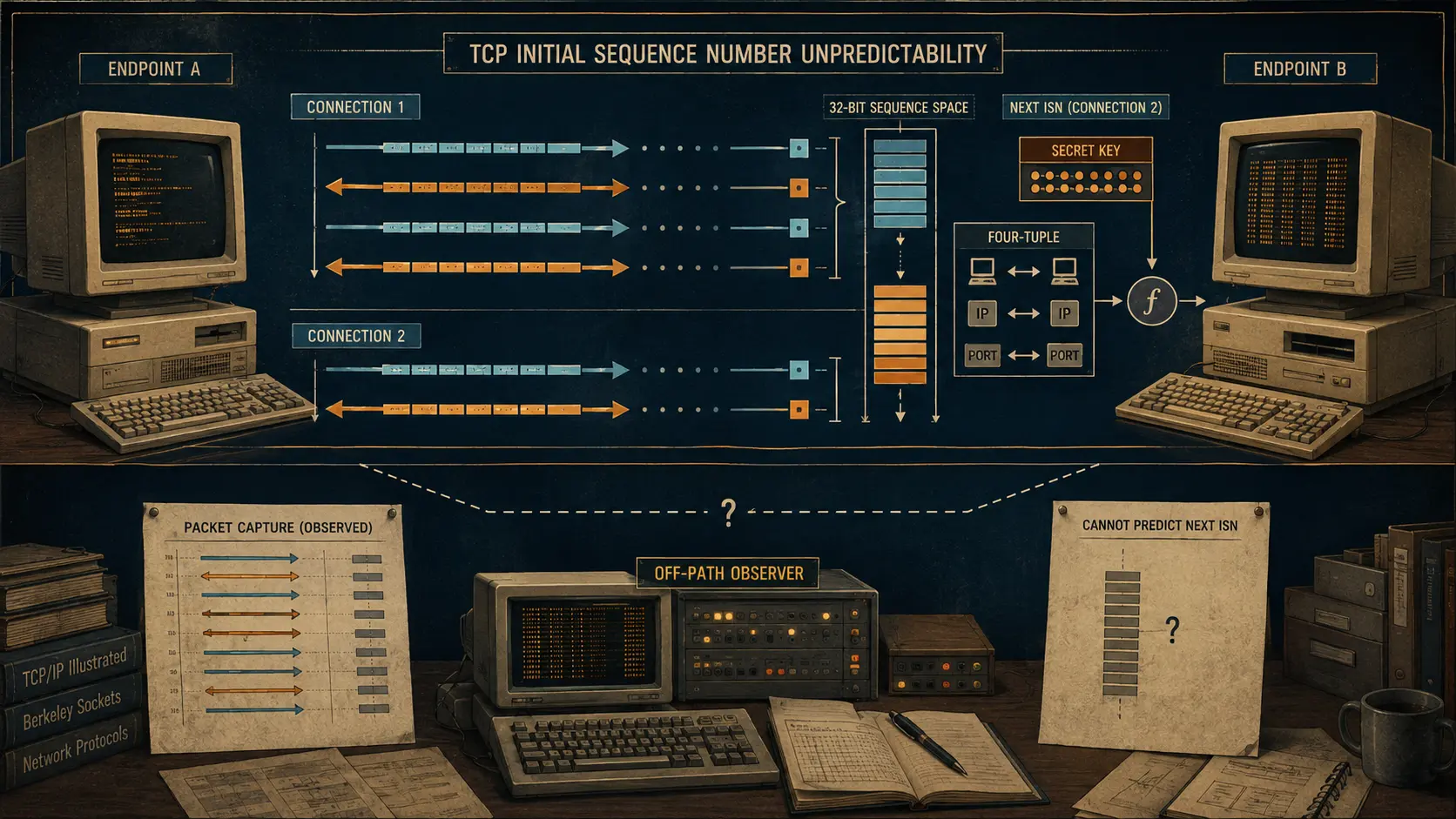
The Number Made Harder for an Off-Path Attacker to Predict: TCP Initial Sequence Numbers
A TCP connection begins by exchanging numbers. The security change was not to hide that exchange, but to stop one visible number from revealing the next connection's starting point.

Global Institutional Trends
A Valid Software Signature Is Not a Durable Authority Record
A green verification result can survive long after the authority that made a release legitimate has changed. The cryptography may still be sound. The missing evidence is organisational: who was permitted to sign, under which role, at what time, and what later revocation or…

Global Regional ISP Trends
A Graceful BGP Restart Can Lengthen a Blackhole
Graceful Restart is meant to keep traffic moving while a BGP process returns. Its safety depends on a fact the surviving session cannot prove by itself: whether the restarting router still has the forwarding state needed to carry packets. When a helper retains a route longer than…

CASE FILE
Sixty Names Were Defendants; the Statute Still Defined the Claim: Harrods v Sixty Internet Domain Names
The caption did something unusual: it named sixty domain names as defendants. That procedural choice made a dispute over the Harrods name look, for a moment, like a dispute over things rather than people. The Fourth Circuit’s answer was narrower. The names could be before the…

History
The Chain That Made a Public Key Believable: PEM Certificate Management
A public key does not identify its owner by itself. RFC 1422 addressed that gap for Privacy Enhanced Mail by specifying certificates, certification authorities, validation paths, and revocation information—the institutional machinery needed before a relying party could treat a…

Global Regional ISP Trends
A Fast IPv4 Fallback Can Make Broken IPv6 Look Healthy
A dual-stack service can answer every ordinary check while its IPv6 path is unusable. The availability result is real, but the protocol-family conclusion is not: a client may have escaped through IPv4 before the dashboard noticed what failed.

History
The Pointer That Was Never Out of Band: TCP Urgent Data
TCP urgent data is a small control surface with a long history. The URG flag makes a 16-bit urgent pointer meaningful, but RFC 793 described the boundary it marks in two contradictory ways. That ambiguity crossed from the specification into implementations and application APIs.

Global Cloud Services Trends
A Root Certificate Removal Is a Fleet Migration Before It Is a Browser Update
A root programme can withdraw trust in one release while many applications keep making decisions from older, private or embedded stores. The security change is complete only when the verifiers that matter can prove the intended rejection.

History
Six Bytes Became an Address Only After the Domain Was Known: RFC 1449
An archive can preserve every octet and still lose the fact. Imagine finding six bytes in an old SNMP configuration: four could be an IPv4 address and two could be a UDP port. That reading is valid only if another field says the value belongs to the UDP transport domain. Without…

History
The Database Said One Address. The Reply Followed the Packet Back: RFC 1445
The address book and the live packet disagreed. For a new request, the 1993 SNMPv2 administrative model used the address recorded for the destination. For the reply, it ordered something else: use the transport domain and address from which this request actually arrived, even if…

History
The Clock Went Back. The Key Had to Change: RFC 1446
After a power failure, an SNMP agent wakes with yesterday’s shared secret and a clock that thinks yesterday has not happened yet. A captured request, previously too old to accept, can become “recent” again. Its digest never changed. The receiver’s boundary of acceptable time did.…