
Primary Domain
RIPE NCC
Within the Primary Domain facet, RIPE NCC intelligence groups reporting by primary domain so readers can follow a focused area of internet infrastructure, governance, connectivity markets, or digital capital. The page brings together related articles, public evidence, institutions, companies, people, regional exposure, operating dependencies, and market context that may otherwise sit across separate category pages. It explains the domain, the likely actor class, the market or governance context, and the source material readers should use when comparing signals. Operators, analysts, and governance readers can see how the same domain appears across events, profiles, market shifts, public-source evidence, regional dependencies, and longer-cycle infrastructure decisions over time.

Story
The Identity Chain Nobody Closes: What Can Actually Be Verified About almazcloud.network, AS210328 and AO ALMAZ
The Identity Chain Nobody Closes: What Can Actually Be Verified About almazcloud.network, AS210328 and AO ALMAZ intelligence summary explains the development, the public evidence available to readers, the organisations involved, the regional context, market exposure, and the…
Story
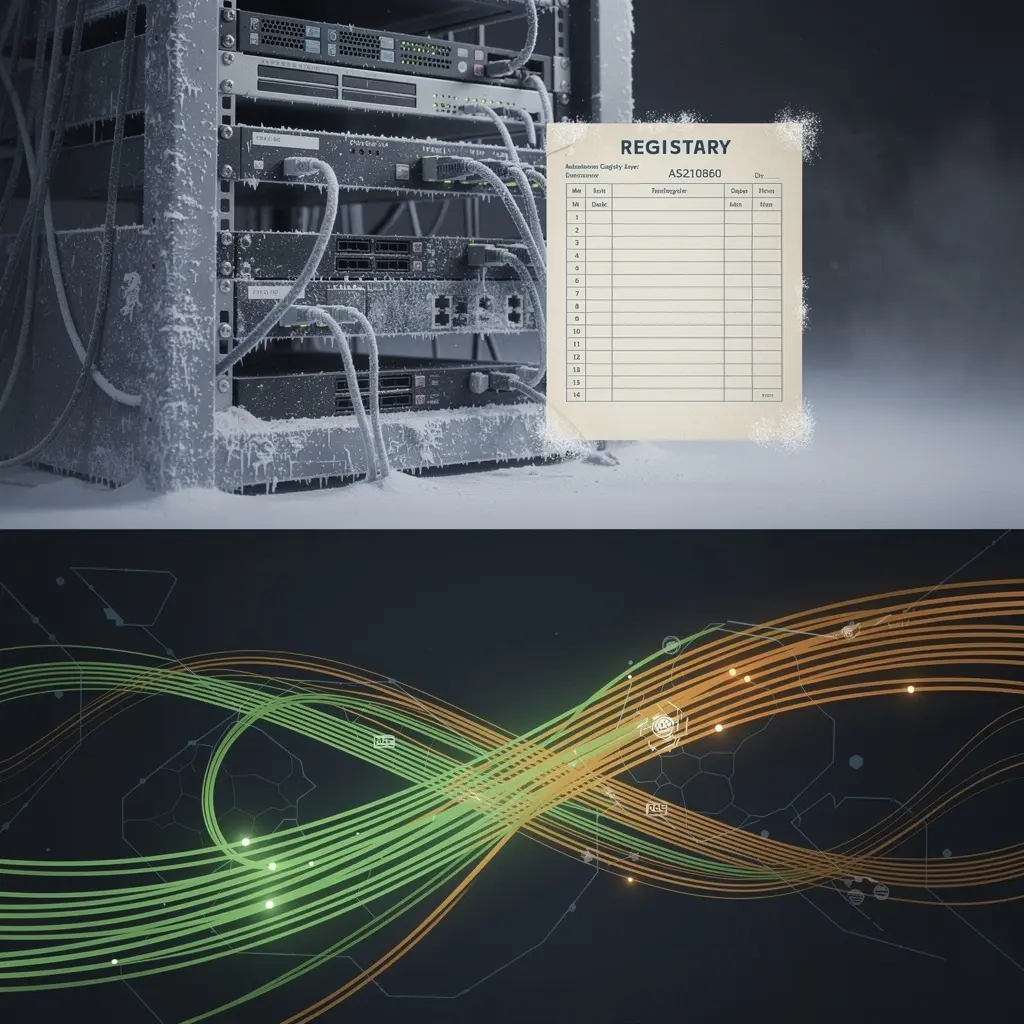
Two tiers of EDEKA: where the frozen registry ends and live routing begins
Two tiers of EDEKA: where the frozen registry ends and live routing begins intelligence summary explains the development, the public evidence available to readers, the organisations involved, the regional context, market exposure, and the infrastructure consequences that may…

Story
RIPE NCC October 2026 General Meeting: The Board Structure Vote and What It Says About Member Control
The RIPE NCC has published a draft agenda for its October 2026 General Meeting that goes beyond routine housekeeping: alongside the 2027 budget discussion, an Arbiter Panel election and a surplus-distribution vote, members will be asked to approve Articles of Association…

Story
The contractual tail: how African LIRs stayed RIPE NCC members while AFRINIC served them
The handover of Africa's internet number registry is usually told as a single act of recognition. The dated instruments tell a more layered story: for over ten months after AFRINIC began operating, African members were legally RIPE NCC members under the RIPE NCC Standard Service…

Number Resource Society
The October 2025 RIPE NCC General Meeting Had No Executive Board Election — and the Record Proves It
The RIPE NCC's General Meeting of 22–24 October 2025 in Bucharest was billed alongside RIPE 91 as a major governance gathering, but the registry's own agenda, minutes and voting report show a meeting with a single resolution and no Executive Board election at all. The one…

Story
The 2019 Excess-Contribution Redistribution: How the RIPE NCC's Own Instruments Authorised and Applied a Contested Remedy
When the RIPE NCC returned EUR 8,365,249 to its members in 2020, the money did not move by improvisation. It moved under Standard Service Agreement Article 7, a Clearing House Procedure that predates the decision, and a General Meeting vote that split hard enough to show how…

Global Regional ISP
Three Clocks, One Handle: What the ACSK-RIPE Record Does and Does Not Settle
Three Clocks, One Handle: What the ACSK-RIPE Record Does and Does Not Settle intelligence summary explains the development, the public evidence available to readers, the organisations involved, the regional context, market exposure, and the infrastructure consequences that may…

Story
The Svea Abuse-Role Record: Validated Contactability, No Documented Processing
The abuse contact recorded and mirrored for Svea's legacy netblock 193.105.138.0/24 is a carrier-era inherited mailbox on the Verizon Business/UUNET lineage — registry-validated for technical deliverability but never documented to have received, answered, escalated or remediated…

CASE FILE
The Architecture of No Recourse: RIPE's Formal Abuse-Escalation Map
Every abuse complaint in the RIPE service region ends in a mailbox the registry validates for deliverability — and in an escalation architecture that, on the published record, offers the reporter no route into any binding mechanism. This investigation reconstructs that…

Story
The First October General Meeting Under RIPE NCC's New Board Structure
On 28 October 2026, at 16:00 (UTC+2), the RIPE NCC membership convenes for the October 2026 General Meeting — held online over 22–24 October and running alongside RIPE 93. By the draft timetable, the formal members-only section begins on Wednesday 28 October, electronic voting…

Story
AS210328 Today: What the Live Record Shows — and Fails to Show — About AO ALMAZ's Cloud Network
AS210328 Today: What the Live Record Shows — and Fails to Show — About AO ALMAZ's Cloud Network intelligence summary explains the development, the public evidence available to readers, the organisations involved, the regional context, market exposure, and the infrastructure…

CASE FILE
The Mailbox Is Not the Complaint: A Four-Layer Test for Whether RIPE's Abuse-Contact System Actually Works
Every network abuse complaint in the RIPE service region ends, at some point, in an email address recorded in the RIPE Database. The registry proves each year that tens of thousands of those mailboxes can receive mail. What nobody can prove — because nothing published measures it…
Europe and Middle East Institutional
The Campaign That Counts Mailboxes: Inside the RIPE abuse-c Validation Machine, 2018–2025
Every year, the RIPE NCC sends a machine's worth of checks against nearly ninety thousand email addresses in the RIPE Database, publishes the tally in its annual report, and calls the exercise complete. This report reconstructs that validation campaign from its own primary…

Story
DFINFRA and AS210860: the cost of verifying a silent registry record
A German retail group's registry entry still names a contact for a network that has not announced a single prefix since March 2026, while a peering profile derived from the same network still promises ten address blocks and an open door. Every counterparty who consults these…
History
Where the Power Sat: The Instrument That Returned EUR 11,035,874 to RIPE NCC Members
When the RIPE NCC's 2020 General Meeting approved returning that year's financial surplus to members, the operative authority was not a board discretion but a contract clause and a single recorded resolution. This examination reads the deciding instruments' own words, the…

Story
The Mailbox That Only Has to Exist: What RIPE's abuse-c Validation Actually Tests
Every network abuse report in the RIPE service region ends up in an operator's mailbox — and the registry's entire enforcement apparatus verifies only that the mailbox can receive mail, never that anyone reads it.
Story
The Four Days That Secured a Network: How AS210328 Acquired Its RPKI Cover in Late August 2026
The Four Days That Secured a Network: How AS210328 Acquired Its RPKI Cover in Late August 2026 intelligence summary explains the development, the public evidence available to readers, the organisations involved, the regional context, market exposure, and the infrastructure…

Story
Who Controls Abuse in the RIPE Region? The Measurement Surface and the Remedy Surface
Every malformed abuse report in the RIPE service region eventually arrives at the same question: who is actually responsible for stopping abusive use of internet number resources? The RIPE NCC's own published documents give an unusually precise answer, and it is not the one…
Number Resource Society
RIPE NCC's 2020 Surplus Redistribution: One Recorded Resolution, One Number, and What Changed Since
When the RIPE NCC returned 11 million euros to its members, the instrument of authority was a single General Meeting resolution — and the record of how it was granted still frames how the membership controls the registry's money today.

Story
DFINFRA and AS210860: the lifecycle ledger of a silent network
DFINFRA and AS210860: the lifecycle ledger of a silent network intelligence summary explains the development, the public evidence available to readers, the organisations involved, the regional context, market exposure, and the infrastructure consequences that may follow. The…