
Primary Domain
Infrastructure
Within the Primary Domain facet, Infrastructure intelligence groups reporting by primary domain so readers can follow a focused area of internet infrastructure, governance, connectivity markets, or digital capital. The page brings together related articles, public evidence, institutions, companies, people, regional exposure, operating dependencies, and market context that may otherwise sit across separate category pages. It explains the domain, the likely actor class, the market or governance context, and the source material readers should use when comparing signals. Operators, analysts, and governance readers can see how the same domain appears across events, profiles, market shifts, public-source evidence, regional dependencies, and longer-cycle infrastructure decisions over time.

Global National Telecom Trends
Harmonic expands beyond DOCSIS with fibre and AI
Harmonic is pushing further into PON and AI software as cable operators add fibre, aiming to stay relevant as the physical access network changes.

North America National Telecom Trends
Cox and Verizon outages reach global customers
ThousandEyes saw 14-minute Cox and eight-minute Verizon Business outages affect partners and customers across multiple countries despite their brief duration.

Europe and Middle East National Telecom Trends
CMA reviews £2bn Nexfibre-Netomnia deal
The deal could expand VMO2 and Nexfibre's combined footprint towards 10 million premises, while the CMA's Phase 2 review runs to 15 December.

Asia-Pacific National Telecom
Huawei sets out 'Nvidia of ICT' ambition
Huawei chairman Guo Ping says the company wants to become the "Nvidia of ICT", putting computing and connectivity at the centre of its AI strategy.

North America National Telecom
Spectrum reaches 11m former Cox locations
Spectrum pricing and packages are now available across former Cox markets, while Charter continues integrating sales, service and operating processes after the merger.

North America National Telecom
Cricket launches 5G home internet on AT&T network
Cricket has launched fixed wireless home internet over AT&T's 5G network, extending the prepaid brand into broadband without building a separate access network.

North America National Telecom Trends
FCC gives four carriers more time for rip-and-replace
Four US carriers received deadline extensions as labour, logistics, equipment shortages and ransomware replaced funding as the main barriers to completing rip-and-replace work
Asia-Pacific Datacenter Trends
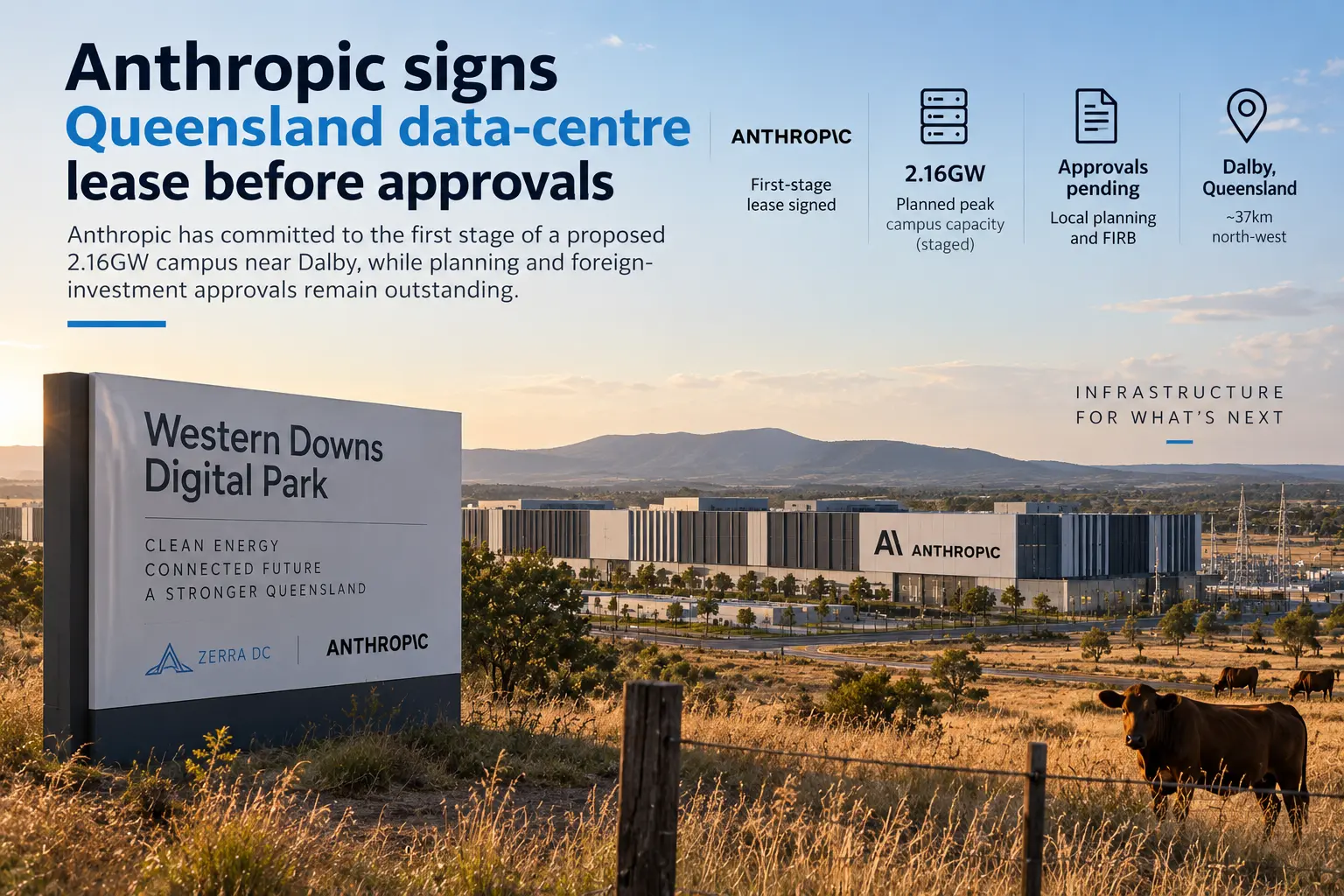
Anthropic signs Queensland lease before approvals
Anthropic has committed to the first stage of Zerra DC's Western Downs campus while local planning and foreign-investment approvals remain outstanding.

North America Cloud Services
CoreWeave brings up multi-rack Vera Rubin cluster
CoreWeave linked hundreds of Rubin GPUs and added storage changes aimed at reducing cross-region write delays for AI workloads.

Africa Datacenter
Digital Parks Africa plans Lagos data centre
Digital Parks Africa has announced NDC1 in Lagos and engaged Uptime Institute for a Tier IV assessment, but no certification, capacity or opening date has been disclosed.

Global National Telecom Trends
Nokia names eight operators testing AI-RAN
Eight operators are testing Nokia and NVIDIA AI-RAN technology, but none has announced a commercial deployment.

Europe and Middle East Datacenter
CRA secures fibre routes for Prague Gateway DC
CRA has contracted optical connectivity from five partners for Prague Gateway DC, combining existing, leased and newly built routes while construction continues.

Global Datacenter Trends
Schneider launches 2.5MW prefabricated power modules
Schneider Electric's 2.5MW prefabricated power modules move more electrical assembly and testing into the factory, reducing work that must be completed on site.

Africa National Telecom Trends
Gabon signs 20-year backbone deal with Gabon Fiber
Gabon Fiber will operate and expand the national backbone under a 20-year concession, with more than CFA41bn sought for 1,651km of new fibre.

North America Datacenter Trends
Microsoft files wetlands permit for Virginia campus
Microsoft has filed with the US Army Corps for a two-building Virginia data-centre campus with an on-site substation.

North America Datacenter Trends
Serverfarm lifts credit facility to $3.89bn
Serverfarm has expanded its revolving credit facility to $3.89bn for North American data-centre development, but has not disclosed how much is drawn.

Europe and Middle East Datacenter Trends
Scotland votes on hyperscale data-centre moratorium
MSPs are debating a moratorium as Scotland adds mandatory environmental assessments for data centres above 50MW but has yet to publish a national strategy.

Europe and Middle East National Telecom
Cambium UK subsidiary enters administration
Cambium's UK subsidiary entered administration days after the group cut 260 jobs, leaving customers waiting to see how product support and warranties will continue.

Asia-Pacific National Telecom Trends
Japan's four operators study shared 28GHz infrastructure
KDDI, NTT DOCOMO, SoftBank, and Rakuten Mobile will study shared 28GHz infrastructure while continuing their own deployments.

Europe and Middle East National Telecom Trends
Norway charges Telenor over Myanmar data disclosures
Norwegian authorities charged Telenor in two Myanmar-related investigations, including alleged disclosures of historical customer traffic data to the military regime.