
Content Type
Research
Within the Content Type facet, Research intelligence gathers BTW.MEDIA articles that share the same editorial format, helping readers compare briefings, profiles, risk notes, market analysis, and event coverage without mixing different kinds of evidence. The page explains how this content type frames internet infrastructure events, company movements, governance decisions, operational signals, and public evidence across the site. Readers can compare which actors or infrastructure systems appear most often, how source quality changes interpretation, and whether the material is a durable profile, a time-sensitive event, a strategic market signal, or a governance development. The result is a useful search page for operators, investors, customers, analysts, and policy stakeholders who need to understand the consequence, timing, and evidence behind similar article formats.

History
The Translator Changed the Packets. It Had to Change the Reports Too: RFC 3158
An RTP translator could make a stream fit a different link by changing its encoding, packet size, sequence numbers or timestamp rate while preserving the source identifier. That success created a quieter obligation. The RTCP reports had to be translated into the same packet…

IETF
The Child Token Was Valid. The Chain Still Had to Authorize It.
A delegated token can carry a perfect signature and still have no usable authority. The proposed OAuth chain works only when every parent, every narrowing step, the leaf key, current status and the resource server’s own policy agree on the same bounded operation.

History
The RFC Still Said Standards Track. Its Record Said Historic: RFC 3167
An old standard can keep its original publication language while its live record changes. RFC 3167 captures one such handoff: a request grounded in a claim about use, followed in today’s catalog by a Historic label.

History
The Server Did Not Need the Plaintext. It Still Controlled Availability: RFC 3157
In August 2001, RFC 3157 asked how one cryptographic identity could follow a user or router from one device to another. Its answer began with confidentiality but did not end there. A credential server might store an entity it could not use as plaintext and still decide whether…

IETF
The Manufacturer Signed the New Trust Roots. The Delivery Server Was Still Untrusted.
A factory-installed key can let a device accept a new operational CA bundle from an endpoint it cannot yet authenticate. That is not a paradox if every grant stays narrow: the signature authorizes the entity, the entity changes a local trust store, and only a fresh validated…

History
The Junior Operator Could Start It. The Senior Operator Built It: RFC 3165
In 2001, the Script MIB made remote management code a set of visible, controllable entities. Its emergency example drew a consequential line: junior operators could press a prepared launch button, while senior operators kept the right to install the script and configure that…

History
The Sender Saw Loss. It Could Not See the Cause: RFC 3155
In August 2001, RFC 3155 confronted a problem hidden inside one of TCP's most useful habits. A missing acknowledgement told the sender that progress had failed, but not why. A congested queue, a corrupted radio transmission, reordered packets and a damaged acknowledgement could…

History
The Relay Added a Header. The Message Lost Its Ending: RFC 3164
In the older BSD syslog format, a relay could make a bare event easier to read by adding a timestamp and hostname. RFC 3164 also gave the whole packet a hard 1,024-byte ceiling—so that helpful header could consume the space reserved for the message itself.

IETF
The Domain Said You May Ask. It Did Not Authorize You to Act.
`dialogue.txt` proposes a public door through which an unfamiliar machine may ask one question. Its most valuable design choice is also the easiest to lose in automation: finding the door is not entering the building, delivering a message is not opening a conversation, and a…

History
The Receiver Offered Multiplexing. The Sender Still Chose Whether to Use It: RFC 3153
In August 2001, RFC 3153 offered a way to make small PPP packets spend fewer bytes on envelopes. Several packets could travel as subframes inside one multiplexed frame. Yet the standard drew an unusually useful line: a receiver could negotiate the ability to understand that…

History
The Server Needed a Third Challenge: RFC 3163
The extra random value in RFC 3163 was not decorative. In its mutual-authentication mode, it addressed an asymmetry created by the order of the exchange: the client chose its own nonce only after it had already seen the server's first challenge. The fix was narrow, and so were…

History
The New Reverse Tree Existed Before the Old One Disappeared: RFC 3152
In August 2001, the Internet moved IPv6 reverse naming from `IP6.INT` toward `IP6.ARPA` without pretending that a sentence in an RFC could move every resolver at once. RFC 3152 chose the infrastructure root, requested its delegation and aligned the hierarchy with address…

IETF
The Mapping System Did Not Know the Destination. It Still Returned an Exit.
A new LISP proposal turns an unknown or unregistered destination into an actionable gateway choice. That can remove static configuration and speed failover. It can also make an authoritative-looking map conceal its most important fact: the system selected where to send the packet…

History
IPv6 Had to Wait for Authentication: RFC 3162
The access server had to authorize the session before it knew which Internet protocol the host would use. RFC 3162 let one RADIUS exchange carry both possibilities, then left the final applicability decision at the network edge.

History
The Old Name Became a URN. It Still Did Not Resolve Itself: RFC 3151
XML inherited public identifiers that could outlive a machine but could not enter every URI-only interface. RFC 3151 gave those strings a precise `urn:publicid:` transcription. The bridge preserved a name's visible structure and made normalized outputs comparable. It did not…

IETF
The DHCP Reply Said 1 Gbit/s. The Bottleneck Had Not Moved.
A proposed DHCP option can tell a router which service rate an operator wants it to use. That is a valuable coordination signal. It is not a measurement of the access path, a receipt from the shaper, or proof that the queue carrying the next packet sits where the policy assumes.

History
A Packet Could Hold Up Everyone Else: RFC 3150
On a very slow link, packet size also determines how long everyone sharing the interface must wait. RFC 3150 turned that interval into a design constraint rather than treating MTU as a matter of byte efficiency alone.

History
The Call Agent Controlled the Features. The Mute Button Stayed Local: RFC 3149
MGCP placed call-control intelligence outside the phone, yet RFC 3149 refused to send every touch across the network. A numbered feature key could acquire its meaning from a remote Call Agent, and an XML display could become a separately addressed endpoint. But volume, the…
History
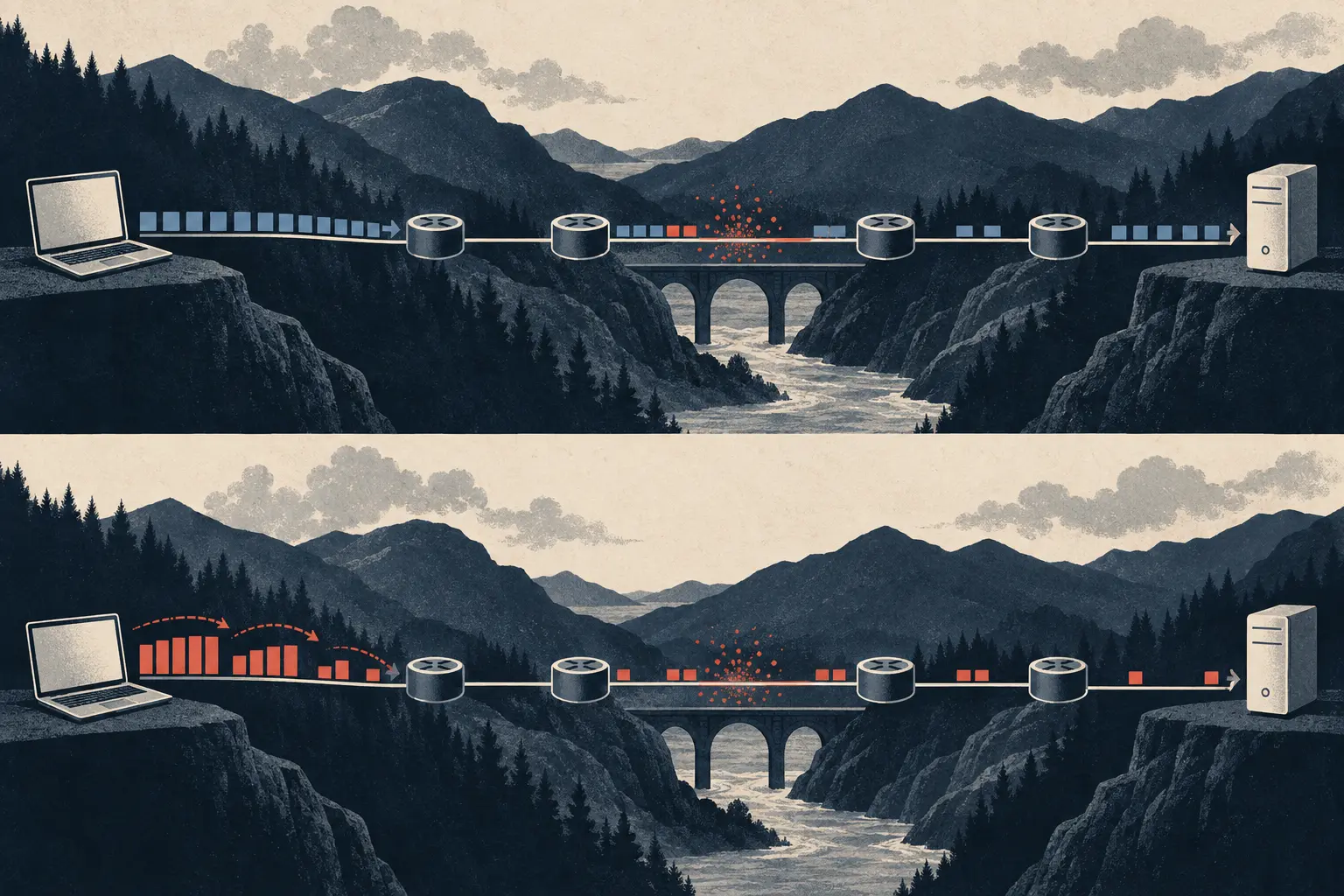
One Path Could Yield Two Valid Capacity Numbers: RFC 3148
A single-flow bulk-transfer measurement looked like one number. RFC 3148 showed why transport choices could make that number method-dependent—and why the trace beside it mattered.

History
The New Management Network Had to Cross the Old One: RFC 3147
A network migration is usually drawn as an arrow from old to new. RFC 3147 captured the harder topology hidden beneath that arrow: a newly IP-managed device could stand on the far side of a CLNS network that operations could not yet remove. The proposed bridge—GRE carried inside…