
Content Type
Briefing
Within the Content Type facet, Briefing intelligence gathers BTW.MEDIA articles that share the same editorial format, helping readers compare briefings, profiles, risk notes, market analysis, and event coverage without mixing different kinds of evidence. The page explains how this content type frames internet infrastructure events, company movements, governance decisions, operational signals, and public evidence across the site. Readers can compare which actors or infrastructure systems appear most often, how source quality changes interpretation, and whether the material is a durable profile, a time-sensitive event, a strategic market signal, or a governance development. The result is a useful search page for operators, investors, customers, analysts, and policy stakeholders who need to understand the consequence, timing, and evidence behind similar article formats.

Europe and Middle East National Telecom Trends
OFN’s Iraq dark-fibre agreement extends FIG inland; the service chain is still unproven
A new fibre purchase puts a named terrestrial supplier behind Ooredoo’s planned Iraq landing for FIG. It advances the route on paper; the public record still stops short of showing who will operate, repair and sell the complete service.

Europe and Middle East Institutional Trends
RIPE’s Abuse-Contact Check Stops at Mailbox Reachability
A registry can make an abuse address easier to find and test whether its technical path looks configured. Those signals matter. They still leave a separate question unanswered: what happens after a real complaint arrives?
History
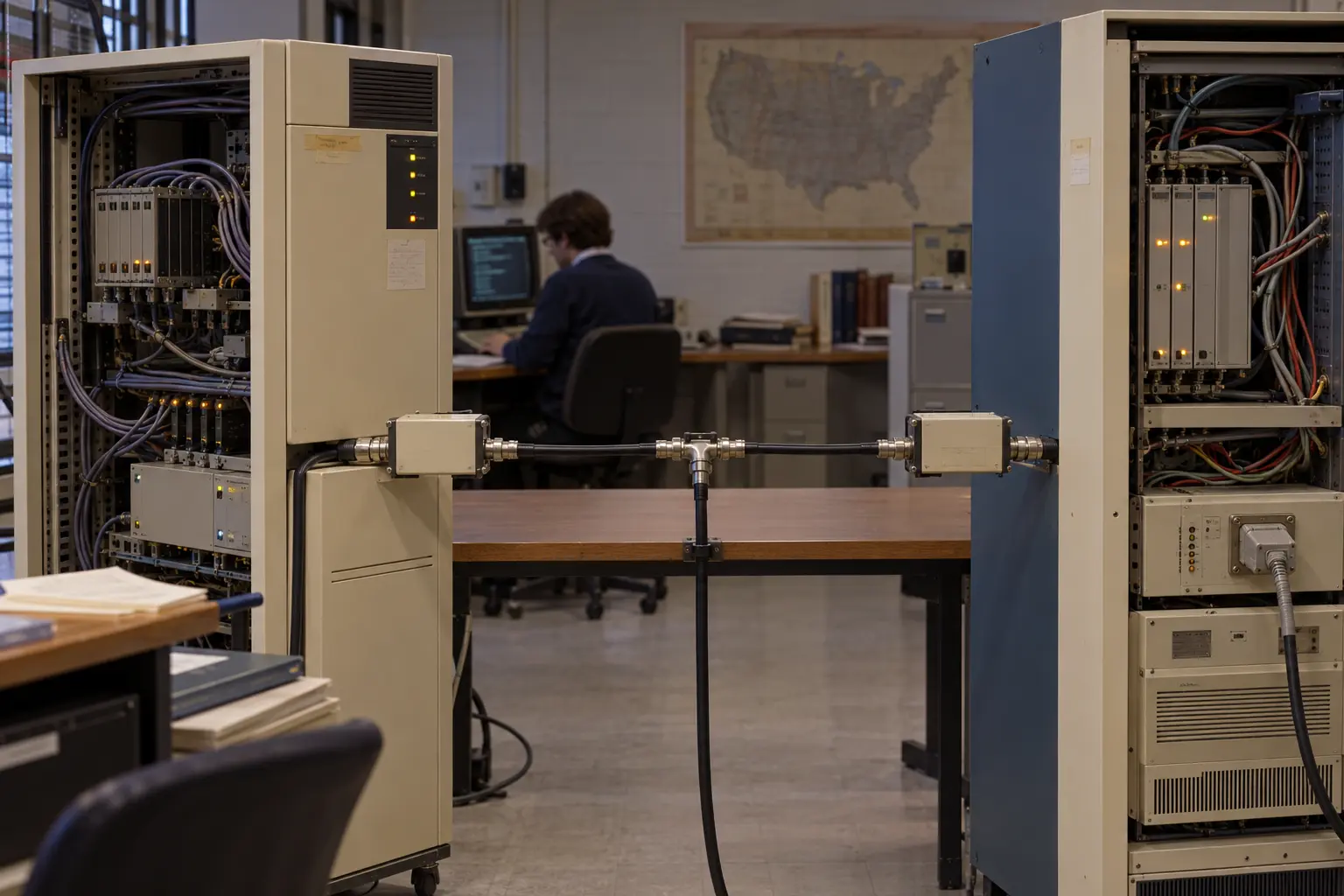
The Ethernet Handoff Was Common. An Open IGP Was Not: RFC 1009
In 1987, the National Science Foundation required gateways from different vendors to meet at a familiar boundary: Ethernet, with serial links as a minimum companion. The same specification admitted that the vendors still had no open interior gateway protocol in common. One layer…

Europe and Middle East Institutional
Tideo Administration: The RIPE Contact Handle That Outlived Its Operator
Tideo Administration: The RIPE Contact Handle That Outlived Its Operator intelligence summary explains the development, the public evidence available to readers, the organisations involved, the regional context, market exposure, and the infrastructure consequences that may…

Europe and Middle East National Telecom
Deutsche Telekom’s AI savings need a cash-flow bridge
Deutsche Telekom has put a larger number on AI’s expected contribution, but the €2.5 billion headline is a gross cost target. Investors and operating leaders still need a bridge from that accounting measure to the cash spent, the work changed and the benefits retained.

Asia-Pacific Institutional Trends
ASEAN’s Cable-Repair Clock Still Runs Through National Gates
The enhanced ASEAN submarine-cable guidelines give governments and operators a clearer regional playbook. Their familiar seven-to-ten-working-day permit target, however, was already in the 2019 version—and the 2026 text still qualifies it as a goal “where possible,” subject to…

History
When a Usenet Cancel Failed Locally, RFC 1036 Said to Stop
A cancel message could travel through the same distribution machinery as ordinary Usenet news, yet its authority remained tied to what each host could find and verify for itself. RFC 1036 drew a sharp boundary: if a system could not cancel the named article locally, it should not…

North America National Telecom
AT&T’s Fiber JV: Open Access Depends on the Anchor Tenant
AT&T plans to combine Forged Fiber 37 and Gigapower with GIP and CPP Investments. The ownership split is public; the wholesale rules that will turn “open access” into an orderable service are not. AT&T remains central to the customer relationship and was named as the planned…

History
A Port Was Not Enough: RFC 675 Put the Network in the Socket Name
A process could choose a port that made sense on its own machine. It could not assume that the same number named the same endpoint across a network of independently run systems. RFC 675 answered that scope problem by joining a port to the address of the TCP that owned it, then…

Global Cloud Services Trends
Insurers expect autonomous AI within three years; production use is 16%
A survey commissioned by insurance-software vendor Sapiens finds that about two-thirds of respondents expect fully autonomous AI in insurance within two to three years. The report’s present-day baseline is more prosaic: 16% say agentic AI is running in production, while human…

CASE FILE
Philippines’ cable outage: three clocks behind one “restored” notice
On 2 October, public probes saw a sharp rise in latency between the Philippines and Singapore, but could not identify a cable. InfiniVAN later reported its C2C segment restored; carriers then described their own rerouting and service recovery. These are connected events, not…

Europe and Middle East National Telecom Trends
Openreach’s 800G offer needs a route map
Openreach says it has introduced national 800G services using Ciena optical equipment, but the announcement does not show which routes wholesale customers can order or what the service costs. A 1.6 Tb/s wavelength is a transport capability, not proof of a 1.6 Tb/s customer…

History
A Language Tag Was One Token, Not a Navigation Map: RFC 1766
RFC 1766 split a language tag into a primary value and hyphenated subtags, then told applications to treat the complete string as one token. Its consequential boundary was administrative: the parts helped organize a shared namespace, but did not become a universal route through…

NANOG
Five Candidates, Two Seats: NANOG’s Ballot Outlasts Its Meeting
NANOG’s 2026 Board contest puts five candidates before members for two staggered seats. Candidate presentations are scheduled during NANOG 98 in Miami, but voting opens on the same date and stays open after the meeting ends: the published window runs from 20 through 26 October…

History
WAIS Let a Document Become Its Own Query: RFC 1625’s Relevance Loop
A reader could type a few seed words, add a document or even one passage, and ask WAIS to find similar material. What came back was a ranked citation, not a durable result set or the document itself. RFC 1625’s small but consequential design was to make a selected text entity…

Asia-Pacific National Telecom
Telstra’s Perth–Sydney fibre is live. Regional access depends on the off-ramps
Telstra says its new Aura route across Australia is in service. For the towns it passes, the more consequential milestone is whether a carrier can connect at a named handoff, buy capacity on workable terms and carry traffic onward over a separately resilient path.

Asia-Pacific Institutional Trends
Singapore’s Passed Infrastructure Bill Sets Three Different Licensing Tests
Parliament passed Singapore’s Digital Infrastructure Bill on 7 October. Its three numerical tests measure different things: data-centre capacity, the reach of a facility service, and cloud revenue tied to Singapore users.

History
Who Chose the Address? RFC 4014 Carried RADIUS Authorization into DHCP
A successful access decision does not hand a device an address. In 2005, RFC 4014 gave a network access server a narrow way to carry selected RADIUS authorization attributes into a later DHCP exchange, joining two decisions without pretending they were one.

Europe and Middle East Cloud Services Trends
Toku’s UAE cloud deal opens a CX route, not a disclosed sale
Toku’s UAE subsidiary has agreed to host its customer-experience platform on Core42’s Azure-based cloud in the Emirates, and Toku says onboarding has begun. The agreement adds a local deployment option; the announcement names no customer, workload, commercial terms or completed…

ICANN
Five `.agent` Applicants Recur Across ICANN’s Contention Sets
ICANN’s first 2026-round CSV places 13 named applicants in the `.agent` group. Five of those applicant entities appear in at least 11 of the file’s numbered contention sets, giving the crowded name a portfolio dimension that a single application count misses.