
Summary
- Openreach says it is adding national 800G services to its OSEA portfolio with Ciena Waveserver and WaveLogic 6 equipment. The announcement distinguishes 400G and 800G client traffic from dedicated 1.6 Tb/s optical wavelengths.
- Neither the release nor the public product description identifies the routes, prices, order volumes, service levels or customers that would turn the capacity figure into evidence of commercial use.
The fibre rate is not the order-form rate
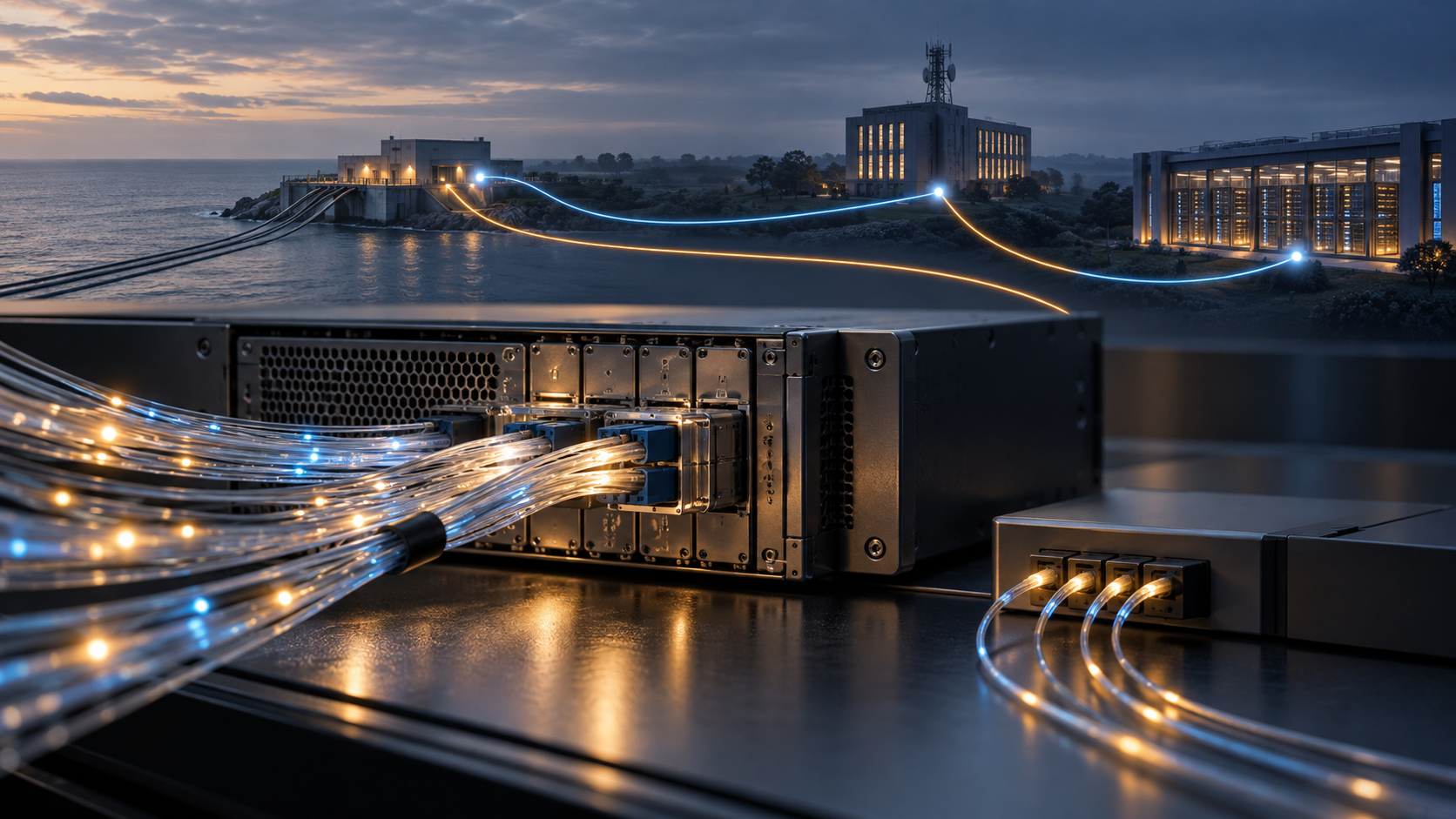
Ciena’s 7 October announcement says Openreach is deploying Waveserver equipment powered by WaveLogic 6 into Optical Spectrum Extended Access (OSEA). It describes 400G and 800G client traffic travelling over dedicated 1.6 Tb/s wavelengths, and says a 2RU chassis can support up to 32 400G services. Openreach says it has introduced national 800G services for wholesale customers, including connections involving cable landing stations, access and backhaul, core-interconnect nodes and data centres. Ciena’s announcement is therefore evidence of a higher-capacity transport layer and a new service claim, not of a 1.6 Tb/s circuit sold to a customer.
That distinction matters because buyers purchase endpoints, handoffs, provisioning and remedies as well as bandwidth. Openreach’s OSEA product page describes its managed 6500 service and customer-facing channel options separately. It gives an existing ceiling of up to 800 Gb/s per channel, while the new announcement does not explain how the 1.6 Tb/s wavelength maps onto the service specification, which routes support it, or when those routes can be ordered. The two figures can describe different layers; the release does not supply the configuration needed to connect them.
Ciena’s headline also cites 3.2 Tb of scalable capacity over diverse fibre across the United Kingdom. It does not publish the route count, endpoint list, wavelength mix or calculation behind that aggregate. “Diverse” signals an intended design property, but without route-level disclosure it cannot establish that paths avoid shared ducts, exchanges, landing stations or other failure points. Data Centre Dynamics reports the same deployment and wholesale use cases; it does not add customer orders or commercial terms.
Ciena says it will help deploy, proactively monitor and maintain the OSEA product. That may shape how faults are detected and escalated, but the announcement does not specify customer visibility, restoration targets or which party owns each repair obligation. Nor does it name a buyer, price, contract value, service-level agreement, utilisation level or revenue contribution. References to AI and critical national infrastructure describe possible demand contexts, not booked traffic.
The practical test is not whether 800G appears in the product announcement. It is whether a carrier can order a named endpoint pair, receive a defined service level and compare its price with alternatives. Until Openreach publishes that service map, the deployment is a capacity and product signal whose commercial reach remains unmeasured.
Sources: Openreach optical products.
Member Briefing
Deeper Profile Context
Sign in with the right membership level to unlock the full briefing and source notes.
Only for Strategic Circle
Strategic Circle
Open to all readers. Unlock profile briefings after joining and signing in.
Join Strategic CircleOnly for Leadership Alliance
Leadership Alliance
For qualified IP-asset owners and management; sign in to unlock alliance briefings.
Join Leadership Alliance