Summary
- Europe's data-centre census is a delegated act, not a survey: Commission Delegated Regulation (EU) 2024/1364 admits a facility only if its installed information technology power demand is at least 500 kW, and defines that quantity as the sum of the nominal power demand of network, server and storage equipment in the computer room — a design figure, not a reading from a meter.
- The act publishes sums and averages only. Its five size bands are led by a 100–500 kW class that sits below the reporting threshold the same act sets, its weighting factor is total energy consumption, and a category may not be shown until it holds three facilities.
- Article 5(5) makes every individual facility's return confidential. Article 3(2) opens one omission window, for the first reporting period, over a list of indicators that includes total energy consumption — the variable the published averages are weighted by.
The regulation is short, and it is unusually candid about what it is. Its opening sentence says the instrument "sets out the information and key performance indicators to be communicated to the European database by the operators of data centres with an installed information technology power demand of at least 500 kW" (Official Journal text). Read that twice. A census normally starts by looking for its population. This one starts by stating the qualification for appearing in it.
The entry ticket is a nameplate
The unit matters more than the number. Article 2(14) defines installed information technology power demand as "the sum of the nominal power demand, in kW, of the network or networks, servers and storage equipment installed in the data centre computer room floor area" (consolidated text). Nominal power demand is what a piece of equipment is rated to draw, aggregated over the equipment inside one defined floor area. It is the number a commissioning engineer signs off, not the number a utility meter accumulates.
That choice is defensible and it is not a measurement. A facility can clear 500 kW on paper and run far below it for years, or be filled to its nameplate within months. The regulation knows this: Annex II point 1(a) requires a weighted average where the installed figure changed during the year, permits the rated information technology power demand where the installed figure cannot be determined, and requires the filer to say which of the two metrics it used. The disclosure is honest. It also tells you that the headline capacity of the European census is an engineering estimate reported by its subject.
The filing calendar is set in Article 3(1): 15 September 2024, then 15 May 2025, then annually, with each return covering the calendar year before it, routed through a national scheme where one exists and straight into the European database where none does. The duty sits on "reporting data centre operators". No third party confirms the nameplate before the number leaves the building; validation, on the Commission's own account, happens at national level (DG Energy).
The chart's smallest class is below its own line
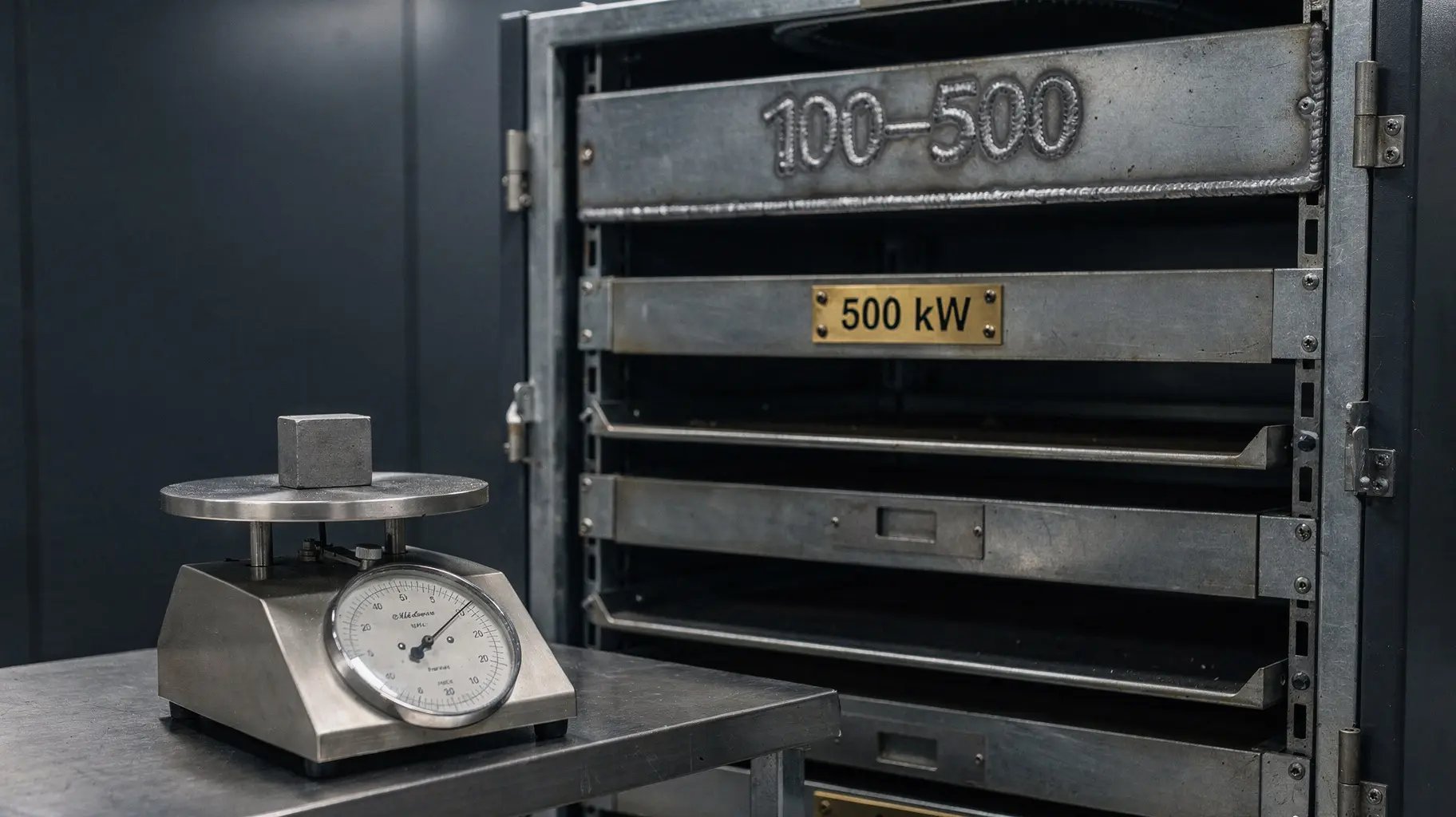
Now look at what gets published. Annex IV sorts facilities by installed IT power into five classes: "(a) very small data centre: 100–500 kW; (b) small data centre: 500–1 000 kW; (c) medium size data centre: 1–2 MW; (d) large data centre: 2–10 MW; (e) very large data centre: > 10 MW" (Official Journal HTML).
Five bands, one instrument, one threshold. The first band describes the range from 100 kW to the line. Everything strictly inside it is outside the census: a 300 kW facility cannot be a member of the reporting population, so it cannot appear in the class named for it. The only facility that can ever populate band (a) is one sitting exactly on the boundary — 500 kW belongs to band (a) and band (b) simultaneously, because the bands share their endpoints rather than partitioning the range.
That is a small drafting artefact with a large reading consequence. Anyone who opens the Commission's dashboard and finds a column headed "very small" will reasonably conclude that Europe has counted its small data centres. It has not. It has counted the ones that reached half a megawatt of nameplate IT load and told them what the band below them is called. The sub-threshold estate — the edge facilities, the enterprise rooms, the campus closets — is a stated blind spot, not a rounding error.
Weighted by a variable, suppressed by a count
Two further rules in Annex IV do more work than their length suggests. The first is the weight: "the aggregation of the sustainability indicators shall be performed with a weighted metric aggregation, using the total energy consumption as the weighting factor" (Official Journal HTML). The European average is therefore not a mean over facilities. It is a mean over energy, so the largest consumers dominate it, and a mid-sized facility reporting a superb efficiency ratio barely moves the figure. The published number is a description of the load, not of the industry.
The second is the floor on publication: aggregated data per type and per size category are presented only where "the respective category contains data from at least three data centres" (Official Journal HTML). The reasoning is sound — a class holding one facility is not a statistic, it is a disclosure with a rounding error attached. The effect is that the thinnest categories vanish, and they vanish precisely where a regulator would most want them: the unusual configuration, the single outlier, the member state with two facilities.
Neither rule is a scandal. Both are perimeter decisions, and a perimeter decision made by the body that also publishes the total is worth naming. It is the same species of problem this desk found in Ireland's electricity statistics, where a statistical office classified data centres itself after sweeping roughly 2.6 million meters (prior briefing). The difference is direction. Dublin decided what counted after the meter ran. Brussels decided what counts before anyone reads one.
Sealed at the facility, published at the Union
Article 5(2) is the publication duty: the communicated information and the sustainability indicators "shall be made public in an aggregated manner, at Member State and Union level" (consolidated text). Article 5(5) is the seal: "The Commission and Member States concerned shall keep confidential all information and key performance indicators for individual data centres that are communicated to the database", and the text grounds that in the commercial-interests exemption of the EU access-to-documents regulation and the environmental-information access directive (consolidated text).
That is the architecture in two sentences. The public layer is an aggregate. The facility layer is a secret held by two public authorities. A journalist, a researcher or a competing operator cannot check one facility's declared power against its declared consumption, because the act forbids the second party in that comparison from speaking. Article 5(6) softens this only for statistics: aggregated data may be reused for European statistics under the standard statistical regulation.
A national parliament has already read the two provisions the same way. Answering a question on 9 June 2026, the Irish government described Article 5(2) as aggregated publication and Article 5(5) as confidentiality for "all information for individual data centres", and pointed to the Commission's dashboard as the public surface (Dáil question). Irish guidance on the same scheme restates the entry criterion and adds the scope detail that enterprise, colocation and co-hosting facilities are all covered (gov.ie).
The number everyone will quote
Which brings us to the figures now circulating. The Commission's dashboard exists and is refreshed monthly from data that member states have submitted and validated (DG Energy). Its tables were not readable for this desk on 18 November 2026, so what follows is reported, not read: trade press puts the published data at 776 facilities across 18 countries, with 6.4 GW of installed IT power, 16.7 TWh of consumption and a weighted average PUE of 1.36 (DatacenterDynamics); a scholarly account reports the same 776, 18, 6.4 GW and 16.7 TWh, describing the database as opened in April 2026 and covering the 2023 and 2024 cycles (EJRR); a non-peer-reviewed preprint describes the dashboard as three worksheets — Category, Type, Country — and gives 11.2 TWh for 2023 and 16.8 TWh for 2024 separately, with 19 countries available (preprint).
The disagreements are not cosmetic. Either the headline 16.7 TWh is a sum across two reporting cycles or it is one year's number; 11.2 plus 16.8 is 28.0, not 16.7, so the two shapes cannot both be right. Eighteen countries or nineteen. A census whose own public figures cannot be reconciled by its readers is not yet a statistic — it is a tabulation in progress.
Two temptations follow, and I am refusing both. Divide 6,400 MW by 776 facilities and you get 8.25 MW per facility, which is arithmetically fine and analytically worthless: the count is reported across two cycles while the capacity is not stated per cycle, so the quotient assumes a shared period nobody published. Divide 16.7 TWh by 6.4 GW and you get 2,609 hours — about 29.8 per cent of a year — and that number would be quoted everywhere as a load factor. It is not one. An energy total over a nameplate sum yields hours only when both cover the same period, and on the evidence obtained here, they do not.
What the act does not say
One omission deserves precision, because it is the only place where the instrument's own timing touches its own weighting. Article 3(2) lets an operator, "for the first reporting period", leave out a named list of Annex II points "for technical reasons", stating why (consolidated text). The list begins with point 1(d), which the annex describes as total energy consumption in kWh per the EN 50600-4-2 methodology, and includes point 1(h), total water input. Total energy consumption is the weight Annex IV applies to every published sustainability average.
So in one of the two cycles behind the headline figure, a filer could lawfully withhold the weighting variable, with a reason and no penalty stated in the act. I am not claiming that anyone did. I am claiming that the published aggregate cannot tell you whether anyone did, and that the design permits the question to remain open at exactly the point where the average is most sensitive.
The regulation also does not do several things a reader might assume. It does not require a per-facility row anywhere. It does not oblige republication, verification of the declared nameplate, or any correction route visible to a stranger. It requires operators to keep records of their measurement points and devices for at least ten years — a retention duty, which is not the same thing as an audit trail, because nothing in the text obtained here obliges those records to be shown to anyone outside the authority that asks.
The check that stops at the door
Europe now has a data-centre census with a precise threshold, a named indicator set, an annual calendar and a public dashboard. It also has a census whose published layer cannot be traced back to the objects it describes, by design and in writing. That is the finding, and it is a finding about the instrument, not about the operators who file honestly into it.
For anyone who wants to test the number rather than repeat it, three moves are available. Read the threshold definition, not the headline capacity: 500 kW of nominal demand inside a computer room is not 500 kW of load. Check which reporting year a published total belongs to before dividing anything by anything. And check whether a category is absent because Europe has no such facilities or because it has fewer than three — the act makes those two situations look identical on the page, and only one of them is a fact about data centres.
Member Briefing
Read the full trend briefing
Members read the full briefing with the source notes behind every finding.
Strategic Circle
A daily briefing in your language, built from changes we have verified.
Join for USD 20/monthCancel anytime.
Members also get the full research library, a daily briefing on the networks they follow and the private forum.