
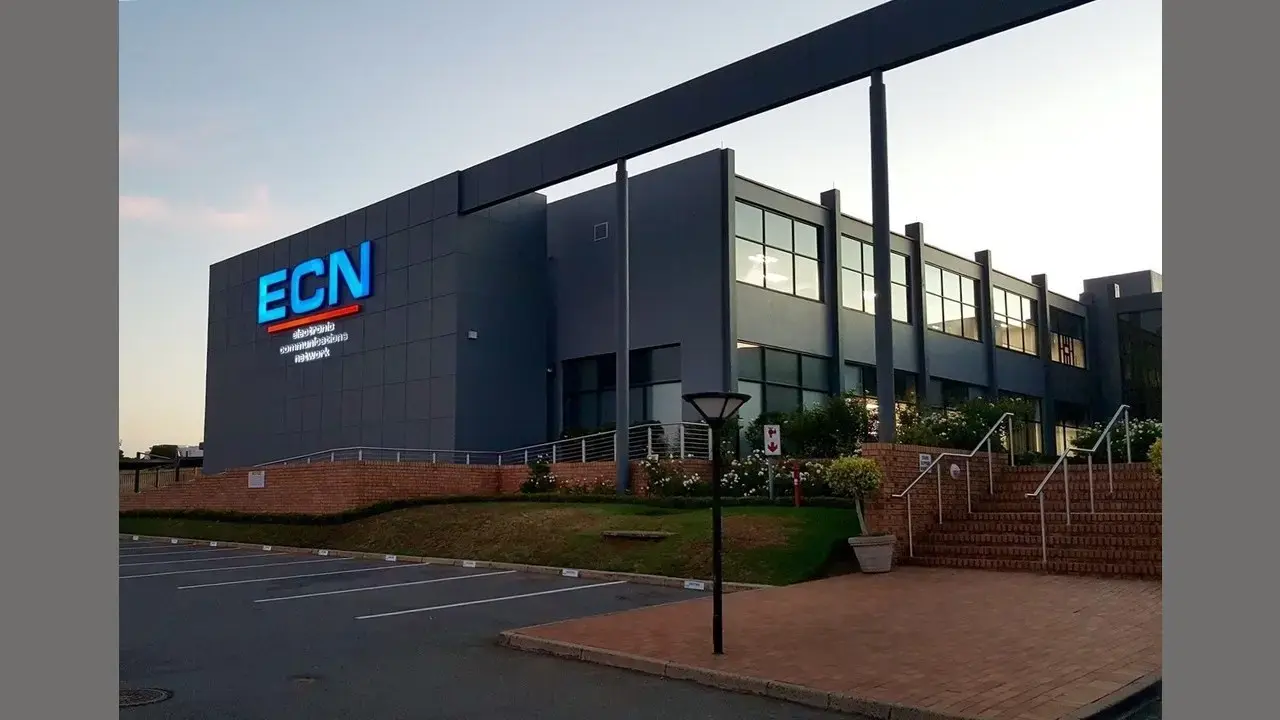
ECN has spent two decades in the least photogenic corner of South African technology: the part where packets actually move. Founded in 2005 as a division of Reunert Limited, the Johannesburg-headquartered provider sells cloud hosting, business-grade internet and voice to enterprises that would rather not think about any of it — which is precisely the point. Nobody buys connectivity for the thrill. They buy it so the call centre stays up when the substation does not.
That is the business model in one sentence: ECN sells continuity. And in a market with infrastructure gaps, regulatory complexity and a cybersecurity threat surface that grows faster than the fibre map, continuity is a premium product with a very ordinary name.
What ECN actually sells: cloud, voice and data for South African enterprises
ECN interconnects with Telkom, MTN, Vodacom and Cell C, and runs out of Johannesburg, Durban and Cape Town — three metros, three sets of latency problems, one national sales story. Its Cloud PBX and hosted call recording services are the quiet workhorses: flexible, secure and cost-effective telephony for firms that want a switchboard without owning a switchboard.
Look at the shape of the offer rather than the brochure. Cloud hosting, business-grade internet and voice share one network, one support desk and one billing relationship. Cross-selling here is not a strategy slide; it is arithmetic. Every additional service riding an existing line drops the marginal cost of the next one — and raises the cost of leaving.
Cloud PBX and hosted call recording: the unglamorous margin
Voice is the product everyone declares dead and nobody stops paying for. Hosted call recording in particular is sticky in the way compliance software is sticky: once an enterprise's retention policy, audit trail and training workflow sit inside your platform, the switching cost is measured in process, not price. That is where a mid-market ICT provider earns a defensible renewal.
The South African ICT tax: infrastructure gaps, regulation and cyber risk
The local landscape hands operators three recurring bills. Infrastructure gaps mean coverage is uneven and resilience is expensive. Regulatory complexity means compliance headcount grows whether revenue does or not. Cybersecurity threats mean every enterprise buyer now arrives with a risk committee attached.
ECN's answer is to invest in next-generation network architecture, build open-source solutions in-house, and partner selectively with technology vendors. Read that as a margin story rather than a technology story: the less you rent from someone else's platform, the less someone else can reprice you. In-house engineering is the cheapest form of pricing power available to a company of ECN's size.
Also Read: Castlerock: Empowering Businesses with Tailored IT Solutions
Also Read: Reflex partners with Nokia to upgrade South African broadband
SDN, hybrid cloud and the real cost of ownership
ECN is pushing Software-Defined Networking and hybrid cloud infrastructure into its enterprise stack, which does two useful things at once. It makes capacity programmable, so scaling is a configuration change rather than a purchase order. And it lets customers keep the workloads that must stay on-premise on-premise, without pretending the public cloud is a religion.
Then there is the item most vendors bury in an appendix: energy efficiency. In South Africa, power is not a sustainability footnote — it is a line item that shows up in uptime, in generator diesel and in the customer's quarterly review. A provider that treats energy as an engineering constraint rather than a marketing badge is a provider that has actually run a data centre.
The company also keeps investing in people, which is the least fashionable and most accurate signal of intent in this sector. Networks are operated by engineers at 3 a.m., not by press releases.
The outlook: continuity is the product, everything else is packaging
ECN's bet is straightforward. South African enterprises will keep outsourcing the plumbing, because the plumbing is not their competitive advantage and never will be. The winners in that market are not the loudest cloud evangelists; they are the operators who can promise a working phone line, a stable host and a support desk that answers, then bill for it every month.
Which is why the least exciting company in the room is often the one with the best renewal rate. The cloud gets the headlines. The company that keeps the phones ringing gets the invoices.


