
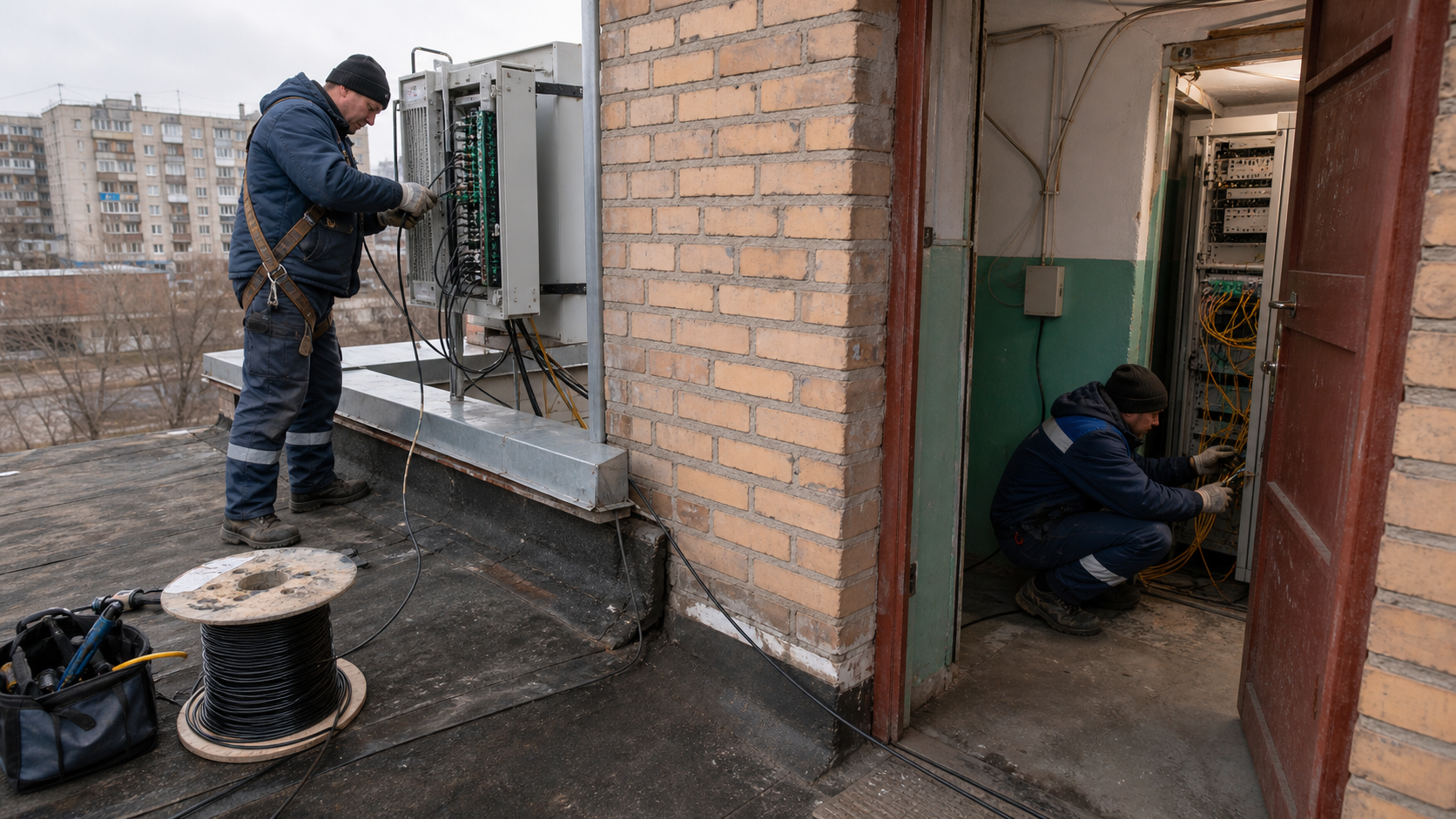
Summary
- Limited Company Digital channel has enough public evidence to be treated as an operating Kursk telecom provider, not merely as a dormant RIPE record. Its own site presents licensed internet access, channel leasing, technical maintenance, fibre/LAN construction, TV service, support, bank-card payment, cash payment, bank-transfer payment and a customer cabinet.
- The network footprint is modest: AS44276, as-name DCL-AS, one originated IPv4 prefix, no visible IPv6 prefix in the main public BGP views, about 2,048 IPv4 addresses, and two observed upstream or peer relationships, MegaFon and AVANT. That supports a real access network, but it does not by itself prove scale or profitability.
- The strongest operating evidence comes from the overlap of official site, registries, finance pages, local directories, government-contract aggregators and address-level records. Those sources identify a company registered in 2002, based at Sadovaya Street 5 in Kursk, with telecom-by-wire as its main activity, active status, small charter capital, very small headcount and recent annual revenue in the tens of millions of rubles.
- The most important boundary issue is separation from related or similarly branded records. The associated Agency of Digital Communications site uses the same Sadovaya Street address and similar service language, and network databases show historical labels such as JSC Digital channel inside the address block. Those are useful context, not automatic proof that every customer, subnet label or revenue line belongs to the assigned entity.
- The base judgment is cautious. Digital Channel appears to be a real small regional ISP and channel-services operator, but its economics work only if recurring local accounts and institutional circuits cover capacity, field technicians, support, last-mile equipment, licence compliance, payment friction and renewal capital.
The narrowest verified operating boundary is a company that sells communications services in Kursk Oblast, not an autonomous system looking for a business model after the fact. The official site is the strongest starting point because it is not a network database. It calls the company a communications operator, gives the public name and details, lists the tax identifiers and registration number, names Sadovaya Street 5 in Kursk as the address, provides a local telephone number and support email, and describes services to subscribers.
The service list is ordinary but economically meaningful: internet access, organisation and lease of channels, technical maintenance of channels, fibre-optic line construction, LAN construction, supply and configuration of telecom equipment, and access to a real-time television service. The site also points to a personal account, bank-card top-up, cash payment, bank transfer and customer documents. Those are customer-service surfaces. They do not prove a large business, but they do prove more than an inert routing object.
That distinction matters because many small telecom entries in routing databases can mislead. A RIPE organisation record, an autonomous-system number and a prefix show the right to originate resources and the existence of routing policy. They do not show whether the resource holder has paying subscribers, active installers, help-desk load, renewal capex or customer contracts.
For Limited Company Digital channel, the operating case is stronger because the technical record aligns with a website that sells services, registries that show an active telecom company, local directories that list an office, and procurement aggregators that describe internet and channel-service supply. The network evidence is therefore a support column, not the whole building.
The legal entity is small. Russian business databases identify OOO "TsK", Limited Liability Company "Digital Channel", with INN 4632021450, OGRN 1024600962430 and a registration date in March 2002. The address is consistently Kursk, Sadovaya Street 5. The main OKVED activity is wireline communications, and the charter capital is 11,000 rubles. Public finance summaries differ by source and reporting cut, but they point in the same direction: this is not a national carrier, not a hyperscale data-centre platform and not a large wholesale backbone.
RBC reports 2025 revenue of 17.506 million rubles, 2025 profit of 1.160 million rubles, assets of 4.446 million rubles and equity of 2.273 million rubles. Other databases report two or three employees for recent years, microenterprise status, and a small regional ranking against bigger Kursk wireline operators.
Those figures frame the economic question. If revenue is around 17.5 million rubles a year, average monthly revenue is roughly 1.46 million rubles before considering VAT, payment costs, network capacity, wages, office expense, regulatory compliance, equipment and repairs. A small operator can survive on that if it has a stable base of local subscribers, a few institutional circuits and disciplined field operations. It cannot absorb the cost structure of a broad low-density network. It must know exactly which streets, buildings, businesses and public-sector sites produce recurring contribution after support and maintenance.
The business is not "own 2,048 IPv4 addresses and wait." It is "turn a small address pool and licensed local service capability into monthly bills that renew."
The customer-service evidence is unusually specific for a small operator. The official site says Digital Channel provides internet access through its own data network, the public communications network and intermediate networks of other telecom operators. That phrasing is important. It does not claim complete self-sufficiency. It describes a provider that controls a local network but also depends on other operators for part of the chain. The same page advertises FTTx/PON up to 1 Gbit/s, xDSL up to 24 Mbit/s and WiMax up to 12 Mbit/s. It also advertises fibre and LAN construction, channel leasing and technical maintenance.
The most economical reading is a hybrid local-access and channel-services operator: some customers may be connected through fibre, some through older copper-line technologies or wireless last-mile, and some business customers may need leased channel or equipment work rather than ordinary household broadband.
The tariff and offer links visible on the company site indicate a standard recurring-service model, but public sources do not disclose the current tariff table in a way that allows a reliable ARPU calculation. That is a limitation, not a reason to abandon analysis. The presence of personal account payment, Sberbank card payment, cash settlement, bank transfer and contract-number payment language means the company expects repeated billing. The site distinguishes physical persons, legal entities and individual entrepreneurs in the payment section. It also explains that legal entities and individual entrepreneurs pay by cashless bank transfer.
That is operationally significant: business customers and public institutions can be billed by invoice, while residential users can maintain a balance through ordinary consumer payment rails.
The network footprint is narrow and consistent. BGP databases identify AS44276, DCL-AS, as Limited Company Digital channel. IPIP, Hurricane Electric, bgp.tools, IPinfo, CAIDA AS Rank, BigDataCloud and RIPE membership records all point to the same basic shape: Russia, RIPE, one visible IPv4 prefix, no visible IPv6 originated prefix in the public snapshots, and about 2,048 originated IPv4 addresses. The originated prefix is 92.42.128.0/21. Hurricane Electric reports two observed IPv4 peers, AVANT and MegaFon, and 2,048 originated IPv4 addresses.
bgp.tools describes the network as active under RIPE, registered on 17 December 2007, with one IPv4 prefix, zero IPv6 prefixes, two upstreams and two peers. IPinfo classifies the ASN as an ISP and consumer network, with Russia geography and a day-night rhythm consistent with eyeball use.
That is enough routing substance to reject the idea that this is just a paper company. But it is not enough routing scale to infer a large business. A /21 can support a local provider with a meaningful customer base, especially with NAT, dynamic pools, business static assignments and internal segmentation. It can also be exhausted quickly if the operator serves many public-address residential customers, hosts services or provisions business circuits generously. The address pool by itself does not tell us the subscriber count.
It tells us that the company controls a small but real public address resource and originates it through two larger or regional upstreams. The commercial significance depends on utilisation, churn, support costs and whether customers pay enough for the services attached to that address space.
The two upstream relationships define a risk posture. MegaFon is a large Russian national carrier, while AVANT appears as a smaller Russian network in the public BGP tools. Having two visible upstreams is better than single-homing, because the operator is not necessarily dependent on one route to the internet. It is still not a deep interconnection strategy. There is no visible public-exchange profile in the searched sources, no broad peering matrix, and no large route set. For a small Kursk ISP, that may be appropriate.
Buying transit or upstream service from larger carriers is usually cheaper and simpler than operating a broad peering network. The tradeoff is dependence: if upstream price, quality, filtering, outage handling or commercial terms change, the local ISP has limited leverage.
The route records also expose a boundary caution. The public AS record says Limited Company Digital channel, but the BigDataCloud network lookup splits the 92.42.128.0/21 range into labelled sub-ranges, including JSC Digital channel, Eldorado shop, isp tks46, kuaes energoatom, isp krmes and Limited Company Digital channel. That kind of third-party range labelling is useful for hypothesis generation, but it is not a verified customer register. The labels could represent historical assignments, reverse-DNS hints, database inheritance, downstream customer ranges, stale naming, or local network segmentation.
A serious reader should not convert those labels directly into customer counts or revenue concentration. They do, however, strengthen the case that the address block has been used for more than one undifferentiated pool.
The strongest possible version of the business is an operator with a local access base plus a few institutional or business circuits. Procurement aggregators point in that direction. B2B.House reports participation in eleven purchases, eleven wins and total supplied goods or services around 15.195 million rubles, with item descriptions that include telephone and internet access in public buildings, broadband access by wireline networks, channel services, telematic services for a NIKIMT-Atomstroy branch at the Kursk nuclear power station directorate, and internet access for Kursk NPP-2 divisions.
Rusprofile shows government-contract totals and names customers including Rosenergoatom, Atomenergoremont, NIKIMT-Atomstroy, Atom-Okhrana and a hygiene and epidemiology centre for railway transport. The exact counts and values differ by database, so the safe conclusion is not a precise contract backlog. The safe conclusion is that public procurement records have repeatedly associated the company with paid communications services for institutional customers.
Institutional work can be valuable for a small ISP. A public building, industrial site, local office or energy-sector location may need a managed internet link, channel lease, backup path, fixed telephone or technical-maintenance arrangement. Such customers may value local responsiveness and existing route knowledge more than the cheapest household broadband price. They may also require documentation, invoice payment, service continuity and technician access. For Digital Channel, this can lift average revenue and reduce pure residential churn risk. It can also strain a small team.
A two- or three-person employee count in registry summaries cannot be read literally as the entire operational capacity without caution, because contractors, related entities and outsourced field work may exist. But if the organisation is genuinely that small, each institutional service obligation competes with ordinary residential support.
That is why the related-company boundary is not a footnote. The official site for Agency of Digital Communications, at the same dchannel domain family, describes an operator at Sadovaya Street 5, office 511, with a similar phone number and email domain. It says OOO "ATsK" provides internet access in Kursk Oblast under licences for telematic services, data transmission and channel provision. It also says its partner, OOO "TsK", provides the television-without-borders service.
Third-party records for OOO "ATsK", INN 4632080840, show the same address, the same apparent ownership and management names in some public records, related telecom activities and separate revenue. This does not undermine Digital Channel. It clarifies the perimeter. A customer may see a family of related local telecom businesses, but the assigned entity's public article must not automatically merge the revenues, customers, licences and assets of the related company.
In practical terms, the business may operate as a local group. One entity may hold certain licences or contracts; another may operate customer relationships; the same people, office and technical resources may serve both; the public website family may use shared design and similar service language. That is common in small telecom markets. It can be efficient if the boundary is clean internally. It becomes a risk if no one outside the company can identify which entity owns the fibre, signs the customer contract, receives the recurring fee, employs technicians, pays upstreams or holds the route objects.
For an investor, lender, supplier or large institutional buyer, the perimeter map is a first diligence item.
The local-market evidence supports a small office-based provider. 2GIS lists Digital Channel as a telecommunications company at Sadovaya Street 5, office 511, fifth floor, with weekday hours. Orgpage lists it as an internet provider in Kursk with the same phone, website and email. Rubrikator gives the same address, category and workweek. Spravker lists it among telecom and television-related businesses in Kursk, alongside larger names such as ER-Telecom, Dom.ru and other providers. Asktel's provider directory shows many alternative internet providers in the city. FirmList similarly lists Digital Channel within telecom companies in Kursk.
These sources are not high-authority finance records, but they prove local visibility and the competitive context: customers in Kursk can choose among multiple providers, including national or larger regional operators.
Competition changes the meaning of price and support. A small ISP can remain viable when it has building access, local reputation, niche business links or coverage in pockets where larger operators are less responsive. It cannot rely on network-resource possession alone. If a customer can switch to Dom.ru, Rostelecom, MegaFon, MTS, Beeline or another local operator, a small provider's retention depends on reliability, fast response and a fair price. Digital Channel's official site leans into local service surfaces: support email, phone, personal account, manager contact, payment details and document base. That is the correct posture.
The question is whether the field operation can deliver it consistently.
The economics of FTTx/PON, xDSL and WiMax differ sharply. FTTx/PON up to 1 Gbit/s is the modern access product and can be attractive if deployed densely. The operator needs fibre route, splitters, customer ONTs or routers, splicing, testing, power and local maintenance. Once built, fibre can support higher speeds and lower fault rates than old copper, but the initial drop and equipment capital must be repaid. xDSL up to 24 Mbit/s is a legacy-compatible access method. It can keep customers online without full fibre replacement, but it is slower and may create more quality complaints as customer expectations rise.
WiMax up to 12 Mbit/s may serve hard-to-wire locations or legacy wireless pockets, but it is unlikely to support modern high-throughput household expectations. A small operator must migrate customers toward fibre where density justifies the capital while not spending too much on low-density upgrades.
Channel leasing and technical maintenance may be the better-margin piece if customers are business or institutional. A leased channel is often stickier than a retail household subscription because it supports an office, industrial site, payment terminal, monitoring point, public building or backup path. The customer cares about uptime and accountability, not just headline speed. The operator can charge for design, installation and maintenance. But this business requires competent field work and spare capacity. The same technician who installs a household router may not be enough for a channel SLA serving an institutional customer.
If the company sells channel services without enough engineering depth, it risks overpromising.
The source record does not provide a detailed cost base, so the right analysis is threshold-based. Start with recurring revenue. A company with annual revenue near 17.5 million rubles must keep fixed costs extremely disciplined. One full-time technician, one office administrator, one network engineer and one manager can already absorb a meaningful share of gross margin once payroll taxes, vehicle use, tools, rent, power, software, accountant costs and regulatory obligations are considered. Add upstream capacity, licence compliance, billing, bank acquiring, customer-premises equipment and emergency repairs, and the margin narrows.
The business works when customers are close together, repairs are infrequent and recurring invoices arrive on time. It breaks when low-density routes require repeated truck rolls.
The address pool offers one useful scale check. With 2,048 public IPv4 addresses, Digital Channel cannot give a unique public IPv4 address to every customer if the customer base is very large. That is normal. Many retail ISPs use NAT, dynamic allocation and private addressing. The useful question is not "How many customers fit in a /21?" It is "How much paid service can a /21 support without degrading customer experience?" Business customers may need static addresses; ordinary households may not. Some public IPs may be assigned to infrastructure, subnets, servers or legacy customers.
If the company has more demand for public addressing than supply, it may have to use carrier-grade NAT or procure addresses indirectly, which adds support complexity. If it has far fewer paying customers than the address pool could support, the network resource is underutilised.
Public geolocation and IP lookup pages should be used carefully. SpeedGuide and IPS.OSNOVA pages map sample addresses inside 92.42.128.0/21 to Russia, Kursk Oblast and AS44276, sometimes noting proxy labels for specific addresses. IPinfo tags at least one IP as BitTorrent and VPN in recent activity. Those are external observations of address use, not proof of company policy or customer type. Consumer ISP networks naturally see residential traffic, file sharing, VPNs, malware noise and proxy claims. The key use of these sources is to confirm that the address space is active and associated with the local provider.
It would be wrong to turn such signals into accusations or revenue claims.
Cloudflare Radar, Qrator Radar and similar dashboards are also monitoring sources rather than operating accounts. They can show routing information, traffic trends, quality metrics, application-layer or network-layer security signals and route-leak views for AS44276. Those dashboards help a network analyst watch whether Digital Channel's internet path is visible, stable and abnormal. They do not disclose customer lists, financial statements or service contracts.
In a professional monitoring plan, they belong below the higher-authority evidence: company site, registries, licences, procurement, RIPE/BGP route objects and local service records.
The company appears to have active communications licences, but licence evidence must be read from multiple sources because public snippets and database pages vary in how they group current and historical licences. The official site says the company provides services on the basis of licences for telematic services, data transmission and channel provision. B2B.House reports active licence entries and historical licence changes, including a licence from 2016 running to 2026 and two licences from 2017 running to 2027. Inndex reports multiple licences across communications categories. Rusprofile records licence events in 2023.
The safe conclusion is that public records support a licensed communications operator with telematic, data and channel-service permissions. The unsafe conclusion would be to assert an exact active licence set without a fresh official Roskomnadzor extract.
Small-company finance raises two opposite interpretations. The positive interpretation is that Digital Channel is a lean, local, profitable microenterprise. RBC's 2025 figures show revenue growth from 14.220 million rubles to 17.506 million rubles and positive profit, which suggests that the company can sell enough service to cover its direct cost base. The negative interpretation is that profit is thin, headcount is low, cost of sales is high and replacement capex may not be fully visible in simple accounting summaries.
A 1.160 million ruble profit on 17.506 million rubles of revenue leaves limited buffer for a major equipment cycle, route failure, customer loss, licence issue, bad debt or war-region disruption around Kursk Oblast.
Kursk's location adds a non-theoretical risk. The region has faced security pressure and infrastructure risk in recent years. This article does not need to assert a specific outage or damage event for Digital Channel to make the economic point. A local access operator in a border-adjacent region has higher operational uncertainty than an operator in a placid market: field safety, power continuity, customer movement, public-institution demand, repair access and emergency communications can all change. That can make local telecom service more important, but it can also raise costs and interrupt ordinary customer acquisition.
The management question is whether the operator has enough redundancy, spare equipment and working capital for unstable conditions.
The procurement hints around nuclear and public-sector customers make resilience more important. If Digital Channel provides or has provided internet access or channel services to public buildings, atom-sector branches, guard services or regional institutions, its service is not merely household entertainment. It becomes part of local operating infrastructure. That can improve revenue quality if contracts renew and customers pay. It can also heighten expectations. An institutional customer will not care that the operator is small if a circuit fails. It will ask who is responsible, when repair occurs and whether a backup path exists.
The operator's public BGP shape, with only two visible upstreams, should be assessed against that obligation.
There is no evidence that Digital Channel is vertically integrated enough to remove supplier dependence. Its own site explicitly references public networks and intermediate networks of other telecom operators. Upstream BGP views point to MegaFon and AVANT. Payment depends on Sberbank acquiring or payment rails. Equipment supply is partly suggested by the official site's reference to a long-term partnership with the Nateks group. This is normal for a small ISP. The risk is concentration.
If one upstream provides most usable capacity, one vendor provides critical field equipment, one bank handles customer card payments or one related entity handles field labour, the operating company has less control than its service promise implies.
Customer concentration is unresolved. Procurement sources name public or energy-sector customers, and BigDataCloud's subnetwork labels include entities that look like a shop, a local ISP label and a nuclear-power-related shorthand. None of that is enough to identify current revenue concentration. It does justify a control question: how much of Digital Channel's recurring revenue depends on a handful of business or institutional accounts? If the answer is high, the company is more stable than a pure residential provider while the contracts are active, but more fragile if one contract is lost.
If the answer is low, it may have broader customer diversification, but each household account contributes little and requires support discipline.
The best economic sign is renewal behaviour, but public sources do not expose churn. The next best proxy is the presence of repeatable customer infrastructure: a personal cabinet, multiple payment methods, standard documents, support contacts, licences, a stable address, a two-decade registration history and a routed prefix that has existed since 2007. That combination suggests persistence. The company has not appeared overnight to exploit a temporary address resource. It has operated long enough to develop routines, local relationships and a public identity.
Longevity does not guarantee current profitability, but it lowers the risk that the public record is merely accidental.
The worst economic sign is thin disclosure. A serious assessment still lacks tariff tables, current subscriber count, churn, ARPU, active circuit count, upstream capacity, network map, field workforce, capex schedule, debt, related-party agreements and the exact current licence extract. Public registry finances are helpful but insufficient. Network dashboards reveal routes, not cash. Local directories reveal a storefront, not unit economics. Procurement aggregators reveal contracts, but not margins or renewals. Therefore the judgment must remain conditional.
Digital Channel should be valued as a small operating telecom provider with real evidence, not as a scalable digital platform or a large backbone.
The immediate professional implication is monitoring by exception. Watch revenue and profit filings; watch licence expiry and renewal dates; watch the AS44276 prefix count and upstream set; watch whether IPv6 appears; watch Cloudflare and Qrator for abnormal routing or security signals; watch local directory and review surfaces for support complaints; watch procurement records for recurring institutional awards; and watch the related-company boundary between Digital Channel and Agency of Digital Communications. Any one metric is noisy. Together they show whether network possession is turning into durable customer economics.
For management, the decision logic is practical. Preserve the dense customers first. A small Kursk provider should avoid treating every technically reachable address as a good sale. It should score each area by active subscribers, monthly revenue, repair history, equipment age, upstream load, installation distance, support frequency and renewal needs. It should invest in FTTx/PON where many customers share the same route or building. It should maintain xDSL only where customer expectations and margins justify it. It should price WiMax or hard-to-serve links to include the real cost of maintenance.
It should reserve enough cash for router, switch, optics, battery, CPE and field-tool replacement.
For customers and institutions, the diligence questions are simple. Ask which legal entity signs the contract. Ask what service is covered by the licence. Ask whether the path is delivered over Digital Channel's own access network or through another operator. Ask whether there is a backup route. Ask what repair times are actually promised. Ask whether static IPs are available and how NAT is handled. Ask whether payment and support are managed through Digital Channel or a related entity. None of these questions imply distrust.
They are the ordinary questions that turn a small ISP from a vague local provider into a contractable service partner.
For a competitor, the pressure points are equally clear. Digital Channel's exposed weakness is not brand. It is scale. A national operator can compete with bundled mobile, TV and broadband; a larger regional operator can compete with lower cost per customer; a specialist business ISP can compete on SLAs. Digital Channel's defence is local familiarity, established address/contract relationships, legacy customer base, willingness to serve awkward pockets and channel-service knowledge. If it keeps support responsive, it can survive around the edges of larger networks.
If support slips, larger operators can use promotions and faster installation to take the best customers.
For a supplier or lender, the central underwriting issue is cash conversion from recurring service. A supplier financing routers, optics, cabinets or customer equipment should not be satisfied by the existence of AS44276. It should ask how many active paying accounts each equipment batch supports, how quickly invoices convert to cash, how much churn occurs after installation, and whether public-sector payments are timely. A lender should separate ordinary operating cash flow from related-party flows and from one-off contracts. The route object is a technical asset; the borrower repays from monthly customer cash.
The change-of-view facts are concrete. The judgment improves if fresh official extracts confirm active licences through 2027 and beyond; if company accounts show sustained revenue growth and profit; if procurement records show renewing channel and internet contracts; if BGP views continue to show two healthy upstreams or add diversity; if customer-facing records show expanded fibre availability; and if related-company disclosures clarify which entity owns each service. The judgment also improves if the company publishes clearer tariffs, repair commitments and business-service terms.
The judgment worsens if revenue falls back toward the low-teens millions of rubles while costs rise; if profit disappears; if licence renewals fail; if AS44276 loses an upstream; if the single /21 is withdrawn or re-originated by another party; if customer complaints concentrate around long repair windows; if procurement awards end; if related-company overlap creates confusion over contract responsibility; or if field capacity proves too thin for promised services. The irreversible risk is overextending the network into low-density or high-maintenance areas without enough recurring revenue to pay for repairs and renewal.
My base case is that Limited Company Digital channel is a real but small regional telecom operator whose network resources should be taken seriously and kept in proportion. The company has a routable /21, an ASN, a local office, licences, customer payment channels, support surfaces, registry longevity and evidence of communications-service contracts. It does not have public evidence of national scale, deep peering, large staffing or a high-margin digital platform.
The operating business is credible precisely because it is ordinary: sell internet access, lease and maintain channels, build fibre/LAN where it pays, support customers, pay upstreams, and renew equipment. The hard part is not proving that the company exists. The hard part is proving that recurring local service revenue reliably outruns the physical cost of keeping customers connected.
The pricing problem follows from that ordinary reality. Public sources do not provide a clean current tariff sheet, but the service mix itself tells us how pricing must behave. Household internet access cannot be priced as if each additional subscriber were free to serve. A customer may start as a balance entry in the personal cabinet, but behind the account there is a route, a port, a cable, a router, a payment method, a support path and a future fault probability. If Digital Channel discounts too deeply to win a building or retain a residential customer, it may still report revenue growth while weakening contribution.
If it prices business channels too cheaply to win institutional work, it may accept SLA-style expectations without the margins needed for standby capacity and fast repair.
Payment friction is also economic evidence. The official site spends meaningful space explaining cash settlement, bank-card settlement and cashless settlement for legal entities and individual entrepreneurs. That is not decorative. A small telecom provider lives on collection discipline. Slow payment by households increases support and accounting work; slow payment by legal entities can create working-capital pressure; card acquiring and bank rails cost money; manual reconciliation consumes time. The more customers use the personal account or standard payment flow, the less staff time is lost to billing clarification.
The more invoices require individual follow-up, the less attractive the same headline revenue becomes.
IPv6 is a useful monitoring point because the visible BGP sources show no originated IPv6 prefixes for AS44276. That is not fatal for a local ISP in 2026, especially in a market where many residential customers still experience the internet through IPv4, NAT and provider-managed routers. But it is a long-term constraint. IPv4 scarcity can increase address-management complexity, support tickets around inbound access, business static-IP pricing and dependence on NAT. A small operator may rationally delay IPv6 if customers do not demand it, but it should have a plan.
The absence of visible IPv6 becomes a negative signal only if competitors begin using IPv6 capability as part of business-service quality, gaming performance, hosting, remote access or public-sector requirements.
Field-service control is the decisive hidden variable. A 2,048-address network can be monitored from a desk, but the actual customer experience is repaired in stairwells, offices, basements, poles, cabinets and customer premises. A local provider that answers the phone but cannot dispatch quickly loses the very advantage it has over larger carriers. Conversely, a small company with a well-known technician route, stable equipment and honest appointment windows can retain customers even when national carriers advertise lower bundle prices. Digital Channel's public record does not reveal repair times.
The correct inference is therefore conditional: the company is strongest where field work is clustered and predictable, and weakest where each additional customer creates an isolated future truck roll.
Related-party coordination can either help or hurt that field model. If TsK and ATsK share practical knowledge, office infrastructure, technicians or customer relationships while keeping contracts clear, the local group can cover more territory than either small legal entity could support alone. If the sharing is informal or unclear, customers may not know who is responsible when a bill, TV service, channel lease or repair fails. That ambiguity is not just legal tidiness. It affects trust. A customer with an outage needs one accountable operator, not a domain-family explanation.
The core answer is therefore deliberately narrow. Network records show control over an ASN and a small IPv4 block. Registries show a real legal entity. The official site and local directories show an operating service surface. Procurement aggregators show paid communications-service signals. None of those sources alone proves a high-quality business. Together they prove that Digital Channel has the ingredients of a small local telecom operator.
Whether those ingredients compound into value depends on discipline: do not mistake address resources for customers, do not mistake customers for contribution, do not mistake related-company scale for assigned-entity scale, and do not mistake route visibility for service resilience.
Sources
- https://www.dchannel.ru/
- https://www.dchannel.ru/docs.html
- https://www.dchannel.ru/docs_dch/oferta_fl.mht
- https://www.dchannel.ru/docs_dch/agreement_user.pdf
- https://www.dchannel.ru/docs_dch/privacy_policy.mht
- https://www.dchannel.ru/docs_dch/anticorr.mht
- https://billi.dchannel.ru/
- https://ack.dchannel.ru/
- https://www.rusprofile.ru/id/3058258
- https://companies.rbc.ru/id/1024600962430-ooo-tsifrovoj-kanal/
- https://companies.rbc.ru/amp/ogrn/1024600962430/
- https://xfirm.ru/company/4632021450
- https://b2b.house/company/OOO-CK_907c8bf2-abb5-47c9-a803-00bd56207422/
- https://spark-interfax.ru/kurskaya-oblast-kursk/ooo-tsk-inn-4632021450-ogrn-1024600962430-1f127c9500054700b7361a4b141f2b1b
- https://inndex.ru/ul/kursk/ogrn-1024600962430-bed-ooo-tsk
- https://cio-navigator.ru/tsk-4632021450/
- https://marketpublishers.ru/report/company_reports/company_4632021450_business_profile.html
- https://www.ripe.net/membership/member-support/list-of-members/ru/dchannel/
- https://whois.ipip.net/AS44276
- https://ipgeolocation.io/browse/asn/AS44276
- https://bgp.tools/as/44276
- https://bgp.he.net/AS44276
- https://asrank.caida.org/asns/44276
- https://ipinfo.io/AS44276
- https://www.bigdatacloud.com/network-lookup/92.42.128.0/21
- https://radar.cloudflare.com/routing/as44276
- https://radar.cloudflare.com/quality/as44276
- https://radar.cloudflare.com/traffic/as44276
- https://radar.cloudflare.com/security/network-layer/as44276
- https://radar.cloudflare.com/security/application-layer/as44276
- https://radar.qrator.net/as/44276/security-issues/leaks
- https://ips.osnova.news/ip-v4/92.42.128.113/
- https://ips.osnova.news/ip-v4/92.42.128.173/
- https://www.speedguide.net/ip/92.42.128.56
- https://2gis.ru/kursk/firm/10274364931069120
- https://www.orgpage.ru/kursk/tsifrovoy-kanal-1007601.html
- https://rubrikator.org/russia/kursk/cifrovoi-kanal
- https://rese-r.ru/catalog/93/3477/tsifrovoy-kanal-telekommunikatsionnaya-kompaniya/
- https://kursk.spravker.ru/telekompanii-telestudii-teleprogrammyi/
- https://asktel.ru/kursk/provajdery_interneta/
- https://firmlist.ru/ru_kursk/telekommunikacii-i-svyaz/telekommunikacionnie-kompanii
- https://2ip.ua/ru/services/providers-rating?desc=0&from=2245&limit=50&sort=1&start=2950
- https://companium.ru/id/1074632010793-ack
- https://saby.ru/profile/4632080840-463201001
- https://kursk.spravka.city/company/ack-1
Member Briefing
Deeper Profile Context
Sign in with the right membership level to unlock the full briefing and source notes.
Only for Strategic Circle
Strategic Circle
Open to all readers. Unlock profile briefings after joining and signing in.
Join Strategic CircleOnly for Leadership Alliance
Leadership Alliance
For qualified IP-asset owners and management; sign in to unlock alliance briefings.
Join Leadership Alliance