Summary
- A registry or holder label records an association; it does not establish that DFINFRA owns, maintains or operates AS210860.
- Route objects, RPKI records and BGP observations answer different questions. Even when they align, they do not automatically identify the party exercising operational control.
DFINFRA appears in public network-resource research connected with AS210860. Prior coverage correctly treated that appearance as a registry signal rather than a control finding. The next evidentiary step is to separate four propositions: what a record says, what an authorization artifact permits or represents, what routing observers saw, and who could actually change the network.
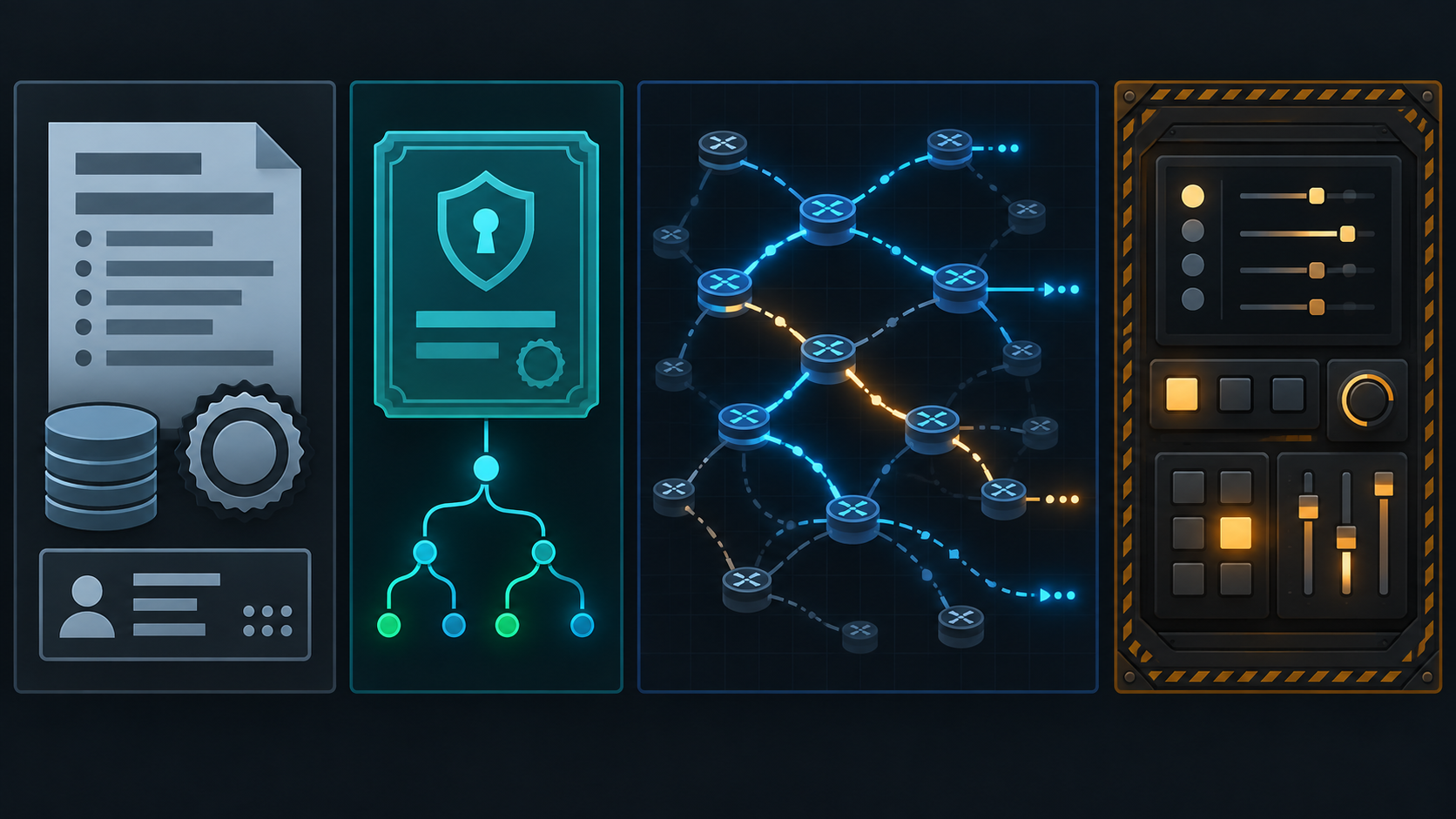
Four different evidence layers
The first layer is recorded. RIPEstat’s AS Overview and related registry material can associate a holder or label with AS210860. The RIPE Database can also expose route and route6 objects whose origin attribute names the ASN. These records are important because they identify the administrative and technical surface that investigators should examine. They remain records of a database state, however. A name in a contact or holder field is not interchangeable with a legal entity, an ASN operator or a person with authority to make live configuration changes. RIPEstat’s AS Overview and the RIPE Database inverse-origin lookup belong to this layer.
The second layer is authorized. Route objects express Internet Routing Registry intent, while RPKI data can show the state of Route Origin Authorizations for a prefix-origin combination. These are more specific than a general contact label, but their meaning is bounded by the system that created them. An IRR object can be stale or declarative. An RPKI state can support a cryptographic authorization proposition for a defined prefix, origin and time; it does not, on its own, prove who exercised operational control. The relevant evidence includes RIPEstat’s routing-consistency data and RPKI history.
The third layer is observed. RIPEstat’s announced-prefixes, routing-status, BGP-state and BGP-updates services are designed to show what specified collectors observed about AS210860 and its routes. A non-empty prefix observation or a path ending in the ASN could support a statement that routing activity was visible from particular vantage points during a stated interval. It would not establish global activity, entitlement, legal ownership or the identity of the operator. Announced-prefix data, routing status, BGP state and BGP updates must therefore be read with their observation windows and collector limits intact.
Third-party services can provide useful corroboration. BGP.Tools, Hurricane Electric’s BGP Toolkit and BGPView may show prefixes, peers or network labels that can be compared with RIPEstat. Agreement across services would strengthen the case that AS210860 was externally visible in routing data. It would not make registry-derived names independent evidence of control, and several services may rely on overlapping measurement sources.
The fourth layer is controlled. Operational control requires evidence that links a named actor to the ability—and, for a stronger claim, the exercised authority—to direct routing or network-configuration changes. None of the other layers is a substitute for that link. A contact association can identify where to investigate. An authorization record can describe a permitted relationship within its own scope. A BGP view can record behavior. None alone answers who made the change or who could have prevented it.
What the current package establishes—and what it does not
The research package preserves source snapshots for the relevant RIPEstat, RIPE Database, RPKI and routing-view endpoints, including the BGPView originated-prefixes endpoint. It also identifies the principal uncertainty: the exact live field values, timestamps, route-object contents, RPKI states, collector views and change histories are not exposed in the current documentary projection. That limitation is material.
Accordingly, this briefing does not claim that DFINFRA currently operates AS210860. It also does not claim the opposite. The evidence available here supports a disciplined research path, not a present-tense control attribution. A current conclusion would require field-level, time-aligned evidence showing the relevant registry role, any authorization status, the prefixes or paths observed, and the relationship between those records and the actor able to direct changes.
The distinction matters commercially and institutionally. Treating a registry label as control can overstate a company’s network footprint and misidentify responsibility for incidents. Treating observed routing as ownership can confuse behavior with entitlement. Treating an authorization record as proof of operation can turn a scoped technical permission into an unsupported institutional claim. The safer conclusion is narrower: DFINFRA is a traceable subject in the public evidence surrounding AS210860, while the chain from recorded association to operational control remains unresolved.
The DFINFRA directory record is therefore best read as an investigation anchor, not as a substitute for the underlying network evidence. Future monitoring should preserve the exact object, prefix, source, retrieval time, effective time and status for every material change.
What would change the assessment
A stronger assessment would require convergent evidence. For example, a time-aligned route authorization and matching BGP observation could support the narrower proposition that a prefix was authorized and observed as originated by AS210860 during a specified period. It would still not identify the organization exercising control. Direct operational records linking DFINFRA to routing or configuration changes would be needed for that conclusion.
Conversely, an authorization record without an observed route would mean authorization without observation from the specified views—not proof of inactivity. Observed routing without a matching authorization record would mean observed behavior without demonstrated matching authorization—not proof of illegality or motive. Apparent contradictions may also be temporal: records captured on different dates cannot safely be treated as simultaneous.
The practical finding is thus bounded but useful. DFINFRA and AS210860 warrant continued evidence-led monitoring. The decisive work is not finding another occurrence of the name; it is building a time-aligned chain from record, to authorization, to observation, to attributable control.
Member Briefing
Deeper Profile Context
Sign in with the right membership level to unlock the full briefing and source notes.
Only for Strategic Circle
Strategic Circle
Open to all readers. Unlock profile briefings after joining and signing in.
Join Strategic CircleOnly for Leadership Alliance
Leadership Alliance
For qualified IP-asset owners and management; sign in to unlock alliance briefings.
Join Leadership Alliance