
Summary
- RFC 3871 asks for a console that remains usable when forwarding and IP control fail, but it also exposes the dependencies hidden behind the phrase “out of band”.
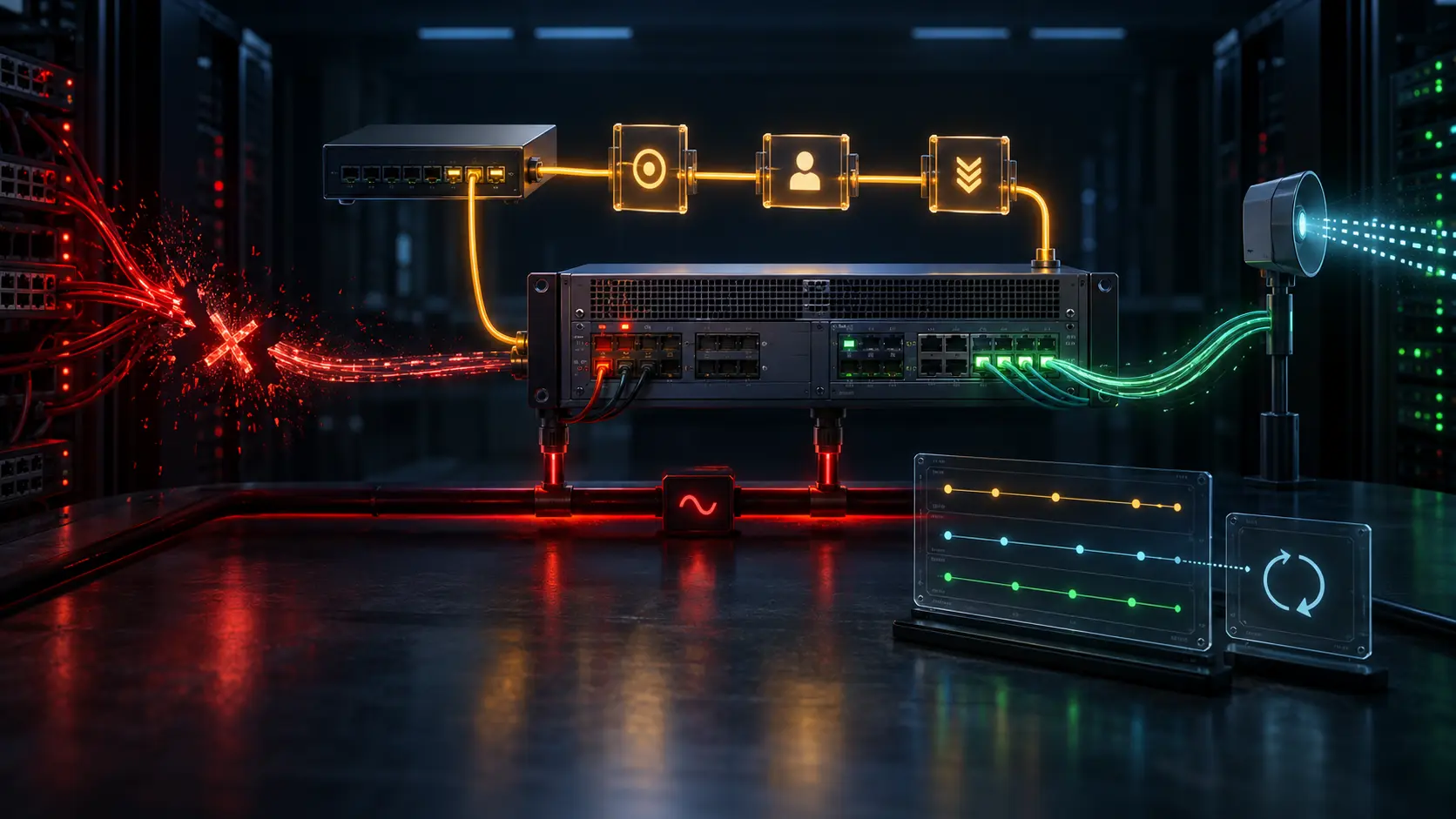
- A defensible recovery claim needs separate evidence for the alternate path, the device reached, the authentication mode, the granted privilege, the accepted command, the resulting state and independent restoration of customer traffic.
At 02:13, the production routing domain disappears from the operator's screen. The serial-console concentrator still answers. A prompt appears with the expected hostname. Then the normal TACACS service times out, because its route crossed the network that just failed.
This is the moment at which many recovery diagrams stop being useful. The console cable is physically separate from customer traffic, but the account decision is not. The operator possesses a path to the device and no authority to act through it. “Console reachable” is true. “Router recoverable” is not yet established.
RFC 3871 is unusually helpful because it does not collapse those two statements. Published in September 2004 as an Informational RFC, it defines operational security requirements for managed routers and switches in large ISP networks. It is a procurement and test-plan framework, not a certification, current vendor comparison or deployment census. Its examples are products of their period; its decomposition of the problem remains useful.
Why the console exists
In-band management is economical because it reuses interfaces and paths. It also shares their failures. Congestion can starve the management packets. A routing mistake can remove the route used to correct that mistake. A defect in a public-facing interface or IP stack can take the repair channel down with the service. Giving management traffic higher priority helps only inside the resources that still function; RFC 3871 warns that priority is not a cure for a saturated or broken path.
The RFC therefore requires a console capable of complete configuration and management independently of the forwarding and IP control planes. Its examples favor a simple serial interface because the emergency path should have fewer prerequisites than the system it is meant to repair. The document also requires a published reset method for unknown console communication parameters and rejects proprietary client requirements. In a crisis, a port that works only with a forgotten utility or an unknown baud rate is an inventory entry, not a capability.
The important noun is not port. It is path. Between the operator and the router may sit a laptop, bastion, credential vault, remote-access gateway, management network, terminal server, patch panel, serial adapter and the device's own console implementation. Each can share power, software, routing, identity or staff with the failed production environment. A different cable proves a different cable. It does not prove a different failure domain.
Remote convenience changes the authority surface
RFC 3871 explicitly notices what happens when a serial port is attached to a networked terminal server. Remote access becomes faster, but console-only powers also become remotely reachable. Password recovery, boot interruption and full configuration are valuable precisely because they sit below ordinary network management. Moving them behind an IP-accessible concentrator gives that concentrator custody of a powerful control surface.
A labelled concentrator port does not bind the session to the intended router. Patch changes, stale inventory and reused port numbers can place the right label on the wrong wire. A login banner is useful evidence, but it may be copied configuration. Stronger acceptance combines the intended concentrator and physical port with device-specific hardware identity, a controlled challenge, local observation or another proof that cannot be satisfied by the neighbouring chassis.
That identity step matters before any command is sent. A perfectly authorized reset applied to the wrong device converts a contained incident into a second outage. The recovery path must therefore preserve both reachability and target identity.
Fallback authentication is a controlled contradiction
RFC 3871 says the console should offer an authentication method that does not need functional IP or an external service. A local account can preserve access when TACACS or RADIUS is unavailable. Yet the same local account weakens centralized revocation, policy and observation if it is left broadly enabled.
The RFC treats that as a trade-off, not a slogan. A fail-open design can become a back door; a fail-closed design can make the router impossible to repair. If local fallback is enabled only after external authentication failure, the failure detector and transition logic become parts of the safety case. They need testing under timeout, rejection, partial reachability and delayed-response conditions. “AAA did not answer” is not the same event as “AAA rejected this principal”. Confusing them can either strand a legitimate operator or grant emergency access when the central authority was deliberately saying no.
Authentication also does not confer unlimited command authority. RFC 3871 separately asks for privilege levels, a default of no privilege, explicit assignment and re-authentication when privilege rises. Modern management protocols retain that separation: secure transport and an authenticated NETCONF session do not make every operation or datastore node writable, and NACM exists to decide which requests and data a user may access.
A useful incident record consequently says more than “Daniel logged in”. It identifies the authentication path, whether fallback was invoked, the policy version, the role obtained, the approval or break-glass event, the exact commands allowed and the later rotation or closure of emergency access.
A dedicated management Ethernet port is not a console
RFC 3871 allows a designated management-plane IP interface and requires that a device with such an interface not forward between management and non-management interfaces. Isolation limits accidental or hostile transit through the router. It does not make the interface independent of the router's operating system, IP stack or management configuration. The RFC says so in its warning.
This distinction is easy to lose in asset databases. Both a serial console and a dedicated Ethernet port may be tagged OOB. The serial console is intended to survive loss of the IP and forwarding planes. The Ethernet management port may be segregated yet still require the very software and configuration that failed. They are different recovery instruments and should not receive one undifferentiated availability score.
Later standards make the self-dependency problem even clearer. RFC 8994 defines an Autonomic Control Plane as a virtual out-of-band channel designed to remain independent of ordinary data-plane configuration and routing as far as practicable. It recounts a failure pattern in which engineers could not restore a disabled link because the remote tools relied on the same path. RFC 8368 is equally candid: an in-band management plane cannot obtain all the separation of a physically distinct data-communications network.
Virtual separation may still be the right engineering choice. It can remove configuration dependencies, authenticate neighbours and provide a stable address and route. But it creates an evidence chain of its own: enrollment, certificate state, secure-channel formation, adjacency, routing, endpoint reachability, application authorization and device response. Calling it virtual OOB is a design description, not a result receipt.
The nine receipts of recovery
A practical acceptance test can be organized around nine joins.
First, the declared topology must name the device, port, concentrator, alternate path, power source and authentication modes. Second, a controlled exercise must remove the production route and remote AAA rather than merely asking whether the alternate path pings. Third, the transport record must show the intended management path was used. Fourth, the device record must bind the session to the intended hardware.
Fifth, authentication must show which authority accepted the principal and why fallback was or was not invoked. Sixth, authorization must show the exact role and the permitted recovery operation. Seventh, a command receipt must bind an accepted action to a known pre-state and configuration generation. Eighth, local state must show the intended process, route or configuration changed without creating forwarding between management and customer planes. Ninth, an independent service probe must demonstrate that customer traffic or the affected application actually recovered.
The ninth record cannot be replaced by the seventh. A CLI returning success may mean only that a parser accepted a line. The process may reject the new state, a downstream router may retain stale information, forwarding hardware may not install it, or the original diagnosis may be wrong. Conversely, a service can recover through an unrelated event while the operator's command happens to be nearby in time. Command chronology is not causal proof.
After recovery comes custody. Emergency credentials need rotation. Temporary routes and filters need removal. A configuration backup must be reconciled with the actual running state. Logs need reliable time, original addresses and remote retention; RFC 3871's logging requirements exist because an incident without a trustworthy record cannot distinguish approved repair from unauthorized change.
What RFC 3871 does not prove
Nothing in this packet establishes that a named operator implements these controls, that a particular vendor's console is independent, or that physical OOB always outperforms a virtual alternative. The RFC's 2004 cryptographic examples are historical and must not be mistaken for current algorithm advice. The document excludes physical security from its added requirements even though building access, rack access and shared power are central to a real recovery design.
It also does not turn any one successful test into permanent assurance. Cabling changes, account rotation, terminal-server upgrades, topology redesign and staff turnover can invalidate the path. The durable evidence is a dated exercise against a declared failure model, followed by remediation and another exercise.
Sources
- https://bib.ietf.org/public/rfc/bibxml/reference.RFC.3871.xml
- https://datatracker.ietf.org/api/v1/doc/document/rfc3871/?format=json
- https://datatracker.ietf.org/doc/rfc3871/
- https://datatracker.ietf.org/doc/rfc3871/history/
- https://heng.lu/minimum-initial-specification-localized-future-decision-voluntary-adoption-internet-coordination-system/
- https://heng.lu/running-code-primary-the-patch-needed-to-preserve-the-internet-original-design/
- https://heng.lu/the-policy-mirror/
- https://www.rfc-editor.org/errata_search.php?rfc=3871
- https://www.rfc-editor.org/info/rfc3871
- https://www.rfc-editor.org/rfc/rfc2196.html
- https://www.rfc-editor.org/rfc/rfc3013.html
- https://www.rfc-editor.org/rfc/rfc3631.html
- https://www.rfc-editor.org/rfc/rfc3871.html
- https://www.rfc-editor.org/rfc/rfc3871.txt
- https://www.rfc-editor.org/rfc/rfc4778.html
- https://www.rfc-editor.org/rfc/rfc5424.html
- https://www.rfc-editor.org/rfc/rfc5920.html
- https://www.rfc-editor.org/rfc/rfc6241.html
- https://www.rfc-editor.org/rfc/rfc8341.html
- https://www.rfc-editor.org/rfc/rfc8368.html
- https://www.rfc-editor.org/rfc/rfc8994.html
Member Briefing
Deeper Profile Context
Sign in with the right membership level to unlock the full briefing and source notes.
Only for Strategic Circle
Strategic Circle
Open to all readers. Unlock profile briefings after joining and signing in.
Join Strategic CircleOnly for Leadership Alliance
Leadership Alliance
For qualified IP-asset owners and management; sign in to unlock alliance briefings.
Join Leadership Alliance