The short version
- McLane Company, Inc. (USDOT 144101) carries a Satisfactory safety rating earned at a compliance review that closed on 14 November 2002. The rating issued six days later. Nothing in the provisions read here obliges the agency to hold another one.
- The monthly percentile that now does the work of a verdict has no decision, no author and no date behind it — and 97.9 per cent of the exposure factor deciding who McLane is measured against comes from the carrier's own eighteen-month-old filing.
On 14 November 2002 a federal inspector finished a compliance review of McLane Company's trucking operation and filed it. Six days later the paperwork came back carrying one word: Satisfactory. On 15 November 2026 — the currency date printed on the same government page, under a heading that promises the rating below is current — that word was still carrying the entire load. The interval is 8,767 days. Across every provision read for this article, not one of them requires anybody to look again.
That page is the Federal Motor Carrier Safety Administration's company snapshot for McLane Company, Inc., USDOT 144101 (the company snapshot). It answers three questions in a single screen: may this fleet run, who said so, and when. Legal name. MC-183811. An address at 4747 McLane Parkway, Temple, Texas. Operating authority reading AUTHORIZED FOR: Motor Carrier of Property (Except Household Goods). Status ACTIVE. No out-of-service date. And then, under a heading declaring the rating below current as of 11/15/2026, the line that matters: Rating Date: 11/20/2002 Review Date: 11/14/2002 Rating: Satisfactory Type: Compliance Review.
Six days is not a scandal; it is a clock. The rule allows thirty, because a safety rating "will be issued to a motor carrier within 30 days following the completion of a compliance review" (49 CFR Part 385). The trigger is the review. Not the calendar, not the anniversary, not the fleet's growth, not the arrival of a new tractor. The review.
What "Satisfactory" was actually measuring
The standard that produced the word is not a score, and that is where the trouble starts. Section 385.5 asks a carrier to show "adequate safety management controls in place, which function effectively to ensure acceptable compliance with applicable safety requirements to reduce the risk associated with" eleven numbered risk areas, lettered (a) through (k), beginning with commercial driver licence violations (49 CFR 385.5). The section was last amended at 77 FR 28454 in May 2012 — a decade after McLane's review — and it assigns no rating of its own.
What the agency weighs when it does assign one sits at 385.7, and it sits there in the permissive mood: the factors "may include all or some of the following." Then seven of them — the adequacy of management controls, the frequency and severity of regulatory violations, violations found at roadside, out-of-service violations, whether the same violations recur across reviews, accident and hazardous-materials rates and trends, and violations of compatible state, Canadian or Mexican rules (49 CFR 385.7). Seven factors here. Six in the rating methodology that actually computes the grade. Both counts circulate in the wild, and neither is the other.
Four words, one of which has teeth
The vocabulary has four places, not three. Satisfactory, Conditional, Unsatisfactory, and Unrated — which 385.3 defines as a carrier to which no safety rating has been assigned, adding in terms that safety audits do not result in safety ratings (49 CFR 385.3). Conditional and Unsatisfactory are separated by a single tense: controls whose inadequacy could result in the listed risks, against controls whose inadequacy has resulted in them.
Only one of those words carries a bar. Under 385.13 an Unsatisfactory carrier is prohibited from operating a commercial motor vehicle, the prohibition beginning on the 46th day after notice for placardable-hazmat and passenger carriers and the 61st day for everyone else, extendable by up to 60 further days for good-faith repair, with operating authority revoked where the proposed rating becomes final (49 CFR 385.13). A Conditional carrier runs. So does an Unrated one. And the section itself points readers to the electronic records system for a carrier's most current safety rating — the same page that answered our three questions.
Two trucks, four drivers, and a 185-unit ghost
What that page says about the fleet deserves a second read. Two power units. Four drivers. An MCS-150 form dated 19 December 2025, its mileage field reading 1 (2025). Two power units and four drivers is a two-truck operation as printed — and the same record's own measurement page supplies 185 power units eighteen months earlier.
The finding is about the record, not the trucks. For this carrier the public page anchors a name, an authority and a 2002 verdict, and the operating scale it prints cannot be reconciled with the scale its own exposure factor is built from. A bookkeeper that starts believing its ledger is a throne stops explaining itself; here the ledger cannot even agree with itself.
The score that replaced the verdict has no author
Then there is the other answer. The agency's Safety Measurement System publishes a percentile for each behaviour category, and is careful to say what it is not. A displayed symbol "is not intended to imply any federal safety rating of the carrier pursuant to 49 USC 31144"; absent an UNSATISFACTORY rating or a discontinuance order the carrier "is authorized to operate on the Nation's roadways"; and the page carries a currency date of 30 October 2026 (the CSA site's disclaimer). The December 2012 factsheet goes further — "SMS data are not safety ratings" — and defines the percentile: 0 to 100, where 100 is the worst performance, computed inside a peer group of carriers with similar inspection counts, over the last 24 months (the December 2012 factsheet). The August 2014 factsheet adds that BASIC percentiles do not affect a safety rating, that a rating reflects the date of the investigation, and that the percentiles update monthly (the August 2014 factsheet).
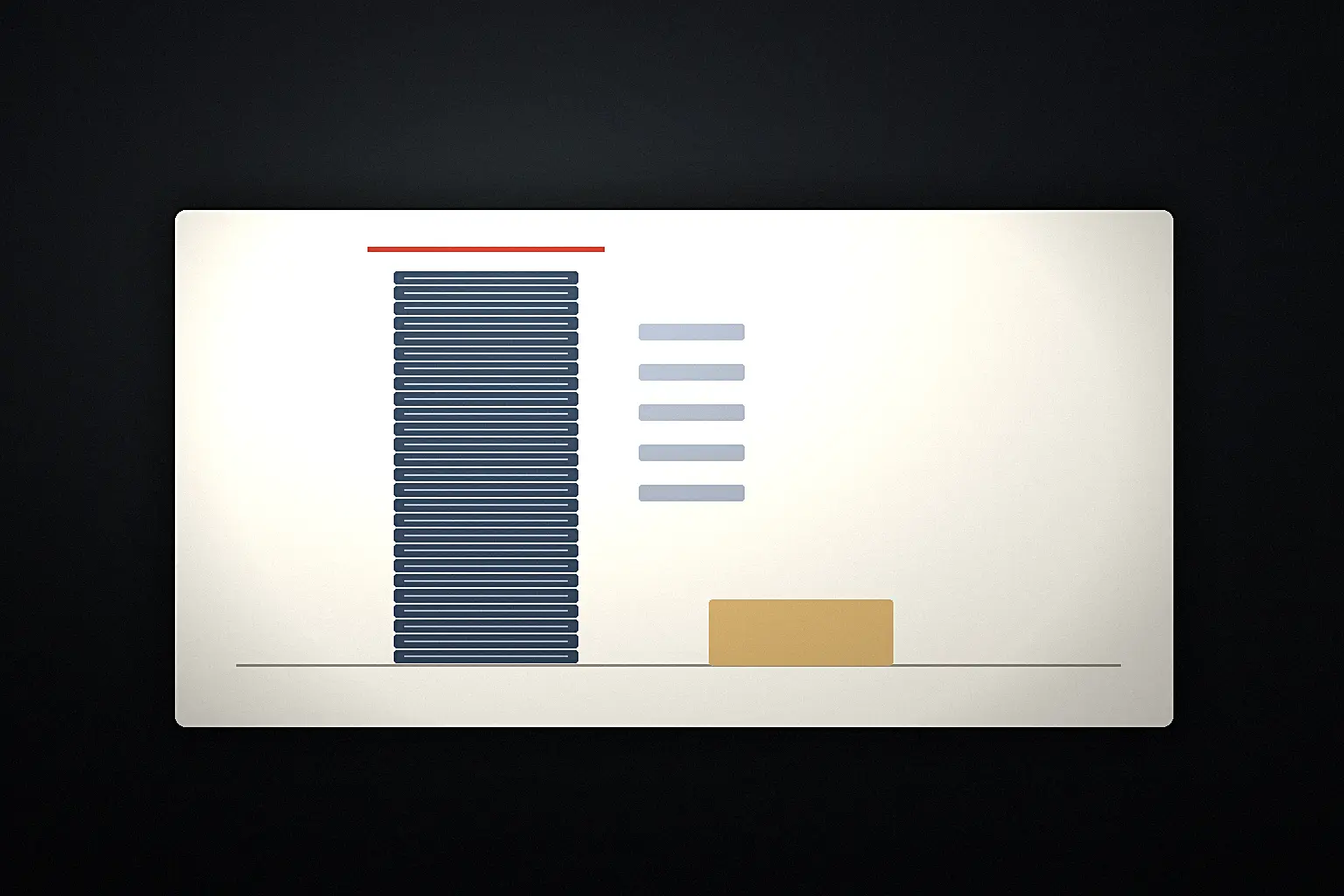
For USDOT 144101 the SMS overview covers a 24-month record ending 25 September 2026 — 51 days before the SAFER snapshot's own currency date — and prints the seven categories with Crash Indicator and HM Compliance marked Not Public (the SMS overview). It also prints the three inputs behind one number: 2 current power units, plus 2 power units six months ago, plus 185 power units eighteen months ago, averaging 63. Two plus two plus 185 is 189; 189 divided by three is 63 exactly. And 185 divided by 189 is 0.9788 — so 97.9 per cent of the units behind that average come from the eighteen-month-old snapshot. The ratio between the fleet the same page prints eighteen months ago and the fleet it prints now is 92.5 to 1.
Read on 28 November 2026, that page printed no numeric percentile for this carrier in its public property-carrier view. The numbers exist on a mirror. CarrierSource, a commercial aggregator, publishes a Vehicle Maintenance measure of 4 at the 29.6th percentile and an Unsafe Driving measure of 0.12 at the 0.9th percentile, with HOS Compliance, Driver Fitness and Controlled Substances at zero violations and zero measure, driver inspections 4 and vehicle inspections 1, all at 0 per cent out of service (CarrierSource's record). The agency's own 2014 factsheet warns that such third-party scores are "not generated or endorsed by FMCSA."
The alternative the agency described and then abandoned
The agency has also described the road it did not take. A rulemaking FAQ contrasts the two instruments in its own words: "SMS is based on percentiles - SFD is based on absolute or fixed performance measures", and "SMS scores can be impacted by other carriers - SFD can only be impacted by a carrier's own inspections and investigations." It adds that SMS can generate a score on three or five inspections where the proposed fixed measure would have required eleven or more with violations (the Safety Fitness Determination rulemaking FAQ). The page's footer reads last updated 22 January 2016. The proposal it explains was never adopted, and the percentile stayed.
Ninety-four per cent of the register is unrated
How many carriers that percentile speaks for is a question the agency's own file answers and two third parties have computed, on two different perimeters. CarrierScrub reports a read of the company census file on 16 September 2026: 4,502,467 records, 236,352 of them carrying a rating — 150,175 Satisfactory, 70,279 Conditional, 15,898 Unsatisfactory — and 4,266,115 unrated, stated as 94.8 per cent (CarrierScrub's read of the census file). The four parts add back to the total exactly; 4,266,115 over 4,502,467 is 0.9475, which prints as 94.8 only on rounding up. fleetfax traces a widely quoted figure to the Pocket Guide to Large Truck and Bus Statistics, 2022 edition, 2021 data, snapshot of 28 January 2022: 646,777 of 690,091 interstate freight carriers with no rating, stated as 93.7 per cent, with the warning that a share over all registrants measures something else (fleetfax's account). 646,777 over 690,091 is 0.9372, which prints as 93.7 only on rounding down. Two shares, two perimeters, no trend formed across them, and neither underlying agency file was opened here.
The page nobody has built
A stranger trying to read one carrier as a closed record needs eight fields: identity; what the registration authorises; out-of-service status; the determination word; the date of the act that produced it; the date it issued; the findings; and the current measurement with its month, peer group, exposure and resulting percentile. Six of those sit on one page and carry dates from 2002.
The findings appear nowhere across the two agency surfaces read on 28 November 2026 — which of the eleven risk areas failed, and what the carrier was required to do about it. The current measurement arrives in three pieces: the window and the exposure on the SMS page, the peer-group method in a factsheet, and a percentile for this carrier only on a commercial mirror. One page that printed, beside a DOT number, the review date, the eleven risk areas examined and the ones that failed, and the measurement month with the size of the peer group it was scored against, would let a stranger date the determination and audit the percentile.
No reviewed page does.
Our own archive is a different animal, and the copy should say so. McLane Company, Inc. in the BTW directory is a number-resource entry: region Global, primary domain null, no relationships, no leadership contacts, no earlier articles, and one evidence link to the RDAP record for autonomous system 18961. It anchors a name recorded against internet number resources. It anchors nothing about motor carriage — no rating, no inspection, no percentile. A literal search of existing article titles for the phrase motor carrier, run on 28 November 2026, returned nothing.
The answer, and the two ways of not giving it
So: yes, McLane may run. The page says ACTIVE, no out-of-service date, authority for motor carrier of property, and a Satisfactory rating that has stood since a review closing on 14 November 2002. The sentence has no reasons attached. The number that refreshes monthly has no author, no decision and no date. And 97.9 per cent of the exposure deciding which fleets this one is measured against comes from its own return of eighteen months ago.
A verdict with no reasons and a score with no author are not two answers to one question. They are two ways of not answering it.
Member Briefing
Read the full trend briefing
Members read the full briefing with the source notes behind every finding.
Strategic Circle
A daily briefing in your language, built from changes we have verified.
Join for USD 20/monthCancel anytime.
Members also get the full research library, a daily briefing on the networks they follow and the private forum.