Summary
- The Auditor General of Canada's report, tabled on 29 October 2026, concludes that FINTRAC did not effectively carry out either of its core responsibilities: producing financial intelligence and overseeing compliance with anti-money-laundering and anti-terrorist-financing law.
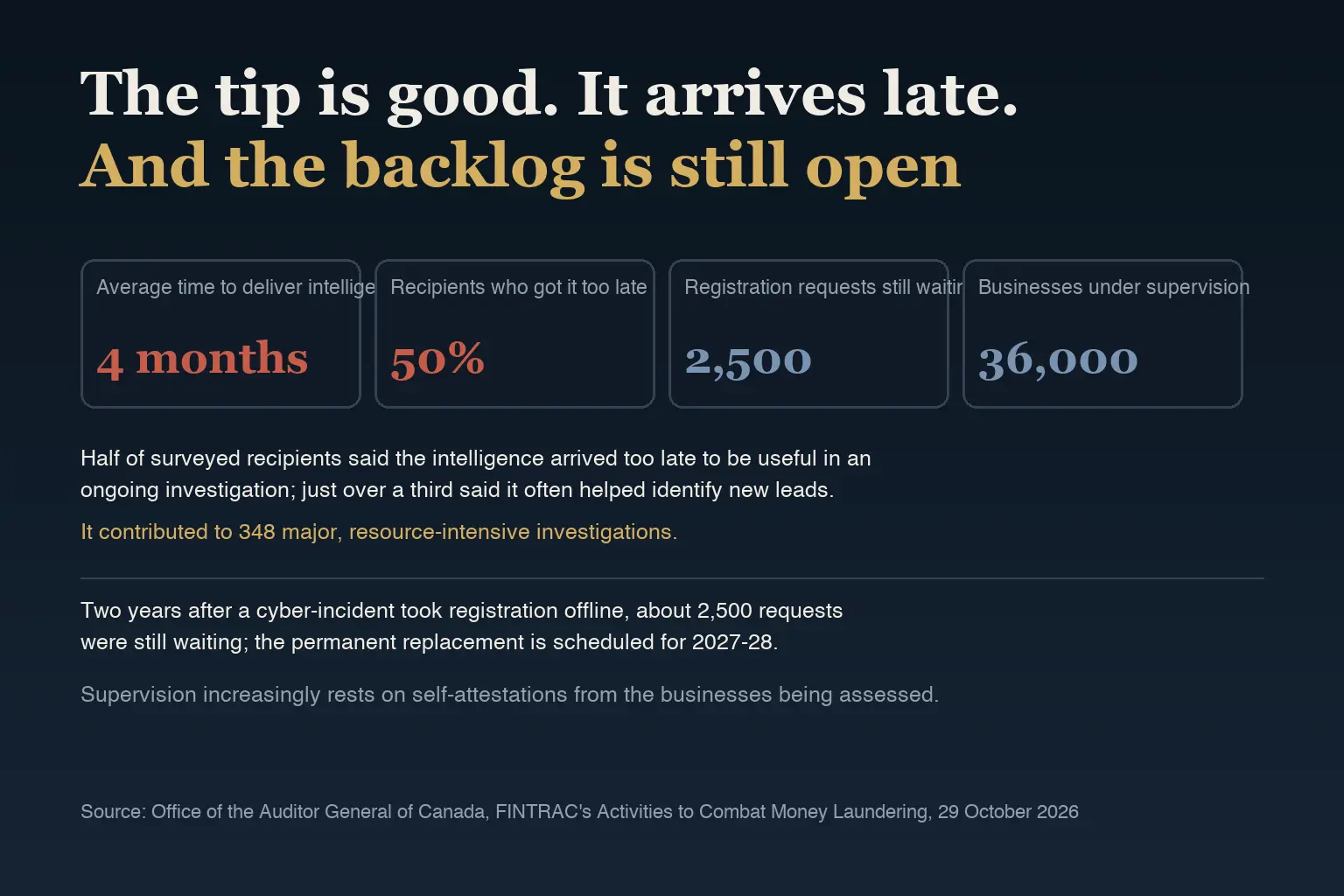
- FINTRAC took an average of nearly four months to provide financial intelligence to law enforcement and other agencies; half of the surveyed recipients said it arrived too late to be useful in ongoing investigations, while just over a third said it often helped identify new leads.
- The agency oversees about 36,000 businesses, and as that number grew it increasingly relied on self-attestations and information provided by businesses to judge whether they met their obligations.
- Two years after a cyber-incident forced its registration system offline, FINTRAC had not cleared the backlog: about 2,500 requests were awaiting processing at the audit's publication, with a permanent replacement not expected before 2027–28.
The intelligence works; it arrives after the moment
Start with what the audit credits, because it makes the finding sharper. Just over a third of surveyed recipients said FINTRAC's intelligence often helped identify new leads, and the government's response to the report notes that the intelligence contributed to 348 major, resource-intensive investigations. The product is not worthless. It is late.
Half of the recipients surveyed said the intelligence arrived too late to be useful in ongoing criminal investigations. The average time from a flag by law enforcement to delivery was nearly four months. In money laundering, timing is the whole mechanism: assets are frozen or they are moved, transactions are stopped or they clear, a lead is pursued now or it goes cold.
Thirty-six thousand businesses and a signature
FINTRAC supervises roughly 36,000 reporting entities — banks, casinos, mortgage lenders, money services businesses. The audit finds that as the population under supervision grew, the agency leaned more heavily on self-attestations and on information the businesses themselves supplied. That is a rational response to volume and a weak basis for assurance, because the entity being assessed is also the entity producing the evidence.
A cyber-incident with a two-year tail
In March 2024 a cyber-incident forced FINTRAC to take its corporate systems, including registration, offline to protect data. Two years later the consequences were still in the queue: about 2,500 registration, renewal and other requests from money services businesses were awaiting processing at publication, handled through a temporary manual process while a permanent system is built for 2027–28.
That tail is the most concrete governance failure in the report. An agency whose job includes knowing who is registered to move money spent two years not fully knowing it, and the fix is scheduled into a fiscal year two and a half years after the disruption.
What the audit is really describing
Put the three findings together and the shape is capacity without throughput. The intelligence is produced and used, the supervision exists, the registration work is being done by hand. What is missing is the machinery to move each of those at the speed the purpose requires: a delivery pipeline for intelligence, an assurance model that does not rest on self-declaration, and a registration system that can be replaced without a two-year manual interlude.
The policy context sharpens it. The 2026 budget proposed moving supervision of banks' anti-money-laundering efforts from FINTRAC to OSFI, the banking regulator, to strengthen supervision of the largest institutions. Whether or not that transfer proceeds, the audit's logic points the same way: someone has to own throughput, not just mandate.
What would change the judgement
Three measures, all publishable. Median and 90th-percentile days from flag to intelligence delivery, alongside the average, so the tail is visible. The share of supervisory assessments based on evidence the agency generated rather than received. And a dated backlog curve for registration requests, with the number still open each quarter until it reaches zero.
A fourth is harder and matters more: a published statement of what FINTRAC is for, in numbers. If the test is convictions or frozen assets, the agency should say so and measure it. If the test is timely intelligence, then four months is the number to beat, and the public can watch it fall.
Sources
Member Briefing
Read the full trend briefing
Members read the full briefing with the source notes behind every finding.
Strategic Circle
A daily briefing in your language, built from changes we have verified.
Join for USD 20/monthCancel anytime.
Members also get the full research library, a daily briefing on the networks they follow and the private forum.