Summary
- The NAO's 13 November report finds the Prevent programme has evidence of positive impact on those it supports, with 159 multi-agency Channel panels in England and Wales taking a strong collaborative approach, but rising demand and changing case types are straining the system.
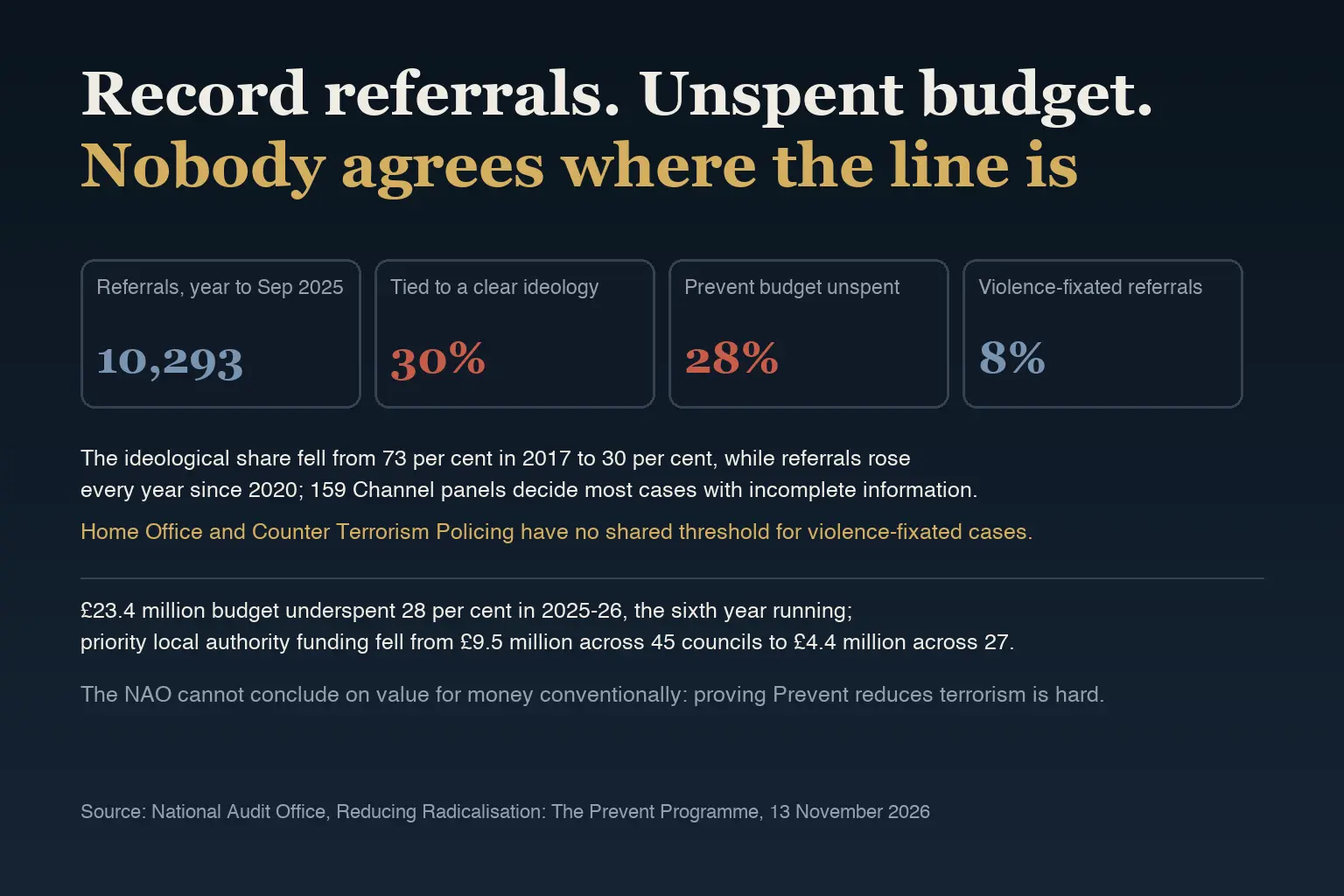
- Referrals reached a record 10,293 in the year ending September 2025, up year on year since 2020, while the share linked to a clear, dominant extremist ideology fell from 73 per cent in 2017 to 30 per cent.
- In 2025–26 the Home Office underspent its £23.4 million Prevent budget by 28 per cent, continuing a six-year pattern averaging £5.6 million (17 per cent) a year, while funding for priority local authorities fell from £9.5 million across 45 authorities in 2020–21 to £4.4 million across 27 in 2026–27.
- The Home Office and Counter Terrorism Policing have no unified threshold for violence-fixated individuals, who made up 8 per cent of referrals in the year to September 2025, and the department has not done enough to evaluate Channel interventions or explain where Prevent works.
Demand went up, the definition went soft
Two lines in the report, read together, describe the whole problem. Referrals to Prevent reached 10,293 in the year ending September 2025, rising every year since 2020 and boosted by awareness after the 2024 Southport attack. And the proportion of referrals linked to a clear, dominant extremist ideology fell from 73 per cent in 2017 to 30 per cent.
That is not a failure of the programme; it is a change in the population it meets. A system built to spot a recognisable ideology now receives mostly cases without one: people fixated on extreme violence or mass-casualty attacks, the category introduced in April 2024, which accounted for 8 per cent of referrals in the year to September 2025. The NAO's finding is that the Home Office and Counter Terrorism Policing do not share a view of when those individuals cross the threshold for Channel support.
Local panels are the best and weakest part
The Channel panels are the programme's strength and its exposure. One hundred and fifty-nine multi-agency panels bring policing, health, education and social care together and, in the NAO's account, consider cases carefully and build a fuller picture than any single agency could. They are also the place where the absence of a shared threshold becomes a decision made by whoever is in the room.
The audit records panels deciding with incomplete data because information requests from delivery partners arrive late. Add rising volumes and more borderline cases, and the risk named in the report follows: inconsistent decision-making between local authorities. A person's support can depend on which panel area they live in, which is precisely the kind of variation that a national programme with local delivery is supposed to control.
The money is small, and it is not being spent
Prevent is cheap next to an attack, and cheap next to the £3 billion counter-terrorism budget it sits inside. It is also, by the audit's account, under-managed: the Home Office underspent its £23.4 million budget by 28 per cent in 2025–26, the sixth consecutive year of underspending, averaging £5.6 million or 17 per cent a year in real terms.
At the same time, funding to priority local authorities fell from £9.5 million to 45 authorities in 2020–21 to £4.4 million to 27 authorities in 2026–27. The combination is unusual: a programme under pressure from demand, with money unspent at the centre and less money reaching the places that do the work. Because delivery is local and spread across partners, the department also lacks a complete picture of the programme's full cost, which makes the underspend harder to interpret than it looks.
Value for money that cannot be conventionally assessed
The NAO says plainly that it cannot conclude on value for money in the usual way, because it is inherently difficult to prove that Prevent reduces the incidence of terrorism. What it can do is note that available evidence suggests a positive impact on many supported individuals, and that the department has not evaluated Channel interventions well enough to tell the public or itself which parts work.
That is the governance gap in one sentence. A programme whose outcome is hard to measure needs its intermediate measures to be excellent, and this one's are not: no agreed threshold, incomplete data at the point of decision, and a communications problem that the report links to continued public scepticism.
What would change the judgement
Three things, all inside the department's control. A published, joint Home Office and Counter Terrorism Policing threshold for violence-fixated cases, so panels apply one rule. A cost model for local delivery, including what local authorities spend on panels, so the next budget decision is made on evidence rather than on an underspend nobody explains. And a published evaluation of Channel support against a comparison group, so the claim of positive impact can be tested rather than asserted.
There is a fourth, larger question in the report: as the department considers future scope and eligibility, it should recognise that the programme already supports people who do not fit traditional notions of a terrorist threat. If they are to be supported elsewhere, the report says, alternative services need the capacity, skills and resources first. That sequencing is the difference between a redesign and a handover.
Sources
Member Briefing
Read the full trend briefing
Members read the full briefing with the source notes behind every finding.
Strategic Circle
A daily briefing in your language, built from changes we have verified.
Join for USD 20/monthCancel anytime.
Members also get the full research library, a daily briefing on the networks they follow and the private forum.