Summary
- A 1 November individual Internet-Draft describes a mismatch in home broadband: gateways can identify AI inference or live-video traffic, while standard subscriber permission and accounting still cover the whole session.
- The authors name three missing common pieces: a service-flow identifier shared across network and billing systems, per-flow authorization, and per-flow accounting with a lifecycle and correlation record.
- The document is a problem statement, not an adopted protocol. It also says a terminal’s traffic label cannot authorize better treatment; failed validation should fall back to the session profile.
The meter still has one dial
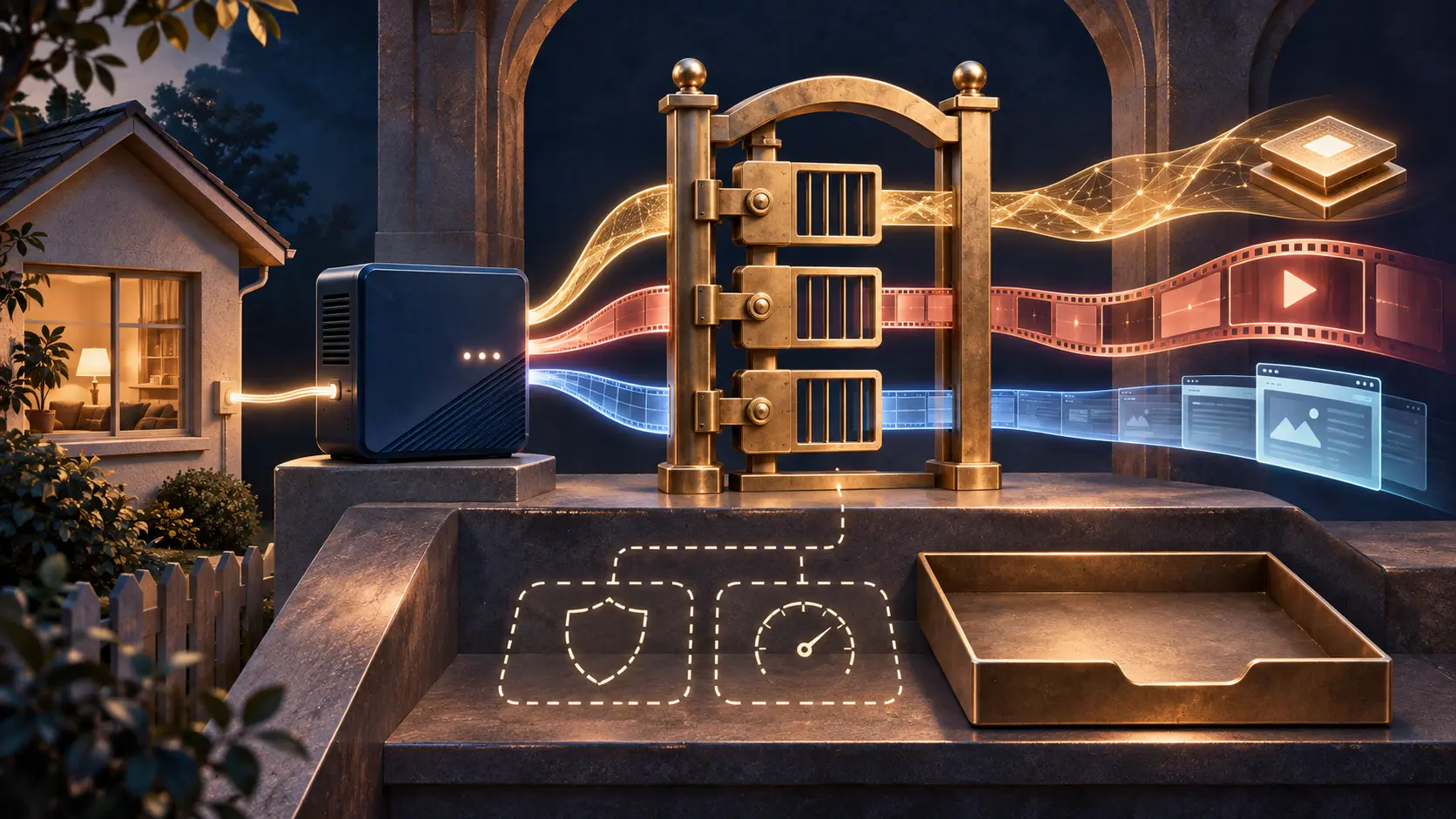
A household may be using a cloud assistant while someone else streams video. The access gateway can classify these as different flows and place them on different paths, the new draft says. But the ordinary broadband account is one PPPoE or IPoE session. Its RADIUS authorization and accounting describe that whole session. The gateway can see a distinction that the shared permission and billing language cannot carry across systems.
The authors put the missing chain in order: identify the service flow, authorize its treatment, then account for it. A device-local Filter-Id name means little to another vendor. A terminal can set DSCP or 802.1p markings itself, so the marking cannot stand in for permission. Five-tuples change across connections and are not known at the authorization point. Without a common identifier, a classifier’s judgment has no stable name that the BNG, AAA server and accounting system can all understand.
The second gap is who may change the service. Standard RADIUS attributes, and a Change of Authorization, operate on a subscriber session. The draft says they do not express a short-lived grant for one flow, its queue or its rate. Existing extension syntax could carry structured data, but no shared semantics define this specific service. The third gap is the receipt: standard accounting counts the session’s bytes and time. It has no separate flow counter, creation or termination event, or combined session/flow/instance identifier to reconcile a particular charge.
Vendors may build private systems; the authors’ claim is that the common interoperation path is missing.
The security section makes the power boundary explicit. A terminal’s claim that a flow deserves special treatment must be checked against the subscriber’s authorization. If it fails, use the ordinary session profile. A flow-level grant also cannot outrun the session’s aggregate limit. More detailed accounting records could reveal habits inside a home, so the draft calls for minimal identifiers and bounded retention. The IETF record labels this an individual Internet-Draft, I-D Exists, with no IETF endorsement or protocol extension. The paper maps a missing decision-and-receipt chain; it does not show a customer charged for an AI stream.
Member Briefing
Deeper Profile Context
Sign in with the right membership level to unlock the full briefing and source notes.
Only for Strategic Circle
Strategic Circle
Open to all readers. Unlock profile briefings after joining and signing in.
Join Strategic CircleOnly for Leadership Alliance
Leadership Alliance
For qualified IP-asset owners and management; sign in to unlock alliance briefings.
Join Leadership Alliance