
Summary
- On 14 October, Rio prison authorities identified 143 devices in irregular use; Anatel later blocked them under the new administrative route.
- This is an individual IMEI-based network restriction, not a report of broad-area radio jamming. Public sources do not show carrier receipts or post-block tests for the 143 devices.
A control path, not a jammer test
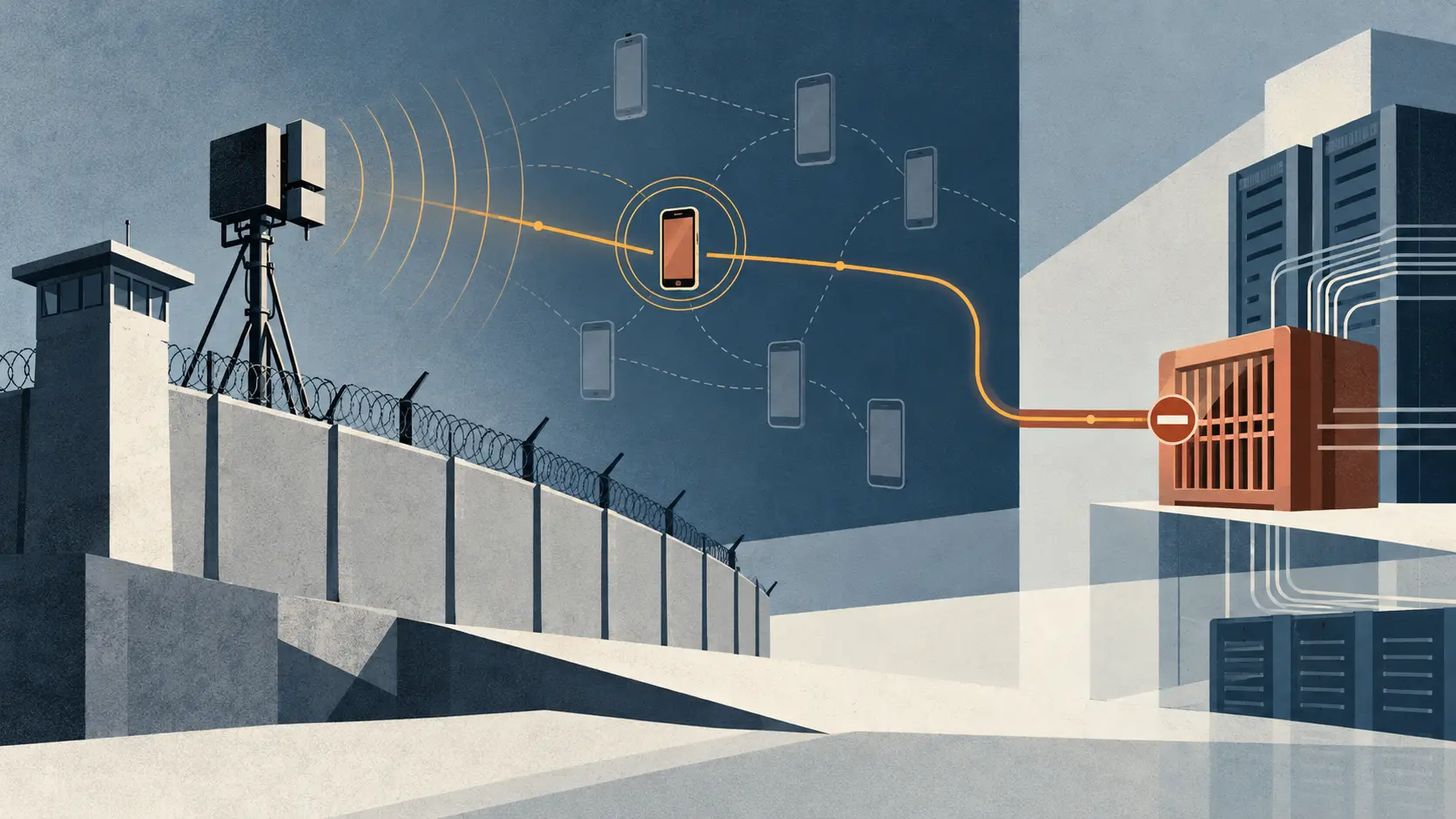
Brazil has moved one step from a prison intelligence finding to a telecom-network action. SENAPPEN says an operation in Rio de Janeiro on 14 October identified 143 devices in irregular use in state prisons and that Anatel subsequently blocked them. The detection equipment found devices connected to mobile networks and identified their IMEIs, the identifiers used to request an individual restriction. No physical seizure was required.
That distinction matters. Decree 13.136/2026 establishes separate mechanisms: an individual terminal can be blocked by IMEI, while a radio-signal blocker can operate within a registered prison-security perimeter. The 143-device announcement describes the first mechanism. It is not evidence that a jammer was installed or that a surrounding area was subjected to a radio blackout.
The decree creates a national perimeter register and a platform intended to route reports through Sisdepen. That system has up to 180 days for implementation. During the transition, a designated state prison authority may send an individual IMEI request directly to Anatel and notify the Justice Ministry at the same time. The first operation therefore tests a practical interim route before the national platform is complete.
The invisible middle of the transaction
The published account confirms a total identified and a total described as blocked. It does not disclose which carriers received which identifiers, whether each carrier acknowledged the request, how completion was tested, or whether any request failed. Those records may exist internally; they are not in the public release. The difference between “blocked” as an official outcome and a reproducible, device-level audit trail is the central evidence gap.
This is also a governance question. An IMEI is a device identifier, not proof by itself that a particular person used the device. Detection, attribution, request authority, network execution, and later correction are separate steps. The decree calls for a standardized technical report and provides for correction or removal where an IMEI is wrong or unauthorized use is not established. The BNCR rules separately provide for access controls, audit trails, review, and removal for material error. How those protections work together in this new prison context is not demonstrated by the first press release.
The operating model also has two records to reconcile. A prison authority creates the factual basis; Anatel takes the network action; the Ministry receives notice; and the restriction enters the national restricted-device framework. Each hand-off needs a durable link between the report, exact IMEI, request, operator response, effective time, and any correction. Without that chain, a headline number measures throughput but not the quality or reversibility of the control.
The next useful disclosure is not another aggregate. It is a privacy-safe reconciliation: requests submitted, accepted, rejected, completed, and independently checked; the time between each step; and corrections or removals. That would let observers distinguish an administrative power that is legally available from one whose operational execution is both reliable and contestable.
Sources
Member Briefing
Deeper Profile Context
Sign in with the right membership level to unlock the full briefing and source notes.
Only for Strategic Circle
Strategic Circle
Open to all readers. Unlock profile briefings after joining and signing in.
Join Strategic CircleOnly for Leadership Alliance
Leadership Alliance
For qualified IP-asset owners and management; sign in to unlock alliance briefings.
Join Leadership Alliance