
Summary
- Batfish is an Apache 2.0 open-source network-analysis project that converts supported device, cloud and routing inputs into a common model and answers network-wide questions before a change reaches production.
- Its symbolic analysis can search large classes of packet headers, routes and failure states, but every result is conditional on snapshot completeness, parser fidelity, supported semantics and the property the operator chose to test.
- The project grew from research published at NSDI in 2015 into an actively maintained automation engine with pybatfish, differential analysis, cloud modelling and expanding support for platforms including SONiC, A10 and EVPN/VXLAN.
- Batfish is distinct from Intentionet and other commercial assurance products: the open project can move failures into review, but operators still own collection, intent, staged rollout, live telemetry and the decision to trust or override the model.
A harmless-looking edit can have a network-wide blast radius
A network change usually appears first as text. An engineer edits a route map, an access list, a BGP neighbour, a redistribution rule or a cloud route table and reviews the few lines that changed. The local edit may be syntactically valid and entirely reasonable. Production does not execute that line in isolation. Routers, firewalls, virtual networks and overlays combine it with every other relevant policy, route advertisement, topology constraint, tunnel, default and failure state. A one-line change can therefore alter reachability or route selection far from the device on which the line was written.
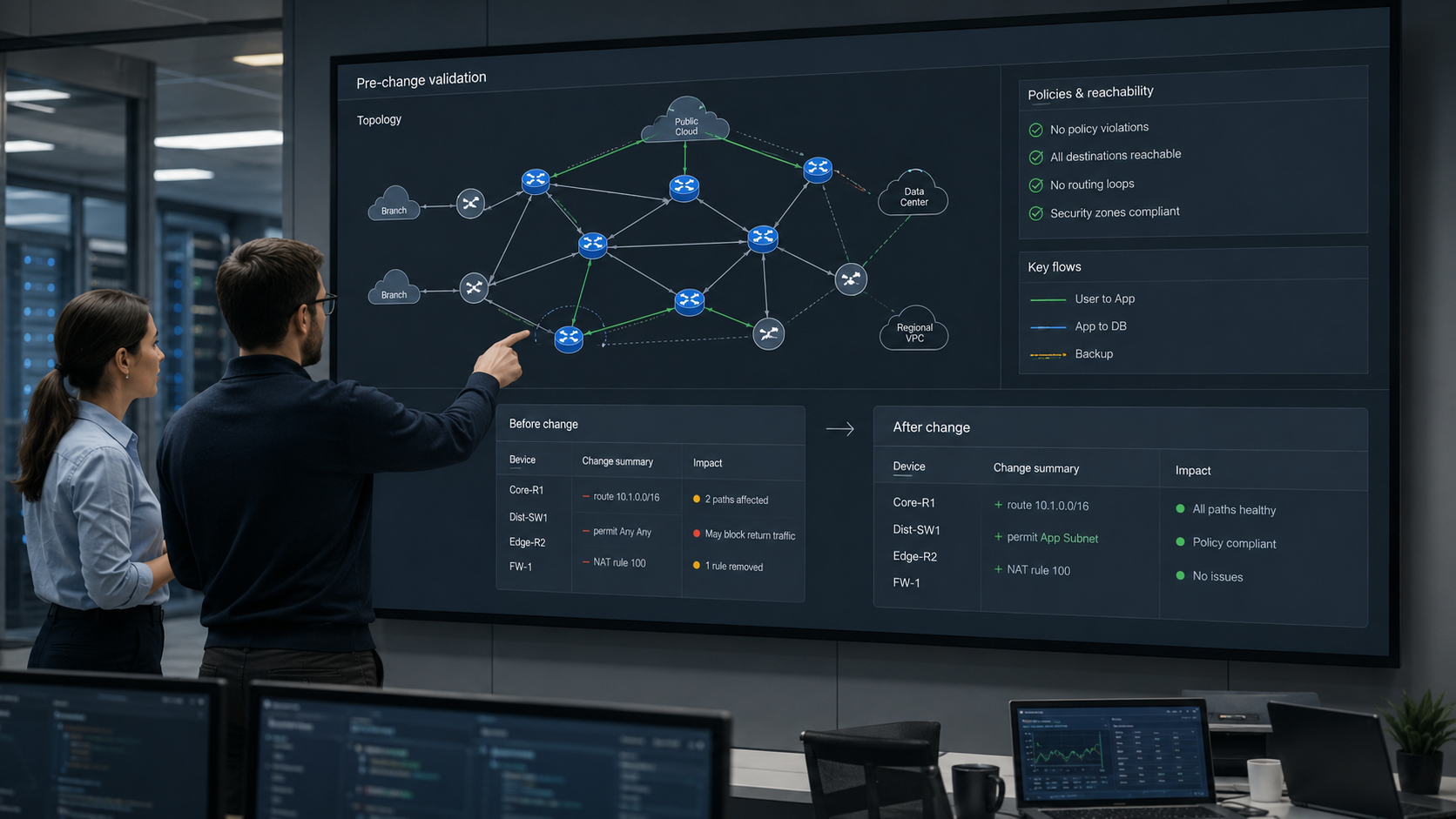
That gap between local configuration and global behaviour is the problem Batfish was built to analyse. The operator gives Batfish a snapshot containing configurations and, where necessary, environmental information such as topology hints, runtime routes, host data or cloud state. The engine parses the supported syntax, converts it into a vendor-independent representation, computes control-plane and forwarding outcomes and answers questions about paths, filters, reachability, routing policy and selected failures.
Through the Python client pybatfish, those questions can become tests inside the same repository and review process that prepares the configuration.
The strongest Batfish results are sometimes described as proofs. That description is useful only when the boundary is stated at the same time. A symbolic reachability query can search the packet-header space represented by the model and show that no modelled packet in a defined class reaches a forbidden destination, or return a counterexample when one does. The result can cover far more combinations than a human reviewer could enumerate manually.
It still says nothing about a device, route or physical condition that never entered the snapshot, and it does not observe queue depth, optical power, packet corruption, an undocumented ASIC behaviour or an application failure above the network.
The distinction is central to the project rather than a caveat added after the fact. Batfish is most useful when it turns assumptions into inspectable engineering objects: this is the configuration that was analysed, this is the parser coverage, this is the property that was asked, this is the engine version and this is the result. A passing answer is therefore evidence about a defined model of a proposed state. It is not an immunity certificate for production.
That narrower promise is still significant. Traditional network assurance has often relied on text review, lab testing, post-change probes and the experience of the engineer carrying the pager. Batfish moves a large class of questions earlier. A route leak, blocked backup path or unexpected security-policy change can be found while the proposed state is still a pull request rather than after it has become an incident. The project is infrastructure for the change process rather than the packet path itself.
Configuration became distributed code before most networks treated it that way
The technical problem that produced Batfish is not that network devices lack configuration checkers. It is that network policy is distributed across many devices and systems that implement overlapping parts of one outcome. Reachability can depend on a route being originated, imported, transformed, selected, exported, accepted by another device, installed into a forwarding table, permitted by an ACL, translated by NAT and carried through a tunnel. Each individual configuration may look correct while their interaction violates the intended policy.
That makes device-by-device review structurally incomplete. A local syntax checker can tell an operator that a command is accepted. A linter can flag deprecated syntax, unusual values or patterns that commonly cause errors. Neither necessarily computes the end-to-end consequence after routing policy, forwarding state and filters interact across the whole estate. Batfish’s design treats the network as one semantic object, even though the source of that object is a collection of files and external state.
Vendor diversity makes the task harder. Equivalent ideas are expressed through different commands, defaults and feature models across network operating systems, firewalls and cloud platforms. One vendor may encode policy as route maps, another through policy statements, and a third may attach behaviour to a cloud object that has no direct configuration-file equivalent. Batfish addresses that diversity with parsers and a vendor-independent representation for the semantics it supports. The value of the common model is that operators can ask one type of network-wide question across several implementation languages.
Normalisation introduces its own risk. A common representation is only as faithful as the conversion of each relevant feature. Unsupported statements, partially modelled behaviour and vendor-specific defaults cannot safely disappear into the background. The Batfish workflow therefore produces warnings and coverage boundaries that should be treated as part of the analysis rather than as log noise. If a parser accepts a file but fails to represent a statement that changes forwarding, the resulting confidence can be more dangerous than an obvious parse failure.
The same problem appears in cloud infrastructure. A repository may contain templates or intended configuration while routes, interfaces, attachments and security state are created dynamically through provider APIs. A snapshot can include AWS and Azure constructs, but the operator remains responsible for collecting the state required by the particular question. Batfish does not make a snapshot complete merely because the input format is supported.
This is why the project’s core idea is better described as semantic analysis than as configuration checking. Batfish asks what the supplied network would do under supported semantics. The question can be asked before deployment, repeated after a change and compared across versions. The engineering gain comes from making a global behaviour testable without requiring the reviewer to mentally execute thousands of local statements.
Research turned the network-wide question into a reusable engine
Batfish grew from academic and engineering work that culminated in the 2015 NSDI paper A General Approach to Network Configuration Analysis. The foundational paper had seven authors: Ari Fogel, Stanley Fung, Luis Pedrosa, Meg Walraed-Sullivan, Ramesh Govindan, Ratul Mahajan and Todd Millstein. That authorship matters because the project should not be reduced to a single founder narrative. Parsing, formal analysis, routing semantics, data structures and later platform support have always involved multiple contributors.
The research prototype developed during 2013 and 2014 combined configuration parsing, control-plane computation and data-plane queries into a general architecture for analysing a whole network. The 2015 paper and public code established the technical foundation. Between 2015 and 2018, parser coverage, question libraries and community use expanded, moving the engine beyond the networks and feature set represented in the first publication. Coverage remained feature-specific, but the project was becoming an operational tool rather than only a research result.
A second transition came through automation. Between 2019 and 2021, pybatfish notebooks, Python workflows and base-versus-delta analysis made the engine easier to use from CI/CD systems and internal network-automation tooling. The important shift was not the notebook interface by itself. It was the ability to treat a network property as an executable test that could run every time a candidate state changed.
The internal analysis architecture also evolved. The original work used a Datalog-centred design, but later engineering moved substantial analysis towards specialised representations, including binary decision diagrams, or BDDs. A 2023 experience paper described the redesign and reported large speed improvements on the evaluated workloads, including analysis of networks with thousands of devices in minutes. Those results establish that the implementation scaled materially better in the tested cases; they do not guarantee a fixed runtime for every topology or query.
The project then followed the changing network estate. During 2024–2026, work continued on cloud, SONiC, A10 and EVPN/VXLAN modelling. The tagged release v2025.07.07, dated 7 July 2025, added initial A10 support covering a subset that included BGP, ACLs, virtual servers, NAT and VRRP-A, and initial SONiC coverage through config_db.json and frr.conf. The same release expanded Layer-3 EVPN/VXLAN tunnel and Type-5 route support. The wording “initial” and “expanded” is important: a platform appearing in release notes does not mean every feature on that platform is modelled.
By the research cutoff of 10 August 2026, the main repository and documentation remained active after the July 2025 tag. The most recent tagged release identified in the supplied material was still v2025.07.07, while development continued on the main branch. pybatfish documentation was available as version 0.36.0, which is a client-documentation version rather than the Batfish engine release. Those separate version lines are exactly the kind of distinction an assurance pipeline has to preserve.
The dated record therefore shows several different kinds of maturity rather than one simple progress line. The project moved from research prototype to public engine, from a narrower set of parsers to broader multi-vendor coverage, from manual questions to automation workflows and from one analysis architecture to another designed for scale. Each step solved a problem and opened another maintenance surface: more vendors mean more parser work, more automation means more version dependencies, and more symbolic power means more responsibility to explain the limits of the result.
The engine computes a network, not a collection of configuration files
Batfish begins with an analysis snapshot rather than a live packet stream. Device configurations form the core input, but the snapshot may also contain topology information, host data, cloud state, runtime BGP routes, LLDP or CDP information and other context needed for a particular environment. Treating that set of inputs as an immutable unit matters because it lets the operator reproduce the basis on which a decision was made. A later reviewer can identify which configuration, external state and software version produced a given answer.
Parsing is the first hard boundary. Network operating systems have different grammars, defaults and ways of representing similar concepts. Batfish parsers create syntax structures for supported input formats and convert understood statements into a common internal model. The conversion layer needs to preserve the semantics that influence routing, forwarding and policy while exposing warnings where the translation is incomplete. An unsupported command that changes behaviour cannot safely be treated like an irrelevant comment.
The vendor-independent model then supports control-plane computation. Batfish reasons about supported protocol sessions, route origination, propagation, import and export policy, redistribution, route selection, virtual routing instances and related state. The result is not an emulation of a vendor’s private code. It is an independent model of the outcome implied by the supplied configuration and the protocol semantics implemented by Batfish.
That difference explains both the value and the limit. An independent model can find consequences without booting the actual operating system and can apply the same analytical framework across vendors. It can also differ from production when an implementation has an undocumented behaviour, a software defect, a timing dependency or a feature the model does not represent. A model earns confidence through testing against real behaviour and through visible coverage, not through the label “vendor independent” alone.
From the computed control plane, Batfish synthesises forwarding behaviour. Forwarding tables, access controls, NAT, topology and supported tunnel state can be combined into a model of how packets move. This is the layer on which an operator can ask whether traffic from one set of locations can reach another, which path a flow can take, where a packet is filtered or how a route-policy change changes the available forwarding state.
The same architecture supports differential analysis. A base snapshot and a candidate snapshot are evaluated under the same question, allowing the operator to compare behaviour rather than just lines of text. If the proposed edit changes a BGP attribute that eventually shifts remote route selection, the difference can surface in the analysis even when the edited file contains only a few characters of change. The network becomes a semantic diff rather than a textual diff.
Batfish is predominantly implemented in Java, with pybatfish providing the Python-facing client used in notebooks and automation. That separation is operationally relevant. Internal tools may depend on pybatfish question schemas and answer formats even when the analysis engine is operated as a separate service. Versioning the client, engine and internal tests is therefore part of the assurance system, not an administrative detail.
Symbolic reachability searches a property instead of sending a few probes
A ping asks a narrow question about a live system: did one selected packet reach one destination at one moment? Synthetic transactions and traceroutes add useful evidence, but any finite probe set samples only a small fraction of the possible headers, ingress points, paths and failure conditions allowed by network policy. A passing probe cannot establish that every prohibited source is blocked, and a failing probe may not reveal whether the cause is a route, filter, host, application or measurement path.
Batfish approaches reachability from the opposite direction. The operator states a property, such as “guest networks must not reach the management subnet”, and the engine represents the relevant packet-header space symbolically. Binary decision diagrams can compactly represent large sets of addresses, ports, protocols and transformations, allowing the analysis to search classes of packets without enumerating each concrete packet one by one.
A useful result can therefore be negative or constructive. Batfish may establish that no header represented by the model satisfies a forbidden path, or it may return a counterexample showing a specific source, destination, protocol and trace that violates the property. The counterexample is often more valuable operationally than a generic failure because it gives an engineer a reproducible case to inspect. The question shifts from “something is wrong” to “this class of traffic follows this path and crosses this policy decision”.
Symbolic analysis also changes the timing of assurance. The candidate configuration does not have to exist on a production router for the model to reason about it. A reachability violation can therefore block a pull request or change ticket before a maintenance window begins. This is the heart of Batfish’s appeal to network automation teams: a network property becomes part of pre-deployment software testing.
The symbolic search is not costless or unlimited. Some topologies, transformations and questions can still create expensive state spaces, and performance depends on the structure of the query as well as the network. The BDD redesign improved scaling on published workloads, but “symbolic” does not mean every possible question completes instantly. Capacity planning for the assurance system itself becomes necessary when large estates run large suites frequently.
More importantly, symbolic completeness inside the model is not physical completeness. Batfish does not measure queue depth, optical degradation, congestion on a real interface, a flapping transceiver, packet corruption or application response time. It usually reasons about stable or selected routing states rather than replaying every transient timer and race during convergence. The live system can therefore violate the expected service even when the modelled routing and filtering are correct.
That is why model and telemetry are complements rather than competing sources of truth. Batfish can establish what the supplied configuration and state imply. Probes, device telemetry and application measurements show what the deployed system actually did. A mature operator uses the difference between the two as diagnostic evidence rather than insisting that one must always be right.
Differential analysis asks what changed, not merely whether the syntax is valid
Large change reviews often begin with the wrong question: “Is this configuration valid?” A valid configuration can still create an unintended route leak, remove a backup path or change the reachability of a distant network. Differential analysis reframes the review around behaviour. It asks what the candidate network does differently from the approved baseline and whether each difference was intended.
This is particularly valuable for routing policy because effects propagate. Adding a community, changing a local preference, modifying redistribution or adjusting a filter can affect decisions several hops away. A cloud route-table edit in one account can expose or isolate another network. Removing one path can accidentally remove the only path that survives a failure. Text review makes the engineer reconstruct those interactions mentally; a model can compute them.
The workflow fits continuous integration naturally. Configuration is versioned in a repository, the pipeline builds a candidate snapshot and a set of questions compares the candidate with the current approved state. Some organisations can encode hard invariants: management networks must remain unreachable from user segments; reserved address space must never be accepted from external BGP; a critical prefix must retain two failure-independent paths; a default route must not leak into a protected domain. Other changes may produce a structured report for human review rather than a simple pass or fail.
The value of the pipeline depends on the quality of those properties. A test suite can be perfectly green while omitting the property that later fails in production. Tests that only reproduce current behaviour can preserve an existing design mistake. Service owners, security teams and network engineers therefore have to connect assertions to actual service objectives, incident history and risk. Batfish can execute an invariant; it cannot decide which business requirement deserves to become one.
Test maintenance is part of the operating cost. As the network changes, an invariant may need a new scope, a new exception or a different failure-domain model. The dangerous response to a failing test is to disable it until the pipeline becomes green without understanding what changed. A mature programme treats a changed answer as a review event and records why the test, network or model was updated.
Answer stability matters as well. pybatfish questions and typed answer elements become interfaces consumed by internal tools. An engine or client upgrade can improve parser correctness while also changing answer schemas or previously accepted semantics. A serious deployment therefore records the engine and question definitions used for approval, pins versions where necessary and tests upgrades against representative snapshots before using the new version as a release gate.
Differential analysis also exposes a subtle modelling risk. If the same missing input or parser error exists in both the base and candidate snapshots, the difference may look harmless even though both models are wrong. Comparing snapshots does not eliminate the need to validate the underlying model. It gives the operator another analytical dimension, not an independent source of completeness.
The support matrix is a map of risk, not a row of vendor logos
Batfish documents support for a wide range of network operating systems, firewalls and public-cloud constructs. That breadth is necessary because modern infrastructure is hybrid: a single service path may cross physical routers, virtual appliances, security policy, cloud route tables and an EVPN/VXLAN fabric. A network-wide property is only as reliable as the least accurately represented element on the path relevant to the question.
“Supported” is therefore too broad a word unless it is tied to a feature. A parser may recognise a device format while the vendor-independent conversion covers only common statements. A protocol may be implemented without every vendor extension. A configuration element may be parsed but not affect a particular question, or it may be conservatively approximated. Operators need to know which semantics are modelled, not simply whether a platform appears on a support page.
The July 2025 release illustrates that progression. Initial A10 coverage included a defined subset such as BGP, ACLs, virtual servers, NAT and VRRP-A. Initial SONiC support used config_db.json and frr.conf, while EVPN/VXLAN modelling expanded around Layer-3 tunnel establishment and Type-5 routes. Those changes extend the class of networks that can be analysed, but every new platform starts with a coverage boundary and accumulates depth over time.
Conversion warnings make that boundary operationally visible. Some warnings concern statements that are irrelevant to the property being tested; others identify unsupported behaviour that can change the path under examination. Treating every warning as fatal can make the tool impractical in a large heterogeneous estate, while suppressing all warnings can create false assurance. Teams need a policy that classifies warning types by their effect on each invariant and escalates unfamiliar warnings until they are understood.
Defaults create another form of model risk. Vendors may implement behaviour that is implied rather than written explicitly, and operating-system versions can change the implied behaviour. Cloud platforms generate routing and security state from services outside a traditional configuration file. A complete analysis may therefore require inventory, interface state, external routes, cloud API exports, host addresses and topology information alongside text configuration.
The support matrix is also a resource-allocation decision for the project. Maintaining parsers for many vendors and features requires specialised knowledge, regression tests and ongoing review as products change. Open-source contributors, commercial users, vendors and integrators may all have different incentives about which feature should be implemented next. A broad logo list can expand adoption while increasing the maintenance surface that determines whether the model remains trustworthy.
Network to Code appears in the supplied material as part of the contributor and integrator ecosystem, with contributions to platform support and automation usage. Vendor network-operating-system communities provide the formats and semantics that Batfish has to represent. GitHub contributors add parsers, questions and fixes. These relationships matter because project sustainability depends on code and review, but none by itself establishes ownership or a formal member-governed foundation.
Failure analysis is only as good as the failure domain supplied to the model
Batfish can model selected failures by changing interface, route, node or protocol activation state and recomputing routing and reachability. That gives resilience engineers a way to ask whether policy and connectivity survive a failure before intentionally causing one. A redundant design can be tested for single points of failure, filters that block the backup route or paths that unexpectedly collapse onto the same logical dependency.
The scenario still has to correspond to a real failure domain. Removing one interface is not the same as losing a line card, a rack, a fibre conduit, a data-centre building, a cloud region or a shared control service. Two links can look independent in configuration while sharing the same physical duct. Two virtual networks can depend on one provider control plane. If those relationships are absent from the snapshot, the model can correctly prove redundancy that the physical system does not possess.
This is a recurring boundary between logical and physical assurance. Batfish computes the topology and failure assumptions it receives; it does not discover every common cause in the world outside the configuration. Inventory quality, circuit records, facility data and cloud architecture therefore become part of the evidence needed for meaningful resilience testing. A false label on a failure domain can undermine an otherwise correct analysis.
Convergence introduces another distinction. The stable state after a link or node is removed may preserve reachability, while the transient path during withdrawal, timer expiry and recomputation may briefly violate a service objective. Batfish can answer many questions about resulting control-plane and forwarding states, but it does not reproduce every vendor timer, queue and race that occurs during a live event. Failure drills and protocol telemetry remain necessary.
The best use of failure analysis is to make resilience claims executable. If a service claims zone independence, encode the zones and test the loss of each one. If a backbone claims two diverse exits, represent the relevant dependencies and remove them in turn. If a change adds a backup route, ask what path remains after the primary is removed and whether the same security policy still applies. The model turns “redundant” from an adjective into a property that can be inspected.
That property should be reviewed again when the physical system changes. A new cross-connect, cloud attachment, tunnel or shared appliance can introduce common dependency without changing the high-level service design. The assurance programme therefore needs to update failure-domain information with the same discipline applied to configuration. Static topology labels eventually become stale.
Open-source governance and commercial stewardship are related but not interchangeable
Batfish is distributed under the Apache License 2.0 and remains publicly accessible as an open-source project. The public repository, issue history, documentation and release notes create a visible technical record that users can inspect. The foundational research was collective, and later repositories contain work from a broader contributor base. Those facts support an open engineering identity, but they do not imply a member-governed foundation or a simple public governance hierarchy.
The supplied material does not identify an independent membership foundation controlling Batfish. Current maintainer roles are less legible in public sources than code and release activity, so a profile should avoid inventing formal governance titles from commit history alone. Repository evidence can establish who contributed a parser, question or fix; it does not automatically establish which person holds final project authority across every subsystem.
Several names remain historically important. Ari Fogel and Ratul Mahajan were foundational co-authors and later co-founders of Intentionet. Todd Millstein contributed from the programming-languages and analysis side, while Ramesh Govindan contributed from academic networking. Stanley Fung, Luis Pedrosa and Meg Walraed-Sullivan are also authors of the foundational paper. The safest attribution is collective: the early architecture was a multi-author research result and later Batfish is a maintained open-source codebase with a wider contributor history.
Intentionet, formed in 2018 around commercial use of Batfish, is a separate company. It builds products and services around the engine and provides a visible channel for commercial support and enterprise adoption. Its staff may contribute to or steward parts of the open project, but company leadership, project maintenance and customer operation are different categories. Batfish should not inherit Intentionet’s revenue, funding, customer claims or product capabilities unless a source explicitly connects the claim to the open project.
That distinction matters because commercial stewardship can strengthen an open-source project. Paid engineering can fund parser work, integrations, documentation, support and response to production problems that volunteers alone may struggle to sustain. The same relationship can create attribution and priority risk if users assume every commercial feature is part of upstream Batfish or if the practical knowledge required to operate the engine concentrates inside one company.
The open licence provides a legal path to inspect, use and modify the code without a project licence fee. It does not create an operations team, maintained data pipeline or guaranteed support policy for the user. An enterprise still needs people who understand snapshot construction, warnings, question design, version upgrades and the limits of each supported platform. Open source reduces one form of dependence while leaving skills and integration as real switching costs.
Long-term project credibility will therefore be visible in ordinary maintenance signals: public releases, issue response, regression tests, parser corrections, documentation, contributor diversity and clear treatment of unsupported behaviour. A project can be technically open and still become difficult to operate independently if essential knowledge or workflow moves outside the public codebase. Conversely, commercial support can coexist with genuine upstream portability when users can reproduce and understand the core analysis without a proprietary dependency.
The portfolio spans parsing, routing, forwarding, policy, cloud and automation
Batfish is often described in one phrase as a network configuration analysis tool, but its working surface is broader. Configuration parsing normalises supported vendor syntax. Control-plane computation derives routing outcomes. Forwarding analysis turns those outcomes into path and reachability behaviour. Differential analysis compares candidate and approved snapshots. Failure questions change selected state. ACL and routing-policy questions inspect filters and route transformations. Cloud models bring parts of AWS and Azure into the same analytical workflow.
These functions have different users. Network automation teams care about parser fidelity and repeatability. Architects and routing engineers use control-plane and policy questions to understand route selection. Change reviewers and security teams care about reachability and filter effects. Resilience engineers use failure scenarios. Developers and SREs use pybatfish to integrate analysis into internal systems. An enterprise may use several of these roles at once without treating Batfish as a single monolithic product.
The snapshot model is the connective layer. It packages a defined state so that an analysis can be repeated and compared. For a change-management team, that makes the evidence auditable: the answer belongs to this snapshot, this engine version and this question. For a security team, it means an assertion about segmentation can be attached to a versioned network state. For an automation team, it means a failed invariant can stop a change before device access is required.
Parsing and conversion are the first source of trust. Control-plane computation then lets the project model supported route origination, propagation, filtering and selection. Forwarding synthesis combines routing with filters, NAT and topology. BDD reachability lets a question cover packet classes. Differential questions separate semantic change from textual change. ACL equivalence and search can identify permit/deny differences, unreachable lines or matching flows, while routing-policy analysis tests how route maps and BGP attributes transform routes.
Each function also has a limit. Runtime protocol timing and vendor defects can differ from the control-plane model. Physical loss and performance remain outside forwarding analysis. Both snapshots in a differential test can share the same modelling error. Application identity may sit above the packet fields represented in an ACL query. Unsupported vendor extensions can change routing-policy results. Failure modelling simplifies some correlated and transient behaviours. EVPN/VXLAN coverage is platform and feature specific.
pybatfish makes those analytical functions accessible to automation without changing the underlying responsibility. The Python library can return typed tables, traces and properties, but an engine service is still required and the user still needs a valid snapshot. Public documentation and examples lower the barrier to entry but are not production guarantees. The fact that a notebook works on a sample topology says nothing about feature coverage in a private network until that network is tested.
Commercial integration adds another layer. Intentionet and other integrators can package collection, dashboards, workflow and support around the engine. That may be exactly what an enterprise needs, particularly if it does not want to build every adapter and pipeline itself. The commercial product should still be described separately from the open-source project so that operational claims, economics and portability remain clear.
Batfish sits between linting, emulation and live observability
The easiest way to understand Batfish’s role is to compare it with adjacent approaches. A configuration linter generally examines text or local policy and can catch syntax, style or known risky patterns quickly. Batfish goes further by computing interactions across a network-wide model. The trade-off is that the model requires more complete inputs and more semantic coverage than a local linter.
Device emulation takes another route. Platforms such as Cisco CML or EVE-NG can run network operating-system images and reproduce aspects of actual protocol implementations and timing. That can be valuable for labs and behavioural testing, particularly when vendor-specific software matters. It is also more resource intensive to enumerate large combinations of packet headers, topologies and failures by executing every virtual device. Batfish is more abstract, which gives it different scale and different blind spots.
Commercial assurance platforms such as Forward Networks and IP Fabric pursue overlapping goals through packaged products. The supplied material characterises Forward Networks as a commercial network digital-twin peer with live collection and a supported product platform, and IP Fabric as a network-assurance and discovery peer with emphasis on operational snapshots and visualisation. Those products may reduce the integration burden by bundling data collection, topology discovery, support and dashboards.
Batfish’s distinguishing advantage is an open, inspectable analysis engine; its disadvantage is the engineering work needed to construct a complete operational system around it.
Formal-methods tools form another neighbouring category. They may verify narrower properties, protocols or configuration languages with strong mathematical guarantees. Batfish’s significance lies in bringing broad multi-vendor network semantics, packet behaviour and operator-facing questions into one practical engine. It is not the only formal approach, and the word “verification” should not erase differences in model scope.
Live telemetry platforms solve a different problem. They observe actual routes, interfaces, latency, flow records, logs and service behaviour after or during deployment. That evidence can reveal optical degradation, transient failures or congestion that Batfish does not model. It cannot always tell an operator what a candidate configuration will do before the change exists. The strongest assurance programme uses pre-change modelling and live measurement together.
This comparison also clarifies why the phrase “digital twin” can mislead. Batfish models configuration, routing and forwarding state to a substantial degree, but it does not reproduce every physical, temporal and application behaviour of the network. Calling it a network model or a configuration-analysis twin with explicit boundaries is more precise than implying a complete mirror of production. The decisive question is not the label; it is which inputs, features, states and properties the model can justify.
Model governance becomes network governance when tests become release gates
Once a Batfish question can block a production change, the model acquires institutional power. A parser decision influences whether a configuration is understood. A question definition can encode security or resilience policy. An engine upgrade can change the result of a previously passing test. The team maintaining snapshots and assertions can therefore shape network change even if it does not own the routers or cloud accounts being modelled.
That power needs the same controls applied to other production software. Questions should be versioned, reviewed and owned. Test fixtures should reproduce important bugs. Engine upgrades should be evaluated against representative snapshots. Rollback should exist for a broken assurance pipeline as well as for a broken network change. A failed analysis should have an escalation path rather than an informal exception that becomes permanent.
Disagreement between the model and an operator is particularly important. If a live route, trace or packet observation contradicts Batfish, neither side should automatically win. Treating every disagreement as a device bug undermines the credibility of the model; treating every disagreement as a model limitation removes its authority. The useful response is a reproducible case containing the configuration, external inputs, engine version, warnings, question and production evidence.
The investigation can then locate the mismatch. The parser may have missed syntax. The conversion layer may approximate a feature. A snapshot may omit runtime state. A device may have undocumented behaviour. Deployment may differ from source control. The property may simply express the wrong business requirement. A durable programme ends that investigation with a regression test, a corrected input, an updated invariant or a documented limit.
This process changes ownership from configuration towards intent. A configuration is an implementation, not the requirement itself. The service requirement may be that payment servers are reachable from application networks but not from users, that customer routes never leak to the public internet, or that every critical site survives the loss of one defined failure domain. Those statements can be reviewed by people who do not know every vendor command and then translated into executable questions.
Encoding intent distributes responsibility rather than eliminating it. Service owners have to state the property. Network engineers map it to topology, packet headers and routing policy. Security teams define prohibited paths. Automation teams collect snapshots and run tests. Maintainers represent vendor semantics. Operations verifies the deployed result. A passing pipeline and a broken service can still coexist if any one layer is wrong, but the failure is easier to localise when each layer leaves evidence.
Overrides therefore need governance. Some unsupported syntax may be irrelevant to a given invariant, and some model discrepancies may have a known safe explanation. An organisation that cannot override the assurance system may stop using it; an organisation that can bypass every failed test without record gains little safety. Exceptions should identify the affected property, evidence, owner and expiry condition.
The institutional result is more than a new tool. Network change begins to resemble software delivery: source state is versioned, tests express expected behaviour, review occurs before deployment, staged rollout limits blast radius and post-deployment evidence checks whether reality matched the model. Batfish does not create that discipline by itself, but it gives the discipline a network-wide analytical engine.
The source of truth decides whether the engine is proving the right network
Batfish can calculate the implications of a snapshot more consistently than a human reviewer can mentally execute thousands of configuration lines. The snapshot still has to represent the system that will run. This sounds obvious, but it is one of the most important failure modes in model-based assurance. An exact answer about a stale or incomplete world can be operationally wrong with complete internal consistency.
Source-control drift is one example. The repository may contain intended configuration while production devices have local emergency changes. In that case, pre-change analysis proves the repository’s state rather than the actual starting point. A later change can interact with the unrecorded production difference in a way the model never sees. Capturing deployed state and comparing it with intended state closes part of that gap.
Cloud state creates another. Routes, security attachments, interfaces or service-generated objects may come from APIs or control planes outside the repository. A network model that includes the configuration templates but not the generated state can miss the path being tested. The operator has to define which external data belongs in the snapshot and how fresh it must be.
Inventory can fail in a less visible way. Two circuits can be labelled diverse while sharing a conduit, or two devices can be assigned different failure zones while depending on one power system. Batfish can execute a perfect failure test against those labels and still reach the wrong physical conclusion. Logical assurance depends on the quality of the physical and organisational data attached to it.
A disciplined workflow closes the loop among intent, delivery and observation. The organisation records the property it wants to preserve, builds a candidate snapshot from the intended configuration and external state, runs the questions and stores the engine version, warnings and answers. After deployment, it captures actual device or cloud state, compares that state with intent and uses live probes and telemetry to test selected outcomes.
That staged chain can distinguish several failure classes. The intended change may have been wrong. The deployment may have differed from intent. The live system may have behaved outside the model because of an unsupported feature or physical condition. The query may have failed to encode the real service requirement. Preserving evidence at each stage creates a diagnostic fork rather than a generic “network problem”.
Warnings deserve the same institutional treatment because they describe the edge of knowledge. Some can be safely classified as irrelevant to a particular invariant. Others directly affect the route or filter being tested. A mature programme links warning classes to the properties they can invalidate, reduces recurring noise and treats new warning types as review events until somebody understands them.
The questions themselves need owners. Basic reachability is not the same as correct reachability. A network can remain connected while losing path diversity, exposing a management service, choosing the wrong exit or leaking a route into an unintended domain. Service and security owners therefore have to define the outcome, while network engineers translate it into locations, headers, routes and failures. The quality of the question is part of the control system.
Version upgrades add a final source-of-truth problem. A new Batfish release may correct an existing modelling bug and therefore change answers on a network whose configuration did not change. That is a feature, not necessarily a regression, but it means the model itself is a versioned dependency. A production assurance programme should know which engine approved a change and should review answer differences before promoting a new engine version.
A model earns trust by turning disagreement into shared engineering knowledge
No analysis engine remains correct simply because it once matched production. Vendors add commands, cloud providers change services, operators adopt new protocols and internal tooling generates state in new ways. Batfish has to be maintained as actively as the networks it represents. That maintenance is not evidence that the concept failed; it is the cost of keeping assumptions visible.
A parser bug is particularly instructive. If a vendor command is accepted incorrectly, the right response is not merely to patch the immediate customer snapshot. The configuration, expected semantics and observed production behaviour can become a test that prevents the same modelling error from returning. Open code and public tests make that learning potentially shareable across users.
The same principle applies to a poorly framed query. A team may discover after an incident that its reachability assertion allowed a path it considered unacceptable because the service requirement had never been encoded. The fix is partly technical and partly organisational. The query must change, but so must the process by which service owners communicate intent to the assurance team.
Black-box products can simplify collection and daily operation, which has genuine value. They can also make this learning harder if users cannot inspect why a result was produced. Batfish’s open engine and structured answers give sophisticated teams a path to challenge the reasoning, reproduce a counterexample and contribute a fix. Commercial packaging can sit around that core, but transparency remains one of the project’s main strategic advantages.
Portability should therefore be tested in practice. A buyer using commercial support should know which questions, snapshots and results can be exported, which capabilities live in upstream Batfish and which depend on a proprietary service. If the vendor relationship ends, the Apache-licensed code remains available, but practical independence also depends on retained skills, data pipelines, test fixtures and operating knowledge.
The operating burden is substantial. Collecting reliable snapshots across vendors and clouds requires adapters, credentials and inventory discipline. Large question suites consume compute and need scheduling. Warnings require triage, failed tests require owners and upgrades require validation. The benefit is not free automation. It is the ability to move engineering effort from emergency diagnosis towards maintaining a model, a test suite and a deployment process that can fail visibly before production does.
This is also the most credible way to judge Batfish over time. A longer platform list is useful only if semantics are accurate enough for real properties. More downloads do not prove production maturity. A high-profile customer story is informative only if the deployment boundary and maintenance process are clear. The project earns trust when users can identify where the model was wrong, correct it and preserve the lesson.
Funding, ownership and geography place hard limits on commercial claims
Batfish is an open-source project and does not have a standalone public revenue or profit statement. Its code is available under Apache 2.0 without a project licence fee. Development is sustained through a mixture of employer time, research activity, commercial products and services, integrator work and community contribution. The supplied evidence does not provide one consolidated Batfish budget.
Intentionet’s company economics must remain separate. Its funding, revenue, customer base, valuation and margins should not be attributed to Batfish unless a source explicitly describes those figures as project economics. The relationship is meaningful because the company was formed by project creators and builds products and services around the engine, but that does not turn a commercial metric into an open-source project metric.
The same caution applies to deployment savings. Avoiding a network outage can have substantial economic value, and moving an error into code review can save engineering and customer-impact costs. Those benefits are real in principle but cannot be converted into a Batfish return-on-investment figure without named customer evidence, an avoided incident or a measured change-validation study. No such universal financial number is supplied here.
Contributor labour is similarly distributed. Some work is paid by employers, some is associated with commercial support and some arrives through community contribution. Maintaining many vendor parsers is itself a sustainability risk because each operating-system family evolves and specialist reviewers are limited. Commercial and upstream priorities can diverge, model regressions can occur and documentation can lag behind new feature coverage.
Competition creates another economic pressure. Vertically integrated assurance platforms can sell collection, discovery, visualisation, support and workflow as one product. An organisation may choose that convenience over building its own Batfish-based system even when the open engine is technically capable. Batfish’s economic advantage is therefore not “free network assurance”; it is the option to build on an inspectable, reusable engine without paying a project licence, while retaining more integration work internally.
Geographically, the software is global. Its research origins and Intentionet base are associated with the United States, but repository location and contributor affiliation do not map to deployment geography. The engine can analyse configurations wherever operators run it, and supported vendor formats represent products deployed across many regions. No audited country-by-country census of Batfish deployments is supplied.
Cloud modelling introduces provider-region context without changing ownership. Batfish can analyse supported AWS and Azure constructs, but it does not own or operate those cloud networks. Enterprise and provider configurations remain customer-controlled. The project’s global reach is therefore best described as software applicability rather than a physical network footprint.
The constraints that remain after every qualification
Snapshot completeness is the first irreducible constraint. The model sees only the configurations and environmental data supplied to it. Missing devices, external routes, generated state or incorrect topology labels can produce an answer that is internally confident and operationally incomplete. Better parsing does not solve missing input.
Parser coverage is the second. Vendor features are implemented incrementally, and support depth varies by syntax, release and question. A statement outside the model can change real behaviour. Conversion warnings and regression tests reduce the risk, but no multi-vendor engine can honestly treat coverage as a permanent binary property.
Intent encoding is the third. Batfish answers explicit questions; it does not infer every business requirement from the configuration. A team can test the wrong property perfectly. The more powerful the analysis becomes, the more important it is that service, security and network owners agree on what the property is supposed to mean.
Dynamic protocol behaviour creates a fourth boundary. Batfish computes stable or selected states under supported semantics. Real networks experience timers, asynchronous updates, implementation quirks and transient convergence. A safe steady state can still include an unsafe transition, which is why failure drills and live protocol telemetry remain part of assurance.
The physical network is a fifth boundary. Configuration does not reveal a dirty fibre, bad optic, queueing delay, overheated line card, packet corruption or ASIC defect. Those failures can degrade production while every modelled routing and policy invariant remains true. Network assurance cannot replace physical observability.
BDD performance is a sixth. Symbolic representations compress enormous packet spaces, but some combinations of topology, transformations and queries remain computationally expensive. The assurance platform needs its own capacity planning and time budgets if it is going to act as a release gate for a large estate.
Cloud-state freshness is a seventh. Provider APIs and service semantics change quickly, and snapshots depend on timely exports and current feature support. A cloud model can become stale even when the repository itself has not changed. Data collection and parser maintenance therefore remain linked.
Company-project attribution is an eighth. Commercial products built around Batfish may have capabilities, support commitments and economics not present in the open project. Mixing the two can overstate adoption or misrepresent who owns a feature. Clear naming is part of technical accuracy.
False assurance is a ninth. Formal language can make a result sound absolute and encourage teams to skip staged rollout, probes or live validation. The safest cultural rule is the opposite: a formal answer is valuable because its conditions are explicit, not because it makes uncertainty disappear.
Adoption opacity is the tenth. Public repositories, downloads and visible case studies do not reveal the full number of private production deployments or the versions they run. Market-leadership claims are therefore hard to verify. Project influence should be judged from code, use cases and documented deployments without inventing a census.
The practical promise is a staged assurance chain, not total correctness
The deepest contribution of Batfish is a change in the default question. Traditional review asks whether a configuration looks reasonable. Batfish asks what the network model says the whole system will do. That shift converts routing, security and resilience expectations into properties that can be tested before deployment rather than discovered only through incident response.
The assurance chain has several stages, and their separation is an advantage. A parser can accept a configuration. The common model can compute a control plane. A question can pass against a forwarding state. Deployment can install the expected configuration. Live packets, optics and applications can still behave differently because an input was missing or a physical condition intervened. Recording each stage makes disagreement diagnosable.
A passing result should therefore be read precisely: one defined property survived one explicit model of one network state under one version of the engine. That statement is narrower than “the change is safe”, but it is also more defensible. It can be reproduced, challenged and improved. Visual review rarely offers the same audit trail.
The model-and-measurement boundary reinforces the same point. Batfish can predict that routing and filters permit a flow. Telemetry can show whether packets, queues, optics and applications deliver the expected service. When the two disagree, the organisation gains a useful fork: the intended change may be wrong, the deployment may differ, the model may be incomplete or the physical system may have failed.
Success is therefore not the number of files parsed. It is the number of consequential properties that teams can state, test, review, deploy and then verify in production. Vendor coverage matters because it supports that discipline, not because a support matrix substitutes for fidelity. Release velocity matters because the model must follow the network, not because a newer tag is inherently safer.
Batfish’s promise is deliberately incomplete. It can move a large class of network failures from production into review, make assumptions explicit and provide counterexamples that teams can investigate before customers experience them. It cannot make the physical network, operational judgement or live evidence disappear. The project becomes most valuable when those boundaries remain visible.
Member Briefing
Deeper Profile Context
Sign in with the right membership level to unlock the full briefing and source notes.
Only for Strategic Circle
Strategic Circle
Open to all readers. Unlock profile briefings after joining and signing in.
Join Strategic CircleOnly for Leadership Alliance
Leadership Alliance
For qualified IP-asset owners and management; sign in to unlock alliance briefings.
Join Leadership Alliance