Summary
- Since 15 April 2025 a qualifying 911 outage must be reported to the affected facility's designated outage contact within 30 minutes of discovery, and third-party discovery starts that clock.
- The Commission has priced the failure in adopted settlements — 950,000 dollars at AT&T for eight PSAPs, 15 million at Charter for more than 1,000 — while the underlying reports stay presumptively confidential.
A caller dials three digits. Somewhere between the handset and the dispatcher's screen, a software platform accepts the call, looks up the address that goes with it, decides which answering point should get it, and hands it over. Bandwidth Inc. describes itself in its own annual report as a cloud communications platform whose interfaces embed voice, messaging, emergency services and artificial intelligence into other companies' products. Its Emergency Services offering, in the company's words, provides full-PSTN-replacement communications with integrated local emergency services in 42 countries. Dynamic location routing, an Emergency Calling API and an Emergency Notification API sit inside that line of business, and access to emergency services is charged as a service-based fee, recognised ratably over roughly a month (Bandwidth Inc., Form 10-K for fiscal 2025).
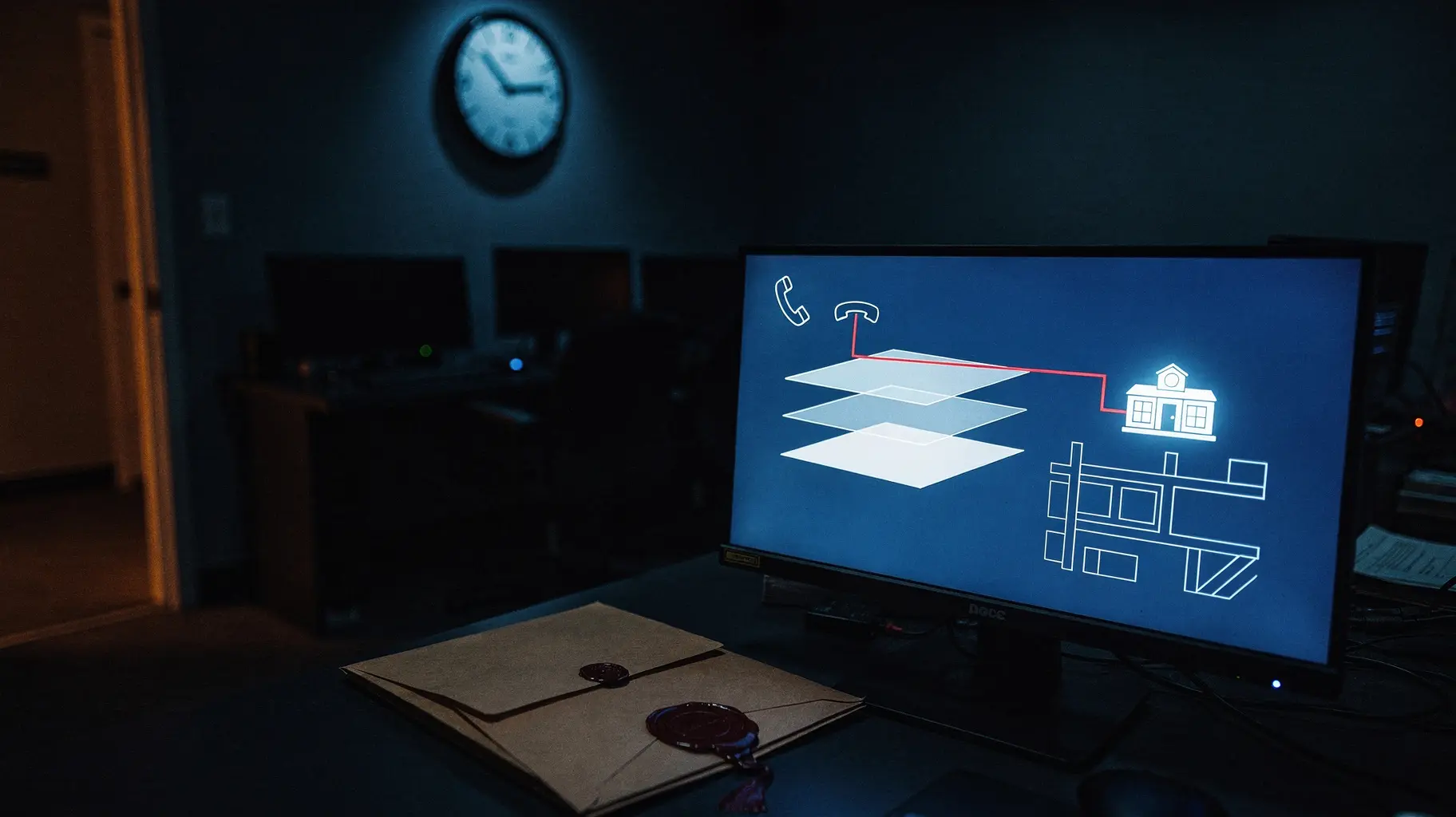
What happens when the address is wrong is documented in unusually plain terms. A support note dated 19 March 2026 explains that dynamic location routing and the Emergency Calling API need endpoint and geolocation information at the moment of the call; where that information is missing, or the inbound identity data or address is wrong, the call is treated as unprovisioned and routed to Bandwidth's own Emergency Call Center. Calls inside the jurisdiction of an I1 answering point go to that center and are then transferred by hand to the answering point's administrative line. The same note states that Bandwidth answers all 911 calls regardless of the originating number, and calls that part of its responsibility as a telecommunications provider (Emergency Call Center FAQ).
Scale gets the marketing treatment. The Emergency Calling API page claims more than 6,000 public safety answering points and automatic delivery of caller location (Emergency Calling API). The VoIP emergency services page claims standard and nomadic emergency calling across more than 40 countries and territories, infrastructure the company says it owns and operates, and an outage-alert tool that automates notification to answering points in support of the Commission's outage-notification rules (VoIP Emergency Services). A resource page describes Bandwidth as a VoIP provisioning center with a facilities-based CLEC network and says 98 percent of calls each month reach Enhanced answering points (911 FAQs). None of those pages carries a visible publication date, the 40-plus and 42 country figures do not agree, and no independent audit of the counts was located. Treat them as sales copy about reach, not as evidence about any particular night.
The rule is the opposite of vague. Cable, satellite, wireless, wireline and interconnected VoIP providers, and covered 911 service providers, must notify the affected facility's designated outage contact as soon as possible and no later than 30 minutes after discovering an outage, including on facilities they own, operate, lease or otherwise use. The same section sets 120 minutes for cable, satellite, wireless and wireline providers but 240 minutes for interconnected VoIP providers to file with the Commission, an initial report within 72 hours and a final report within 30 days (47 CFR 4.9).
Reportability has its own arithmetic, and the arithmetic is widely misread. An outage is a significant degradation of an end user's communications capability caused by network failure or degradation. Every alternative threshold requires at least 30 minutes' duration. Three of the four use 900,000 user-minutes; the loss of 911 call-processing capability in an E-911 tandem or selective router carries no such minimum (47 CFR 4.5). And user-minutes are not calls. For telephony, including non-mobile interconnected VoIP, they are the outage's duration multiplied by the relevant potentially affected telephone numbers, so 30,000 affected numbers across 30 minutes produce 900,000 telephone-number minutes without a single failed call (47 CFR 4.7). A board pack that reports user-minutes as a call-loss count is wrong in the direction that flatters nobody.
Wholesale is not a free pass. Covered-provider status for the notification duty is confined to four functional categories: direct 911 capability, central offices directly serving answering points, next-generation core facilities provided directly to a 911 authority, and ESInet or legacy gateway operators. The definition excludes government answering points and entities that merely originate calls another provider delivers — while leaving those entities' separate originating-provider duties intact (47 CFR 9.19). Bandwidth itself told investors in 2024 that there had been ambiguity about the specific obligations of each party in the emergency-service delivery chain, and recorded that the Commission had expanded 911 outage reporting to reach originating providers (Form 10-K for fiscal 2023). That ambiguity is the interesting part. It means category follows function, and function has to be mapped before anyone can say whose clock was running.
The date matters as much as the duty. The Public Safety and Homeland Security Bureau fixed 15 April 2025 for compliance with the harmonised notification rules, named cable, satellite, wireless, wireline and interconnected VoIP providers as the originating service providers covered, and stated that their obligations also reach outages in middle-mile or wholesale transport facilities. Both originating providers and covered providers must identify, maintain and annually confirm notification contacts for the facilities in their service areas (DA 24-1260). Outsourcing does not move the clock either: reliance on a third party for 911 processing does not relieve the duty, discovery by that third party can start the 30 minutes, notification must be completed rather than begun, the Commission declined to exempt a provider that only learns of the outage after restoration, and it refused to require providers to notify their own customers directly (FCC 22-88, Federal Register).
The regime was also trimmed in 2026. A rule published on 10 July 2026 and effective 10 August 2026 replaced the annual reliability certification with a one-time certification plus updates on material change, declined to extend outage-notification duties to newly designated categories merely by designation, and reaffirmed that existing providers' notification duties cannot be delegated away. Its footnote 189 draws a line that matters to anyone reading a filing index: an entity appears in the outage-reporting system because it falls inside a regulated category, not simply because it is a covered 911 provider (FCC 26-39).
The Commission has already priced the failure. On 26 August 2024 the Enforcement Bureau adopted a consent decree resolving its investigation of AT&T Enterprises over 911 call delivery and notification conduct during the 22 August 2023 outage, imposing a 950,000 dollar civil penalty and a three-year compliance plan, with 47 CFR 4.9(f) and 4.9(h) expressly among the rules investigated (AT&T order). The decree records eight potentially affected answering points not notified in time; AT&T was the covered provider for all but one and the originating wireline provider for the remaining one, and admitted the underlying facts as a factual admission rather than a general concession of every investigated violation (AT&T decree).
Charter Communications settled for 15 million dollars, admitting notification and reporting violations: it failed to notify more than 1,000 answering points in time about its 19 February 2023 outage, its required notification to the Commission ran almost six hours late, and the admitted failures extended to its 31 March and 26 April 2023 outages and hundreds of planned-maintenance outages. The order states plainly that late and never-filed notifications are both violations (Charter order and decree). Altice Mobile paid 96,000 dollars for filing lateness alone, with an initial report roughly six days late and a notification roughly eight and a half hours late on a second outage, in a case where 911 voice calls were not affected and answering-point notification was not required (Altice order, Altice decree). And Lumen was served a proposed forfeiture of 867,000 dollars over two February 2022 outages, built on a published scale of 10,000 dollars per answering point for the first 500, 5,000 for the next 500 and 1,000 for each one after that — a proposal, not a final disposition, and no later final order was located in the material examined (Lumen notice).
Then the record closes. Reports filed under Part 4 are presumptively confidential; inspection requests run through the Commission's general procedure; qualifying state, District of Columbia, territorial, federal and Tribal agencies may receive jurisdiction-relevant direct access after certifying need-to-know and confidentiality safeguards; and public release is permitted only for anonymised aggregates drawn from at least four providers, with no obligation to publish anything (47 CFR 4.2). What does come out is aggregate and instructive: the Commission reported at least 92 sympathetic, multistate outages in 2024 on the strength of filed data, where a sympathetic outage is one provider's report of a failure rooted in another provider's network — a statistic bounded to reports naming multiple states and excluding transport and SS7 causes (FCC 25-21). Ninety-two reports of one network taking another down is the wholesale problem stated in the regulator's own arithmetic.
For Bandwidth specifically, the public record in the material examined here goes quiet. No Commission action, consent decree or provider-specific outage filing naming Bandwidth Inc. was located, and no Bandwidth disclosure of a 911 outage it caused, the answering points affected or a dated remediation was found. That is a statement about what was read, not a clean bill and not an allegation. The rule that governs the function does not depend on that silence being broken.
Here is the practical conclusion for anyone who buys, sells or supervises emergency calling. The duty is real, the deadline is short, the penalty has been assessed against named companies at eight figures, and the evidence that would let an outsider check any given night is held in confidence by design. Accountability therefore lives at the point of production: whether the operator that touched the call can produce the discovery timestamp, the category mapping, the threshold worksheet, the affected-facility list and the completion receipts on demand. That is a harder standard than a risk-factor paragraph, and it is the only one that survives contact with a 30-minute clock. Bandwidth Inc. is recorded in the BTW directory as the entity at the centre of this routing layer.
Member Briefing
Deeper Trend Context
Sign in with the right membership level to unlock the full briefing and source notes.
Strategic Circle
A daily briefing in your language, built from changes we have verified.
Join for USD 20/monthCancel anytime.
Public reporting stays free. Member research, the daily briefing and the forum need a membership.