Summary
- The last audited year printed 72 per cent payload utilisation without printing the denominator behind it; the next interim supplied 183 transponders and 128 leased or utilised, and 128 divided by 183 is 69.95 per cent.
- The same 31 December 2018 date carries HK$0.4 million of total capital commitments in the annual report and HK$269,064,000 contracted in the interim's comparative column. No document read on 19 November 2026 reconciles them, and this article prints both.
- For FY2018 the dividend of HK$149 million was 1.99 times the HK$75 million of capital expenditure — my arithmetic on two printed figures, not a conclusion about the payout. Five weeks after the second total appeared, shareholders approved a scheme at HK$10.22 a share.
A fleet is a schedule, not a stock
A transponder count is the least interesting number a satellite operator publishes. What matters is the term behind each transponder, the age of the spacecraft carrying it, and the money already promised to the spacecraft that will replace it years before the first invoice on that replacement goes out.
That is why three printed quantities belong in one frame. The denominator behind a utilisation percentage, because a rate without a base cannot be checked. The capital commitment note, because that is where a fleet becomes a financing decision, money spent before a single transponder on the new bird earns. And the cash paid out in the same period, because a payout is only readable against what has already been promised.
Two legal persons published the material below, and they are not interchangeable. The audited and interim financial disclosures were filed by Asia Satellite Telecommunications Holdings Limited, Stock Code 1135, listed on The Stock Exchange of Hong Kong Limited until 5 September 2019. The fleet pages and datasheets come from Asia Satellite Telecommunications Company Limited, the operator's website. No figure here crosses from one to the other.
The percentage that needed a second document
At 31 December 2018 the annual report, https://www.hkexnews.hk/listedco/listconews/sehk/2019/0426/ltn20190426395.pdf, records 131 transponders leased or utilised, against 126 a year earlier, and overall payload utilisation of 72 per cent, against 69 per cent. It does not print the divisor.
Work backwards and 131 divided by 0.72 implies about 182 transponders. Eight months later the interim results, https://www.asiasat.com/sites/default/files/AsiaSat%202019%20Interim%20Results_Eng.pdf, supply the base: a core fleet of AsiaSat 5, AsiaSat 6, AsiaSat 7, AsiaSat 8 and AsiaSat 9, 183 C-band and Ku-band transponders, 128 leased or utilised, utilisation of 70 per cent. The arithmetic reproduces precisely — 128 divided by 183 is 69.95 per cent — but only because a later document handed over a number the earlier one had kept to itself.
This is the first crack in the schedule. A utilisation rate is the single figure an operator's reader is most likely to carry away, and in the audited year it was published unanchored. It is also the figure whose meaning is least settled in this fleet, because the interim describes part of the payload as sold wholesale: AsiaSat 4 carrying 28 C-band and 20 Ku-band transponders under a full-payload lease, AsiaSat 8 carrying 24 high-powered Ku-band transponders under a minimum four-year lease. A ratio that counts transponders leased or utilised does not say how a fully leased payload enters it, and the documents read do not explain.
What the cash did while contracts shortened
FY2018 revenue was HK$1,442 million against HK$1,354 million; profit attributable to owners HK$429 million against HK$397 million. The dividend for the year was HK$149 million, or HK$0.38 a share, being an interim HK$0.18 and a final HK$0.20. Capital expenditure was HK$75 million, against HK$544 million the year before.
Set beside each other, the payout was 1.99 times the capital expenditure booked in the same year. That multiple is mine, computed from the two printed figures, and it is the whole of what it says: in the last year AsiaSat published audited accounts, the cash it returned to shareholders was roughly twice the cash it put into capital projects.
It is not a finding that the dividend was unfunded. The honest test of that would run through the commitment note, and the commitment note does not survive contact with itself.
What the audited year also prints is a shorter future. The value of contracts on hand fell from HK$3,684 million to HK$2,976 million, a 19 per cent reduction the report attributes to subdued demand and shorter customer commitments, with almost all contracts denominated in US dollars. In the six months to 30 June 2019 the same line fell again, to HK$2,628 million, while revenue slipped 5 per cent to HK$693 million and profit attributable to owners rose to HK$223 million. Capital expenditure for that half was HK$9 million and cash and bank balances stood at HK$938 million.
Contracts on hand are the nearest equivalent to a backlog this company prints. A shortening book is not the same as a collapsing one: it means the operator will re-price a larger share of its capacity sooner, because fewer customers are locked in beyond the near term. That is a demand-side fact dressed as a balance-sheet one, and it is the reason the commitment line matters so much. If the book is shortening at the same time that replacement capacity is being promised, a reader needs both numbers in one view.
One date, two totals
Here is what the material actually says.
The annual report states that at 31 December 2018 the Group had total capital commitments of HK$0.4 million, against HK$3 million in 2017, all of which was contracted for but not provided in the financial statements.
The interim results state that at 30 June 2019 capital commitments were HK$316,562,000 contracted, with a comparative of HK$269,064,000 at 31 December 2018, and HK$194,667,000 authorised but not contracted, with the identical comparative of HK$194,667,000 at 31 December 2018. The returned text describes these as relating mainly to the associate investment.
Treated as the same measure at the same date, the contracted totals differ by a factor of about 673: 269.064 divided by 0.4 is 672.66. No document read on 19 November 2026 reconciles them. This article does not average them, does not prefer one, and does not use either as a standalone claim about the fleet.
Two things are worth stating plainly beside that conflict. The interim attributes its own commitment figure mainly to an associate investment, not to spacecraft, so neither total is a visible order book for a replacement satellite. And the authorised-but-not-contracted column carries the identical figure at both balance-sheet dates, HK$194,667,000 twice, which is what a reader would expect of a carried-forward authorisation and of nothing else. Printed as it stands, it reinforces the point: these are accounting columns, and the one field a fleet reader would want — a spacecraft commitment with a payment period — is not among them.
Seven satellites, five, six, 183 transponders
The fleet count in the material divides four ways, and every count belongs to its own document.
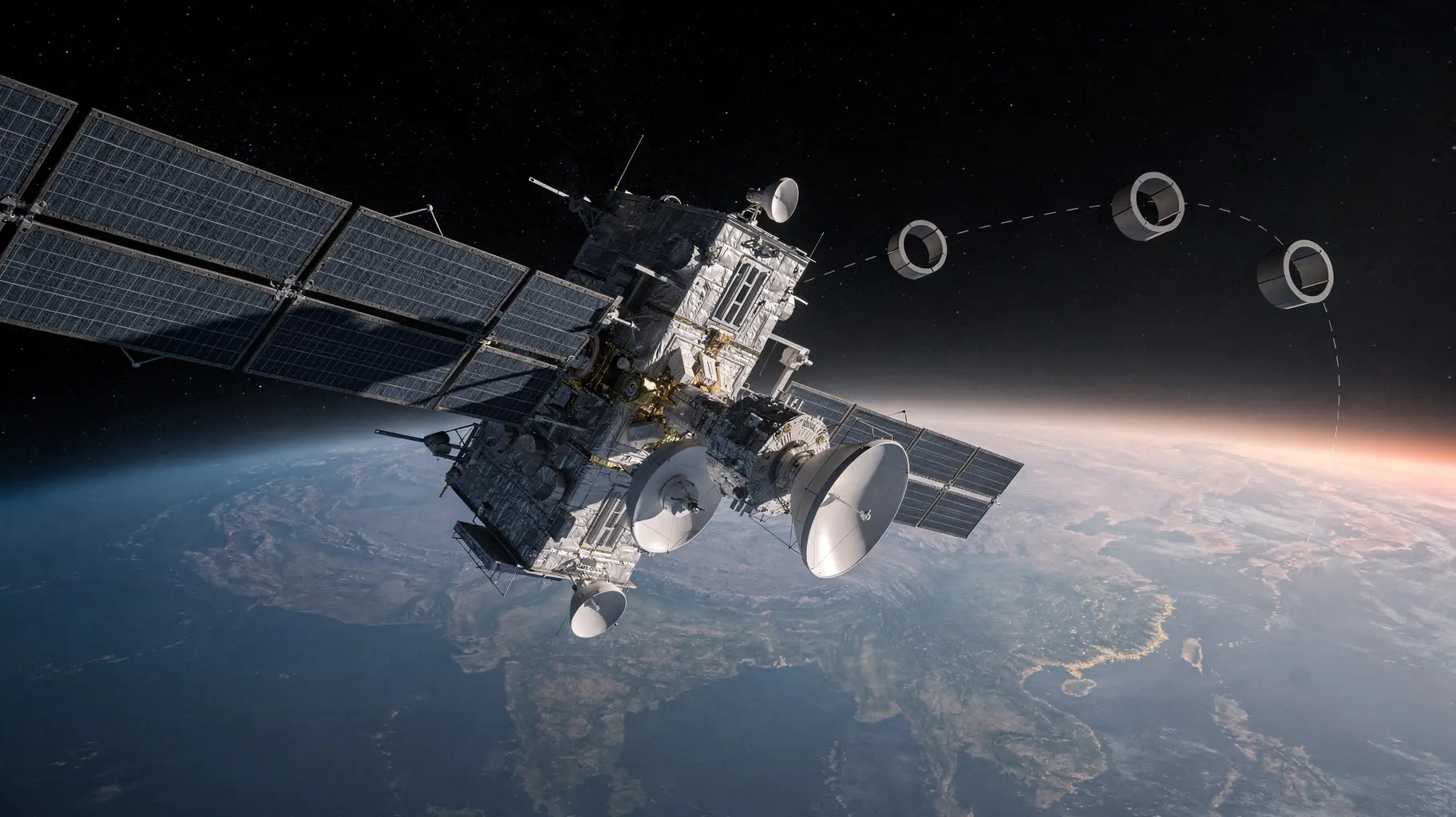
The audited year says the Group owns seven satellites, primarily in geostationary positions over the Asian landmass, covering two-thirds of the world's population. The interim counts 183 transponders across five named core satellites. The corporate homepage, https://www.asiasat.com/, runs a fleet module of five satellites with orbital positions — AsiaSat 5 at 100.5 degrees East, AsiaSat 7 at 105.5 degrees East, AsiaSat 6 at 120 degrees East, AsiaSat 9 at 122 degrees East and AsiaSat 8 at 105.5 degrees East — and AsiaSat 4 is not on it. A 2025 press report counts six in orbit, including AsiaSat 4.
The fleet page, https://asiasat.com/satellite-fleet, presents AsiaSat 9, 8, 7 and 6 with coverage and payload descriptions and prints no aggregate transponder count, no utilisation figure, no revenue and no as-of date. None of the four counts is wrong. They are dated differently and they count different things, and a reader who collapses them into one number loses the only thing they can teach: which document was watching which fleet on which day.
A maintained website with no dated money
The homepage publishes no transponder counts, no utilisation rate, no revenue backlog, no capex, no capital commitments and no dividend. Its newest dated items are a white paper of 5 January 2026 and a blog post of 8 December 2025, so the site is maintained. It simply maintains no money.
The date-stamped technical documents are real and specific. The AsiaSat 9 datasheet, https://www.asiasat.com/sites/default/files/2026-06/AsiaSat%209%20insert_23%20May%202025_0.pdf, gives 28 C-band transponders at 36 MHz and 32 Ku-band transponders at 54 MHz across five Ku-band beams plus a Ka-band payload, records a launch on 29 September 2017 on an ILS Proton M with an SSL 1300 bus, is marked AsiaSat Proprietary, May 2025, and states that technical data are for reference only. The AsiaSat 8 datasheet, https://www.asiasat.com/sites/default/files/2024-05/AsiaSat%208%20Insert_May%202024_1.pdf, records a plan to operate at 105.5 degrees East from May 2025, co-locating with AsiaSat 7, and gives 24 Ku-band transponders at 54 MHz with 210W travelling-wave tube amplifiers plus a Ka-band payload, launched 5 August 2014 on a SpaceX Falcon 9.
Those dates are document revision dates. They are not statements that capacity is available, leased or utilised, and the AsiaSat 8 move is written as a plan, not as a result. What they prove is narrower and still useful: the operator still dates its satellites in public, so a reader can see a fleet being maintained even where no financial statement accompanies it.
The investor relations section, https://www.asiasat.com/investors/financial-reports, exists, headed Financial Reports/Presentations with filters for annual report, interim report and investor presentation. The list of downloadable documents was not retrievable, so what the newest report offered there is could not be established from the material read on 19 November 2026.
The horizon that closed, and one reported restriction
On 23 August 2019 the scheme shareholders approved the privatisation at HK$10.22 per share in cash, and the company stated that its listing on The Stock Exchange of Hong Kong Limited would be withdrawn on 5 September 2019, https://www.asiasat.com/news/press/asiasat-shareholders-approve-privatisation-proposal. Five weeks earlier, the interim's comparative columns had carried the second of the two commitment totals for one date.
That is the boundary. After it there is no continuing series of audited commitments, dividends per share and utilisation rates to extend, and the material read on 19 November 2026 does not state who controls the company afterwards; the press release names the consideration and the delisting date and nothing more.
One reported operational restriction sits outside that boundary, and it should be read at exactly the strength it has. The Economic Times reported on 5 August 2025 that IN-SPACe withdrew authorisation for the use of AsiaSat 5 and AsiaSat 7 capacity in India beyond 31 March 2026, following an advisory from the Ministry of Information and Broadcasting in early August 2025, and that JioStar and Zee Entertainment were migrating to government-authorised satellites including GSAT and Intelsat. The same report counts six in-orbit satellites, AsiaSat 4, 5, 6, 7, 8 and 9, and notes that the advisory did not specify a reason, https://economictimes.indiatimes.com/industry/telecom/in-space-blocks-chinese-owned-asiasat-services-in-india-beyond-march-2026-zee-jiostar-begin-migration-to-other-satellites/articleshow/123107478.cms.
This is a single secondary report. No AsiaSat statement, IN-SPACe instrument or ministry advisory was read, and the revenue effect of losing Indian demand on two satellites is not measurable from any document in the material. Motive is reported in the headline, never established by anything read here.
What a reader can still check
A reader can still check a great deal about this fleet: how many transponders each spacecraft carries, what bands and beams, when it launched, where it sits, and when the operator last revised its specification sheet. That is a genuine public record of an operating fleet.
What a reader cannot check is any number carrying money. There is no dated commitment to a successor spacecraft, no utilisation denominator printed beside the rate, no payment period for whatever has been ordered, and no reconciling line between the two totals that share one balance-sheet date. The dividend and the replacement schedule therefore sit in different rooms, and nothing read on 19 November 2026 opens the door between them.
BTW's directory entry for Asia Satellite Telecommunications Co. Ltd. records an APNIC membership card, country HK, and nothing else, https://btw.media/en/directory/asia-satellite-telecommunications-co-ltd-hk. The card is a membership, not a filing, and it carries no figure this article could lean on.
So the useful question is not what AsiaSat's fleet cost. It is what a fleet operator has to print before a payout can be read as funded at all: the denominator, the committed replacement capital and the period it falls due, in one document, at one date. AsiaSat printed two of the three. On the third it printed two answers for one date, stopped being a listed issuer five weeks later, and has not printed a dated money figure since. The schedule did not fail. It became unauditable, which for a capital-intensive operator is worse.
Member Briefing
Read the full trend briefing
Members read the full briefing with the source notes behind every finding.
Strategic Circle
A daily briefing in your language, built from changes we have verified.
Join for USD 20/monthCancel anytime.
Members also get the full research library, a daily briefing on the networks they follow and the private forum.