
Summary
- Instituto Federal de Telecomunicaciones resolution
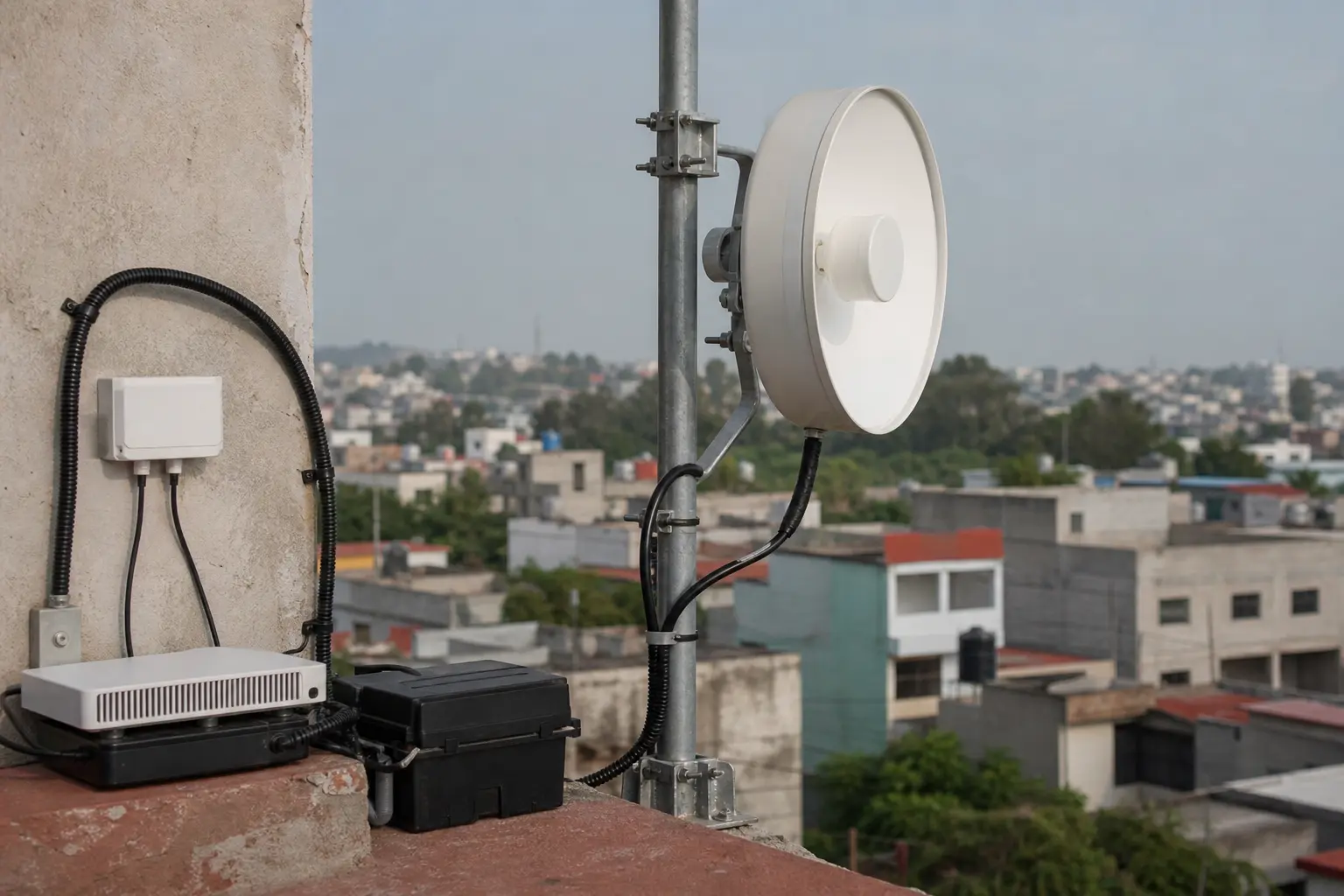
P/IFT/070421/149records Fiberwifi's 2020 proposal for an internet-access network in Zapopan using unlicensed 2.4 and 5.8 GHz spectrum, point-to-point and point-to-multipoint microwave links, switches, routers and antennas. IFT granted a 30-year commercial single concession on 7 April 2021. The concession created a broad legal operating surface; it did not certify a present nationwide build or a current topology. - LACNIC identifies Fiberwifi SA de CV as the registrant of active
AS270133, while RIPEstat observed three announced IPv4/24routes from 8 to 22 July 2026. That is useful evidence of a visible network edge, but it cannot be converted into subscriber scale, usable capacity, address ownership, physical diversity, upstream independence or delivered service quality. - Public PeeringDB queries returned neither a network object for ASN 270133 nor netixlan rows. This leaves no public PeeringDB exchange footprint to inspect. It does not show that Fiberwifi lacks private transit, private peering, colocation, fibre handoffs or facilities, and a Metrocarrier quotation recorded in the 2021 concession file is not a current supplier contract.
- Fiberwifi markets residential, SME, business and dedicated access, along with firewall, cloud, managed infrastructure, voice and VPN services. Its plan speeds, 99.9 percent availability language, 24/7 support proposition and security claims remain first-party statements. The public record does not expose the measurement terms, repair depth, backup-power design, customer capacity or operating evidence needed to test the resilience behind them.
The bill sits at the end of a longer chain
An internet bill compresses a complicated service into a few legible items: a provider name, a speed tier, a period of service and an amount due. None of those fields describes the full path that has to work before a household can open a page or a small company can reach a cloud application. The customer needs working premises equipment, a viable access link, local aggregation, power, routing, upstream connectivity, operational monitoring and somebody able to repair the failed layer. A bill records the commercial relationship at the end of that chain, not the condition of each link inside it.
Fiberwifi's public evidence is unusually useful for seeing both the outline of such a chain and its blank spaces. The regulatory file describes the equipment and spectrum contemplated for an initial Zapopan access project. The regional internet registry ties a named company to a specific autonomous system. Public route observations show that the number is visible with three IPv4 prefixes. The company's own website then presents the retail and business services it wants customers and resellers to buy.
These records line up at the level of identity. Fiberwifi SA de CV, Zapopan and AS270133 recur across official or first-party sources. Yet identity continuity is not operational continuity. The records were created for different purposes, at different times, and they answer different questions. A concession answers whether a legal right was granted. RDAP answers who is registered for an internet number resource. Route collectors show what they observed in the routing system during a defined window. A service page shows what a company markets. None is a substitute for measured customer experience.
That distinction is especially important because the name Fiberwifi can invite an easy but unsupported picture of the physical network. The evidence reviewed here does not establish ownership of fibre, towers or poles. The strongest physical description is historical and fixed-wireless: a project using microwave links in unlicensed bands. Even that description belongs to the 2020 application and 2021 decision, not a verified inventory for July 2026. The starting point for analysis is therefore not an imagined fibre footprint. It is the smaller set of things the records actually reveal.
A concession records permission and an intended project
Fiberwifi applied to IFT on 11 December 2020 for a commercial single concession. The application described an internet-access network in Zapopan, Jalisco, using the unlicensed 2.4 and 5.8 GHz bands. Its proposed technical elements included point-to-point and point-to-multipoint microwave links, switches, routers and antennas. The file also contained a quotation from Mega Cable / Metrocarrier concerning the exchange of the project's network traffic.
IFT approved the concession on 7 April 2021 for a term of 30 years. Its legal scope was national and covered the provision of telecommunications and broadcasting services, subject to further authorizations where required. That is substantial evidence. It shows that the regulator considered an identified applicant and granted a long-lived commercial right under Mexico's telecommunications framework. It also provides a dated description of the project Fiberwifi put before the regulator.
The decision should be read as a regulatory document, not a live network diagram. An application can describe what an operator intends to deploy, procure or connect at a particular stage. Equipment can later be replaced, routes can change, suppliers can change and a service area can expand or contract. The public sources here do not provide the intervening operating record. They therefore cannot show whether the original radio design remains complete, whether every listed component was installed, or whether the 2021 traffic-exchange option became a lasting commercial arrangement.
The time boundary matters. Five years separate the concession decision from the route observations used in this article. The IFT record remains authoritative for the grant and for the proposal it describes, but age reduces its value as proof of present topology. Treating every 2020 design choice as current would erase the possibility of normal network change. Treating none of it as relevant would discard the clearest public account of the company's starting architecture. The defensible middle is to use the resolution as historical project evidence and then look for newer signals without pretending they fill every gap.
The distinction also changes how the access medium should be described. The proposal supports saying that Fiberwifi planned internet access through point-to-point and point-to-multipoint microwave links in 2.4 and 5.8 GHz spectrum. It does not support saying that every Fiberwifi customer in 2026 is served that way, nor that no other medium is involved. It certainly does not turn the company's name into evidence of owned fibre plant. The physical network remains only partly visible.
National legal scope is not a national network map
The concession's national scope can be misunderstood if legal reach and deployed reach are folded together. A national authorization gives an operator a framework in which it may provide covered services. It does not place radios, fibre, routers, technicians or spare equipment across the country. Deployment still requires investment, sites, access rights, equipment, upstream connectivity, customer demand and, where relevant, additional permissions.
The project described to IFT was more geographically specific: internet access in Zapopan, Jalisco. Fiberwifi's current contact page also lists an office on Avenida Lopez Mateos Sur in Zapopan, and LACNIC's registration data places the organization in the same city. This repeated locality is good evidence of a Zapopan administrative and commercial anchor. It is not a coverage polygon. An office address does not identify a point of presence, a tower, an aggregation room or a repair depot unless another source says that it performs one of those functions.
Fiberwifi's own coverage process reinforces the limit. Rather than publishing a fixed map on the service page, the company asks prospective users to submit details so availability can be checked. That may be a practical way to qualify installations, especially where a usable access path can depend on a precise address. Publicly, however, it means there is no stable map against which a reader can compare the broad legal concession with the network actually offered today.
The correct geographic statement is consequently modest. Fiberwifi has national legal scope under the concession, a historically described Zapopan project and present public contact and registry ties to Zapopan. The available material does not demonstrate nationwide deployed coverage, a municipal service boundary or a list of active network locations. A reader should not convert permission into plant.
AS270133 makes a network edge visible
LACNIC's RDAP record provides the clearest current bridge from company identity to internet routing. It identifies active AS270133, records 17 December 2020 as its registration date and names Fiberwifi SA de CV in Zapopan. Administrative, technical and abuse contacts use the Fiberwifi domain. These details connect the legal name, locality and internet number resource without relying on an inferred brand match.
An autonomous system number is useful because it identifies a routing policy domain in the public internet. When it appears in observed announcements, analysts can see an edge that is more precise than a service advertisement. It offers a stable object around which to ask whether prefixes are visible and whether other public routing or interconnection records exist. In Fiberwifi's case, RIPEstat reported the ASN as announced when the evidence was collected.
The registration date is close to the concession application date, which was six days earlier. That sequence shows that legal and routing preparations were occurring in the same period. It does not establish that one caused the other, that customer service began then, or that the eventual network followed the proposed design without change. Dates can align while the operational milestones behind them remain unknown.
RDAP also has a limited job. It identifies the registrant and contact roles for the resource. It does not enumerate subscribers, equipment, towers, fibre strands, access radios or upstream contracts. A technical contact address shows that the registry object has a channel for technical responsibility; it does not show the number of engineers available at night or the time needed to reach a failed site. An abuse contact is important for internet stewardship but says nothing about backup batteries or replacement radios.
AS270133 should therefore be treated as a verified network-resource identity and a starting point for observation. It is stronger than a marketing claim because the record comes from the regional registry. It is narrower than an operating audit because the registry was not designed to certify resilience. The ASN tells readers where to look at the public routing edge. It does not illuminate the whole path behind it.
Three routes are a signal, not a capacity statement
RIPEstat's announced-prefixes data showed three IPv4 /24 routes associated with AS270133 during the 8 to 22 July 2026 window: 38.22.160.0/24, 38.22.170.0/24 and 38.123.65.0/24. Combined with the AS overview's announced status, this is direct evidence that the ASN had a visible routing surface during the period examined. Fiberwifi's network-resource identity is not merely a dormant registry entry in these observations.
What three observed routes mean for users is much less direct. A prefix count is not a speed test. It does not state how much upstream capacity has been purchased, how heavily links are loaded at the busiest hour or how bandwidth is divided among residential, business and managed-service customers. It does not reveal the number of subscribers behind address translation, the proportion of addresses in use or the commercial terms attached to any connection.
The observations also should not be used as an ownership certificate for the address space. Routing data shows that a prefix was announced in association with an autonomous system during a selected interval. The evidence here does not close the separate legal or contractual question of address ownership. Nor does it show whether the three routes take physically independent paths. Multiple prefixes can traverse the same upstream handoff, the same conduit, the same powered room or the same piece of aggregation equipment.
Route diversity has several layers. A network can have more than one logical BGP path while retaining a common physical failure point. It can connect to different upstream services that eventually converge in one building or duct. Conversely, a small public route footprint can sit on a thoughtfully engineered access and transport system. The number of prefixes alone cannot distinguish these cases. The public observations provide no topology with which to trace common points of failure.
Time is another boundary. The RIPEstat result describes the specified July 2026 window and the status returned when the data was collected. It is not an outage history or a promise that the same routes will remain visible. Longer observation could show change, but even a stable route history would still need to be joined to physical and commercial evidence before it could support a resilience conclusion.
For Fiberwifi, the three /24s answer a useful first question: there was a publicly observable routed edge for AS270133. They leave the harder questions open. The routes do not disclose usable capacity, independence, customer impact, repair practice or service-level performance. Reading them responsibly means preserving both halves of that finding.
PeeringDB's blank answer narrows the public view
Public PeeringDB queries for ASN 270133 returned no network object and no netixlan rows. In practical terms, the directory supplied no self-disclosed network profile to inspect and no listed public exchange-LAN participation for the ASN. There is no PeeringDB record in this source set from which to read a traffic policy, exchange presence or related interconnection details.
That absence is informative because it defines the limit of one common transparency surface. A PeeringDB entry can help other networks understand where and under what policy an operator presents itself for interconnection. Without one, an outside reader has less public material with which to compare the observed routes against claimed exchange or facility presence. The blank result makes Fiberwifi's upstream and interconnection design harder to examine from open records.
It would be wrong, however, to convert missing disclosure into missing infrastructure. PeeringDB does not inventory every private commercial arrangement. Fiberwifi could use private transit, private peering, a fibre handoff, colocation or another facility relationship without producing either of the queried rows. The evidence reviewed here neither confirms nor rules out those possibilities.
The distinction is more than a disclaimer. If no public exchange participation is listed, the next question is not, "Does the network have no upstream?" The active route observations already show that traffic can be represented in the public routing system. The better questions concern concentration and verification: how many current upstream paths exist, where they hand off, whether they share physical dependencies and what happens when one fails. PeeringDB cannot answer those questions for AS270133 in its current public state.
For customers, the consequence is an evidence gap rather than a verdict. A local provider may operate competently without extensive public interconnection disclosure. But buyers evaluating continuity cannot infer resilience from silence. They need contract terms, architecture-level explanations or independent measurements that connect the visible ASN to the service they purchase.
A 2021 quotation is not a 2026 supplier map
The IFT resolution notes that Fiberwifi's application included a Mega Cable / Metrocarrier quotation for exchanging the proposed network's traffic. This gives the project file a concrete upstream reference. At the application stage, the applicant had put forward at least one commercial quotation relevant to carrying traffic beyond the local network.
A quotation records an option or proposal, not necessarily a completed purchase. Even if it later became a contract, the supplied evidence does not show its term, renewal, capacity, route, handoff location or present status. Five years of possible procurement and network change sit between the regulatory record and the July 2026 routing snapshot. Calling Metrocarrier Fiberwifi's current upstream would cross that gap without support.
Nor would one historical supplier name settle the resilience question. A customer would need to know whether there is one external path or several, whether nominally separate paths enter through different physical routes, and whether maintenance or failure at a shared point can interrupt all of them. The quotation does not provide those answers. It is best used to show that upstream traffic exchange formed part of the original project planning, while current dependency remains undisclosed.
This is a recurring problem in local-network analysis. Regulatory files often preserve the clearest technical detail because an applicant had to explain a project at a particular moment. The detail can feel more concrete than a sparse current website or route record. Precision in an old document should not be mistaken for freshness. Fiberwifi's supplier evidence is specific, but historical.
The access path carries most of the unanswered risk
The proposed 2.4 and 5.8 GHz architecture places the original project in a physical environment that BGP cannot see. In a point-to-multipoint arrangement, an access radio can serve multiple endpoints; a point-to-point link can move traffic between network locations. Switches and routers then aggregate and direct that traffic. Each layer has its own failure modes, and a route collector at the internet edge cannot say which of them is healthy.
Unlicensed spectrum is shared rather than exclusively assigned to one operator. As a general engineering matter, usable performance can depend on interference, channel planning, equipment placement, line of sight and changing local conditions. This does not establish that Fiberwifi has an interference problem. It explains why a regulator's list of frequency bands is not enough to predict the performance at a specific address.
The same caution applies to capacity. A 20, 30 or 50 Mbps retail tier states the service speed Fiberwifi advertises for home plans. It does not reveal the radio-sector load, aggregation capacity, upstream commitment or busy-hour policy behind the tier. Two customers buying the same nominal plan can sit behind different access conditions. Without measurements or contractual definitions, the advertised number cannot be used to infer the amount consistently delivered.
Customer-premises equipment adds another boundary. A service can depend on an outdoor radio, indoor termination, power supply, cable run or local Wi-Fi arrangement, depending on how it is installed. The public record does not document Fiberwifi's current installation standard, equipment ownership or replacement practice. It therefore cannot tell a prospective customer which failures are the provider's responsibility, which belong to the premises and how quickly a failed unit would be swapped.
Nor does the original fixed-wireless description prove the complete present access mix. Fiberwifi may have changed or extended its design; the available sources do not say. Its name cannot fill that silence with fibre ownership, and website wording such as "5G Wifi" cannot be treated as proof of a licensed 5G mobile network. A marketing label does not replace spectrum, network and service evidence.
The physically grounded conclusion is narrow. Fiberwifi proposed a fixed-wireless network in Zapopan and now markets internet access. The public routing edge is visible. Between an individual premises and AS270133, however, the current access topology, aggregation design and failure domains remain undisclosed. That middle is where much of the customer's day-to-day reliability is made.
Coverage by inquiry keeps geography opaque
Fiberwifi's service page asks a prospective user to provide information for a coverage check instead of offering a fixed public map. Address qualification can be sensible for access services because feasibility may depend on the exact location and installation conditions. It also prevents an outside observer from drawing a supported service boundary.
The absence of a map means that neither the Zapopan project nor the national concession can be translated into a current footprint. There is no public list of neighbourhoods, municipalities, access sites or installed sectors in the material reviewed here. A coverage claim for a particular place would therefore need a fresh Fiberwifi qualification or another current source.
This has commercial consequences. A regional provider's effective market is defined not by the widest legal permission but by the addresses it can install, support and restore at an acceptable cost. Each additional service area can require access capacity, transport, power, spares and technician travel. The public form shows that availability is checked, but it does not reveal the operating model behind the answer.
It also complicates comparisons. A large advertised territory with sparse installable pockets is different from a dense, maintainable local footprint, yet a simple provider list may treat both as coverage. Fiberwifi's evidence does not allow either picture to be chosen. The responsible approach is to leave the map blank where the company has left it unverified.
The service menu lengthens the dependency chain
Fiberwifi markets more than household connectivity. Its site addresses residential users, SMEs and larger businesses, and it offers business or dedicated internet alongside firewall configuration, cloud servers, managed infrastructure, VoIP/PBX and VPN services. A reseller page invites partners to redistribute enterprise services. The company is presenting itself as both an access provider and a broader technology supplier.
That portfolio matters because each added service changes what continuity means. An access connection fails when the path between the premises and the wider internet is unusable. A managed firewall also depends on configuration control, software maintenance and recovery from a bad change. A VPN depends on endpoints, authentication and the paths between sites. Hosted voice depends on access, voice systems and the ability to reach other networks. A cloud-server proposition introduces compute, storage, platform and facility dependencies that are not described by AS270133 alone.
The website establishes that these services are offered. It does not establish how they are built, where systems are hosted, who owns the underlying assets or what third parties are involved. It gives no supported basis for naming a data centre, claiming a cloud platform footprint or assuming that every managed service runs on Fiberwifi-owned infrastructure. A broad menu can be assembled through owned systems, leased capacity, partners or combinations of them.
This distinction is important for business buyers. Bundling services can simplify support if one provider genuinely coordinates the stack. It can also concentrate dependency if access, voice, VPN and managed infrastructure share one fault domain or one escalation channel. The public material does not show which condition applies. A buyer would need service-specific architecture and responsibility terms rather than a single general assurance.
The 24/7 support language should be read in the same way. It states a first-party support proposition. It does not specify whether an engineer is continuously staffed, whether the channel only accepts tickets, which incidents receive immediate action or what repair target applies. Round-the-clock contact and round-the-clock restoration are different commitments. The website does not provide enough detail to equate them.
The 99.9 percent claim needs a denominator
Fiberwifi advertises 99.9 percent availability. The number sounds exact, but availability is meaningful only when its scope is defined. A customer needs to know the measurement period, the starting and ending points of the measured service, which events are excluded, how planned maintenance is treated and what remedy follows a miss.
The arithmetic illustrates the need for terms. If every minute of a 30-day month were included, 99.9 percent would leave roughly 43 minutes outside the available state. If the calculation excludes scheduled work, customer equipment, upstream events, power failures or periods before a ticket is opened, the practical result can be very different. The website material reviewed here does not supply the denominator or exclusions, so the percentage cannot be audited as an SLA.
Availability also says little about degraded service unless the threshold is explicit. A link can remain technically up while latency, packet loss or congestion makes an application difficult to use. A speed tier can be reachable under one test condition and unavailable at the busy hour. For voice or VPN users, intermittent loss may matter before a connection is counted as down. The public claim does not explain how these states are classified.
Independent operating records could close part of this gap. They might include a defined measurement point, an observation window, incident totals and a method for separating customer-premises faults from provider-network faults. Contract language could explain credits and exclusions. None appears in the cited material. The 99.9 percent figure must therefore remain a marketing statement, not evidence of achieved performance.
The same treatment applies to personalized support, security and certification language on the service pages. These claims may describe genuine capabilities, but the supplied sources contain no independent audit, tariff, contract or performance record with which to test them. Precision in wording should not be mistaken for verification.
Repair depth is an invisible operating asset
Network diagrams often focus on links and routers, while customers experience the organization that repairs them. A failed radio, damaged cable, power-supply fault or misconfigured device becomes a prolonged service interruption if nobody can diagnose it, reach it and replace it. Resilience therefore depends on people, access, inventory and procedure as much as on nominal redundancy.
The public sources say nothing about Fiberwifi's field-crew capacity. They do not identify technician locations, staffing levels, spare holdings, vehicle access, escalation rules or target restoration times. The Zapopan office address cannot be assumed to be a network operations centre or a warehouse. The 24/7 support statement cannot be converted into evidence of around-the-clock field dispatch.
For a local provider, geography can make repair economics decisive. A compact footprint can shorten travel and make local knowledge valuable. A dispersed footprint can require more stock and more crews to achieve the same restoration target. Neither pattern can be assigned to Fiberwifi because its current service map and repair base are not public. The coverage form asks where service is wanted, but it does not show where repair resources sit.
Spares are equally hard to see. A network may have a redundant logical path and still wait on one replacement power supply or radio. It may have backup equipment that is incompatible with an installed generation. It may restore a priority business customer before a residential sector under internal rules not stated publicly. These are ordinary operational variables, not allegations about Fiberwifi. Their absence from the evidence is precisely why an ASN and a concession cannot settle resilience.
Customers can ask concrete questions without demanding confidential detail. What is the escalation path after first-line support? Which faults can be handled remotely? What restoration target applies to the access link? Are critical replacement units held locally? When a site is inaccessible, what alternative path or temporary equipment is available? The quality of the answers would reveal more about continuity than the number of prefixes alone.
Power and interference sit outside the routing record
Every active layer in the described project needs electricity: customer equipment, access radios, intermediate links, switches and routers. A route can remain visible from one part of a network while a local powered site is unavailable, or it can disappear because a central dependency failed. Public BGP observation cannot separate those situations without additional operating evidence.
The sources do not document Fiberwifi's backup-power design. They do not state whether access or aggregation locations use batteries, generators or dual feeds, how long any reserve lasts, or how equipment is monitored during a utility failure. There is also no evidence about the customer's power dependency. As a result, no claim can be made about endurance during an outage.
For links using unlicensed spectrum, interference adds another local variable. Channel conditions can differ by site and time. Antenna alignment, obstructions and competing use can influence link quality even when the internet edge remains announced. Again, this is an engineering dependency associated with the historical design, not proof of a Fiberwifi incident or current defect.
The interaction among dependencies is often more important than any one component. A backup battery may protect a radio but not the upstream handoff. A second route may exist but share the same powered switch. Remote monitoring may identify a failure but not shorten travel to the site. Public evidence of resilience needs to show how these layers fit together, not merely that each is mentioned somewhere.
Fiberwifi's records do not expose that integration. They support a list of questions about power, interference and common equipment, while leaving the answers open. That is a more accurate conclusion than assuming either fragility or strength from the fixed-wireless label.
Resellers extend the commercial edge
Fiberwifi's reseller page offers partners the ability to redistribute enterprise services. This is evidence of an indirect-sales proposition, not evidence of how many partners participate or how much traffic they represent. The distinction matters because a reseller can sit between the network operator and the organization experiencing a fault.
An indirect model can broaden market reach and provide customers with local commercial support. It can also divide responsibility among the party that sells the service, the party that operates access and the suppliers behind upstream or managed components. When something fails, the useful contract is the one that says who accepts the ticket, who has diagnostic access and who is accountable for restoration.
The public reseller page does not define those boundaries. It does not show whether partners resell connectivity, managed services or both; whether they install customer equipment; or whether service terms flow through unchanged. It should not be used to infer a reseller count, geographic reach or operating capacity.
For resilience analysis, the page adds a question rather than an answer. Does the customer have one accountable support route across reseller and operator, or a chain of handoffs? A commercial channel can be valuable, but its continuity depends on clear operational ownership. That evidence would have to come from current agreements or service documentation.
Regional economics are hidden behind the speed tier
Fiberwifi advertises home plans at up to 20, 30 and 50 Mbps. Those tiers place a clear retail promise in front of prospective users. They do not reveal the economics needed to sustain the promise: access-equipment utilization, upstream commitment, installation cost, maintenance travel, support staffing and the rate at which capacity must be added.
For any regional ISP, the bill must fund both normal operation and the capacity to absorb faults. A spare radio that rarely gets used still has to be purchased and stored. A second upstream path may carry little traffic until the first fails. Batteries age even when there is no outage. Technicians need training before the incident that tests it. These costs can look inefficient in a simple utilization calculation, yet they are part of resilience.
Nothing in the public evidence shows how Fiberwifi balances those costs. The three announced prefixes do not disclose revenue or network load. The plan speeds do not disclose contention or the number of active lines. The concession does not set out present capital expenditure. The reseller offer does not reveal margins or support obligations. Any claim about Fiberwifi's financial strength, oversubscription or investment level would therefore be speculation.
The useful economic question is narrower: which parts of the service are designed with reserve, and which are restored after failure? A provider can buy duplication in advance, hold spares and staff response, or accept longer repair exposure in exchange for lower cost. Different customer segments may receive different terms. Without a published service schedule or independent evidence, the bill does not show where Fiberwifi has made those tradeoffs.
Business and dedicated services make the question sharper. The word "dedicated" can describe several commercial and technical arrangements. Buyers need to know whether it refers to access capacity, an uncontended port, a committed information rate, a separate path or another defined feature. The website offer alone does not resolve the meaning. Contract detail, not the label, determines what resilience has actually been purchased.
Better evidence would connect the layers
Fiberwifi already has the beginnings of a verifiable public picture. IFT supplies the legal and historical project layer. LACNIC supplies resource identity. RIPEstat supplies a time-bounded view of announcements. The company website supplies its service and support proposition. PeeringDB, by returning no relevant records, shows where one public interconnection layer is absent.
Stronger disclosure would not require publishing sensitive router configurations or exact site coordinates. An architecture-level account could distinguish access, aggregation and upstream transport, state whether major paths have common physical dependencies and explain which parts of the 2020 project remain representative. A dated statement could clarify whether the network still relies substantially on the described unlicensed fixed-wireless design without revealing individual customer locations.
Current interconnection evidence could explain the number of upstream relationships and whether failover has been tested, while avoiding disclosure of confidential prices. If supplier names cannot be published, Fiberwifi could still state whether paths terminate at distinct handoffs and whether they share facilities or transport. Public route observation could then be read alongside an operator explanation rather than treated as a proxy for physical diversity.
Service evidence needs the same connection. A defined availability schedule could specify the measurement point, period, exclusions and remedy. Performance reporting could distinguish a complete outage from congestion, latency or packet loss. Installation terms could state responsibility for customer-premises equipment. Support terms could separate ticket acceptance from technical response and field restoration.
Coverage could also be described without overpromising. A dated service-area statement, or an explanation of the address-qualification process, would help readers understand why a particular premises is accepted or rejected. It could distinguish legal scope from active installation capability and make clear whether different service types have different geographic limits.
Operational evidence is the final bridge. Aggregated incident reporting, maintenance notices, restoration statistics or post-incident explanations would show how the organization behaves when dependencies fail. Even a modest record, consistently dated and clearly scoped, would be more useful than a universal adjective such as reliable. It would allow the 99.9 percent language to be checked against a method.
None of these disclosures is present in the source material reviewed here, so they cannot be credited to Fiberwifi. They are examples of the evidence needed to move from a visible network identity to a supportable resilience assessment. The gap is not unique to one company. It is common wherever retail promises are public but the operating chain remains private.
Reading the local bill without overreading it
A Fiberwifi customer can reasonably take several things from the public record. The provider has a 30-year commercial single concession granted in 2021. The initial project described to IFT concerned internet access in Zapopan using specified fixed-wireless elements. LACNIC ties the company to AS270133, and RIPEstat observed the ASN with three announced IPv4 prefixes in July 2026. The company publicly offers access and a range of managed services.
The same customer should resist conclusions those records cannot carry. The national concession is not proof of national deployment. Three routes are not three independent physical paths. An ASN is not a subscriber count or a capacity certificate. The Fiberwifi name is not proof of fibre ownership. A blank PeeringDB result is not proof that private interconnection is absent. A historical Metrocarrier quotation is not a current contract. A coverage form is not a coverage map. A 99.9 percent statement is not an auditable SLA without terms.
This leaves the bill as the start of due diligence rather than the end. Residential users may care most about installation feasibility, busy-hour performance, customer-equipment replacement and restoration after a local power or radio fault. SMEs may need escalation, backup connectivity and a clear definition of availability. Buyers of voice, VPN, firewall or cloud services need to know whether those products share the same access and upstream failure domains.
The questions can be specific. Where is service availability measured? Which events are excluded? Is the access link backed by an alternative path, and is that path physically separate? How long can network equipment operate without utility power? What happens after remote troubleshooting fails? Who owns the customer equipment, and what is the replacement target? If service is bought through a reseller, who remains accountable for restoration?
Answers should be evaluated against contracts and measurements, not only sales language. A provider may have good answers that are not public. The absence of public proof is not proof of poor operation. It does mean that an outside analyst cannot award resilience on trust, and a customer should obtain the missing terms before treating the service as a critical dependency.
The visible edge is real, while resilience remains unpriced in public
Fiberwifi is not an invisible or purely nominal operator in the available records. Its legal concession, active ASN, observed routes, Zapopan identity and first-party service pages form a coherent public outline. That outline is enough to study the company as a regional access-network case and to reject the opposite error of treating it as nothing more than a name.
The outline is also thin where infrastructure risk becomes practical. It contains no current topology, no verified service map, no customer capacity, no public route-diversity proof, no current upstream contract, no field-repair record and no backup-power design. PeeringDB adds no public exchange footprint. Marketing adds promises but not the measurement method needed to test them.
AS270133 therefore shows a reachable edge of Fiberwifi's operating story. It does not show the physical and organizational depth behind that edge. The local bill pays for both, whether or not both are visible: the connection that works on an ordinary day and the capacity to restore it when a shared link, powered device, radio path or supplier relationship stops working.
That is the proper boundary of the evidence. Fiberwifi has a documented legal foundation, a visible routing identity and a public commercial offer. Its delivered resilience remains a question for current contracts, architecture, measurements and repair records. Until those layers are available, the bill can name the service, but it cannot by itself price the dependency.
Sources
- https://www.ift.org.mx/sites/default/files/conocenos/pleno/sesiones/acuerdoliga/pift070421149acc.pdf
- https://www.ift.org.mx/industria/competencia-economica/unidad-de-competencia-economica?page=706
- https://rdap.lacnic.net/rdap/autnum/270133
- https://stat.ripe.net/data/as-overview/data.json?resource=AS270133
- https://stat.ripe.net/data/announced-prefixes/data.json?resource=AS270133
- https://www.peeringdb.com/api/net?asn=270133
- https://www.peeringdb.com/api/netixlan?asn=270133
- https://www.fiberwifi.mx/en/servicios
- https://www.fiberwifi.mx/en/contacto
- https://www.fiberwifi.mx/resellers