
Summary
- Argonne Network is a current BTW directory company object tied to a real network-administration role. ARIN records Argonne National Laboratory as registrant for AS683 and AS75 and identifies Argonne Network Administration as a technical contact group; this does not establish a separate legal company.
- Registry records establish accountable number-resource identity, while public routing observations provide bounded views of running behaviour. Neither is a private topology map, a service-level result, or proof of exclusive route control.
- Official facility and ESnet material describes a real research traffic surface spanning instruments, storage, compute, identity, campus networking, external providers, and remote collaborators. Capability descriptions and project cases do not prove universal reliability or user outcomes.
- Supervision, integration, maintenance, portability, and exception response remain recurring costs because records, routes, facilities, external operators, and research workflows must stay aligned through change and failure.
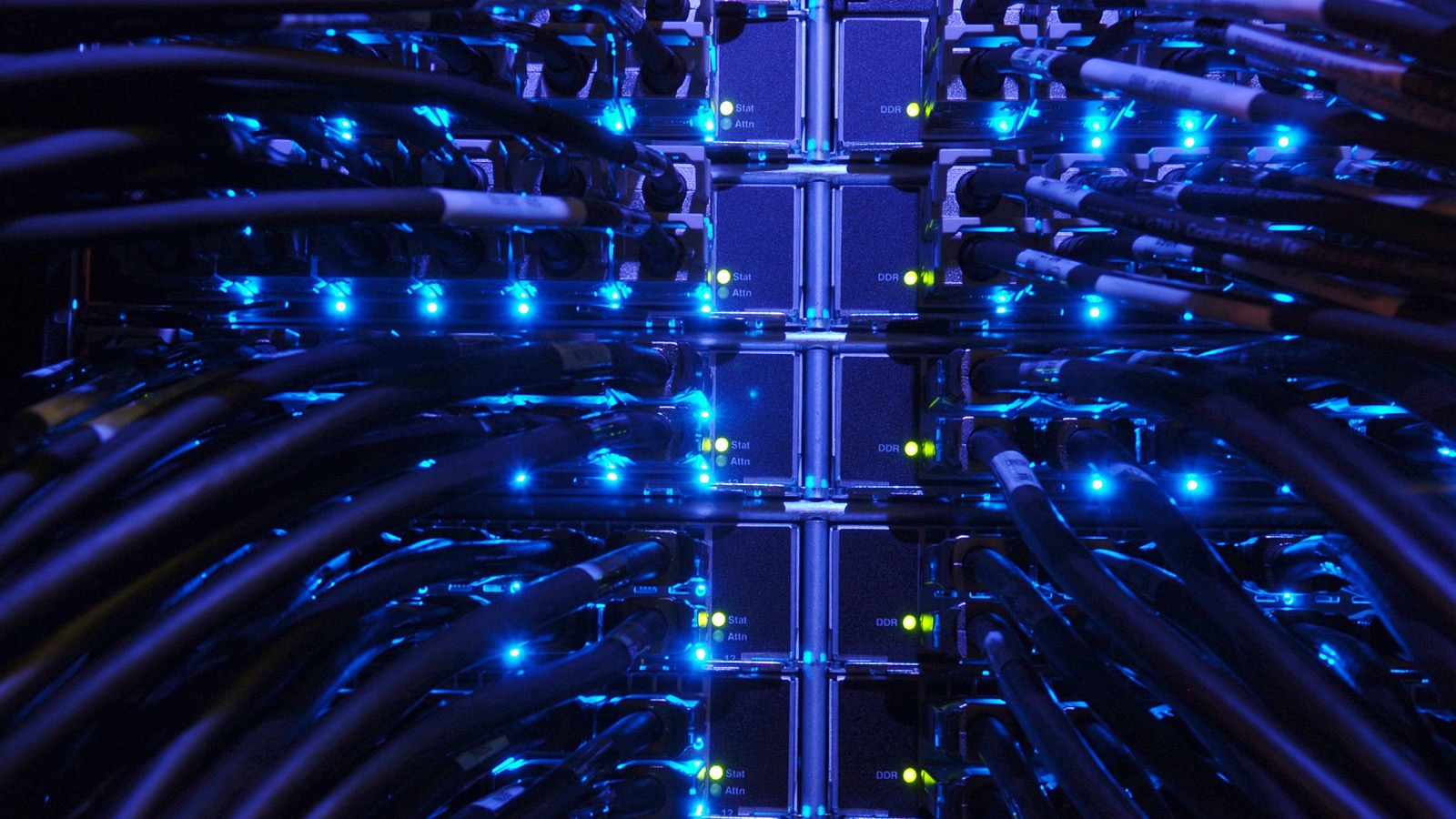
Image note: The accompanying Creative Commons photograph shows computing equipment at Argonne National Laboratory's Center for Nanoscale Materials. It does not show Argonne Network Administration, AS683 or AS75 routing, the campus backbone, ESnet or MREN links, private topology, current controls, incidents, measured reliability, or user outcomes.
Argonne Network appears in the BTW directory as a company object, but the most useful public evidence does not support treating that label as a free-standing commercial network operator. The American Registry for Internet Numbers records Argonne National Laboratory as the registrant for AS683 and AS75. The same records identify Argonne Network Administration as a technical contact group.[1][2] That distinction is the starting point for a responsible analysis.
It binds the directory object to a real network-control role without inventing a separate legal company, a private architecture, or a service portfolio that the public record does not disclose.
The two autonomous system numbers create a concrete technology surface. Registry records establish assigned identities and accountable contacts. Public routing-observation services show what outside collectors could see at a bounded time. Argonne and its facilities describe storage, local and wide-area networking, data movement, access controls, campus investment, and research workflows. The Department of Energy's Energy Sciences Network describes its own role and publishes reports and case studies that place Argonne in a wider research-network context.[3][4][5][6][7][8][9][10][11][12][13][14][15][16][17][18][19][20][21][22][23][24][25]
Together, these sources reveal a control problem rather than a simple product story. Scientific instruments, high-performance computing systems, shared storage, external research networks, identity systems, security controls, and user-operated workflows have to exchange data across multiple administrative boundaries. The network must preserve address and routing identity while equipment, applications, providers, and research demands change. A public route can be visible while a transfer remains slow. A facility can advertise strong capabilities while an individual workflow still fails.
A successful demonstration can prove that a design is possible without proving routine reliability for every user.
This article therefore separates three layers throughout:
- System capability means a documented component or protocol can perform a defined function, such as originating a route, moving data, exposing storage, authenticating a user, or measuring a path.
- Operational reliability means that function remains available, accurate, secure, observable, and recoverable under real maintenance and failure conditions.
- User or research outcome means a named workload produced a measured result over a stated period, with enough context to distinguish network effects from storage, software, instrument, and workflow effects.
The public record is rich enough to examine capability and operating burden. It contains several bounded project examples. It does not provide a fleet-wide availability benchmark, a complete incident history, a private topology map, or a controlled comparison of user outcomes. Those limits are not gaps to fill with assumptions. They define what can and cannot be concluded.
The entity boundary: a directory label, a laboratory, and an operating role
ARIN's records for AS683 and AS75 provide the strongest identity anchors.[1][2] In both cases, Argonne National Laboratory is the registrant. Argonne Network Administration appears as a technical contact group. A registry entry is a record of number-resource administration and contact responsibility. It is not a corporate charter, an architecture diagram, a service-level agreement, or proof that every route observed under an ASN is exclusively operated by one team.
That boundary matters because names can collapse several different things. "Argonne Network" can refer informally to infrastructure, an administrative function, a technical group, or the BTW directory object. "Argonne National Laboratory" is the institution named in the registry. Individual facilities such as the Argonne Leadership Computing Facility, the Advanced Photon Source, and the Laboratory Computing Resource Center publish their own operating documentation. ESnet is a separate Department of Energy network operator. Treating all of them as one product would obscure the handoffs that make the system work.
A precise company-object analysis asks what the directory entity can validly represent. Here it represents the network-administration control surface associated with Argonne's registered autonomous system identities. That surface includes maintaining accurate contact and registration data, coordinating routing changes, supporting connectivity across campus and external networks, and participating in incident and continuity work. Public facility documents show why those responsibilities matter.
They do not show that Argonne Network Administration directly owns every switch, storage system, application, identity service, or external circuit described in those documents.
The distinction also prevents an easy but misleading customer narrative. Researchers using a facility are not necessarily customers of a stand-alone Argonne Network product. They may be users of a DOE facility, members of a project, collaborators, or staff. Their workflows depend on network services, but their outcomes also depend on instruments, storage, compute allocations, software, credentials, data policy, and external partners. The network is a necessary layer in many cases; necessity is not the same as sole causation.
This role-based reading is more useful than a broad brand profile. It directs attention to records, running systems, handoffs, and recovery. An ASN only has operational meaning when registry data, route origination, upstream connectivity, monitoring, access, and response authority continue to align. A group name in a registry only helps during an incident if the contact path is current and the recipients can act. The value lies in continuity between the recorded role and the running network.
What AS683 and AS75 establish, and what they do not
An autonomous system number identifies a routing domain for interdomain routing. ARIN's RDAP records show that AS683 and AS75 are active registrations associated with Argonne National Laboratory.[1][2] RIPEstat's public APIs provide time-bounded outside observations for the two resources, including overview labels, announced-prefix observations, and routing-status data.[3][4][5][6][7][8] These two evidence classes serve different purposes.
The registry is the accountable record. It identifies the assigned resource, registrant, status, and contact roles. It is not a live route monitor. A correct registry record does not prove that any prefix is currently reachable, that the intended origin is being seen globally, or that traffic follows a particular path. Conversely, a route collector can observe a route but does not thereby prove legal assignment or authority. Registry and observation data should agree where their scopes overlap, but neither replaces the other.
The RIPEstat observations are snapshots. They can show prefixes observed as originated by an ASN at the collection time and provide a bounded routing-status view.[5][6][7][8] They cannot establish exclusive control of every prefix, complete global visibility, historical continuity, internal topology, traffic volume, or service quality. Collector coverage, routing policy, transient changes, and observation timing all affect what an external service reports.
The presence of two ASNs is operationally interesting, but it does not reveal why the institution maintains both. Public records alone do not prove that the numbers correspond to different facilities, generations, policies, providers, or redundancy domains. They do create two sets of objects that must remain accurate and supportable. Each can have distinct route policies, contact history, observed prefixes, dependencies, and recovery requirements.
For an operator, dual-AS stewardship creates at least four recurring tasks. First, registry records and contacts have to remain current. Second, intended route origination and external observations have to be reconciled. Third, changes must be authorised and staged without confusing one resource for the other. Fourth, incident responders need a reliable way to decide whether a symptom is specific to one ASN, shared across both, or outside Argonne's control.
The critical asset is not the number by itself. It is the chain of authority and running configuration around the number. That chain includes registry access, routing policy, prefix inventory, upstream and peer relationships, monitoring, filters, security metadata, contact escalation, and recovery evidence. Public sources expose pieces of the chain. They do not disclose the complete implementation.
Research traffic is a system of handoffs
The Argonne Leadership Computing Facility describes storage and networking as interconnected resources rather than isolated products.[9] Its public material discusses storage systems, local infrastructure, wide-area connectivity, and links to external research networks. Separate ALCF guidance assigns users responsibilities for data retention, transfer, and sharing.[10] The facility's data-sharing page describes services and mechanisms used to expose or move data beyond a single compute job.[11] These documents support a clear conclusion: useful research data movement crosses storage, network, identity, and application boundaries.
That conclusion should not be stretched into an availability claim. A facility page describes the intended architecture and available classes of service. It does not report every maintenance event, congestion period, failed transfer, or user configuration problem. Capacity figures, where stated, describe particular interfaces or systems, not an end-to-end guarantee. A path is constrained by its narrowest or most impaired component, which may be outside the facility.
ALCF's data policy adds another boundary.[12] The environment is described as an open research network with defined data-handling expectations. That policy affects what technical controls are appropriate. A research network optimised for large scientific flows has different assumptions from a payment network, a classified system, or a general corporate office. Security cannot be evaluated by copying controls from another context; it must protect the actual workflow and data while preserving legitimate scientific use.
The Laboratory Computing Resource Center publishes cybersecurity guidance for its shared infrastructure.[13] The guidance describes selected authentication and user responsibilities. Such controls are capabilities and policy commitments. They do not prove that credentials are never compromised or that every user follows the policy. Reliability depends on enforcement, monitoring, support, exception handling, and recovery when the normal identity path fails.
The Advanced Photon Source's information-technology mission statement identifies network, firewall, access, server, backup, and support responsibilities.[14] This is important because a modern instrument workflow is not only a link between two machines. It involves acquisition systems, control networks, user access, storage, compute services, and support teams. A mission statement establishes scope and intent. It is not a measured service report.
The common pattern is a chain:
- An instrument or user creates data.
- Local systems buffer, name, and protect that data.
- Identity and policy controls decide who or what may move it.
- Campus networks carry it between facilities or toward an external edge.
- Research networks and partner networks carry it across administrative domains.
- Storage and compute services receive and process it.
- Applications, workflow engines, and people decide what happens next.
Every transition is both an integration point and a failure boundary. The network can deliver packets while a service account is invalid. Storage can accept data while metadata is wrong. A path can have sufficient nominal capacity while a host, protocol, or workflow setting limits throughput. A transfer can finish while the resulting data is unusable. This is why network capability, operational reliability, and research outcome must remain separate.
Campus infrastructure, external providers, and continuity
Argonne's facilities design guide documents governance and technical standards for buildings and infrastructure, including communications and cabling considerations.[15] A standard creates a common design language and review point. It can reduce incompatible installations and make maintenance more predictable. It does not prove that every installed component has been upgraded, documented, or tested recently.
The laboratory's 2024 facilities and infrastructure plan describes campus fiber, core-networking redundancy, data centers, and planned investment.[16] Plans are valuable evidence of identified needs, sequencing, and intended controls. They must be read temporally. A proposed or funded improvement is not the same as a completed deployment. A stated redundancy goal is not proof that all failure domains are independent.
The DOE network-requirements report for Basic Energy Sciences provides a more specific external context.[22] It describes Argonne campus and wide-area architecture at the report's date, including external network providers, connection capacities, redundant nodes, and diverse paths. The report is useful because it shows how laboratory traffic reaches beyond a single campus edge. It is not a current availability audit, and its architecture can change after publication.
ESnet's own description establishes that it is a DOE research network serving scientific collaboration.[21] That role should not be attributed to Argonne. Argonne depends on external operators and partners, while those operators serve many institutions. Responsibility is distributed. An Argonne team may control a campus route and coordinate an external change without controlling every intermediate domain.
This distributed responsibility creates a continuity problem. A service can fail because of local fiber, routing policy, an upstream circuit, a remote institution, a host, storage, authentication, middleware, or application behaviour. A useful operating model needs enough shared evidence to narrow the fault without requiring every organisation to expose its private network.
Path measurement is one way to build that shared evidence. ESnet's case study about data transfer between Argonne and the University of Michigan describes multi-layer diagnosis using tools including perfSONAR and a new connection.[24] The case shows that observed performance can depend on several layers and that diagnosis may require coordinated changes. It is a bounded case, not a fleet-wide performance benchmark.
Historical documents show that this problem is not new. A 2007 network-requirements report recorded an earlier baseline for Argonne connectivity and scientific demand.[25] ESnet also documents historical software-defined networking experiments involving priority bandwidth.[23] These sources demonstrate long-running pressure to connect instruments, facilities, and remote collaborators. They do not establish current topology or current production behaviour.
Continuity therefore requires more than link redundancy. It requires current records, route policy, diverse physical paths where justified, independent observation, tested escalation, usable credentials, recoverable configurations, and a way to keep critical workflows operating when one component or organisation is unavailable. The existence and quality of those controls cannot be inferred in full from public documents. They are the right questions to ask because the visible system crosses so many boundaries.
Capability, reliability, and research outcomes
The public material includes several examples of integrated research workflows. An ALCF article describes an Argonne-led team diagnosing and repairing network problems before a technology demonstration at SC19.[17] Another describes connecting supercomputers and experiments to accelerate discovery.[18] A further article discusses automating data-processing workflows that link instruments, transfer, storage, and compute.[19] ALCF's annual-report feature on Nexus and integrated research infrastructure describes service accounts, Globus-supported movement, and on-demand workflow patterns.[20]
These are useful examples, but they answer different questions.
The SC19 account supports an exception-handling claim: a team encountered network trouble, investigated it, made changes, and completed a demonstration.[17] It does not establish how often similar problems occur, what the normal repair time is, or whether the solution applies to every path.
The instrument-to-compute stories support a system capability claim: facilities can connect experimental data sources to remote or on-demand computing workflows.[18][19][20] They illustrate components and operating patterns. They do not establish that every project can adopt the pattern without integration work.
A research outcome claim would need a named workload, a baseline, a measurement window, and a defensible account of causation. Some published project stories provide elements of that context, but they remain scoped to the described work. They are not evidence that Argonne Network as a directory entity guarantees a particular scientific result or productivity gain.
This separation matters in technology-company analysis because capability claims are often mistaken for reliability claims, and reliability claims are then converted into outcome promises. A 100-gigabit interface, for example, is a capacity attribute. It does not mean an application will sustain that rate. A successful transfer proves that one transfer completed under particular conditions. It does not prove continuous service. A research result may depend on faster data movement, but it also depends on instrument quality, algorithms, compute allocation, storage, software, and people.
A rigorous evaluation should therefore ask three sets of questions.
For capability:
- Which systems, protocols, and interfaces are documented?
- Which parts are controlled locally and which belong to external operators?
- What identities and authorisation paths are required?
- What data classes, applications, and security boundaries are in scope?
For reliability:
- How is intended routing compared with outside observation?
- How are physical, routing, host, storage, identity, and application failures distinguished?
- Which changes are tested, rolled back, and reviewed?
- What can continue when the normal control surface is unavailable?
For outcome:
- Which named workload improved?
- What was the baseline and measurement period?
- Which constraints moved, and which remained?
- Can the effect be separated from changes in compute, storage, software, or experimental method?
The public sources support asking these questions. They do not supply a complete scorecard.
Supervision cost
Supervision cost is the work required to connect a technically possible change to authorised institutional intent. In a dual-AS environment, it includes deciding who may change registry records, route policy, filters, monitoring, contacts, and external peering or transit arrangements. It also includes verifying that the requested change applies to AS683, AS75, or both.
The cost is not simply approval time. A reviewer needs enough context to detect a prefix entered under the wrong ASN, an outdated contact, a route policy that expands beyond the intended scope, or a maintenance sequence that removes both useful paths at once. That context has to remain available as staff, vendors, systems, and research demands change.
Scientific environments add governance complexity. Facilities can have different operating schedules, user populations, security requirements, and change windows. A campus-wide control that is reasonable for one segment may disrupt an instrument or long-running computation elsewhere. Supervision must preserve local expertise while maintaining institutional accountability.
An effective supervision model would keep a clear inventory of number resources, authoritative contacts, route intent, external dependencies, and decision owners. It would require evidence proportionate to consequence. A descriptive change might need one review; a change affecting route origination, security policy, or external continuity might need independent verification and a tested rollback.
The public record does not reveal Argonne's private approval model. ARIN records establish contact roles, and facility documents establish domains of responsibility.[1][2][14] Those records make supervision a visible operating cost even though they do not measure it.
Integration cost
Integration cost arises where separately managed systems must behave like one usable research environment. The visible chain includes ARIN registry data, BGP routing, campus infrastructure, facility networks, ESnet and other external providers, storage systems, identity, data-transfer services, applications, instruments, and remote institutions.
Standards reduce ambiguity, but they do not eliminate coordination. BGP can exchange routes while two organisations disagree about intended policy. A transfer tool can move bytes while identity or file permissions make the result unusable. An instrument can generate data faster than a downstream workflow can validate or retain it. Monitoring systems can use different clocks, labels, and thresholds, making a shared incident timeline difficult.
Integration has a technical side and an ownership side. The technical side covers interfaces, protocols, naming, authentication, capacity, and observability. The ownership side covers who can diagnose, who can approve, who can change, who can communicate, and who accepts residual risk. Failures become expensive when the technical path is visible but authority is not, or when authority is clear but the necessary evidence is held elsewhere.
The dual-AS surface adds another translation layer. Internal teams may think in terms of facilities or services, while external operators see prefixes, AS paths, interfaces, and circuits. A useful incident record has to connect those views without exposing sensitive details unnecessarily.
ALCF's public guidance also makes user integration visible.[10][11][12] Users have responsibilities for data management and sharing. A central network team cannot make every workflow reliable by itself. Documentation, tooling, support, and feedback have to help users distinguish a network problem from storage, application, or policy behaviour.
Integration cost can be reduced by common evidence formats, stable identifiers, clear boundaries, independent measurement, and rehearsed escalation. It cannot be removed by purchasing more capacity alone.
Maintenance cost
Maintenance cost preserves the gap between a documented design and a running service. It includes equipment and software lifecycle, configuration review, certificate and credential renewal, route and filter maintenance, registry contact updates, monitoring changes, backup validation, documentation, capacity planning, and physical infrastructure work.
The facilities design guide and strategic plan show that networking is embedded in long-lived buildings, fiber systems, data centers, and institutional investment.[15][16] Some components can be upgraded in software; others require physical work, budget, permits, access, and coordinated outages. A logical design may outlive several hardware generations, while a physical pathway can constrain later choices.
Maintenance also covers knowledge. A recovery procedure can be technically correct but unusable because the account owner left, a key expired, a device was replaced, or an external contact changed. Rarely used procedures need testing precisely because they can decay silently.
Research demand is not static. New instruments, larger datasets, different workflow engines, and new external partners can change traffic patterns. Capacity planning based only on average use can miss bursts and deadlines. Planning based only on peak demand can waste resources or ignore bottlenecks elsewhere. The operator needs measurement that is useful for both engineering and prioritisation.
Maintenance should not be confused with proof of reliability. A published standard or investment plan shows that maintainability is being considered. Reliability requires evidence that the running environment is observed, updated, tested, and recoverable. Public sources do not provide that complete evidence.
Exception-handling cost
Exception handling begins when the expected sequence stops being trustworthy. A route may be visible from some collectors but not others. A transfer may be slow only for one remote site. An identity token may work for an interactive user but fail for an automated workflow. A maintenance event may expose a hidden dependency. A status dashboard may remain green while application-level work is failing.
The ESnet transfer case illustrates why layered diagnosis matters.[24] A symptom described as poor network performance can involve host tuning, local path conditions, wide-area routing, or a remote endpoint. Adding capacity without locating the constrained layer can leave the problem unchanged. Changing several layers at once can make it impossible to know what worked.
Exception handling consumes expertise, time, and coordination. The responders need a shared timeline, stable identifiers, outside observations, configuration history, and clear change authority. They also need restraint. An isolated failed probe is not proof of an outage. A successful ping is not proof that a scientific workflow works. A route announcement is not proof that the intended service is reachable or secure.
The public SC19 account shows a team resolving a bounded problem before a demonstration.[17] It is evidence that diagnosis and repair were part of the work. It is not evidence of a standard incident rate, a typical response time, or permanent immunity from similar faults.
Good exception handling ends with more than restored service. It should preserve what was observed, what changed, why the change was authorised, what uncertainty remains, and which preventive control deserves revision. Those records reduce the cost of the next event and help distinguish recurring systemic faults from unrelated symptoms.
Failure-mode register
The following failure modes are decision tests derived from the public control surface. They are not claims that these events occurred at Argonne.
1. Registry-contact drift
The registrant remains correct while a technical or administrative contact becomes unreachable, unauthorised, or tied to a retired identity. Normal routing can continue, allowing the weakness to remain hidden until a high-consequence change is needed. Detection requires periodic authority and reachability checks, not merely a non-empty field.
2. ASN-to-prefix inventory mismatch
An internal inventory assigns a prefix to the wrong ASN or omits a legitimate origin. A change based on that inventory can create an unintended announcement or filter. Reconciliation should compare authoritative assignment, intended policy, configuration, and outside observation.
3. One-AS/two-AS change confusion
A maintenance plan intended for AS683 is applied to AS75, or a shared change is assumed to cover both when it does not. Similar naming and common ownership make this an ordinary operational risk. Stable identifiers and per-resource approval reduce it.
4. Stale route-object or filter evidence
An upstream or peer applies policy based on stale registration or filter data. The local configuration may be correct while the route remains rejected. Diagnosis requires knowing which data source each external party uses and when it was refreshed.
5. Partial external visibility
A route is visible through some collectors or providers but absent through others. A single successful observation hides the limited scope. The operator needs multiple observation points and an explicit definition of intended reachability.
6. Route leak or unintended propagation
A prefix is announced beyond its intended policy boundary or through an unexpected path. The registry does not prevent this by itself. Detection depends on route observation, policy comparison, and responsive contacts.
7. Origin-authorisation lag
Security metadata and running route policy become inconsistent during a change. A legitimate announcement may be treated as invalid, or an old authorisation may remain after intent changes. Change sequencing and independent verification are the important controls.
8. Physical-path common mode
Two logical links described as redundant share conduit, power, building entry, equipment, or maintenance authority. The design appears diverse until one physical event affects both. Diversity claims require evidence about actual failure domains, not different interface names.
9. Campus/WAN ownership gap
A fault lies between a facility boundary and an external provider boundary, and neither initial responder has complete evidence. Each component may look healthy from its own dashboard. A shared demarcation record and joint test plan narrow the gap.
10. Host-limited transfer
The network has available capacity, but a sender or receiver is constrained by CPU, memory, storage, protocol settings, or interface configuration. Treating the symptom as a network-capacity problem wastes time and may introduce unrelated changes.
11. Storage backpressure
Data arrives faster than a storage tier can ingest, flush, or make it available to the next stage. Network graphs can show unused capacity while the workflow is delayed. End-to-end observability must include storage state.
12. Identity expiry during automation
A service account, certificate, token, or delegated credential expires during a long-running or unattended workflow. Interactive access tests may still work for a human. The control is lifecycle ownership and a test that exercises the actual automation identity.
13. Policy-enforcement inconsistency
Documentation permits a data flow while a firewall, access list, or application policy blocks it, or the reverse. The written and running policies diverge. Reconciliation should test both intended access and denied paths.
14. Time-base mismatch
Systems record events with inconsistent clocks, zones, or retention. Responders cannot align a route change, transfer slowdown, authentication failure, and storage event. Reliable time and common identifiers are basic incident infrastructure.
15. Monitoring blind spot
Monitoring depends on the same path, credentials, or control plane as the service it observes. A common failure makes both disappear, or the monitor reports success from a location that does not represent users. Independent observation reduces this risk.
16. Dashboard semantics mismatch
One team reports interface availability, another reports path reachability, and a workflow owner reports completed data. All use the word "up" for different conditions. Incident coordination requires explicit metrics and scopes.
17. Planned work represented as completed resilience
A strategic plan describes future redundancy or modernization, and later readers treat it as current architecture. Decisions are then based on protection that may not yet exist. Plans need completion evidence and an effective date.
18. Standard represented as installed state
A design guide specifies cabling or network practices, but older or exceptional installations remain. A standard improves future consistency; it is not an inventory. Maintenance decisions need as-built and tested evidence.
19. External-provider escalation failure
The right external operator is identified, but the contact path, support entitlement, or diagnostic handoff fails. Technical redundancy does not help if nobody can authorise action. Escalation paths should be tested before an incident.
20. Overbroad emergency change
Responders alter several routes, filters, hosts, or services at once to restore a critical workflow. Service returns, but causation and rollback become unclear, and a bounded fault may spread. Controlled hypotheses and reversible steps reduce the blast radius.
21. Incomplete recovery configuration
A backup contains device or service configuration but omits credentials, certificates, external policy, dependency versions, or approval context. Restoration produces a syntactically valid but unusable system. Recovery tests must validate service behaviour, not just file presence.
22. Research-workflow dependency drift
A workflow quietly adds a new endpoint, data format, identity scope, or timing assumption. Network and security controls remain based on the prior design. The first visible symptom appears during a high-value run. Change ownership needs to span both application and infrastructure.
23. Data-retention misunderstanding
Users assume a facility or transfer service retains data longer than documented, or operators assume users have made a durable copy. A successful transfer is followed by loss or inaccessibility. Clear retention boundaries and verification belong to the workflow.
24. Remote-site asymmetry
An Argonne path works to one collaborator but not another because the remote network, policy, host, or route differs. A local success test is treated as universal proof. Comparative path evidence is needed before assigning cause.
25. Demonstration-to-production overreach
A research demonstration proves an integration can work under prepared conditions. It is then treated as evidence that routine users receive the same reliability and support. Production readiness needs repeated operation, ownership, recovery, and measured service behaviour.
A practical evaluation framework
A responsible review of Argonne Network should begin with the accountable records and then move toward running behaviour.
First, verify identity. Confirm the directory entity, ARIN registrant, AS numbers, contact groups, and the date of the observation. Record ambiguity rather than resolving it through naming assumptions.
Second, define intended routing. List the prefixes expected under each ASN, the authorised origins, the external relationships needed for each route, and the security metadata that should accompany them. Compare that intent with multiple outside observations.
Third, map the workflow rather than only the link. Identify the instrument or producer, local storage, identity, campus path, external network, remote storage or compute, orchestration layer, and accountable owner at each boundary. Define what "working" means at each layer.
Fourth, separate capability tests from reliability evidence. A successful protocol response or transfer is a capability observation. Reliability needs repeated measurement, maintenance behaviour, recovery, and a known observation window. Do not promote a point-in-time success into an availability percentage.
Fifth, measure outcome only at the level supported by evidence. If a named project reports a result, preserve the project scope, baseline, and dependencies. Do not attribute all improvement to networking unless the study isolates the network contribution.
Sixth, test continuity. Ask what happens if a registry account is unavailable, a contact is stale, one ASN is withdrawn, a campus path fails, an external provider is unreachable, an identity service fails, or a storage endpoint cannot accept data. Check whether authority, evidence, and recovery access survive the same event.
Seventh, examine portability and lock-in. In this context, lock-in is not merely a vendor contract. It includes configurations, route policy, monitoring history, credentials, facility-specific knowledge, proprietary workflow assumptions, and external dependencies that cannot be reproduced or handed over. A system is more portable when another authorised team can understand intent, restore essential behaviour, and validate the result.
Finally, preserve uncertainty. Public route observations change. Facility pages describe bounded environments. Reports have dates. Plans may describe future work. Case studies select notable events. A sound assessment states exactly which layer and time each source supports.
The image is context, not proof
The featured photograph shows computing equipment at Argonne National Laboratory's Center for Nanoscale Materials. It is used as visual context for physical computing and cabling work. It does not show Argonne Network Administration, AS683 or AS75 routing, the campus backbone, ESnet or MREN connectivity, private topology, current security controls, an incident, measured reliability, or a user outcome.
This boundary is substantive. Infrastructure photographs can make an article feel concrete while implying more than they prove. Visible racks and cables do not reveal route policy, redundancy, capacity, ownership, current configuration, or operational quality. The factual claims in this article come from the cited registry, facility, operator, and report sources, not from visual inference.
Conclusion
Argonne Network is best understood as a real network-administration control surface bound to Argonne National Laboratory's registered AS683 and AS75 identities, not as an invented stand-alone commercial operator. ARIN records establish the registrant and technical-contact relationship.[1][2] Public routing services provide bounded observations.[3][4][5][6][7][8] Argonne facility documents and ESnet material explain why routing identity, campus infrastructure, external connectivity, storage, security, and workflow integration matter to scientific operations.[9][10][11][12][13][14][15][16][17][18][19][20][21][22][23][24][25]
The evidence supports a strong capability story: research facilities can connect instruments, storage, compute, and external networks through documented systems and operating relationships. It supports examples of diagnosis and integrated workflows. It does not support a universal reliability score, a private architecture claim, or a promise of customer outcomes.
The durable engineering question is continuity. Two ASNs, multiple facilities, external providers, shared storage, identity systems, and research applications have to remain aligned through change and failure. That alignment has recurring supervision, integration, maintenance, and exception-handling costs. Registry accuracy matters because it anchors authority. Running-code observation matters because records alone do not move traffic. Recovery matters because scientific work cannot depend on every normal control surface remaining available at once.
For buyers, collaborators, and technical reviewers, the useful test is not whether Argonne publishes an impressive capacity statement or a successful demonstration. It is whether accountable records, intended routes, observed behaviour, workflow dependencies, and recovery authority can be reconciled at the moment they are needed. Public evidence shows the shape of that responsibility. Claims about its measured performance require operational data that is not public.
Sources
Argonne facilities and infrastructure strategic investment plan
Argonne-led team resolves network problems before SC19 demonstration
ALCF annual report: Nexus and integrated research infrastructure
ESnet case study: improving data transfer between Argonne and the University of Michigan
Historical Basic Energy Sciences network requirements workshop report
Wikimedia Commons: Nanoscience High-Performance Computing Facility
Member Briefing
Deeper Profile Context
Sign in with the right membership level to unlock the full briefing and source notes.
Only for Strategic Circle
Strategic Circle
Open to all readers. Unlock profile briefings after joining and signing in.
Join Strategic CircleOnly for Leadership Alliance
Leadership Alliance
For qualified IP-asset owners and management; sign in to unlock alliance briefings.
Join Leadership Alliance