
Summary
- AMS-IX NOC sits on a real peering and network-control surface: port activation, shared-LAN hygiene, route-server filtering, registry-data dependencies, monitoring, maintenance, trouble tickets, and emergency intervention all affect whether participant networks can exchange routes and traffic safely.
- The public record establishes documented capability and operating rules, but it does not by itself establish repeated product reliability or an attributable customer outcome. Buyers and network operators still need measurements, incident evidence, configuration ownership, recovery tests, and exact responsibility boundaries.
The AMS-IX NOC directory object is a useful technology-company research target because it points to an operating function rather than a generic corporate story. AMS-IX publishes detailed documentation for its Amsterdam Internet Peering service, distributed topology, route servers, participant configuration, allowed traffic, quality objectives, maintenance, and support. Independent registry-style records add public identifiers for the exchange, route-server network, and an autonomous-system object carrying the AMS-IX NOC label.
Together, those records expose a control surface where physical links, Ethernet behavior, BGP policy, Internet Routing Registry data, Resource Public Key Infrastructure status, service administration, and human escalation meet. [1] [2] [3] [4] [5] [6] [7] [11] [12] [13] [14] [18]
That surface is not equivalent to a claim that AMS-IX NOC controls every participant router, colocation facility, transport circuit, route object, or customer application. The exchange documentation explicitly separates colocation from the AMS-IX service, while participant-side configuration and routing records remain material inputs. The route-server service can simplify bilateral session management, but participants retain policy choices and must keep their registry objects, route-origin authorizations, prefix announcements, and local filters accurate.
The NOC can observe and intervene at defined boundaries; it cannot make inaccurate external records true or guarantee that every participant's network behaves correctly. [2] [4] [5] [6]
The central operating question is therefore not whether AMS-IX has peering features. It is how the exchange converts public records and participant intent into running behavior, and how it contains divergence when those layers disagree. A capability is visible when documentation describes route servers, monitoring, port activation, or maintenance. Product reliability requires repeated measurements showing that those functions behave correctly over a defined period. A customer outcome requires attributable evidence that a named participant achieved a defined technical or business result because of the service.
The retained record is strong on capability, includes stated quality targets, and is limited on independently attributable outcomes.
The company object is an operations identity, not the whole exchange
The current BTW directory entry names AMS-IX NOC and provides the company object to which this article is attached. [1] The surrounding public record uses several related identities. AMS-IX documentation describes services and operations in Amsterdam. PeeringDB identifies Amsterdam Internet Exchange B.V. as an organisation and links it to exchange and network records. The PeeringDB route-server record identifies AS6777, while another network record identifies AS1200. RIPE RDAP exposes an autonomous-system record for AS211521 with an AMS-IX NOC label. [11] [12] [13] [14] [18]
Those facts should not be collapsed into one interchangeable name. A NOC label can identify an operational contact or function. A legal organisation record identifies an entity. An ASN identifies a routing-domain number and the public registry data attached to it. A route server has a specific BGP role. An exchange LAN is a shared Layer 2 environment. None of those identifiers alone proves ownership of every router, optical path, data centre, software component, or participant connection.
This boundary is operationally important. When an incident occurs, the first question is not simply "Is AMS-IX down?" It is which object and which responsibility layer failed: the participant router, cross-connect, access port, exchange fabric, route-server session, route-policy input, public registry object, monitoring path, or upstream service. The public records help create an accountability map, but they do not replace fault isolation. Good operations preserve the mapping between names, ASNs, ports, facilities, contacts, and service components without treating the registry as a sovereign source of technical truth.
The running system remains decisive, while accurate records make diagnosis and authorized change possible.
An Internet exchange is a shared control surface
An Internet exchange allows connected networks to exchange traffic over a common interconnection platform. AMS-IX describes Internet Peering as a service through which connected parties can establish bilateral sessions or use route servers, with online monitoring and first-line support from the NOC. [7] This is a capability statement about the service boundary. It does not mean the exchange chooses every route or carries every packet between every pair.
The shared surface has two distinct planes. The data plane forwards Ethernet frames across the exchange fabric. The routing control plane uses BGP sessions and policy to determine which IP prefixes a participant can reach through which peer. A route server can receive routes from many participants and redistribute selected routes without becoming the forwarding hop in the same way as a transit router. That separation can reduce session-management work, but it also means a healthy BGP session is not proof of a healthy end-to-end data path.
Shared infrastructure changes failure economics. A participant misconfiguration can leak unwanted Layer 2 protocols, announce an excessive number of routes, present stale registry data, or apply an incorrect policy. A platform change can affect multiple connections. A data-centre or optical dependency can impair one access path while the wider exchange remains available. The NOC therefore operates a boundary where common rules protect many independent networks. The quality of that boundary depends on preventive configuration, monitoring, evidence collection, communication, and reversible intervention, not on a single availability percentage.
Distributed topology creates explicit supplier and facility boundaries
AMS-IX describes its Amsterdam platform as a distributed exchange present at multiple independent colocation facilities. Each site has access devices for participant connections, while colocation services themselves are outside the AMS-IX service. The topology page describes an MPLS/VPLS infrastructure and photonic cross-connects that can connect member routers at Layer 1 to local packet equipment and, where needed, move a connection toward backup equipment. [5]
This public description supports a topology capability claim. It shows that the service is not one switch in one room and that physical and packet layers have distinct components. It does not disclose every current path, vendor dependency, capacity threshold, maintenance relationship, or failure domain. A topology diagram also does not prove that redundancy works during a particular incident. That requires observed failover and recovery evidence.
For an operator connecting to the exchange, the boundary creates integration work. The participant may depend on a data-centre contract, a cross-connect order, local optics, patching, a transport provider, its own router, and an AMS-IX port. Each component can have a different ticket reference, maintenance window, owner, and escalation path. A service review should map these dependencies before an outage. It should also identify which evidence can separate loss of light, local interface failure, access-device impairment, control-plane loss, and a wider fabric problem.
The supplier boundary matters for accountability. Saying that a connection is "at AMS-IX" does not make the exchange responsible for colocation or participant equipment. Conversely, an external dependency does not remove the need for coordinated diagnosis. Operational continuity comes from a tested chain of ownership, not from assigning every component to one brand.
Port delivery is a gated transition, not a cable event
The AMS-IX quality statement describes an initial service-delivery sequence. A new port is first placed in a quarantine VLAN so the participant can complete local equipment and cabling work and verify basic Layer 1, Layer 2, and ping connectivity. The NOC then checks whether the connected equipment follows the exchange rules before moving the interface into the production VLAN. [3]
This sequence is an important control. It separates physical presence from permission to join a shared traffic domain. A connected optic and an up interface prove only part of readiness. The participant still needs the correct MAC behavior, IP addressing, maximum transmission unit, routing configuration, protocol suppression, contact data, and route policy. The NOC needs enough evidence to decide whether the port is clean without assuming responsibility for the participant's whole network.
The gate also creates exception cost. A test may fail because of the cross-connect, optics, VLAN assignment, local router configuration, a disallowed protocol, an address mismatch, or a monitoring anomaly. Each class needs a different owner and a reproducible observation. Bypassing quarantine to meet a date would move uncertainty into the shared environment, where the blast radius can be larger.
The public page states a provisioning objective and describes the gate. It does not reveal completion distributions, rework rates, queue depth, or the number of ports rejected at first review. Those would be needed to judge delivery reliability. A buyer should distinguish the documented workflow from measured performance and should preserve test evidence for its own connection.
Port hygiene turns participant configuration into common-risk control
AMS-IX publishes allowed-traffic rules for the unicast peering LAN and states that the NOC may disable ports that violate them. The rules cover the MAC, IP, and application layers. Examples include one source MAC address per connection, no proxy ARP, restrictions on broadcast and multicast traffic, and limits on link-local or vendor-specific protocols. ARP and specified IPv6 neighbour-discovery traffic are treated separately from disallowed control traffic. [4]
These are not arbitrary formatting rules. A shared Layer 2 platform can propagate traffic that a participant expected to remain local. Spanning-tree messages, discovery protocols, router advertisements, or an unintended bridge can create confusion or affect other connected networks. Port hygiene is therefore both a technical control and an accountability mechanism. It defines what a participant must suppress and what the NOC can enforce at the service edge.
Enforcement has a cost. Monitoring must identify the offending port with sufficient confidence. Evidence must distinguish a sustained violation from a transient observation or a sensor error. The contact path must reach someone authorized to change the participant device. If the risk is immediate, disabling a port may be appropriate, but that action also interrupts legitimate traffic. Recovery then requires proof that the condition is removed, not merely a request to reconnect.
The rule page establishes authority and expected behavior. It does not establish the frequency of violations, the false-positive rate, or the business effect of a port suspension. Those remain outcome questions. The defensible conclusion is that AMS-IX NOC has a published intervention boundary and that participants must budget for configuration review, monitoring, evidence retention, and emergency response.
The configuration guide exposes integration debt in detail
AMS-IX's configuration guide is unusually concrete about participant-side behavior. It covers common platform requirements and vendor-specific examples, including link aggregation, IP configuration, suppression of discovery and internal-routing protocols, proxy ARP behavior, IPv6 neighbour discovery, and BGP sessions. [6] The guide demonstrates that joining an exchange is not a vendor-neutral checkbox.
Integration debt appears in defaults. A router may enable a discovery protocol that is inappropriate on a peering LAN. A bridged interface may carry spanning-tree traffic. An internal routing protocol may be attached to the wrong interface. A link aggregation group may stay up with insufficient capacity after a member fails. An address or filter may be copied from an old deployment. Each device family expresses the corrective configuration differently, and software versions can change defaults.
This makes configuration ownership a lifecycle requirement. Participants need a reviewed template, an inventory of devices and versions, a safe change process, and post-change checks that observe actual packets and sessions. The NOC can publish requirements and detect some violations, but it cannot safely infer the intent of every participant configuration. A "clean" activation is a point-in-time result; later software upgrades or device replacement can reintroduce risk.
The guide does not prove that every participant follows every recommendation or that every example remains correct for every software release. It is evidence of an integration surface and a set of known failure classes. Product reliability requires testing against current equipment and observing the live interface after change.
Route servers reduce session count while preserving policy responsibility
AMS-IX offers route servers to networks connected to its peering LAN. The documentation explains that a participant can replace many bilateral BGP sessions with a session to each route server, while retaining policy choices through IRRDB objects and BGP communities. It lists two Amsterdam route servers and describes participation, filtering, deployment, and support. [2]
The capability can reduce repetitive session administration. Without a route server, a network may need separate BGP sessions and policy coordination with many peers. With route servers, it can receive selected routes through a common control-plane service. The route server does not remove the need for local routing policy, route validation, traffic engineering, monitoring, or bilateral sessions where the participant wants a different relationship.
The distinction between session simplification and operational outsourcing is critical. A participant still decides which prefixes to announce, maintains registry objects and route-origin authorizations, applies local import and export policy, monitors reachability, and responds to anomalies. The route server can distribute policy outcomes based on available inputs. It cannot determine that an incorrect route object reflects the participant's true intent.
The documentation establishes the service design and policy mechanisms. It does not establish how much staff time a participant saves, whether route convergence improves for a named network, or whether all desired peers are reachable. Those are customer outcomes and need attributable before-and-after evidence. The safe interpretation is that the route server changes where session and policy work occurs, not that it eliminates that work.
BGP roles make control-plane semantics explicit
Route-server BGP differs from ordinary transit behavior. AMS-IX's deployment guidance notes that the route server does not insert its own ASN into the relayed AS path, and participant devices may need a configuration that accepts this role. [2] That detail is small in syntax and large in consequence. A router enforcing the wrong first-AS expectation can reject routes even while transport and the remote session endpoint are reachable.
BGP session state is therefore only one layer of evidence. An established session may carry no accepted routes because of local filters, route-server filters, address-family configuration, prefix limits, or registry data. A session can also carry routes that are technically accepted but operationally unwanted. Monitoring should count received, accepted, rejected, and advertised prefixes and should detect unexpected changes by address family and policy mode.
The use of two route servers provides a control-plane resilience option, but dual sessions do not guarantee path diversity all the way through a participant's router, cross-connect, and access topology. If both sessions share one local interface, one configuration template, or one erroneous filter, they can fail together. Reliability analysis should therefore identify shared dependencies and test semantic continuity, not only session redundancy.
The public documentation supports these evaluation criteria. It does not disclose private implementation, historical convergence behavior, or participant-specific results. A buyer should request current role definitions, expected route counts, alarm thresholds, failover evidence, and rollback procedures for its own environment.
IRRDB policy makes registry accuracy operational
AMS-IX describes route-server filters derived from Internet Routing Registry data expressed in Routing Policy Specification Language. Its published list includes official regional registries and additional sources, with priority distinctions. The documentation describes policy modes and warns participants to keep their objects accurate when relying on IRRDB-based filtering. It also describes scheduled policy parsing and a NOC path for an immediate update when needed. [2]
This is where registry records become running controls. An AS-SET, route object, or policy statement is not sovereign truth. It is a maintained record used by software to construct a filter. If the record is stale, incomplete, overly broad, or attached to the wrong maintainer, technically correct parsing can still produce the wrong operational result. Conversely, a correct record may not affect a route server until the next policy refresh.
The gap between record update and running configuration creates a measurable workflow. A participant changes an object, confirms that the registry accepted it, waits for or requests a refresh, and verifies the resulting route acceptance. Each step needs timestamps and exact identifiers. If the route remains filtered, the investigation must distinguish propagation delay, parser behavior, object expansion, route-origin mismatch, and local policy.
The public page establishes that IRRDB data is an input and that refresh behavior exists. It does not prove object quality across participants or filter correctness over time. Product reliability would require repeated comparisons among intended policy, registry state, generated filters, and observed route decisions.
RPKI and ROA status are guardrails, not complete authorization
The route-server documentation describes RPKI-based filtering and explains policy treatment for ROA states such as valid, invalid, and unknown. It also describes modes that combine IRRDB and RPKI information or expose status through BGP communities. [2] This is a concrete security-metadata surface: route-origin authorization can influence which announcements are redistributed.
A ROA answers a limited question about whether an origin ASN and prefix length are authorized by the relevant resource holder. It does not prove the security of the origin network, the correctness of the whole AS path, the absence of a route leak, or the business legitimacy of the traffic. Unknown status is not the same as valid, and invalid status can arise from an attack, a configuration mistake, or stale authorization data.
Operational continuity depends on coordinated changes. A network moving prefixes, changing origin ASNs, or adjusting maximum lengths should update authorizations before changing announcements and should verify that relying systems have refreshed. Otherwise a legitimate migration can become unreachable through policy that correctly follows stale metadata. Rollback must account for both the routing change and the authorization state.
The public documentation supports the existence of filtering choices and status marking. It does not establish the percentage of participant routes covered by valid ROAs, the accuracy of every validation cache, or an absence of incidents. Those are measured reliability questions. The practical control is to track exact prefixes, origin ASNs, authorization state, effective time, and observed route-server treatment during every change.
Combined filters can fail through disagreement rather than absence
IRRDB and RPKI are complementary, not interchangeable. IRRDB can describe richer routing policy and AS-SET relationships. RPKI route-origin validation supplies cryptographically verifiable authorization for an origin ASN and prefix range. AMS-IX documents policy modes that use one or both inputs and describes an option with reduced filtering for organizations that want to apply their own policy. [2]
The hard cases occur when records disagree. A route can be present in an IRRDB object but invalid under a ROA. It can have valid origin authorization but be absent from an expected AS-SET. One data source may update before another. A participant may choose a mode that treats the disagreement differently from a peer's expectation. A route-server implementation can apply the documented rule correctly while the participant still experiences lost reachability.
Exception handling must therefore preserve evidence from all layers: the exact prefix, observed origin and path, route-server policy mode, IRRDB expansion, ROA state, local filter decision, and time of each record update. A generic request to "allow the route" is not enough. An emergency bypass can restore reachability while weakening protection, so it needs an owner, expiry, review, and removal condition.
No retained source reports an AMS-IX filter failure or a named customer impact. The disagreement scenarios are operating risks derived from the documented inputs. A credible reliability review should test them with authorized prefixes and controlled policy changes, then retain the decision evidence.
BGP communities create fast policy with a different risk profile
AMS-IX documents standard and large BGP communities that participants can use to influence route-server redistribution and AS-path prepending. It notes that communities can operate at prefix level and can take effect in band, while IRRDB policy works at AS level and is refreshed on a schedule. The page also publishes limits on community count and AS-path length. [2]
This mechanism gives participants a faster and more granular control than waiting for a registry-policy refresh. It can be used to suppress announcement to particular peers, select groups, or influence path preference. The same immediacy creates change risk. A mistyped community can alter reachability as soon as the update is accepted. A copied policy can behave differently if it uses the wrong route-server ASN for a location.
Controls should therefore make communities reviewable as structured intent, not opaque numbers scattered through router configuration. Operators need an inventory of supported meanings, tests for export policy, route observation after change, and a rollback command that removes or restores the exact attribute. Prefix-level flexibility should not become undocumented exception state.
The documentation supports capability and published limits. It does not establish that a participant's community policy has the intended result, that every peer honors a downstream preference, or that traffic moves as expected. Those require route and data-plane observations. The distinction again separates documented capability from product reliability and customer outcome.
Dynamic prefix limits address volume, not route legitimacy
AMS-IX describes dynamic per-AS prefix limits as a response to route leaks and to the inadequacy of one exchange-wide static threshold. A network that normally announces few prefixes should not inherit the large headroom required by a participant that announces thousands. The published method adapts limits to an AS's observed scale and allows a participant to request a static value. [2]
This control addresses an important failure mode: an unexpected surge in prefixes can consume resources, churn BGP sessions, and affect parties beyond the originator. Dynamic limits narrow the gap between normal behavior and an alarm or session action. They do not determine whether each route is legitimate. A small but incorrect announcement may remain below the limit, while a valid growth event can exceed it.
The operational cost is baseline management. Mergers, traffic migrations, deaggregation during mitigation, new address families, or policy changes can alter a legitimate prefix count. A participant should know its expected range and coordinate material changes before activation. The NOC needs evidence to distinguish a leak from planned growth and to decide whether an override is temporary or durable.
The page establishes the control concept and its rationale. It does not provide a current incident rate, false-positive rate, or participant-specific limit history. A reliability judgment needs observed session behavior under growth and leak conditions. A customer outcome would need evidence that a named network avoided an impact because of the control.
AS1200 adds an administrative and troubleshooting path
AMS-IX's additional documentation discusses peering with AS1200, ARP-sponge behavior, troubleshooting inputs, and participant obligations to update routing-registry data. PeeringDB separately identifies AS1200 with Amsterdam Internet Exchange B.V. and its exchange attachments. [9] [13] The records support a distinct operational role but do not make AS1200 identical to the route-server ASN or the NOC identity.
Administrative peering can help reach exchange-operated services and can provide an observable path during troubleshooting. It also introduces another session, policy, contact, and expected-route set that must be monitored. An operator should know what prefixes are expected through AS1200, what the session is for, and how it differs from AS6777 route-server sessions and bilateral peerings.
ARP-sponge behavior is a useful reminder that control surfaces can deliberately respond to conditions that look unusual without context. Diagnosis should use the exchange documentation and exact packet evidence rather than assuming every response means a live participant host. If a participant changes addressing or equipment, stale neighbour state and registry data can complicate the picture.
The retained sources do not establish that AS1200 resolved a particular incident or improved an outcome. They establish a documented operating interface and identity boundary. Good supervision keeps that interface in the inventory and tests it during planned exercises, not only during an outage.
Public registry records constrain identity without revealing architecture
PeeringDB's exchange record exposes the organisation link, LAN prefixes, facilities, capacity fields, and a technical contact. The route-server record identifies AS6777, endpoint data, IRR sets, filtering references, and exchange binding. The AS1200 record supplies a separate network identity. The RIPE RDAP record for AS211521 attaches an AMS-IX NOC label to a dated autonomous-system object. [11] [12] [13] [14]
These records are valuable because they make numbers, relationships, and contacts inspectable. They are maintained records, not a complete map of running code. A PeeringDB field can be stale. An RDAP object can name a contact role without describing service purpose. An ASN can appear in one context while a separate ASN performs route-server functions. A facility list does not prove that every listed location participates in every service path.
Accuracy still matters. Monitoring, automation, participants, and investigators may use these records to select addresses, identify an operator, build filters, or find a contact. A stale field can slow incident response or direct a change to the wrong owner. Transfer and change history are therefore part of operational continuity.
The correct posture is neither blind trust nor dismissal. Treat registry data as an accountable record, compare it with observed behavior and first-party documentation, record discrepancies, and assign owners for correction. The running service is the reality layer; the registry helps humans and systems locate and govern that reality.
Routing observations need careful negative interpretation
RIPEstat exposes a dated overview and announced-prefix observation for AS6777. [15] [16] Such observations can help an analyst check how an ASN appears in public routing data at a point in time. They are not a complete measurement of a route server's service state.
A route server commonly facilitates the exchange of participant routes without originating a large customer prefix portfolio under its own ASN. An empty or small announced-prefix result for the route-server ASN therefore cannot be interpreted as inactivity. The relevant evidence includes BGP sessions, routes received and redistributed, policy outcomes, and data-plane reachability among participants, most of which are not exposed by one origin-prefix query.
Negative evidence should always be tied to the question the data can answer. If a query asks which prefixes are originated by AS6777, it does not answer how many participant routes pass through route-server control logic. If a registry API returns an object, it does not prove the endpoint is active. If a website is reachable, it does not prove the peering service is healthy.
This distinction prevents false alarms and inflated claims. Public routing data is an important independent layer, but product reliability requires a defined observation model. A buyer should specify the metrics, collection points, time window, and expected semantics before treating any dashboard result as proof.
Participant inventory demonstrates scale, not individual success
AMS-IX publishes a member export containing participant and connection attributes, while PeeringDB links the exchange to an organisation and related networks. [17] [18] These records show that the service has an inspectable participant ecosystem and can support inventory analysis.
An inventory can help plan route-server policy, contact coverage, maintenance communication, and capacity review. It can also reveal integration diversity: participants use different ASNs, connection speeds, facilities, and policy choices. That diversity raises the importance of stable interfaces and explicit rules because a change that is harmless for one participant can break another.
The list does not prove that every listed connection is currently carrying traffic, that every participant uses route servers, or that any organization achieved a business result. Counts can also change after capture. Treating a membership list as customer-outcome evidence would confuse presence with performance.
Operationally, the useful questions are whether the NOC can map an observed port or route to the right participant and contacts, whether maintenance notices reach authorized owners, whether stale entries are corrected, and whether changes preserve exact ASN and service relationships. The public export supports those questions while leaving private service history and satisfaction unverified.
Monitoring must test semantics, not only reachability
AMS-IX describes online monitoring and a quality framework using probes attached to access routers. The quality statement says delay, jitter, and frame-loss observations are collected and aggregated for platform statistics. It also describes continuous NOC monitoring and trouble-ticket support. [3] [7]
Those statements establish an observability capability. They do not, by themselves, prove that every measurement is complete, independent, or representative of a particular participant path. A probe can show platform behavior between selected points while a customer experiences an issue in a cross-connect, router, route policy, or remote network. A green BGP session can coexist with filtered routes. A reachable route-server address can coexist with wrong policy output.
Semantic monitoring therefore needs several layers: physical signal, port state, error counters, VLAN placement, MAC behavior, BGP state, route counts, filter decisions, registry and ROA freshness, test reachability, latency, loss, and ticket context. Alerts should point toward an owner and an action rather than merely accumulate symptoms.
Product reliability can be evaluated only when these observations are retained over time with definitions and exclusions. The public quality objectives are useful reference points, but an assessor should request actual distributions, incident annotations, maintenance treatment, and sampling limits. Customer outcomes need the participant's own end-to-end evidence as well.
Availability objectives are not the same as observed availability
The AMS-IX quality statement says the NOC aims for network availability of at least 99.99 percent and defines service failure to include interruption and deterioration, with stated exclusions. It publishes a per-port availability objective and targets for packet loss, delay, and inter-packet delay variation. It also says that the general quality statement has no penalty scheme, while an optional service-level agreement can be ordered. [3]
The resources page describes that optional service-level arrangement as covering initial port provisioning and daily port availability, with defined service levels and possible service credits for underperformance. It also attributes design characteristics to the platform. [8] These are meaningful contractual and capability statements.
They are not an independently measured reliability result for the period relevant to a buyer. An objective describes the intended threshold. A service-credit mechanism describes a remedy. An architecture description identifies a design. None substitutes for observed uptime, degradation duration, excluded events, maintenance impact, or participant-specific reachability.
Evaluation should therefore request the measurement definition, clock, sampling points, aggregation, exclusions, incident correlation, and calculation period. It should distinguish platform probe results from the participant's end-to-end service. A commercial remedy can reduce financial exposure but cannot restore lost packets or operational time. The customer outcome remains unknown without attributable evidence.
Trouble tickets are part of the control plane
AMS-IX states that the NOC monitors the infrastructure around the clock, accepts problem reports by email or telephone, opens a trouble ticket, assigns an engineer, and keeps the customer informed. The quality statement includes a response aim for service failure, an escalation path, and access to ticket history through a member portal. [3]
A ticket is more than communication overhead. It binds symptoms, timestamps, affected objects, evidence, actions, owners, and closure criteria. In a shared environment, that record can prevent two teams from making conflicting changes and can show whether an apparent exchange issue was a participant-side fault, an external facility problem, or a platform event.
Ticket quality affects recovery. A vague report such as "peering broken" forces rediscovery. A useful report identifies port, ASN, address family, sessions, expected and observed route counts, affected prefixes, policy changes, optical state, time, and tests already performed. The NOC should be able to add exchange-side observations without exposing another participant's sensitive data.
The public page establishes the workflow and stated aim. It does not provide ticket-volume distributions, actual restoration times, or customer satisfaction. Those data would be needed for a product reliability or customer-outcome judgment. The operational conclusion is that evidence capture and authorized communication are first-class parts of the service.
Maintenance is a coordinated network event
AMS-IX says its platform is maintained continuously and upgraded during scheduled windows, described as between midnight and 06:00 CET. The quality statement says scheduled maintenance is announced to the technical mailing list with at least 72 hours' notice. It separately describes emergency scheduled maintenance when immediate equipment replacement is needed and advance notice is not practical. [3]
Maintenance affects more than the exchange device being changed. Participants may need to drain traffic, verify redundant paths, suppress alarms, staff a watch, adjust local policy, or coordinate with a facility and transport provider. A change that is nondisruptive in the intended topology can still expose a hidden single dependency in a participant design.
The distinction between scheduled and emergency work creates different risk controls. Scheduled work allows design review, participant notice, rollback planning, and pre-change baselines. Emergency work compresses those steps and raises the value of preapproved procedures, current contacts, tested spares, and clear authority. In both cases, the post-change check should test routes and traffic semantics, not only device health.
The public statement does not establish change success rates or absence of maintenance-related incidents. Those are evidence gaps. A participant should retain notices, its own risk assessment, observed impact, and follow-up actions. Repeated records can then support a reliability judgment rather than relying on a general maintenance description.
Emergency intervention needs bounded authority
The allowed-traffic rules reserve a right to disable violating ports, and the quality statement gives the technical team discretion to perform urgent replacement work when hardware or software malfunction is detected. [3] [4] Those powers are necessary for containing common risk, but they also make authorization and evidence important.
An intervention should be tied to an exact object, observed condition, risk, decision owner, and restoration condition. Disabling the wrong port or acting on ambiguous evidence can create a new outage. Waiting for perfect certainty can allow harmful traffic or failing equipment to affect more participants. The operating model needs a threshold that is strict enough to protect the fabric and practical enough for an incident.
After containment, the NOC and participant must separate temporary recovery from durable correction. A port can be re-enabled after a configuration change, but the cause may still be unclear. A replacement can restore service while leaving a software defect or process gap. Closeout should preserve observations, changes, verification, and any follow-up control.
No retained source describes a specific intervention or its outcome. The article does not infer one. The evidence supports only the existence of defined authority and emergency maintenance boundaries. Reliability depends on how consistently those powers are exercised, reviewed, and learned from over time.
Supervision cost spans people, records, and running systems
AMS-IX NOC's control surface is not self-governing. Supervision includes observing physical and packet-layer health, reviewing alarms, validating port activation, managing route-server policy, checking registry-data freshness, handling trouble tickets, coordinating maintenance, and deciding exceptions. The general terms also allocate technical, administrative, authorization, suspension, and contact responsibilities. [10]
This work crosses organizational boundaries. The participant owns its router and route intent. A colocation provider may own the cross-connect delivery. AMS-IX operates the exchange service boundary. Registry maintainers and resource holders control external records. Security and abuse contacts may need to act quickly. An effective operating model names primary and backup owners for each boundary and tests whether they can be reached.
Automation can reduce repetitive checks but does not remove judgment. A filter can flag a route as invalid while an authorized migration is underway. A monitor can detect a forbidden frame without knowing whether it came from a transient reboot or a persistent bridge. An emergency change can be technically justified while still requiring communication and post-event review.
The public record does not provide staffing, workload, or cost figures. Those must not be invented. The visible breadth of duties does show why a peering service has ongoing supervision cost beyond port fees and why a participant must maintain competent contacts on its side.
Integration cost is distributed across the service chain
Connecting to AMS-IX requires more than purchasing a port. The participant must coordinate contracts, facility access, cross-connects, optics, router interfaces, addresses, VLANs, BGP roles, routing policy, registry objects, ROAs, monitoring, contacts, and change windows. The NOC's port gate and published configuration requirements make many of these dependencies visible. [3] [5] [6]
Each interface can fail independently. A correct BGP policy is irrelevant if the optical path is down. A clean Ethernet port does not help if a prefix is filtered because an AS-SET is stale. A correct ROA does not fix a local import policy. A redundant exchange fabric does not create redundancy if both participant paths terminate on one router or transport circuit.
Integration evidence should therefore be end to end. It should link the commercial order to the exact port, facility, cross-connect, device interface, IP addresses, route-server sessions, expected route counts, registry objects, authorizations, alerts, and contacts. Changes should update that map before the old state is forgotten.
The sources establish the interfaces but not the participant's total cost or time. A customer outcome can only be claimed when a named network documents the baseline, implementation, operational period, and result. Without that, the useful conclusion is that route-server convenience shifts integration work into policy and evidence rather than eliminating it.
Exception handling is where policy meets reality
Normal paths are easy to document: a clean port, accurate registry objects, valid ROAs, stable BGP sessions, and permitted traffic. Real operations include exceptions. A participant may need an urgent filter refresh. A legitimate route may conflict with stale data. A hardware fault may force emergency maintenance. A port may emit disallowed traffic during a software defect. A contact may be unreachable during the incident it must resolve. [2] [3] [4]
An exception should not become an undocumented permanent state. It needs the exact affected object, technical rationale, approving owner, scope, start time, expiry, monitoring, rollback, and record-correction plan. If a route is temporarily accepted despite one data source, the exception should identify the compensating control. If a port is restored before root cause is complete, enhanced monitoring should have a defined end condition.
Exception metrics can reveal design weakness. Repeated urgent refreshes may show that registry update timing does not match operational change. Repeated port-hygiene violations may show an unsafe participant template. Repeated emergency maintenance may show a lifecycle or spare-management problem. The public record supplies no such metrics, so this article makes no frequency claim.
The diligence question is whether the exception path is safer than ad hoc intervention and whether it feeds back into normal controls. That is a product reliability question requiring operating evidence.
Failure modes form a chain, not a single outage category
The public control surface supports a concrete failure register:
- physical or optical failure between participant equipment, colocation cross-connect, access device, or photonic path;
- incorrect VLAN, address, MTU, link-aggregation, MAC, ARP, IPv6 neighbour-discovery, or protocol configuration;
- disallowed Layer 2 traffic that creates shared-fabric risk;
- route-server session failure caused by role, address-family, authentication, or first-AS assumptions;
- stale or incorrect IRRDB objects that generate unintended filters;
- missing, stale, or overly narrow ROAs that change RPKI treatment;
- incorrect BGP communities or excessive AS-path prepending;
- unexpected prefix growth or a route leak that reaches a dynamic limit;
- monitoring that sees reachability but misses semantic route or traffic failure;
- stale contact, ASN, facility, or service records that delay authorization and diagnosis;
- maintenance that exposes a shared dependency or incomplete rollback;
- emergency containment that restores safety but interrupts legitimate traffic.
These are not allegations that AMS-IX experienced each event. They are failure classes grounded in the documented interfaces and rules. [2] [3] [4] [5] [6] [9] The distinction matters because a credible article records failure modes without manufacturing incidents.
Each class needs a detection signal, owner, containment action, recovery test, and evidence-retention rule. Treating all of them as "network outage" would hide the different controls and responsibility boundaries.
Recovery means restoring coherent state
Recovery is not complete when an interface light turns green. The restored state must align across physical connectivity, VLAN placement, allowed traffic, BGP sessions, route counts, route-server policy, IRRDB data, RPKI state, local filters, monitoring, contacts, and pending maintenance. A partial recovery can carry traffic while leaving an unsafe exception or stale record.
The AMS-IX documentation provides several recovery-relevant mechanisms: NOC tickets, route-policy refresh on request, port disable authority, quarantine checks, maintenance communication, platform monitoring, and troubleshooting guidance. [2] [3] [4] [6] [9] These establish available controls, not proof that a particular recovery met a target.
A useful recovery runbook starts with exact identity. It records the affected port, ASN, prefix, route-server session, policy mode, registry objects, authorization state, and last known good configuration. It then defines containment, restoration order, validation from independent observation points, and rollback. Communication should distinguish restored service from root-cause completion.
Recovery tests should include correlated failure. Two route-server sessions may share one local router. Two cross-connects may share a facility path. Several filters may derive from one stale AS-SET. The purpose is to find shared dependencies before an incident. Product reliability requires repeated recovery evidence over time; the public documentation alone cannot supply it.
Capability, product reliability, and customer outcome must stay separate
The public record supports many capability claims. AMS-IX documents a distributed exchange, Internet Peering, route servers, IRRDB and RPKI filters, BGP communities, dynamic prefix limits, a port-activation gate, allowed-traffic rules, monitoring, maintenance, NOC support, and an optional service-level arrangement. [2] [3] [4] [5] [7] [8]
Product reliability is a higher claim. It requires observations showing that those capabilities operate correctly across a defined population and period. Evidence would include actual availability, loss, delay, route-filter accuracy, change success, ticket handling, recovery time, false-positive rates, and the treatment of excluded events. Published objectives and architecture descriptions are inputs to that evaluation, not the result.
A customer outcome is higher again. It could involve reduced session-management work, improved reachability, lower transit cost, faster incident resolution, or operational resilience for a named participant. Such a claim needs a baseline, attributable implementation, observation period, confounding factors, and the participant's evidence. A participant list or service description cannot provide that proof.
Keeping these levels separate does not diminish the technology. It makes the analysis useful. Decision makers can verify capability now, ask for reliability evidence next, and require attributable cases before accepting outcome claims.
Commercial remedies do not replace technical continuity
The optional AMS-IX service-level arrangement is described as covering port delivery and daily availability, with defined levels and service credits for underperformance. [8] This gives a customer a commercial framework that differs from the general quality statement.
A service credit can align incentives and provide a remedy, but it does not compensate for every operational consequence. Lost reachability can affect traffic engineering, downstream services, incident workload, and customer communications. The value of a credit depends on scope, calculation, exclusions, notification duties, and the relationship between the port metric and the customer's actual service.
Technical continuity therefore needs independent controls: diverse connections where justified, local routing alternatives, tested failover, current contacts, realistic capacity on backup paths, and monitoring that can determine when to move traffic. The participant should understand whether redundancy spans facilities, devices, optics, transport, and configuration ownership or only duplicates one component.
The public page does not reveal a named customer's contract or recovery design. No such architecture is inferred. The decision point is to evaluate the remedy and the technical continuity plan separately, then test whether both match the business impact of failure.
Migration and lock-in reside in evidence and operating knowledge
Peering is based on standards, but operational portability is not automatic. A participant migrating a connection, router, facility, route policy, or exchange service must preserve IP addressing decisions, BGP policy, communities, AS-SETs, ROAs, monitoring, contact records, ticket history, and rollback knowledge. Some details are AMS-IX-specific even when the protocols are common.
Route-server convenience can create soft lock-in if a network's policy is encoded only in exchange-specific communities or undocumented assumptions. A move to bilateral sessions or another exchange may require translating that intent into a different control surface. Physical migration can also involve overlapping contracts, cross-connect lead times, temporary capacity, and simultaneous registry state.
Portability improves when intent is represented independently from device syntax. A network should keep a canonical prefix and peer policy, map it to AMS-IX mechanisms, and test equivalent behavior during transition. It should export its own monitoring and ticket evidence rather than depending entirely on a portal. It should also know which records must change and when to avoid a valid route becoming invalid during migration.
The sources do not report a participant migration or switching cost. These are diligence requirements derived from the published interfaces. A customer outcome would need a named transition with measured continuity and cost.
The image is context, not operating proof
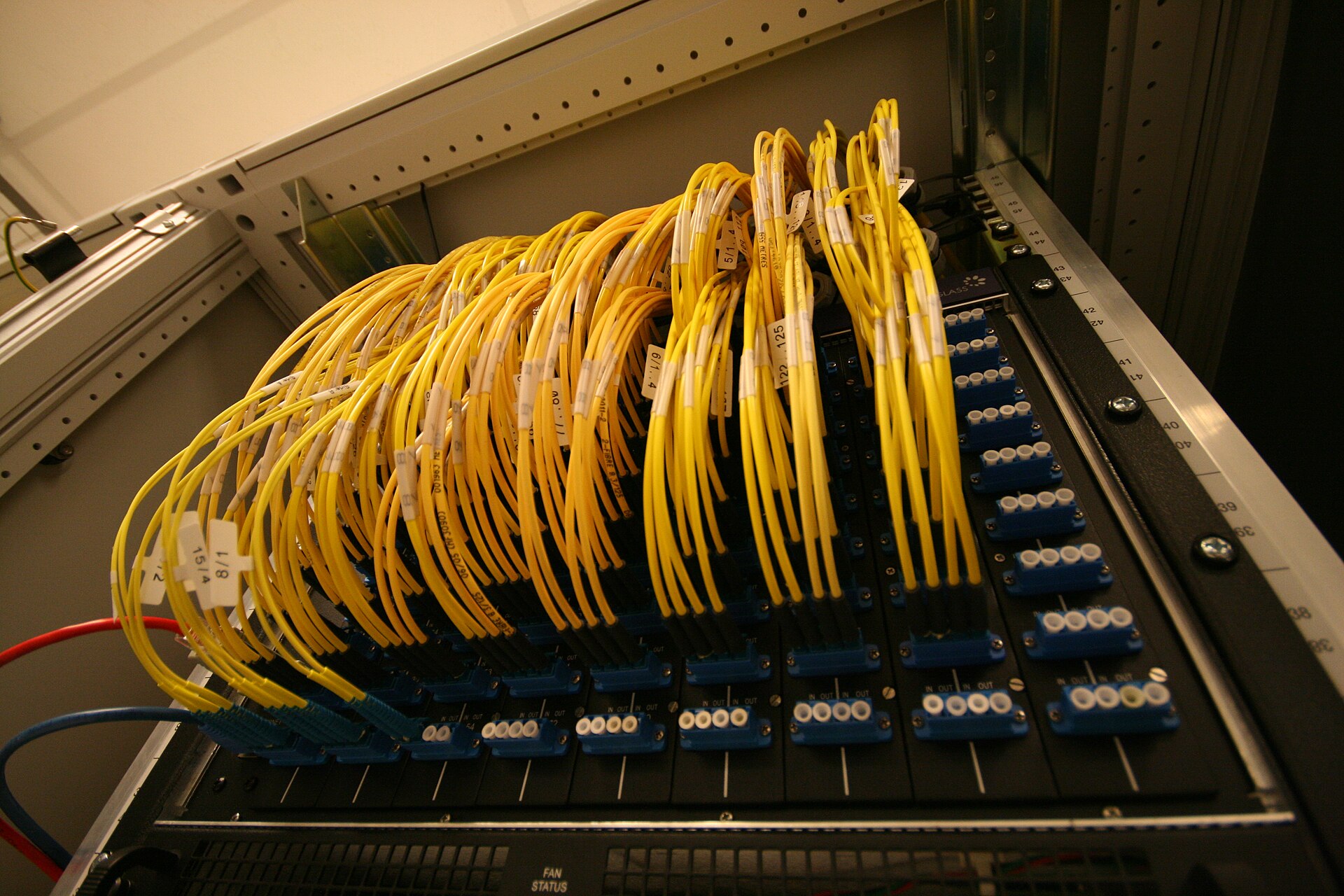
The featured photograph is titled "AMS-IX optical patch panel" and was made by Fabienne Serriere under CC BY-SA 3.0. It shows yellow fiber patch leads and an optical patch-panel environment. The image is relevant as physical interconnection context.
The photograph does not depict AMS-IX NOC staff. It does not prove the current AMS-IX topology, a present production path, ownership of the pictured equipment, port capacity, redundancy, maintenance quality, security, uptime, route-server behavior, or a customer outcome. Its visual details cannot establish how a specific participant is connected today.
That boundary is especially important for infrastructure reporting. A clear photograph can feel more conclusive than a registry record or policy page, but it answers a different question. The technical findings in this article come from the directory object, AMS-IX documentation, PeeringDB, RIPE RDAP, RIPEstat, and the participant export, not from visual inference.
A decision framework for network operators
A participant or buyer can turn the public record into a bounded diligence program:
- Confirm the exact legal, service, NOC, ASN, port, facility, and contact identities.
- Map physical, Layer 2, BGP, route-server, registry, RPKI, monitoring, maintenance, and ticket boundaries.
- Record intended prefixes, origins, peers, policy mode, communities, and expected route counts.
- Validate clean-port behavior and suppress disallowed protocols before activation.
- Test both route-server sessions and identify shared participant-side dependencies.
- Compare intended policy with IRRDB objects, ROAs, generated treatment, and observed routes.
- Define change order for registry data, authorization, BGP announcements, filters, and monitoring.
- Establish exception expiry, emergency authority, rollback, and post-event review.
- Measure actual reliability with definitions, time windows, exclusions, and participant-side observations.
- Preserve transition artifacts so policy can be migrated without reconstructing intent during an outage.
This framework does not assume private facts about AMS-IX NOC. It uses published interfaces to ask for the evidence necessary to move from capability to product reliability and, eventually, to a customer outcome.
What the public record establishes and what remains unknown
The retained evidence establishes a current BTW directory object, published AMS-IX service and operations documentation, exchange and ASN records, a route-server network identity, an RDAP object carrying an AMS-IX NOC label, routing observations, participant inventory, and an organisation boundary. [1] [2] [3] [4] [5] [6] [7] [8] [9] [10] [11] [12] [13] [14] [15] [16] [17] [18]
It establishes that peering operations depend on running fabric behavior and maintained records. It establishes documented controls for route-server policy, port hygiene, activation, maintenance, tickets, and emergency intervention. It establishes published quality objectives and a separate optional commercial arrangement.
It does not establish the private architecture, staffing, current configuration of every component, exact failure frequency, change success rate, actual availability for a selected period, filter false-positive rate, customer savings, traffic growth, security improvement, or business result. It also does not establish that every public record is current merely because it is reachable.
Those unknowns are not defects in the reporting. They are the boundary between public capability evidence and operating proof. A sound decision should preserve that boundary and request measurements where the claim requires them.
Conclusion
AMS-IX NOC operates at the intersection of shared Ethernet, BGP policy, Internet routing records, route-origin authorization, physical interconnection, monitoring, maintenance, and human response. The public documentation is detailed enough to show a real technology control surface. It explains how participants connect, what traffic is allowed, how route servers use IRRDB and RPKI inputs, how BGP communities and prefix limits affect policy, and how the NOC handles activation, tickets, maintenance, and intervention.
The same record shows why the exchange cannot be reduced to a port or a route-server feature. Correct operation depends on unique identifiers, accurate records, participant configuration, security metadata, coordinated change, supervision, exception handling, and coherent recovery. Registry records improve accountability, but running behavior remains the decisive reality.
Capability is visible. Product reliability still needs repeated, scoped measurements. Customer outcomes still need attributable participant evidence. Until those higher claims are supplied, the responsible conclusion is precise: AMS-IX NOC sits on an important peering control surface, its published obligations are inspectable, and the cost of keeping policy, records, physical paths, and live routing aligned is continuous.
Sources
[1] https://btw.media/en/directory/ams-ix-noc
[2] https://www.ams-ix.net/ams/documentation/ams-ix-route-servers
[3] https://www.ams-ix.net/ams/documentation/quality-statement
[4] https://www.ams-ix.net/ams/documentation/allowed-traffic
[5] https://www.ams-ix.net/ams/documentation/ams-ix-topology
[6] https://www.ams-ix.net/ams/documentation/config-guide
[7] https://www.ams-ix.net/ams/service/internet-peering
[8] https://www.ams-ix.net/ams/documentation/resources
[9] https://www.ams-ix.net/ams/documentation/more
[10] https://www-cdn.ams-ix.net/ams/documentation/general-terms-and-conditions
[11] https://www.peeringdb.com/api/ix/26
[12] https://www.peeringdb.com/api/net/4277
[13] https://www.peeringdb.com/api/net/3363
[14] https://rdap.db.ripe.net/autnum/211521
[15] https://stat.ripe.net/data/as-overview/data.json?resource=AS6777
[16] https://stat.ripe.net/data/announced-prefixes/data.json?resource=AS6777
[17] https://my.ams-ix.net/api/v1/members.json?exchange=NL
[18] https://www.peeringdb.com/api/org/2634
Operational assessment
Operating strengths visible in the record
- A current directory object is bound to a real peering and network-operations surface.
- AMS-IX publishes concrete route-server, port-hygiene, configuration, maintenance, monitoring, and trouble-ticket rules.
- Public exchange, organisation, ASN, RDAP, and routing records make identity and number-resource relationships inspectable.
- IRRDB, RPKI, BGP community, and prefix-limit behavior is described with enough specificity to frame verification.
- The quality statement separates stated objectives, monitoring, maintenance, and support, while an optional commercial arrangement is described separately.
Costs that still require operating evidence
- supervision across physical, Layer 2, BGP, registry, security-metadata, maintenance, and support boundaries;
- integration across facilities, cross-connects, optics, routers, VLANs, sessions, filters, contacts, and monitoring;
- maintenance of participant configuration, IRRDB objects, ROAs, route-server policy, and evidence;
- exception handling for stale records, invalid routes, disallowed traffic, urgent refresh, and emergency repair;
- recovery that restores coherent physical, routing, registry, and monitoring state;
- migration of exchange-specific policy and operational knowledge without hidden lock-in.
Evidence still needed for a reliability judgment
- observed service results for a defined period and population;
- semantic route and traffic tests, not only endpoint reachability;
- change success, rollback, and emergency-maintenance histories;
- filter correctness and false-positive evidence across IRRDB and RPKI modes;
- trouble-ticket distributions, containment, recovery, and closure evidence;
- named participant cases with explicit baselines and attributable outcomes.
Decision brief
AMS-IX NOC passes the technology-company fit because it is attached to a concrete Internet exchange control surface. The retained sources connect the directory object to port activation, shared-LAN rules, route servers, routing registries, route-origin authorization, BGP policy, monitoring, maintenance, tickets, and emergency intervention.
The main diligence risk is overstatement. A route-server session is not an end-to-end traffic result. A registry object is not infallible truth. A ROA does not validate an entire route. A topology description is not failover evidence. A quality objective is not observed availability, and a participant list is not a customer outcome.
The practical decision is to require exact identity mapping, clean-port evidence, route-policy and registry reconciliation, current ROAs, semantic monitoring, bounded exceptions, tested rollback, measured reliability, and transition artifacts. Use the public record to define the control surface, then require running evidence before accepting performance or outcome claims.
Member Briefing
Deeper Profile Context
Sign in with the right membership level to unlock the full briefing and source notes.
Only for Strategic Circle
Strategic Circle
Open to all readers. Unlock profile briefings after joining and signing in.
Join Strategic CircleOnly for Leadership Alliance
Leadership Alliance
For qualified IP-asset owners and management; sign in to unlock alliance briefings.
Join Leadership Alliance