
Summary
- American Outdoor Brands reported fiscal-Q1 2027 sales of $37.3 million, 25.4% above $29.7 million a year earlier. The company says growth was 4.3% after adjusting the comparison for about $6 million of retailer orders pulled into fiscal Q4 2025 ahead of tariffs.
- Replacing that missing volume produces a mechanical prior-year base of about $35.7 million and a current increase of about $1.6 million. Those are BTW calculations consistent with the rounded company adjustment, not a disclosed revenue bridge.
- The repair does not isolate consumer demand. Current sales also reflect pricing and new products, revenue is recorded on shipment or delivery, and the company supplies no portfolio-wide point-of-sale or channel-inventory reconciliation.
A growth rate can be true and still tell the wrong story about time. American Outdoor Brands' 25.4% first-quarter increase is calculated correctly from the numbers in its accounts. What the headline does not show is that the earlier quarter had been hollowed out by a retailer ordering decision made one reporting period sooner.
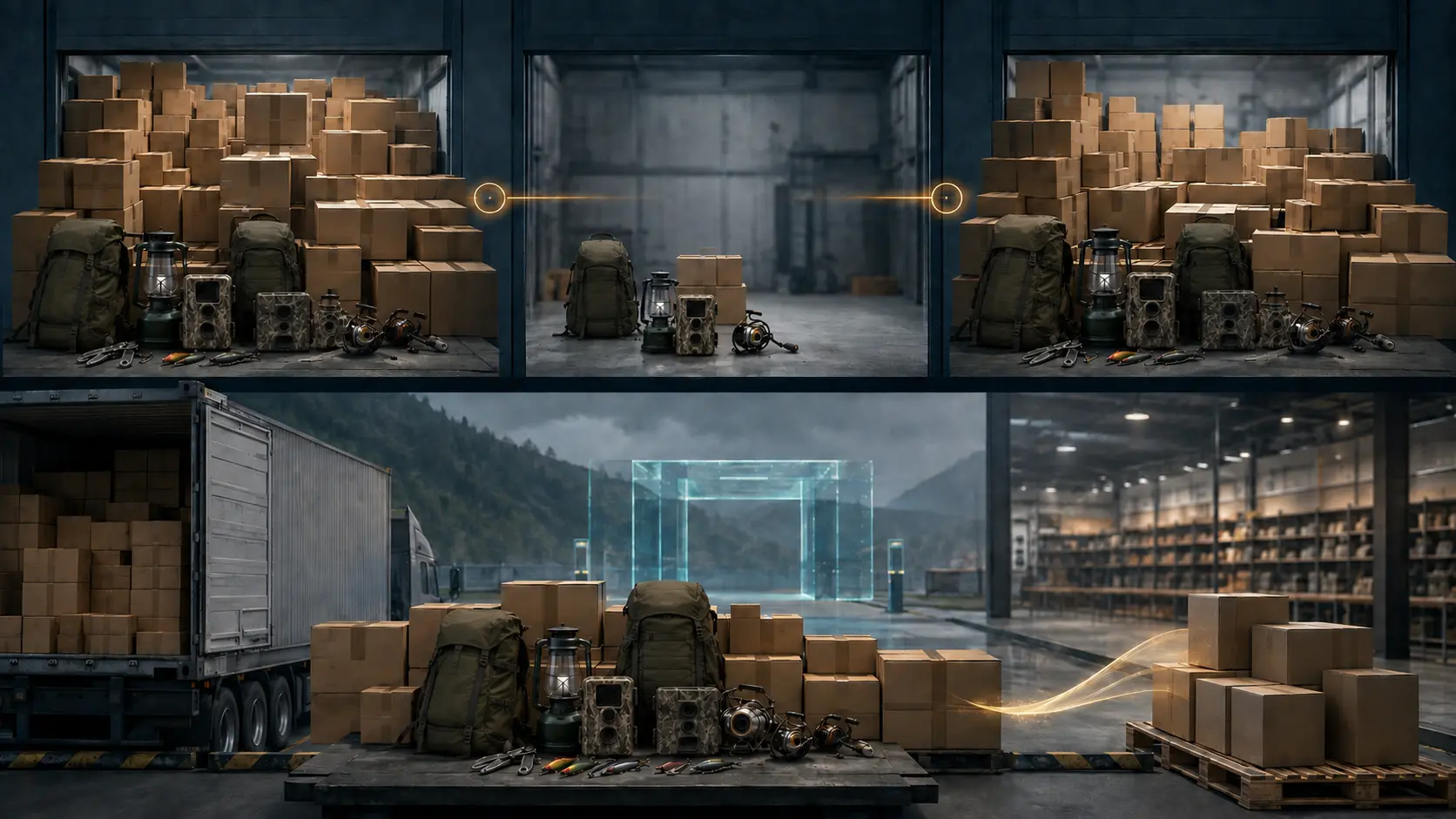
The company reported $37.3 million of net sales for the three months to 31 July 2026, up $7.6 million from $29.7 million. It then supplied the missing calendar note: retailers had accelerated approximately $6 million of orders from fiscal Q1 2026 into fiscal Q4 2025 because tariffs were expected. Adjust for that movement, management said, and the latest quarter grew 4.3% rather than 25.4%.
This is not a dispute between a GAAP number and a corrected GAAP number. Both reported quarters remain where the accounting places them. The 4.3% is an analytical comparison that asks what the current rate would look like if the earlier retailer cohort had remained in its originally intended quarter. It repairs the denominator; it does not rewrite the income statement.
The missing $6 million carries most of the headline
The rough bridge is revealing. Adding $6 million to the reported $29.7 million comparison creates a hypothetical base of $35.7 million. Dividing $37.3 million by that base produces growth of about 4.5%. The company reports 4.3%, a difference compatible with its use of “approximately” and with rounded public sales figures.
On the same simple basis, the apparent $7.6 million year-on-year increase shrinks to roughly $1.6 million after the denominator is restored. These calculations are BTW arithmetic. American Outdoor did not publish the exact underlying cents or a line-by-line adjusted revenue schedule, so false precision would be inappropriate.
The difference between 25.4% and 4.3% is 21.1 percentage points. That gap is not a current-quarter cancellation or lost shipment. It is the echo of where customers placed orders one year earlier. The same commercial pulse helped fiscal Q4 2025, hurt fiscal Q1 2026 and now makes fiscal Q1 2027 look unusually strong against the depleted base.
The broader history needs careful wording. When American Outdoor reported fiscal Q4 2025 sales of $61.9 million, up 33.8%, it estimated that retailers had accelerated $8 million to $10 million of orders originally planned for fiscal 2026. The later $6 million disclosure isolates the portion associated with fiscal Q1 2026. It should not be substituted for the whole $8 million-$10 million estimate, nor should every dollar in the earlier range be assigned to the first quarter.
That distinction prevents an attractive but unreliable reconstruction. Subtracting exactly $6 million from the $61.9 million fourth quarter would produce a pro-forma growth rate, but the company described a wider fiscal-year order pool at the time. Dates, order cohorts and estimates do not align tightly enough to present one seamless three-quarter bridge. What can be said is narrower: at least one identified cohort changed the apparent shape of all three comparison points.
The weak comparison contained more than timing
Fiscal Q1 2026 was not simply a $6 million hole. Sales fell 28.7% to $29.7 million. Traditional-channel sales declined 24.4%, and e-commerce declined 35.2%. Management said the order acceleration was the primary cause in the traditional channel, while pricing partly offset the decline. The e-commerce weakness and other category movements remained part of the quarter.
The full fiscal year makes the limit clearer. Fiscal-2026 net sales were $190.5 million, 14.3% lower than the prior year. American Outdoor described reductions across all channels and product categories, including inventory management by its largest online retailer and pressure on consumer demand. A $6 million shift between adjacent quarters cannot explain that annual contraction because moving revenue within a fiscal year does not remove it from the year's total.
The comparison therefore contains two layers. Calendar displacement explains much of the optical rebound from fiscal Q1 2026. The weaker operating environment explains why investors should not treat the adjusted base as a pristine measure of demand. A good normalization removes a known distortion; it does not erase every other change in the business.
Current growth has real ingredients beyond the calendar
The latest filing points to other contributors. Shooting-sports sales rose by $2.1 million, or 15.3%, while outdoor-lifestyle sales increased by $5.4 million, or 34.4%. Products introduced during the preceding 24 months represented 36.1% of quarterly sales, compared with 28.8% one year earlier. Management also cited pricing actions.
Those facts matter because a denominator repair can become too aggressive in the other direction. It would be wrong to say the quarter was “only timing”. There was no comparable order shift in the current year, but there were new products, price changes and category movements. The company-normalized 4.3% is the better like-for-like headline for the identified ordering effect, not a complete decomposition of organic volume.
Gross margin reinforces the point. It reached 53.0%, 630 basis points above the prior-year quarter. American Outdoor attributed the improvement to new-product sales, pricing, favourable channel mix and lower tariff expense. A timing comparison alone cannot create that margin mix. Yet a stronger gross margin also cannot prove consumer sell-through, because it is calculated on the company's recognized sales and costs rather than retailers' checkout data.
Pricing is especially ambiguous. Higher prices can lift dollars with flat or lower units, protect gross profit against tariffs, or change which products and channels retailers order. New-product share can rise because launches are strong, because legacy products weaken, or both. Without units, average selling prices by cohort and comparable sell-through, the filing cannot separate those possibilities.
Shipments stop before the consumer
American Outdoor recognizes product revenue when control transfers to the customer, generally on shipment or delivery under the contract. Its direct customers include retailers and distributors. That makes reported sales an upstream transaction. They show that merchandise entered a commercial channel, not that a consumer bought it during the same quarter.
The distinction is central to the tariff episode. Retailers advanced orders because the expected landed economics changed. A pre-buy can reflect confidence that goods will sell, a desire to lock in pre-tariff cost, fear of supply disruption or simply a change in replenishment timing. The subsequent shipment comparison cannot reveal which motive dominated.
Channel inventory is the missing balance sheet outside the company. If retailers carried unusually high stock after the accelerated fiscal-Q4 2025 purchases, later orders could fall even while end demand stayed stable. If retailers sold through the stock rapidly, the weak next quarter might overstate demand weakness. American Outdoor's disclosures discuss selected customer inventory behaviour, but they do not provide a portfolio-wide opening inventory, point-of-sale, replenishment and closing inventory bridge.
That is why 4.3% should not be labelled consumer-demand growth. It is a company-selected adjustment to wholesale revenue growth. It controls for one known timing event and leaves price, mix, launches, units and downstream inventory combined.
Cash flow has its own one-off calendar
The quarter produced $13.0 million of cash from operations, compared with a $1.7 million outflow a year earlier. On the surface, that swing appears to support the sales rebound. Its largest disclosed driver, however, was $14.2 million of refunds related to tariffs collected under the International Emergency Economic Powers Act.
Working capital also mattered. Accounts receivable fell by $3.7 million partly because of shipment timing. Accrued expenses and accounts payable supplied cash through timing changes, while inventory consumed $8.4 million as the company prepared for autumn, winter, holiday demand and new-product launches. The cash statement is therefore another calendar with moving parts.
The tariff refund is cash received, but it is not recurring customer demand. Receivables collection converts prior sales into cash; it does not create new sales. Inventory investment may support later revenue or leave the company with excess stock. Readers should not use the $14.7 million year-on-year operating-cash improvement as independent confirmation of a 25.4% demand surge.
The margin and cash results can still be economically valuable. Lower tariff expense, pricing and product mix may improve earnings even if unit demand is modest. The analytical task is to keep those benefits on the right ledger rather than turning every favourable movement into evidence of the same sales thesis.
The annual guide refuses the quarterly extrapolation
American Outdoor maintained fiscal-2027 net-sales guidance of $200 million to $210 million. Against the $190.5 million reported for fiscal 2026, that implies growth of approximately 5.0% to 10.2%. The company raised adjusted EBITDA guidance to $14.5 million-$17.5 million, signalling greater confidence in profit conversion than in a higher revenue range.
The full-year sales range is incompatible with simply annualizing 25.4%. Seasonality alone would make that exercise weak; the repaired denominator makes it indefensible. Even the 4.3% quarterly normalization is not a forecast for the remaining quarters. Product launches, retail orders, tariffs, promotions and channel inventory can move independently as the year progresses.
Guidance is a range based on management's present assumptions, not a contracted outcome. Its usefulness here is disciplinary. It shows that the company itself expects a much narrower annual growth band than the first-quarter reported comparison suggests. Investors should judge subsequent quarters against the annual range and the components behind it, not against a one-period base effect.
Three quarters, one accounting echo
The American Outdoor episode is a compact example of why growth rates need a commercial calendar. The fiscal-Q4 2025 number benefited when retailers moved orders forward. Fiscal Q1 2026 suffered when those orders were absent. Fiscal Q1 2027 then benefited from comparing with the absence. No accounting error is required for all three headlines to be accurate.
The company's choice to publish the 4.3% adjustment is useful disclosure. It gives the market a much better starting point than the statutory comparison alone. The remaining work is to resist promoting that adjustment into a claim it cannot support.
A robust demand view would connect company shipments to retailer inventories and point-of-sale, split price from units, identify comparable new-product and legacy cohorts, and reconcile any further pull-forwards. Until then, 25.4% describes the reported income statement, 4.3% repairs one known denominator problem, and neither number alone describes the consumer.
Sources
- American Outdoor Brands fiscal-Q1 2027 results
- American Outdoor Brands Form 10-Q for the quarter ended 31 July 2026
- American Outdoor Brands Form 10-Q for the quarter ended 31 July 2025
- American Outdoor Brands fiscal-Q4 and full-year 2025 results
- American Outdoor Brands Form 10-K for fiscal 2025
- American Outdoor Brands Form 10-K for fiscal 2026
Member Briefing
Deeper Profile Context
Sign in with the right membership level to unlock the full briefing and source notes.
Only for Strategic Circle
Strategic Circle
Open to all readers. Unlock profile briefings after joining and signing in.
Join Strategic CircleOnly for Leadership Alliance
Leadership Alliance
For qualified IP-asset owners and management; sign in to unlock alliance briefings.
Join Leadership Alliance