Summary
- The Morning Call reported that Allentown City Council unanimously adopted Bill 52 on 5 August, tightening the city’s rules for prospective data-centre applications.
- The amended use table leaves data centres eligible only in the IM industrial district and only by special exception, removing the use from the IG district without imposing a citywide ban.
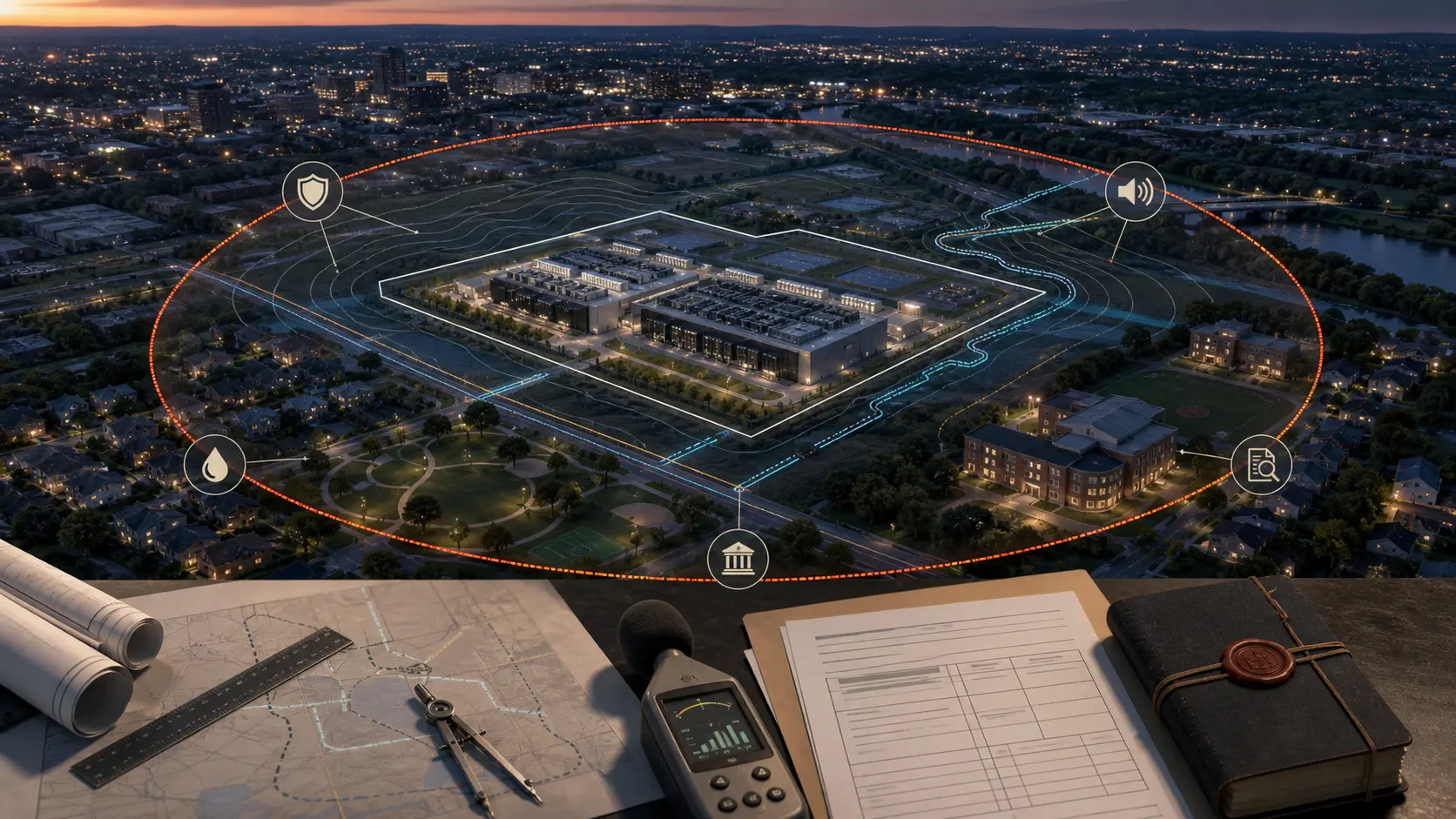
- The bill increases the separation from sensitive uses from 200 feet to 500 feet and demands broader preapproval evidence on dBA, dBC, low-frequency sound, tonal effects and vibration.
- Projects larger than 50,000 square feet must hold a public information meeting and maintain a website containing maps, renderings and information on electricity, noise, construction and permits.
- The text requires as-built sound studies before occupancy, six months after occupancy and later on city request, alongside utility, water, e-waste, emergency-response and decommissioning obligations.
- The Morning Call says the amendments apply to applications filed after 24 June; an earlier filing at 2401 W Emaus Avenue remains outside these amended rules, with its ultimate outcome unresolved.
One district and a special exception replace broad eligibility
The land-use change is narrower than a ban and stronger than a warning. Bill 52 removes data centres from the IG industrial district while retaining them in the IM district by special exception. A future applicant therefore needs both an eligible parcel and an affirmative land-use decision rather than an ordinary entitlement.
The special-exception route moves evidence and public scrutiny into project economics without predetermining the decision.
The 500-foot number is a screen, not a performance certificate
Moving the sensitive-use setback from 200 feet to 500 feet is the easiest amendment to communicate. It is also the easiest to overstate. Distance can reduce some exposure and remove some parcels from consideration, but it cannot establish how sound travels, how backup equipment operates or how a site behaves at full build-out.
Bill 52 therefore asks for dBA and dBC evidence, tonal and low-frequency analysis, vibration work and worst-case operating assumptions. The inclusion of dBC matters because a conventional headline decibel measure may not describe low-frequency energy well. The city is pairing a geometric rule with a performance record rather than pretending one radius answers every question.
Evidence now follows the facility across occupancy
The most consequential provision may be the timing of measurement. Preapproval modelling can be challenged, revised and conditioned, but it remains a forecast. The bill calls for an as-built sound study before occupancy, another six months after occupancy and later testing when the city requests it. That creates a bridge between promised performance and the operating asset.
The enforcement value depends on method and records: who measures, under which load, against which baseline, with what access and what remedy. The text permits applicant-funded engineering or third-party review and contemplates permit consequences for violations. Those tools can shift verification costs away from residents, but independence and consistent administration still have to be demonstrated.
Disclosure becomes part of the permit clock
For a data centre larger than 50,000 square feet, a public information meeting must occur before the first specified land-use review, or at least two weeks before a zoning-permit-only submission. A project website must appear at least two weeks before the meeting and remain through final land-development approval.
That gives neighbours a common record earlier than a final hearing. Useful disclosure will require stable versions, named methodologies and visible changes, not merely a large document store.
Decommissioning turns closure into a funded obligation
Data-centre debates often focus on construction and operation while leaving the end of the asset implicit. Bill 52 requires a decommissioning and site-restoration plan and financial security equal to the projected decommissioning cost. It also addresses e-waste, water, utility capacity and emergency response.
The security matters because today’s owner and balance sheet may not last as long as the asset. Its quality will turn on cost updates, beneficiary rights, duration and the events that let the city draw on it.
The application cutoff preserves two rulebooks
The Morning Call reports that the amendments apply to applications filed after 24 June. It also reports that the proposed data centre at 2401 W Emaus Avenue was submitted before that date, placing it outside Bill 52’s amended requirements. That is a procedural boundary, not a verdict on the project.
Residents may experience the distinction as a gap between the debate and its immediate target. Administratively, however, retroactively changing a filed application raises different reliance and due-process questions. The city now has to explain which rulebook governs each pending matter. An undisclosed second application was reportedly being processed, making filing dates and completeness determinations material facts rather than clerical details.
Sources
Member Briefing
Deeper Profile Context
Sign in with the right membership level to unlock the full briefing and source notes.
Only for Strategic Circle
Strategic Circle
Open to all readers. Unlock profile briefings after joining and signing in.
Join Strategic CircleOnly for Leadership Alliance
Leadership Alliance
For qualified IP-asset owners and management; sign in to unlock alliance briefings.
Join Leadership Alliance