
Summary
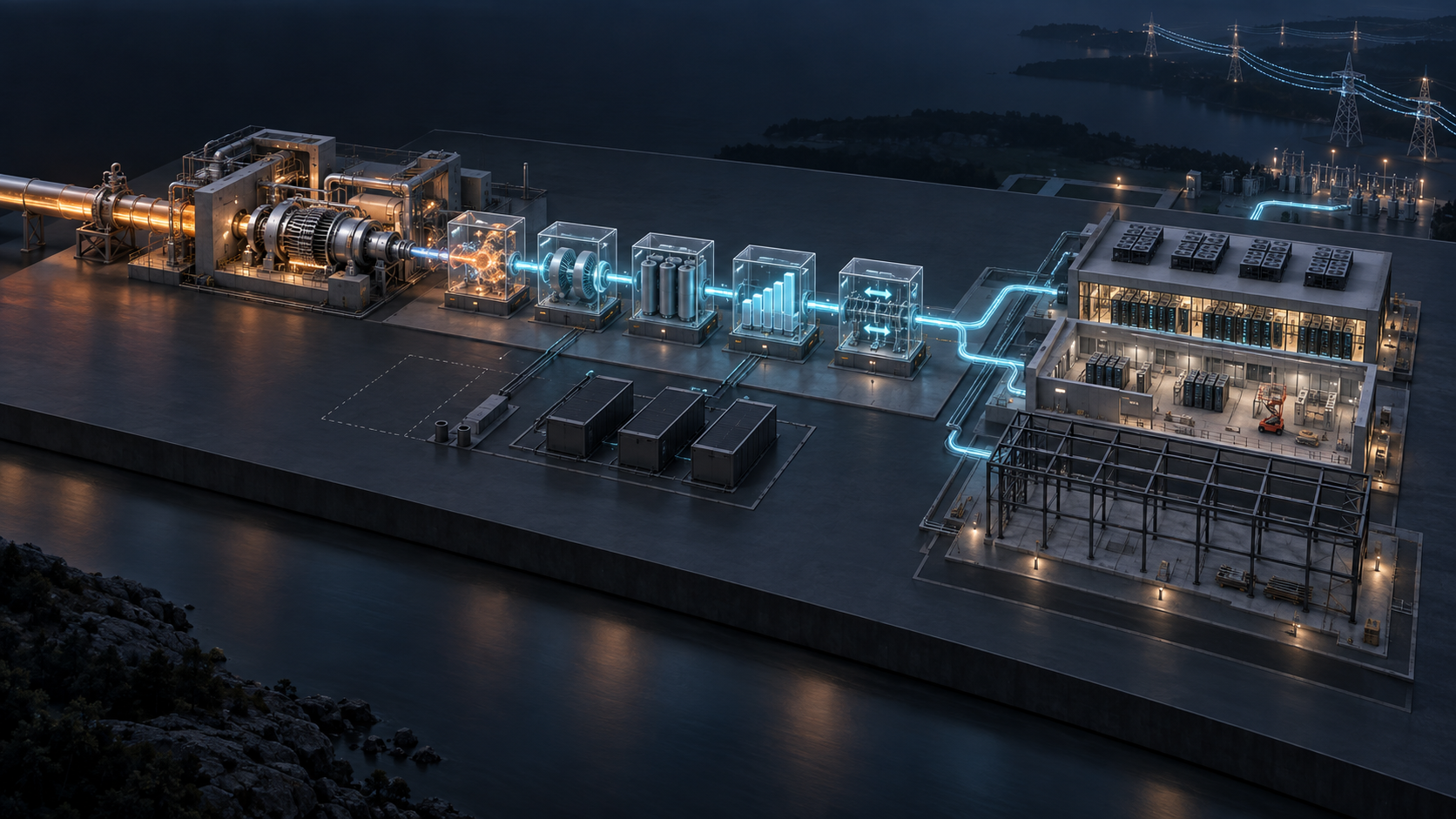
- Aligned Data Centers broke ground on a three-building, 2GW Project Phoenix campus in Shippingport, Pennsylvania. Two gigawatts is a development ceiling, not disclosed commissioned IT load, simultaneous peak demand or contracted tenant capacity.
- National Fuel is building a 7.5-mile lateral with 205,000 Dth/day of firm gas-transport capacity for Shippingport Power Station. At EIA’s 2024 fleet-average gas heat rate, that fuel-energy volume illustrates about 1.10GW of average electricity—not a Project Phoenix forecast and not proof of a shortfall.
- Aligned says the campus will use dedicated onsite generation and eventually send substantial excess power to the grid. The investable proof is a phase-by-phase reconciliation of fuel, dependable net generation, facility demand, PJM exchange and the costs secured under Pennsylvania’s GRID rules.
Two large numbers stop at different meters
Aligned’s 10 September announcement gives Project Phoenix a memorable outline: three data-centre facilities, 2GW of capacity, an estimated US$10 billion of regional investment, its own dedicated onsite power source and, once complete, substantial excess power returned to the grid. The company also projects 3,000 construction jobs and 640 permanent operating careers. Its Pennsylvania project page presents the investment as capital committed to the region.
The wording is strongest where the measurement is least complete. “Two gigawatts” can mean a campus design ceiling, ultimate electrical service, critical IT load or a sum of phases that never operate at full demand together. “US$10 billion” can include a wider ecosystem, tenants, power infrastructure and indirect investment rather than a funded Aligned construction budget. “Excess power” can describe installed nameplate, an occasional surplus or dependable export after the campus and the generator consume their own requirements. The release does not supply the bridge.
That omission is not a reason to dismiss the project. A groundbreaking is evidence that earthwork and procurement have moved beyond a presentation. Beaver County’s 2025 planning report had already listed Project Phoenix Phase 1 among Shippingport land developments. But construction state and operating state are different clocks. The first can advance while tenant load, power blocks and grid rights remain staged.
The upstream meter comes from another company. National Fuel Gas Supply’s fiscal-2025 filing says its Shippingport Lateral was designed to transport 205,000 Dth/day of natural gas to Shippingport Power Station, a generation facility expected to support a co-located data centre. The lateral is about 7.5 miles; the filing put preliminary cost near US$57 million and said a precedent agreement with Shippingport Power Station, LLC subscribed 100% of the capacity. National Fuel later said in its second-quarter update that construction had begun and retained a late-2026 in-service target. Its project tracker records environmental permits and site work in February and pipeline construction from March.
This is more concrete than a power memorandum. It is still only an upstream input.
The arithmetic exposes the missing bridge
A continuous 2GW electrical load consumes 48GWh each day, or 17.52TWh in a full year. That is not a forecast for Project Phoenix; data-centre halls arrive in phases and rarely share one identical utilisation curve. It is the annual-energy denominator needed to understand what the nameplate would mean if fully used.
The pipeline figure is an energy-flow ceiling of a different kind. One dekatherm is approximately one million Btu, so 205,000 Dth/day carries about 205 trillion Btu per day. The EIA conversion table assigns 3,412 Btu to one kilowatt-hour of electricity. With impossible 100% conversion, the lateral’s daily energy equals about 2.50GW of continuous electrical output. The fact that this exceeds 2GW does not close the account: a gas plant loses energy in conversion.
EIA’s latest annual heat-rate table gives 7,754 Btu/kWh as the 2024 operating average for US natural-gas generation. At that reference rate, 205,000 Dth/day would produce roughly 1.10GW on average, or 9.65TWh a year. EIA separately notes that modern combined-cycle plants entering service from 2014 to 2023 typically had heat rates below 7,000 Btu/kWh. Using 7,000 as an illustrative case gives about 1.22GW and 10.69TWh.
Neither result describes Shippingport Power Station. Its generating technology, gross and net output, heat rate, auxiliary load, unit configuration and outage reserve have not been disclosed in Aligned’s announcement. The station may have other firm gas paths. The campus may draw from another source, import at some times, ramp well below 2GW for years or use 2GW as a portfolio ceiling rather than a simultaneous net load. The 205,000-Dth contract may also serve a perimeter broader than the three data-centre buildings.
That is precisely the point. The public numbers do not prove the power is insufficient. They prove a conversion table is missing. At a 7,754-Btu/kWh reference rate, continuous 2GW gross output would consume about 372,192 Dth/day; at 7,000, about 336,000 Dth/day. A disclosed pipeline entitlement of 205,000 therefore cannot be treated as a one-line confirmation of a 2GW campus plus grid exports. Investors need the actual plant and load design, not a national-average inference.
“Behind the meter” still has a grid boundary
Aligned says Project Phoenix will use its own dedicated onsite source rather than the local electrical grid. It also says the finished project will send substantial excess power back to the grid. Those statements can coexist: a privately supplied campus can interconnect for export, balancing, emergency support or staged operation. But once power crosses either direction, the market needs to know which meter owns the risk.
Export requires more than spare nameplate. There must be a connection with defined deliverability, protection equipment, telemetry, dispatch rules and a commercial counterparty. Dependable export is the remainder after the plant’s auxiliary use, data-centre load, reserve margin and outages. If two gigawatts describes IT load, total facility demand is higher because cooling and electrical conversion consume power. If it describes total campus service, the IT denominator is lower. The release does not choose between those interpretations.
The timing is also asymmetric. National Fuel targets the lateral for autumn 2026. Aligned has not published a date when all three facilities, the full generation complex or 2GW of load will operate. A pipeline can enter service before a data hall; a power block can start before tenants; a campus can import during maintenance even if it is normally self-supplied. Each handoff needs its own acceptance evidence.
This matters financially. A dedicated plant can reduce exposure to a congested utility queue and make power procurement more controllable. It also moves capital, fuel-price, emissions, maintenance and availability risk into a contract or asset perimeter that tenants must ultimately support. “Own power” is not free power, and “off-grid” is not a useful economic category without the fuel price, capacity payment, availability standard, escalation formula and interconnection obligations.
Pennsylvania has specified the receipt
Project Phoenix arrives just after Pennsylvania changed the approval context. The state’s GRID requirements page says an August executive order directs the Department of Environmental Protection to evaluate new data-centre permits only when a developer has made a legally binding GRID commitment and obtained local approval. The state’s executive-order announcement describes the same gate.
For projects above 25MW, the template consent agreement turns broad promises into measurement duties. Developers must secure incremental capacity and incremental energy sufficient for the full peak demand and annual consumption of the facility, with physical deliverability in the relevant PJM area. Within 60 days after each operating year, evidence must show that procured capacity met actual peak demand and that energy met annual consumption. The developer must also pay 100% of costs caused by the project, including energy, ancillary services, transmission, distribution, network upgrades and dedicated substations.
Those are two separate tests: peak MW and annual MWh. A plant can cover annual energy while missing the highest hour; it can cover peak capacity while relying on lower utilisation to balance the year. The rule also asks who pays when the project closes or uses the network differently from plan. That makes GRID more useful than a slogan about self-generation.
The framework adds a clean-firm schedule: 10% from 2027, 14.5% from 2030 and 32% from 2035. A gas-fired station is not, by itself, proof of that component. Aligned says it signed the Ratepayer Protection Pledge and supports GRID. The decision-grade document will be the project-specific binding agreement, followed by its annual evidence—not the signature line in a launch release.
Groundbreaking is the first receipt, not the last
Aligned’s environmental and employment claims need the same discipline. The company says its closed-loop cooling consumes zero water in operation and gives each facility an overall water footprint comparable to a normal office building. The distinction between cooling water and total site water matters, as do construction, humidification, domestic use and the electricity system’s upstream water and emissions. Pursuit of Green Globes certification is not certification already awarded.
Likewise, 3,000 construction jobs and 640 operating careers are projections. A useful local record would separate peak construction positions, worker-hours, unique people, local residency, apprenticeships, permanent full-time equivalents and payroll. The US$10 billion headline should be reconciled to Aligned spending, power-station investment, tenant equipment, public infrastructure and induced regional activity rather than counted as one corporate cheque.
The power account can be equally compact. For each phase, publish the date; building and IT load; facility peak and annual consumption; generator gross and net dependable output; heat rate and firm fuel; imported and exported MWh; outage hours; capacity reserved for the campus; GRID cost security; and the clean-firm share. One table would replace a debate between believers and sceptics with an auditable operating sequence.
Project Phoenix may ultimately demonstrate a viable model for building large compute beside dedicated generation. The pipeline is real construction, the land-development process predates the launch, and Pennsylvania now has unusually explicit cost-allocation rules. But scale is not proved by placing 2GW next to 205,000 Dth/day. Scale is proved when fuel crosses the lateral, the generator produces dependable net electricity, the halls take measured load, PJM receives or supplies the recorded balance, and the developer pays every attributed cost. The groundbreaking opens the ledger. Those five meters close it.
Primary evidence: Aligned’s Project Phoenix announcement and Pennsylvania project page; National Fuel’s FY2025 filing, Q2 FY2026 update and Shippingport Lateral tracker; Pennsylvania’s GRID requirements and executive-order announcement; Beaver County’s 2025 planning report; and EIA’s heat-rate table, conversion table and modern gas-generation comparison.
Member Briefing
Deeper Profile Context
Sign in with the right membership level to unlock the full briefing and source notes.
Only for Strategic Circle
Strategic Circle
Open to all readers. Unlock profile briefings after joining and signing in.
Join Strategic CircleOnly for Leadership Alliance
Leadership Alliance
For qualified IP-asset owners and management; sign in to unlock alliance briefings.
Join Leadership Alliance