Summary
- Alibaba completed the placement of 710 million new ordinary shares at HK$112.70 on 26 August. The block represents 3.57% of the enlarged share count; gross proceeds were HK$80.0 billion and net proceeds approximately HK$79.7 billion.
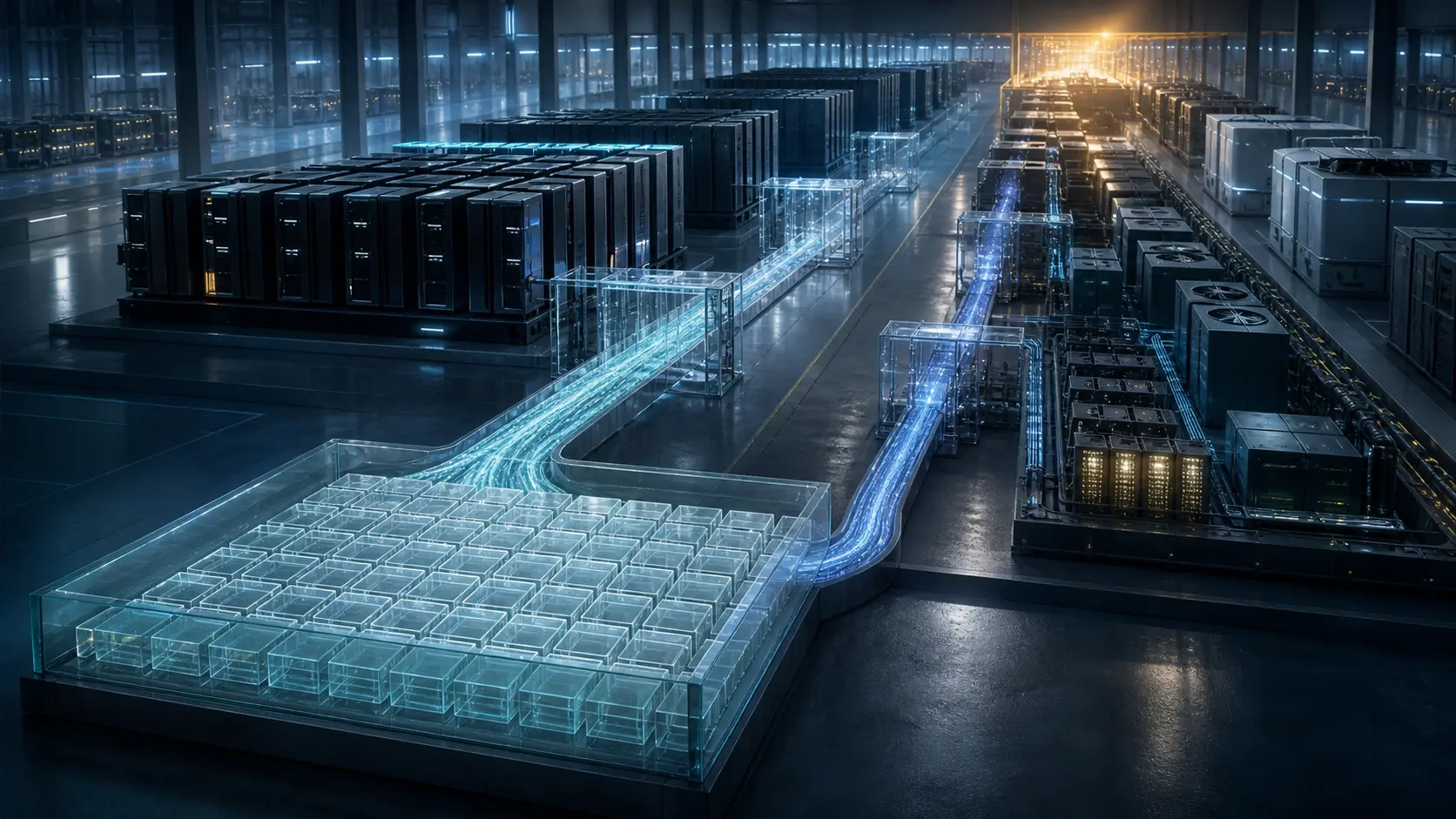
- The company assigned about 60%, or HK$47.871 billion, to global computing infrastructure and about 40%, or HK$31.914 billion, to hyperscale AI data centres and upgrades across storage, databases and high-performance networking. These are intended budgets, not installed capacity.
- The June quarter supplies a demanding baseline: capex reached RMB67.678 billion, free cash flow was a RMB44.670 billion outflow, and AI Cloud and Compute Services revenue rose 45%. None of that pre-placement performance can be attributed to the new shares.
The capital receipt is complete
The placement moved through three states in three days. Alibaba proposed the transaction on 23 August, priced it on 24 August and completed it on 26 August after the stated conditions were fulfilled. At completion, at least six placees had taken 710 million shares at HK$112.70 each.
Those numbers establish a real financing event. The shares represented 3.70% of the 19.175 billion shares outstanding when the placing agreement was signed and 3.57% of the 19.885 billion enlarged total. Existing holders did not lose 3.57% of the market value of their positions by arithmetic. They did own a smaller proportion of the same company immediately after the issue, before any later change in price, earnings or share count.
The price also contains two comparison bases. HK$112.70 was approximately 3.6% below the referenced HK$116.95 close derived from the New York ADS on 21 August and approximately 9.0% below the five-session average of HK$123.80. The discounts describe placement pricing against defined historical marks. They are not a forecast of where the shares should trade after the transaction or a permanent measure of value transferred.
Gross and net proceeds belong in separate columns. Multiplying the placement price by the share count gives the disclosed HK$80.0 billion gross amount. After commission and expenses, Alibaba says the net amount is approximately HK$79.7 billion and the expected net price is about HK$112.19 per share. Rounded aggregate figures should not be used to invent a fee reconciliation more precise than the announcement provides.
Two budgets still need two operating ledgers
The completion notice makes the intended allocation more specific than the initial proposal. Approximately 60%, or HK$47.871 billion, is meant to expand global computing infrastructure to meet customer demand. Approximately 40%, or HK$31.914 billion, is meant to accelerate hyperscale AI data-centre construction and upgrade storage, databases and high-performance networking for an Agentic Cloud architecture.
The labels overlap operationally but should not be collapsed. A compute programme can contain accelerators, CPUs, servers and supporting systems. A data-centre and cloud-platform programme can contain buildings, power, cooling, storage, databases and networks. Some equipment may sit inside the new sites, but that does not make every dollar interchangeable or allow the same commissioned resource to satisfy both budgets twice.
The public notice does not name facilities, power capacity, accelerator counts, suppliers, delivery dates, contract commitments, utilisation targets or return hurdles. Nor does it say that the money is segregated and unavailable for any temporary treasury use while projects progress. “Will be used” is an allocation of purpose, not evidence that purchase orders have been accepted or that a rack is ready for customer workloads.
A useful deployment ledger would begin with the HK$79.7 billion receipt. It would then show committed procurement, cash paid, facilities under construction, equipment delivered, power and network readiness, commissioned capacity, capacity available for sale, paid utilisation, and gross profit. Each step prevents one state from impersonating the next.
One quarter of heavy investment came first
Alibaba had already accelerated spending before issuing the shares. Capital expenditure in the June quarter was RMB67.678 billion, 75% above the prior year. The company cited procurement-cycle fluctuations, more CPU compute capacity for expected AI-agent adoption and higher prices across a broad range of chip components.
Operating cash flow remained positive at RMB22.945 billion. Company-defined free cash flow was a RMB44.670 billion outflow, compared with an RMB18.815 billion outflow a year earlier, mainly because cloud-infrastructure expenditure increased. The distinction matters. The business was generating operating cash while investment spending pushed the broader liquidity measure negative.
Alibaba also held RMB474.505 billion of cash and other liquid investments at 30 June. That is strong counterevidence to a simple rescue-financing story. It does not answer why new equity was preferred to spending more of that pool, issuing debt or pacing the programme differently. The public documents do not provide the legal-entity, currency, tax, minimum-liquidity or strategic-flexibility map needed to reconstruct the counterfactual.
The honest conclusion is narrower. Alibaba chose to share the next stage of AI-infrastructure risk with new equity investors while preserving more balance-sheet flexibility than an all-cash alternative would have allowed. Equity brings no stated coupon or maturity, but it gives another 710 million shares a pari passu claim on future distributions and value.
Strong cloud growth is evidence of demand, not return on the raise
The operating case is not speculative in the sense of having no customers. June-quarter AI Cloud and Compute Services revenue reached RMB48.437 billion, up 45% year over year for both total and external revenue. AI-related product revenue reached RMB12.376 billion and recorded a twelfth consecutive quarter of triple-digit growth. Cloud segment EBITA margin improved to 12%.
These figures show an expanding revenue engine and provide a plausible reason to add capacity. They ended on 30 June, almost two months before the placement completed. They therefore cannot demonstrate what the new proceeds produced.
They also do not provide a capacity denominator. Forty-five per cent revenue growth does not reveal installed accelerators, available megawatts, occupancy, queue time, inference volume or gross profit by infrastructure cohort. The company can have strong demand and still face a poor purchasing cycle, slow energisation, component obsolescence or underused capacity in a particular site.
The return test should preserve both sides. External cloud revenue, AI-product revenue and segment profit show demand and monetisation. Capex, depreciation, power, network cost, component pricing and free cash flow show the resources consumed. A placement-funded cohort becomes productive only when those ledgers can be joined without assigning older revenue to newer capital.
Issuance overwhelms the preceding quarter’s repurchase count
Alibaba repurchased 13.4 million ordinary shares in the June quarter for US$162 million. The later placement issued 710 million ordinary shares, about 53 times that quarterly count. The comparison supplies scale, not a net issuance calculation.
The dates, prices and purposes differ. Repurchased shares may be cancelled according to the applicable process; the placement shares were issued after quarter end and rank alongside the other shares. Share incentives and later capital actions can move the denominator again. Investors should therefore follow the reported issued share count, cancellations, awards and repurchases rather than describing the quarter’s buyback as an offset to the placement.
This is also why per-share evidence matters. A larger company can generate more revenue and profit while a continuing holder receives less of each aggregate amount unless growth outruns the enlarged denominator. The placement does not need to pay back in one quarter. It does need to produce incremental long-term economics beyond what Alibaba could have earned without issuing the shares.
Sources
Member Briefing
Deeper Profile Context
Sign in with the right membership level to unlock the full briefing and source notes.
Only for Strategic Circle
Strategic Circle
Open to all readers. Unlock profile briefings after joining and signing in.
Join Strategic CircleOnly for Leadership Alliance
Leadership Alliance
For qualified IP-asset owners and management; sign in to unlock alliance briefings.
Join Leadership Alliance