
Summary
- The exact subject is AL ROOYA Co. For Communication and Internet Services LTD, represented by the current BTW directory object and the RIPE holder string for AS211732. The registry record gives the analysis a precise entity and number-resource boundary. It does not disclose the company's commercial products, customers, private systems or contracts [S01][S02][S08][S13].
- At the dated RIPEstat query point, AS211732 was announced and originated one IPv4 prefix, 185.243.128.0/24. RIPEstat counted 256 announced IPv4 addresses, no announced IPv6 prefixes and broad IPv4 visibility across its collector peers [S03][S04][S11][S12]. Those observations establish a public routing footprint, not application uptime, bandwidth, latency or customer reach.
- RIPEstat observed one current neighbour, AS42705, even though the registry object contains declared import and export policy for more than one ASN [S05][S08]. Declared policy and observed routing are different evidence classes. The difference is a reason to monitor change and reconcile records, not proof that either record is wrong.
- The BGP-state response contains many collector paths to the same origin and prefix [S06]. Multiple collector paths do not mean AL ROOYA has multiple direct suppliers. They show how the route propagated through the wider internet from the collector vantage points that reported it.
- RIPEstat's RPKI history recorded one route-origin authorization object covering 256 IPv4 addresses through the latest retained date, while the independent BGP view labelled the visible prefix RPKI valid [S09][S14]. Origin validation is a valuable control. It does not prove route-policy correctness, protect every path decision or establish end-to-end security.
- The public record supports a technology-operations analysis because a small routing footprint still needs supervision, integration, maintenance and exception handling. Filters, contact records, route objects, authorization, monitoring, change review, upstream coordination and recovery all have continuing cost [S16][S17][S18][S19][S20].
- Capability, production reliability and customer outcome remain separate. Capability means the ASN and prefix can be registered and propagated. Production reliability concerns stable, correct operation under change and failure. Customer outcome requires evidence about an actual service and a defined business result. The retained sources establish the first category and selected control signals, but not the latter two.
The phrase "single-prefix network" sounds simple. There is one visible route, one origin and a compact address range. The public data for AS211732 makes that description unusually concrete. RIPEstat reported one announced IPv4 /24 at the query point, no announced IPv6 space, one observed neighbour and visibility from nearly all of the reporting IPv4 peers in its routing-status response [S03][S04][S05]. The prefix overview tied 185.243.128.0/24 to AS211732 and the AL ROOYA holder string [S11][S12].
That compact footprint is not the same as a simple operating model. A route can be short to describe while still depending on accurate registry records, explicit policy, correct filters, maintained route-origin authorization, functional routers, upstream coordination, monitoring coverage and practiced recovery. A small number of public objects can make each object more consequential because there are fewer alternatives when one is stale, withdrawn or rejected.
The public evidence also imposes an important limit. It does not show what service AL ROOYA sells, which applications use the prefix, how much traffic passes through it, whether customers depend on it, what capacity is available or how incidents are handled. The BTW directory and RIPE records identify the company and number resource [S01][S02][S08][S13]. The route collectors show what they observed. They do not provide a private architecture diagram or a service-level report.
This article therefore treats AS211732 as a visible operating surface rather than a proxy for the whole company. The question is not whether one /24 is good or bad. The question is what must remain aligned for a small public network to be dependable, what failure modes deserve attention, what evidence an operator or buyer should request and where public routing data stops supporting a conclusion.
BGP itself is a policy protocol. RFC 4271 defines how autonomous systems exchange reachability information and select routes according to local policy [S16]. RFC 7454 adds operational and security guidance around filtering, sessions, prefixes, AS paths, communities and monitoring [S17]. These standards make clear that the route visible to the internet is the result of repeated control decisions, not a self-maintaining fact.
The cost model has four recurring parts. Supervision means someone owns the route, watches changes and has authority to respond. Integration means registry, RPKI, router policy, upstream acceptance, monitoring and service dependencies remain consistent. Maintenance means contacts, objects, software, filters and runbooks stay current. Exception handling means the operator can recognize and resolve withdrawal, rejection, leak, stale authorization, equipment failure or a disagreement with an upstream.
The strongest public conclusion is deliberately narrow. AL ROOYA has an active, visible IPv4 routing footprint associated with AS211732. The retained evidence supports an analysis of routing controls and operational concentration. It does not establish product capability beyond that footprint, production reliability for a named service or a customer outcome.
1. Exact entity, registry authority and evidence boundary
The analysis starts with entity resolution. The BTW directory object names AL ROOYA Co. For Communication and Internet Services LTD and associates it with AS211732 [S01]. RIPEstat's overview returns a matching holder string and reports that the ASN was announced at the query time [S02]. The RIPE Database search exposes the aut-num object, organization reference, status, maintainers, administrative and technical contacts, and dated creation and modification fields [S13].
These records solve one problem: they identify the public number-resource holder with enough precision to avoid writing about an unrelated company with a similar name. They do not solve every legal or commercial identity question. An internet registry object is designed to support number-resource administration and coordination. It is not a substitute for a current corporate register, customer contract, tax record or service description.
The aut-num record carries operational meaning. It records AS211732 as assigned, names the AL ROOYA organization object and publishes declared import and export policy for several neighbouring ASNs [S08]. It also identifies the maintainers and contacts responsible for the record. Those fields create accountability paths for registry and routing coordination.
Registry authority is not the same as real-time topology. A declared import statement describes intended policy. A route collector reports what it observed from a particular set of peers at a particular time. One can change before the other. A relationship can be configured but inactive, retained for contingency, visible outside the selected vantage set or simply stale. A disciplined operator reconciles those classes instead of forcing them into a single interpretation.
The public record also has timing limits. RIPEstat responses include query times or observation intervals. The current prefix and neighbour counts are therefore dated facts, not timeless properties. A route can change after collection. A complete review records the observation time, repeats the query when a decision depends on freshness and preserves the earlier result so that change is visible.
There is no first-party corporate website in the retained set. That absence matters because it removes a potential source of product, support and customer claims. It does not prove that the company lacks a site or service; it means this article has no retained public page that supports such statements. The analysis should not fill that gap with assumptions based on the company name.
The same boundary applies to geography. The organization and directory context place the entity in Iraq, while public path and geolocation services may attach places to observed addresses or network records [S01][S15]. Such metadata can provide context, but it does not identify every facility, radio site, customer location or route endpoint. Address geolocation is not a physical asset inventory.
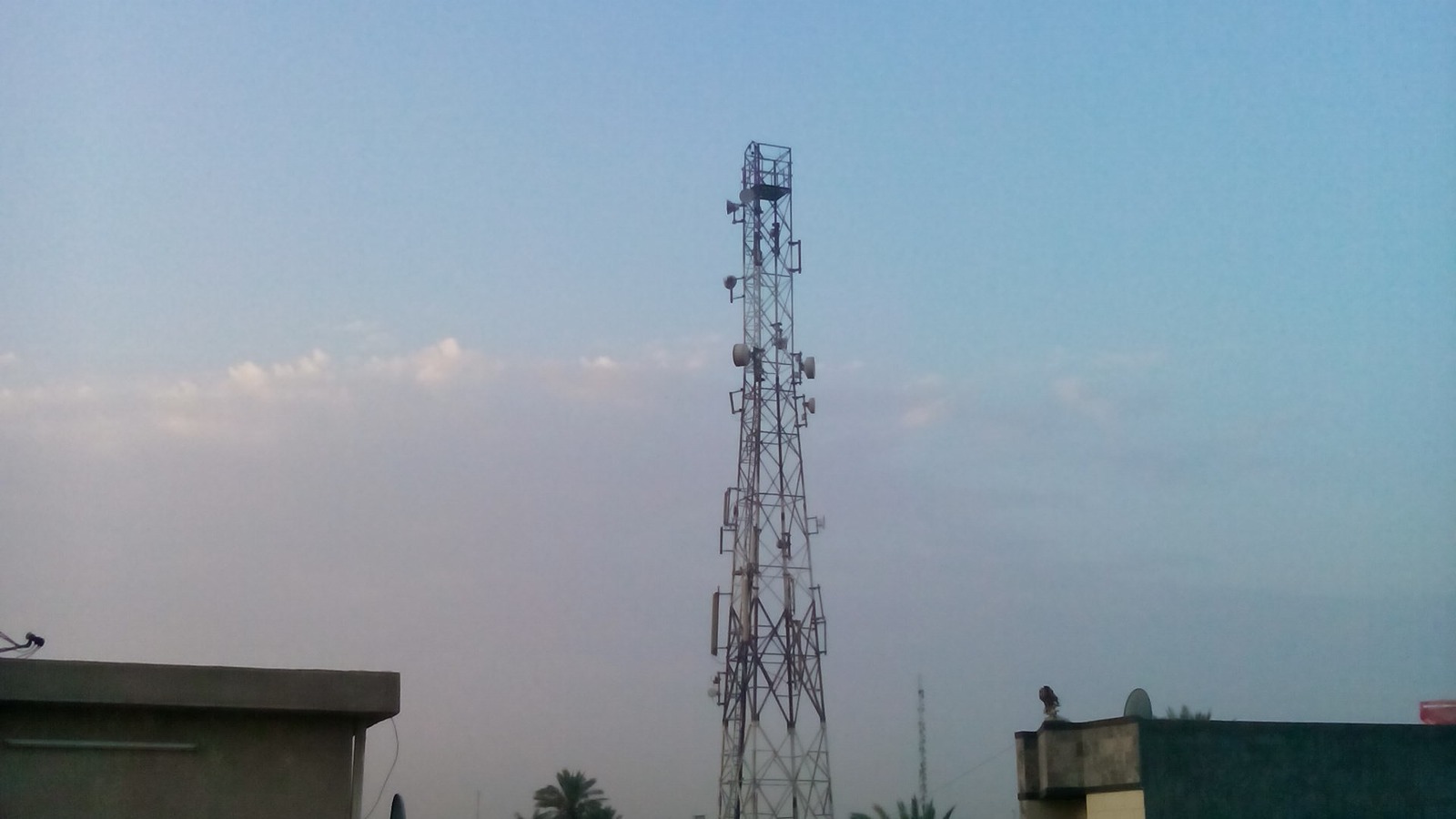
The featured photograph follows this rule. It shows a real mobile communications tower photographed in Baghdad in 2017. It is useful editorial context for Iraqi communications infrastructure. It does not depict AL ROOYA, AS211732, the visible prefix, an upstream, a customer, a facility, a coverage area or a reliability result.
This evidence boundary is not a weakness in the analysis. It is what keeps the analysis technically useful. Public routing evidence can answer questions about visible resources, origin, paths, neighbours, history and selected controls. It cannot answer questions about applications, contracts, staffing, traffic, service levels or business results. Keeping those layers separate prevents an ASN from becoming an invented company profile.
For a buyer or partner, the next identity step would be explicit. Confirm the contracting entity, the service name, the intended use of AS211732 and 185.243.128.0/24, the party controlling route policy, the upstream relationships and the people authorized to make changes. The public record provides starting identifiers. The commercial and technical engagement must supply the missing scope.
2. What one current IPv4 prefix proves and does not prove
RIPEstat's announced-prefixes response reported 185.243.128.0/24 as the current visible prefix for AS211732 during the retained interval [S03]. The routing-status response counted one IPv4 prefix containing 256 addresses and no IPv6 prefix [S04]. The network-information endpoint mapped the /24 to AS211732, while the prefix overview reported the same origin and holder association [S11][S12].
These are strong observations about public routing. They show that the prefix was being originated and seen by the measurement system. They do not show that all 256 addresses were allocated to services, reachable from every network, accepting connections or carrying customer traffic. Address-space size is not service capacity.
A /24 has operational significance in IPv4 because it is commonly accepted as the longest prefix propagated across the global default-free zone. That practical norm can make a /24 portable as a routing unit, but the retained evidence does not say how AL ROOYA uses the addresses or whether more-specific routes exist in limited contexts. The public result should be reported as the observed global route, not a complete internal addressing plan.
Broad collector visibility is also bounded. RIPEstat reported 328 of 329 IPv4 RIS peers seeing the route at its query time [S04]. That is evidence of wide visibility among those peers. It is not evidence that every access network, resolver, application path or user could reach a service. A route can be visible while packets fail later because of filtering, forwarding, congestion, host configuration or an application problem.
The distinction between route presence and service availability is one of the most important production reliability controls. A BGP monitor can report that the prefix exists while an application is down. An application monitor can report a healthy local endpoint while an external route is absent from some regions. Both layers need observation if the business service depends on both.
One prefix also concentrates change. A mistaken withdrawal can remove the entire visible IPv4 footprint. An incorrect origin can create validation or filtering problems for the whole /24. A route-map error can affect every address behind it. With many prefixes, errors can still be severe, but a small footprint leaves less room to isolate a change by routing unit.
That concentration has a favorable side. The operator has a small public set to inventory. Monitoring can assert that exactly one expected prefix is present, originated by exactly one expected ASN and covered by an expected authorization. Unexpected additions, withdrawals or origin changes can be easier to detect than in a large and frequently changing table.
The benefit exists only if the expected state is explicit. A monitoring rule that merely checks "some route is present" can miss a wrong origin or an unexpected more-specific. A rule that checks the exact prefix, origin, validation state and neighbour path is more useful. It should also distinguish a planned maintenance change from an unauthorized deviation.
The public prefix is a shared dependency across layers. Reverse DNS, allowlists, geolocation, reputation systems, abuse contacts and customer configurations may refer to addresses within it. A change in ownership, routing or use can have second-order effects even when BGP itself is healthy. Maintenance therefore includes an inventory of systems that encode the prefix outside the router.
No retained source reports traffic volume, peak utilization, packet loss, delay, route convergence time or capacity headroom. It would be incorrect to estimate those metrics from the /24 size or the number of visible paths. A buyer should ask for service-specific measurements and their collection method rather than treating routing visibility as a benchmark.
The appropriate capability statement is modest: AL ROOYA controls or is associated with a public ASN that was observed originating one IPv4 /24. The production reliability question is whether the route and the services behind it remain correct under normal operation, maintenance and failure. The customer outcome question depends on an actual service and a defined objective, neither of which is established by the retained public record.
3. The operating economics of a single-prefix footprint
A compact public network can reduce some forms of complexity. There is one current prefix to document, one origin to authorize and a small set of external routing assertions to monitor. The operator can build a concise expected-state model and detect deviations quickly. That is capability at the control-plane level.
The compact model can also make fixed costs more visible. Registry maintenance, RPKI operations, router software, monitoring, upstream coordination, security review and on-call coverage do not disappear because the prefix count is one. Some costs are nearly independent of address-space size. A small network may spread them across fewer services or customers.
Supervision is the first fixed cost. Someone must know the intended route state, approve changes, watch alerts and coordinate with external parties. The role needs enough authority to withdraw an unsafe change, contact an upstream, correct a registry object and preserve evidence. If only one person holds that knowledge, the network has a key-person dependency even when the route itself looks healthy.
Integration is the second fixed cost. The registry object, RPKI authorization, router configuration, upstream filters, monitoring expectations, address-management records and any service inventory must describe compatible reality. A mismatch can cause rejection or misleading alerts. The cost is not only initial configuration; it is keeping each control synchronized after change.
Maintenance is the third fixed cost. Contact details expire. People change roles. Keys and credentials rotate. Router software reaches end of support. Upstream policy changes. Monitoring collectors evolve. A route-origin authorization may need adjustment when a prefix or origin changes. A small routing table does not remove this lifecycle.
Exception handling is the fourth fixed cost. The operator needs procedures for withdrawal, wrong origin, validation failure, route leak, upstream rejection, session instability, hardware failure and inaccessible management. Each event crosses technical and organizational boundaries. A correct diagnosis may require comparing local state, registry data, route collectors and upstream observations.
The business case should include these costs before claiming that a small footprint is efficient. Efficiency is not the absence of complexity on a public dashboard. It is the ability to maintain the required controls with proportionate effort and recover within the consequence tolerated by the service.
There can be a rational trade-off. A small operator may prefer one public prefix because it matches its actual scale and reduces unused resources. The trade becomes risky only when the footprint is treated as self-sustaining or when the services behind it require resilience that the routing and operating model do not provide.
Cost also depends on change frequency. A stable route with rare, well-reviewed changes can be inexpensive to maintain compared with a dynamic environment. Yet low change frequency creates its own risk: procedures and access paths may go untested. An annual exercise that validates contacts, credentials, route filters and recovery can be more valuable than a document that no one has executed.
The public history shows that AS211732 has originated more than one prefix over time, while the current view contains one [S07]. That does not identify the reason for historical changes. It does show why the expected-state record must be dated. A rule built around an old prefix can produce noise, while a rule that silently learns every change can normalize an error.
A well-run small network should be able to explain the recurring cost in plain terms. Who owns routing? Which resources are expected? Which upstreams are active? How is origin authorization maintained? What is monitored externally? What failure modes trigger escalation? How is the service restored if the primary path or router fails? Public data cannot answer those questions, but it can make them specific.
4. Observed-neighbour concentration and path supervision
The RIPEstat neighbour response reported one unique observed neighbour for AS211732, AS42705, at the retained query time [S05]. The routing-status response also counted one observed neighbour [S04]. This is a meaningful concentration signal, but it requires careful language.
An observed neighbour is derived from routes visible to collectors. It is not automatically the same as a direct physical connection, a commercial transit contract or the full configured topology. The registry object declares policy relationships with multiple ASNs [S08]. One record may reflect intended or available relationships while the observation reflects active propagation during the selected window.
The BGP-state response helps explain the distinction. It contains many paths from collector sources to 185.243.128.0/24, but the paths converge toward AS42705 before reaching AS211732 [S06]. The earlier ASNs in those paths are part of the wider propagation chain. They are not evidence that AL ROOYA has a direct contract with every ASN listed.
From a production reliability perspective, one observed neighbour creates a question about dependency. If the current public route truly relies on one external path, then a session, policy or infrastructure failure at that boundary could affect the whole visible prefix. The retained data does not report whether there is a hidden backup, a configured but inactive alternative or a rapid failover arrangement. Those are the exact facts a diligence review should request.
Concentration is not automatically poor design. A single supplier can reduce coordination overhead, simplify policy and match a limited service consequence. The decision depends on recovery objectives, supplier performance, alternate access and the cost of a second path. Redundancy that is untested, physically co-located or dependent on the same upstream chain may add expense without removing the actual failure mode.
Supervision should therefore model the dependency rather than count links. Useful checks include BGP session state, expected prefixes, expected origin, next hop, accepted and advertised route counts, policy changes, route flap history and external visibility. A separate check should establish whether the service remains reachable, because control-plane health alone is incomplete.
Integration with the upstream matters in both directions. The operator needs import policy for routes it accepts and export policy for routes it announces. RFC 7454 recommends explicit filtering practices and attention to prefixes, AS paths and communities [S17]. A small origin should know what its upstream expects, how filters are updated and who can resolve a rejected route.
The failure mode is not limited to complete outage. A route can become visible through an unintended path, be accepted in some networks and rejected in others, or carry unexpected attributes. Partial visibility can be harder to diagnose than a clean withdrawal. External collectors provide useful evidence, but their vantage points do not represent every customer path.
Change control should include upstream coordination. If the origin, prefix, maximum length, policy or contact changes, the upstream may need corresponding updates. A local configuration can be correct while an external filter remains stale. The maintenance plan should track both sides and verify the resulting route from outside the network.
The independent Hurricane Electric and IPinfo views provide useful cross-checks [S14][S15]. They can reveal whether another public system sees the expected ASN and prefix. Agreement across sources increases confidence in the observation, but it does not turn the views into an availability guarantee. They share portions of the same public routing ecosystem and have their own collection limits.
A buyer should translate neighbour concentration into a service question. What user-visible consequence follows if the observed path disappears? How quickly can traffic use another path? Is another path technically and commercially active? Does it share physical facilities, power, equipment or upstream dependencies? What evidence from a recent exercise supports the answer? Without those facts, the public concentration signal remains a question, not a verdict.
5. RPKI, registry policy and origin validation
RIPEstat's RPKI history for AS211732 recorded one validation record covering 256 IPv4 addresses through the latest retained date [S09]. The independent BGP view labelled 185.243.128.0/24 RPKI valid [S14]. These observations indicate that the visible origin and a public authorization aligned at the time of collection.
RFC 6811 describes BGP prefix-origin validation using validated route-origin authorization data [S18]. The control answers a bounded question: is the observed origin authorized for the prefix and permitted prefix length? It does not validate the entire AS path, router configuration, forwarding behavior, service identity or application.
That boundary is operationally important. A valid route can still be leaked through an unintended path, sent with an undesirable attribute, withdrawn by mistake or point to a failed service. A valid status should be treated as one required control, not a green light for every layer.
RPKI also creates lifecycle work. The authorization must be created by the appropriate resource holder, remain available through the repository system and be changed when the intended origin or prefix policy changes. A stale authorization can conflict with a legitimate migration. An overly broad maximum length can authorize more-specific announcements beyond what the operator intended.
The operator should inventory the authorization alongside the route. The expected record includes prefix, origin ASN, maximum length, issuer context and validity period. Monitoring should detect absence, invalidity and unexpected changes. A planned origin migration should stage the authorization before the route change and remove obsolete state after validation.
The registry policy record adds a separate layer [S08][S13]. It declares import and export relationships and identifies maintainers. Those statements can support coordination and filtering, but they do not carry the same semantics as a route-origin authorization. A complete control model does not treat IRR-style policy and RPKI as interchangeable.
RFC 7454 recommends prefix and AS-path filtering as part of BGP operations [S17]. Origin validation can strengthen that model, especially when upstreams reject invalid routes. The practical integration question is whether each relevant network applies compatible policy and whether the operator knows how a changed validation state will affect propagation.
Exception handling must account for validation failure. The response is not simply to disable the control. The operator should compare the route, authorization, registry ownership, planned change and upstream observation. It should identify whether the route is unauthorized, the authorization is stale, the origin changed legitimately or a repository problem is affecting validation.
Communication is part of recovery. Current administrative and technical contacts make it possible for an upstream or another operator to reach the resource holder [S08]. Contact maintenance is therefore a security and reliability control. A technically correct authorization is less useful if no one can coordinate during an incident.
The public evidence does not reveal AL ROOYA's internal RPKI workflow, signer access, review process, monitoring or upstream validation policy. It only shows the externally visible state recorded by the retained systems. Any conclusion about process maturity would require direct evidence.
The fair capability conclusion is that the visible prefix had a matching origin-authorization signal. The production reliability question is whether the control remains correct through change and whether the operator can recover from an invalid state. The customer outcome question depends on whether that control measurably reduces disruption or risk for a defined service, which the public record does not establish.
6. Change control, route leaks and safer defaults
Routing failures often begin as changes that were locally plausible. A new policy is applied in the wrong direction. A prefix list is incomplete. A session comes up before filters are loaded. A backup path announces more than intended. A registry or authorization update occurs in the wrong sequence. The network may continue forwarding while the control plane has already diverged from the expected state.
RFC 7908 defines route leaks as propagation beyond the intended scope and classifies several common forms [S19]. The document is useful because it separates a leak from a simple origin hijack. A route can have the correct origin and still travel through an unintended relationship or violate policy.
For AS211732, the compact public footprint makes a change checklist precise. The operator can verify the exact prefix, origin, authorization, import and export policy, neighbour expectations and external visibility before and after a change. The checklist should also confirm that no unexpected prefix or path is introduced.
RFC 8212 recommends safer default external BGP behavior: no routes should be imported or exported without explicit policy [S20]. This reduces the risk that a newly established session propagates everything by default. The principle is especially useful during replacement, recovery or emergency work, when operators may be under time pressure.
Explicit policy is not enough if the policy is stale. Prefix lists, AS-path filters and maximum-prefix limits must match the intended relationship. A control that once prevented error can later block a legitimate migration or allow a new resource that was never added to the expected set.
Review should include the failure mode created by the change itself. If a new filter rejects the only current prefix, the whole visible footprint may disappear. If a change accidentally announces another party's routes, the small origin can become a leak path. The consequence depends on upstream acceptance and wider filtering, but the local operator remains responsible for preventing and detecting the mistake.
Staging reduces risk. The operator can validate configuration syntax, compare generated policy with an approved source of truth, apply changes to one session where architecture permits, and observe external collectors before completing the rollout. A rollback must restore the previous known state rather than improvise a new one.
Emergency change deserves the same evidence with a shorter cycle. The owner should record what failed, which controls are temporarily bypassed, who approved the exception and when the exception expires. A temporary broad policy that remains after recovery can become the next incident.
Historical route data provides context for review [S07]. It can show when prefixes appeared or disappeared and how visibility changed. It cannot identify the cause. A period of reduced visibility could reflect planned migration, collector changes, upstream behavior or an incident. The operator's internal change and incident records are needed to interpret it.
Maintenance should also include software and platform lifecycle. BGP implementations, operating systems and management interfaces change over time. A route policy may remain logically correct while the device that enforces it reaches end of support or behaves differently after an upgrade. Lab or staged validation is proportionate when the public prefix is a concentrated dependency.
The central control is expected-state reconciliation. Registry, authorization, router configuration, upstream acceptance, monitoring and service inventory should agree on the intended route. Each change updates that model deliberately. Any unexplained difference becomes an exception with an owner, not a new normal learned silently.
7. Monitoring, incident response and measurement limits
RIPEstat reported broad IPv4 visibility for AS211732 and no IPv6 visibility in the retained routing-status result [S04]. Its visibility and BGP-state endpoints expose observations from multiple collectors [S06][S10]. These are valuable external views because they can reveal propagation that local router counters cannot.
External visibility is not a complete monitor. Collectors sample the internet through specific peers and locations. A route can be visible to them while a user network filters it, or invisible to a selected collector while service remains reachable elsewhere. The operator should combine external routes, active reachability and service-specific checks.
The monitoring stack should separate layers. The first layer checks router and BGP session health. The second checks the expected prefix, origin, path and validation state from outside. The third checks transport reachability from relevant regions or networks. The fourth checks the actual service, if one is defined. Alerts should identify which layer failed.
This separation improves diagnosis. If the route disappears externally but the local session is up, the problem may be export policy, upstream filtering or propagation. If the route is visible but the service is down, the problem lies further along the forwarding or application chain. If only one region fails, the issue may be partial propagation or a path-specific dependency.
Alert quality is an operating cost. A small footprint can support precise rules, but collectors and paths still change. A monitor that pages on every harmless path variation creates fatigue. A monitor that accepts any origin or any prefix may miss the event that matters. Thresholds and suppression need review against real decision needs.
Incident response begins with authority. Someone must be able to inspect the router, compare external data, contact the upstream, update an authorization or registry object and communicate impact. Access should not depend on one unavailable person. Credentials, out-of-band management and contact methods need periodic verification.
The response plan should cover at least six failure modes. First, complete route withdrawal. Second, wrong-origin or invalid-origin observation. Third, partial visibility. Fourth, unexpected path or neighbour. Fifth, route leak or unexpected export. Sixth, route present but service unreachable. Each requires different evidence and escalation.
Recovery must be verified from outside. A local command showing the session restored is not enough. The operator should confirm that the exact prefix and origin reappear, validation state is expected, propagation is broad enough for the service and the service itself has recovered. The time of each stage helps separate routing convergence from application recovery.
Post-incident review should not assume the public data explains cause. Collector history can show what changed and when [S07][S10]. It cannot show why a configuration changed, whether hardware failed or which decision delayed recovery. The review needs local logs, change records, upstream communication and service evidence.
Status communication should preserve uncertainty. "The route is visible again" is a control-plane statement. It should not be expanded into "all customers are restored" without service-specific evidence. A precise update can state which layer has recovered, what remains under validation and when the next observation will occur.
No retained source reports an AL ROOYA incident, response time or monitoring architecture. The failure modes above are a diligence framework derived from public routing evidence and primary operational standards [S17][S19][S20]. They are not allegations that any event occurred.
8. IPv6 absence and address-lifecycle choices
The retained routing-status response reported zero announced IPv6 prefixes for AS211732 while reporting one IPv4 /24 [S04]. The announced-prefixes response likewise retained the IPv4 prefix as the current visible resource [S03]. This is a dated public observation, not proof that AL ROOYA has no IPv6 capability anywhere.
An organization can use provider-assigned IPv6, private connectivity or another ASN without that state appearing as an AS211732 origin. Conversely, an IPv6 allocation can exist without being announced. The correct statement is limited to the observed public origin at the query point.
IPv4-only public routing creates lifecycle questions. A /24 contains a finite address set. The operator may use address translation, allocate addresses selectively, acquire additional space or plan IPv6 deployment. The retained sources do not show which choice AL ROOYA has made.
Address scarcity has operating cost. Allocation, reclamation, reputation, reverse DNS, allowlists and abuse handling require records. Reusing an address can expose a new service to assumptions built around its previous use. A small pool makes disciplined inventory and cleanup more important.
IPv6 adoption is not simply a larger address field. It adds routing policy, firewall rules, monitoring, DNS records, application support, logging and support procedures. Running dual stack can improve reachability options and reduce some IPv4 pressure, but it also creates two paths that must be secured and observed.
The choice should follow a service requirement rather than a fashion metric. If customers, upstreams or platforms require IPv6, the operator needs an implementation and maintenance plan. If the current service does not require it, the operator should still understand when that decision will be reviewed and what dependencies make later adoption expensive.
Software lifecycle and lock-in appear at this layer. Systems that assume IPv4 literals, store addresses in narrow fields, encode allowlists manually or lack IPv6 monitoring become costly to change. The longer those assumptions spread, the more a later network transition reaches into applications and operations.
Testing must include failure asymmetry. A service can work over IPv4 and fail over IPv6, or vice versa. Clients may prefer one family and wait before falling back. A monitoring system that checks only IPv4 can report health while dual-stack users fail. Production reliability requires family-specific evidence.
The public route-origin authorization history retained for AS211732 concerns IPv4 address space [S09]. If IPv6 is later originated, its registry and authorization state must be added deliberately. A change plan should establish the prefix, origin, filters, upstream acceptance, monitoring and rollback before public announcement.
The customer outcome remains undefined. IPv6 capability can improve compatibility or reduce address-management constraints, but it does not automatically improve customer performance. The result depends on path quality, application support, user networks and operating maturity. A business case should measure the intended effect and the added maintenance cost.
For diligence, the bounded questions are straightforward. Is IPv6 intentionally absent from AS211732? Does any relevant service depend on provider-assigned IPv6 elsewhere? What triggers deployment? Which systems would need change? How will both address families be monitored? Public routing data raises those questions; only the operator can answer them.
9. Capability, production reliability and customer outcome
The public record supports a clear capability statement. AS211732 is registered to the AL ROOYA holder string and was observed originating 185.243.128.0/24 [S02][S03][S08][S12]. The route had broad visibility in the retained RIS result and a matching origin-authorization signal [S04][S09][S14].
That capability has several parts: number-resource administration, route origination, upstream propagation and a public authorization record. Each part is observable to some degree. None establishes a commercial product.
Production reliability asks a different set of questions. Does the route remain correct during change? Are contacts current? Are import and export filters explicit? Is the authorization maintained? Can the operator detect partial visibility? Is recovery practiced? Does the service behind the prefix continue functioning when the control plane changes?
The retained sources cannot answer those questions for AL ROOYA. A point-in-time healthy observation is useful, but reliability is a distribution over time and conditions. It includes maintenance, degraded states, exceptions and recovery, not only the moment sampled by a public endpoint.
Customer outcome is further removed. A customer might value reachability, predictable routing, support, lower coordination cost or access to a particular service. Measuring the outcome requires a named service, baseline, observation period and allocation of responsibility. No retained source supplies that evidence.
Confusing the categories creates predictable errors. Route visibility becomes "uptime." One neighbour becomes "poor redundancy." RPKI validity becomes "secure network." An IPv4 /24 becomes "small capacity." None of those conclusions follows without additional evidence.
The categories also help an operator communicate honestly. Capability can be documented through registry and route observations. Reliability can be supported with monitoring history, change controls, recovery exercises and service indicators. Customer outcome can be supported with deployment-specific measures. Each claim then has evidence appropriate to its level.
Supervision cost belongs mainly to reliability. Someone reviews state and exceptions. Integration cost connects the controls and the service. Maintenance cost keeps the system current. Exception handling cost appears when the expected path fails. A customer outcome should be evaluated after those costs, not before them.
Failure mode analysis connects the levels without collapsing them. A wrong origin is a control-plane failure mode. Whether it causes service loss depends on filtering and alternate paths. Whether it harms a customer depends on the affected service, timing and recovery. The chain must be observed rather than assumed.
The evidence model should preserve negative space. No public product page means no product claim. No service measurements mean no reliability claim. No customer record means no outcome claim. The absence of evidence does not prove failure; it limits what can responsibly be asserted.
This distinction makes the article more useful to buyers and operators. It replaces a broad rating with a request for concrete evidence. It also gives AL ROOYA a fair standard: the company is evaluated on the public routing facts available, while private performance remains an open diligence question rather than an invented conclusion.
10. A buyer and operator evidence plan
A buyer considering a service associated with AL ROOYA should first confirm scope. Which legal entity contracts? What service is supplied? Does the service actually depend on AS211732 or 185.243.128.0/24? Which party controls routing, upstream relationships and incident response? The public directory and registry identifiers provide a starting point [S01][S08][S13].
The second step is architecture at the boundary, not a demand for every private detail. The buyer needs to know which component depends on the public prefix, which upstream paths are active, what alternate paths exist, where control changes are made and how service health is distinguished from route health.
The third step is expected-state evidence. The operator should document the exact prefixes, origins, validation state, neighbours, filters and contacts. The current public observations supply values to cross-check [S03][S04][S05][S09]. The operator's own record should explain any difference.
The fourth step is monitoring evidence. A useful sample includes BGP session checks, external prefix and origin monitoring, RPKI-state monitoring, regional reachability and service-specific tests. It should show alert ownership, thresholds, suppression, escalation and evidence from a recent event or exercise.
The fifth step is change control. The buyer should understand who can change route policy, how configuration is reviewed, how upstream filters are coordinated, how authorization changes are sequenced and how rollback is verified externally. RFC 7454 and RFC 8212 provide relevant operational principles [S17][S20].
The sixth step is failure-mode coverage. Route withdrawal, invalid origin, partial propagation, leak, unexpected neighbour and route-present/service-down should each have a diagnosis and recovery path. RFC 7908 provides a route-leak taxonomy that can make the discussion more exact [S19].
The seventh step is concentration acceptance. If one neighbour is the intended active design, the buyer should know the consequence and the available recovery path. If multiple relationships are intended, the operator should explain why the retained collector view observed one and provide current evidence for the others. The answer can be benign, but it should be explicit.
The eighth step is maintenance. Contacts, registry objects, route-origin authorization, software support, credentials, out-of-band access and monitoring dependencies need owners and review dates. An unchanged route does not mean those supporting controls remain current.
The ninth step is address lifecycle. The buyer should know whether IPv4 scarcity, reputation, reverse DNS or allowlists affect the service and whether IPv6 is required. If IPv6 is intentionally absent, the decision should have a review trigger rather than becoming an invisible permanent assumption.
The tenth step is service evidence. Ask for indicators appropriate to the actual service: availability method, reachability from relevant locations, support response, recovery time, change success and unresolved exceptions. The public route views [S06][S10][S14][S15] can complement those indicators but cannot replace them.
The eleventh step is customer outcome. Define the business measure before deployment. It might be reachability, lower coordination cost, faster recovery or another service-specific result. Record the baseline, observation period and internal work needed to achieve it. A technically correct route is an input, not the outcome itself.
The twelfth step is exit and portability. Determine how addresses, DNS, configurations, logs, documentation and upstream arrangements change if the service ends. Some number resources may not be portable under the intended arrangement. A migration should not discover that dependency only after notice is given.
Evidence should be dated and scoped. A collector observation reflects a time and vantage set. A recovery exercise reflects a configuration. An authorization reflects a prefix, origin and validity context. A customer result reflects one deployment. Reusing any of them outside scope can create more certainty than the evidence supports.
The decision can then be proportionate. A low-consequence service may accept a compact path with clear support. A critical service may require stronger path diversity, recovery evidence and contractual controls. The public record does not dictate the answer. It identifies the exact technical questions that should shape it.
Verdict
AL ROOYA has a precise and currently visible public network identity. The directory object, RIPE records and independent routing views converge on AS211732 and 185.243.128.0/24 [S01][S02][S03][S12][S14]. At the retained query point, the ASN originated one IPv4 /24, had no visible IPv6 prefix, was broadly visible to reporting IPv4 peers and had one observed neighbour [S04][S05].
The public controls include an assigned registry object, declared routing policy and a route-origin authorization history [S08][S09][S13]. These are meaningful capability and governance signals. They do not establish AL ROOYA's product portfolio, capacity, uptime, route convergence, support performance, security effectiveness, customer deployments or business results.
The central operating risk is not that one prefix is inherently inadequate. It is that a compact footprint can concentrate consequence while retaining fixed costs. Registry, policy, authorization, filters, monitoring, upstream coordination, software, contacts and recovery must remain aligned. A small public table can simplify expected-state monitoring, but it does not remove supervision, integration, maintenance or exception handling.
The one observed neighbour should be treated as a diligence question. It may reflect the intended current path, a measurement boundary or a design with inactive alternatives. The public data does not justify a verdict on resilience. A buyer should request current topology and recovery evidence proportional to the service consequence.
The same discipline applies to RPKI. The visible valid-origin signal is a useful control. It does not validate the complete path or the service behind it. The operator still needs explicit policy, leak prevention, change review, external observation and incident response [S17][S18][S19][S20].
AL ROOYA should therefore be understood as an exact current company object with a bounded, observable internet-routing footprint. Public evidence supports the capability to originate and maintain a visible prefix at the sampled time. Production reliability and customer outcome remain open questions that require direct, dated and service-specific evidence.
Sources
- BTW directory: AL ROOYA Co. For Communication and Internet Services LTD
- RIPEstat: AS211732 overview
- RIPEstat: AS211732 announced prefixes
- RIPEstat: AS211732 routing status
- RIPEstat: AS211732 observed neighbours
- RIPEstat: AS211732 BGP state
- RIPEstat: AS211732 routing history
- RIPEstat: AS211732 registry record
- RIPEstat: AS211732 RPKI history
- RIPEstat: AS211732 visibility
- RIPEstat: network information for 185.243.128.0/24
- RIPEstat: prefix overview for 185.243.128.0/24
- RIPE Database: AS211732 aut-num search
- Hurricane Electric BGP Toolkit: AS211732
- IPinfo: AS211732
- RFC 4271: A Border Gateway Protocol 4
- RFC 7454: BGP Operations and Security
- RFC 6811: BGP Prefix Origin Validation
- RFC 7908: Problem Definition and Classification of BGP Route Leaks
- RFC 8212: Default External BGP Route Propagation Behavior
Member Briefing
Deeper Profile Context
Sign in with the right membership level to unlock the full briefing and source notes.
Only for Strategic Circle
Strategic Circle
Open to all readers. Unlock profile briefings after joining and signing in.
Join Strategic CircleOnly for Leadership Alliance
Leadership Alliance
For qualified IP-asset owners and management; sign in to unlock alliance briefings.
Join Leadership Alliance