Summary
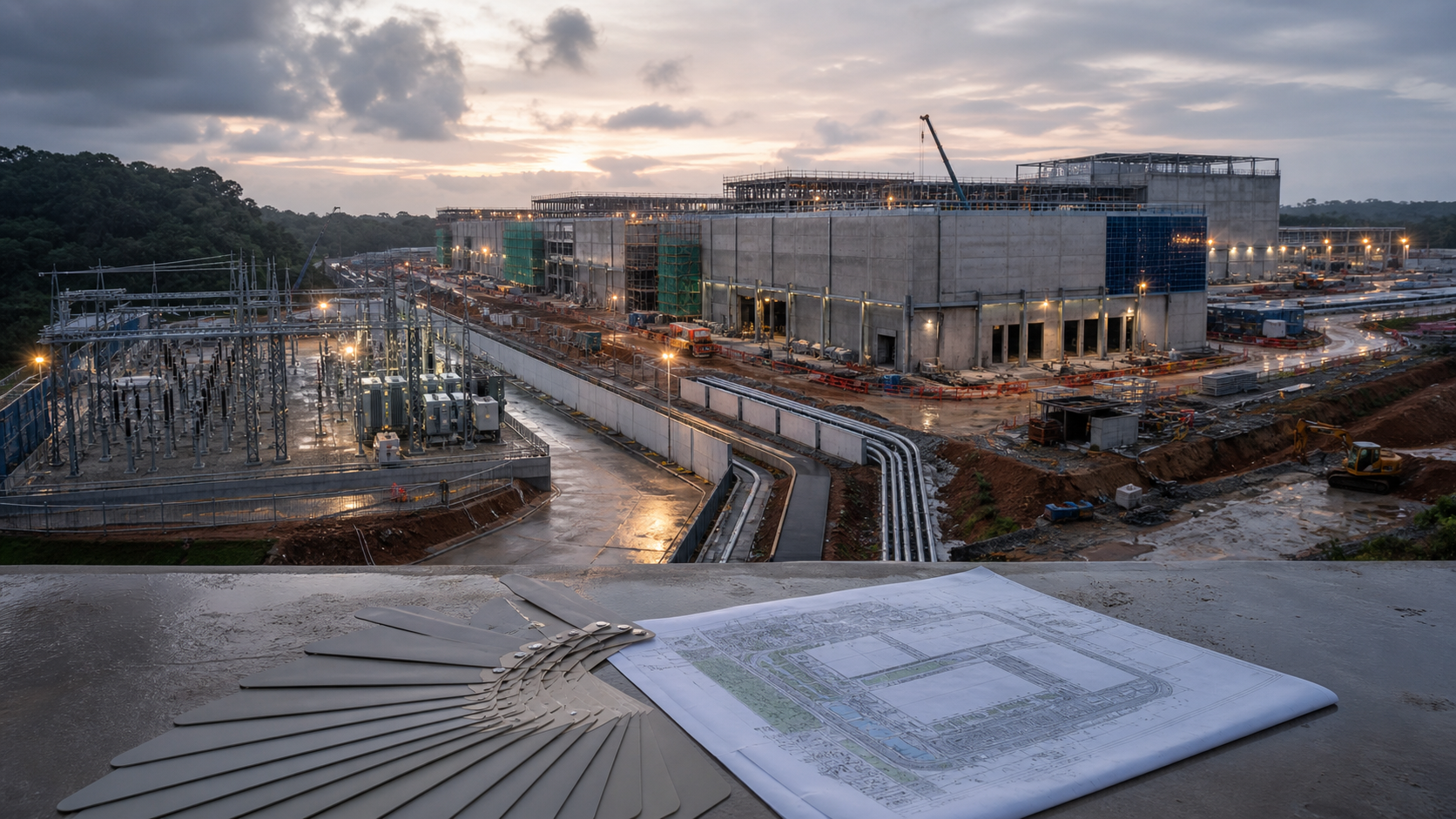
- AirTrunk says it has secured US$2.325 billion, or RM9.5 billion, of green financing to support development of its JHB2 hyperscale data-centre campus in Johor Bahru.
- The close is a genuine state change from May, when the same financing was reported as being marketed to lenders.
- A consortium of 30 financial institutions backed the facility; AirTrunk names 10 global coordinators and four green-loan coordinators.
- JHB2 is described as a campus scalable beyond 270MW, but financing does not establish completed, energised, contracted or operating capacity.
- AirTrunk’s current release targets a design PUE of 1.37 and water-efficient cooling; neither is a measured operating result.
- The missing variables include tenor, pricing, lender allocations, construction timing, tenants, load commitments and the amount of margin savings reaching community programmes.
The new fact is the close
In May, the public fact pattern was a financing process. Bloomberg reported that AirTrunk was marketing a US$2.3 billion loan for JHB2. Lenders were being assembled and the facility was being syndicated. That reporting was important, but it did not establish that the money had been secured.
AirTrunk’s 29 July release changes that state. The company now says US$2.325 billion, equivalent to RM9.5 billion, has been secured under its Green Financing Framework. Data Center Dynamics and Mingtiandi reported the completion on the same day. For an infrastructure project, the distinction between seeking capital and closing it is not semantic. A completed financing provides an executable funding route; a marketed loan remains subject to lender demand, documentation and allocation.
The additional precision also matters. US$2.325 billion is the financing amount, not a claim that AirTrunk spent that sum on 29 July. Nor should it be merged with the RM9.7 billion investment figure attached to the earlier JHB2 campus announcement. One describes a financing facility in the current release; the other described the project investment associated with the campus. Treating them as interchangeable would erase the difference between sources of funds and total development economics.
Thirty institutions distribute exposure and add coordination
AirTrunk says 30 local and international financial institutions supported the transaction. Ten banks are named as global coordinators: BNP Paribas, Crédit Agricole CIB, DBS, ING, Mizuho, MUFG, Société Générale, SMBC, HSBC and UOB. Crédit Agricole CIB, DBS, ING and HSBC also acted as green-loan coordinators. Five further institutions, including IFC and Standard Chartered, are named as mandated lead arrangers, underwriters and bookrunners.
That breadth can distribute credit exposure and give a very large project access to several pools of capital. It also creates an execution surface. Documentation, environmental reporting, drawdown conditions and lender consent processes must work across a large syndicate. The number 30 is evidence of financing participation, not a count of equal cheques, and AirTrunk does not publish each lender’s allocation.
IFC’s participation is notable because AirTrunk calls it the institution’s first financing of the operator. IFC is part of the World Bank Group, and the company’s release says the facility also delivers “blue” impact through water-efficiency technology under IFC guidance. That does not make IFC the sole lender, the dominant lender or the guarantor of every project outcome. It is one participant with a specifically identified development-finance role inside a much broader syndicate.
The loan does not switch on 270MW
JHB2 was announced before this financing. Data Center Dynamics described the Johor campus as scalable beyond 270MW, and its same-day financing report referred to construction of the 270MW site. Capacity language needs careful handling: “scalable to” describes a designed upper path, not current operating load.
The financing can pay for development work, but it does not prove that buildings are finished, grid connections are energised, cooling systems are commissioned or data halls are available to customers. It says nothing about how many megawatts are contracted, reserved, installed or billing. It also does not identify tenants.
This boundary matters in a market where project announcements routinely combine capital values and future capacity. The bankability of JHB2 is now stronger. Its physical delivery still has separate gates: land and permitting, utility milestones, construction, equipment installation, commissioning, customer deployment and commercial operation. Those gates should not be compressed into the word “secured”.
Green labels create measurements, not automatic outcomes
AirTrunk says JHB2 is designed for a PUE of 1.37 and will use water-efficient cooling. A design PUE is an engineering target. Operating PUE emerges from actual facility load, climate, cooling behaviour and utilisation over time. A campus can meet its design assumptions, outperform them or miss them; the financing announcement supplies no measured result.
The same caution applies to water. The release refers to advanced water-efficient cooling and quotes IFC’s view that the facility has blue-finance impact. It does not publish a design WUE, expected annual water withdrawal, source mix or operating measurement. Readers therefore know the direction of the design and financing framework, but not the realised resource intensity.
The facility’s environmental structure is still consequential. AirTrunk says the transaction uses transparent environmental KPIs and that margin savings will continue to support Malaysian programmes involving recycled water in schools, disaster relief and STEM education. That creates a chain worth auditing: KPI definition, performance verification, margin adjustment, savings calculation and programme transfer. The release names the programmes but does not quantify the savings or allocation to each one.
Financing confidence is not demand proof
A 30-institution close is a strong signal that lenders were willing to fund the project structure presented to them. It is not equivalent to a public tenant list, a take-or-pay commitment or a utilisation forecast. Credit approval may reflect sponsors, security, contractual protections and the wider AirTrunk platform as well as expected demand.
The company frames JHB2 as infrastructure for Malaysia’s growing cloud and AI economy. That is a plausible purpose, not a disclosed workload ledger. The announcement does not say which cloud or AI customers will use the campus, when they will arrive, how much capacity they have contracted or what price they will pay.
The economic test therefore has two sides. Financing must be drawn and converted into an operable asset without cost or schedule slippage. The asset must then produce contracted revenue sufficient to service capital while meeting environmental obligations. The close materially improves the first side’s funding visibility. It leaves most of the second side undisclosed.
What the next evidence should show
The useful follow-up is not another restatement of the US$2.325 billion headline. It is a sequence of attributable operating facts. AirTrunk can disclose when major drawdown and construction milestones occur, when utility capacity is energised, when the first data halls are commissioned and how much IT load is contracted or live.
Environmental reporting should separate design from operation. The important figures are measured PUE at stated utilisation, water withdrawal and WUE, the energy supply mix, KPI performance under the green facility and any resulting margin adjustment. Community reporting should disclose the savings generated and how much reached each named programme.
Financial reporting can also close important gaps without exposing commercially sensitive detail. Tenor, broad amortisation shape, fixed-versus-floating exposure and aggregate lender-role allocation would help readers judge refinancing and interest-rate risk. Until those facts arrive, the correct conclusion is narrow: AirTrunk has completed a large financing for JHB2, while the campus’s physical, commercial and environmental outcomes remain work to be delivered.