
Summary
- AIB's 570 MW headline consists of 65 MW of company-described contracted utility power at CLT-01 and about 505 MW at five additional sites under evaluation. None of those five had a definitive lease, purchase or development agreement.
- At 13 August 2026, AIB had commissioned no purpose-built AI/HPC capacity, earned no revenue from a long-term AI/HPC customer contract and had not signed the proposed lease with the single tenant negotiating for all of CLT-01.
- The legacy 40 MW bitcoin-hosting site was de-energized on 5 June and remained off at the filing date. Second-quarter revenue fell 39%, and cost of revenue exceeded revenue.
- Quarter-end cash of $52.8 million was real but mainly equity-funded: the June offering produced $59.0 million net. AIB says its development plan will require capital significantly beyond both that raise and current cash.
AIB Data Centers offers a compact lesson in why infrastructure capacity needs verbs.
The company's August results placed 570 MW of “identified capacity potential” beside a $52.8 million cash balance and a transition to AI infrastructure. Those are all real disclosures, but they do not describe assets at the same stage. The 570 MW is the sum of one utility agreement and five groups of possibilities. The cash came mainly from issuing shares. The AI operating business had not yet begun.
Treating those facts as one completed platform would erase the decisions that still stand between a map and a data centre.
The 570 MW splits 65 to 505
AIB's own arithmetic is unusually clear. CLT-01 in South Carolina carries a 15-year electric service agreement that the company describes as 65 MW of contracted power. Another approximately 505 MW sits across five additional sites under evaluation. Together they produce the 570 MW headline.
That means 88.6% of the labelled capacity was still in the evaluation bucket. None of the five sites had a definitive lease, purchase or development agreement when the company released its results. The remaining 11.4% had crossed a meaningful boundary—utility contracting—but not the later boundaries that create a billable data-centre asset.
The July investor presentation made the development map visible: CLT-01 at 65 MW; a 15 MW first phase and 40 MW expansion at DFW-A; 75 MW in Minnesota; 200 MW at DEN-01; 75 MW at HSV-01; and 100 MW at CLT-02. It also called the schedules and capacities illustrative targets, not commitments, guarantees or forecasts.
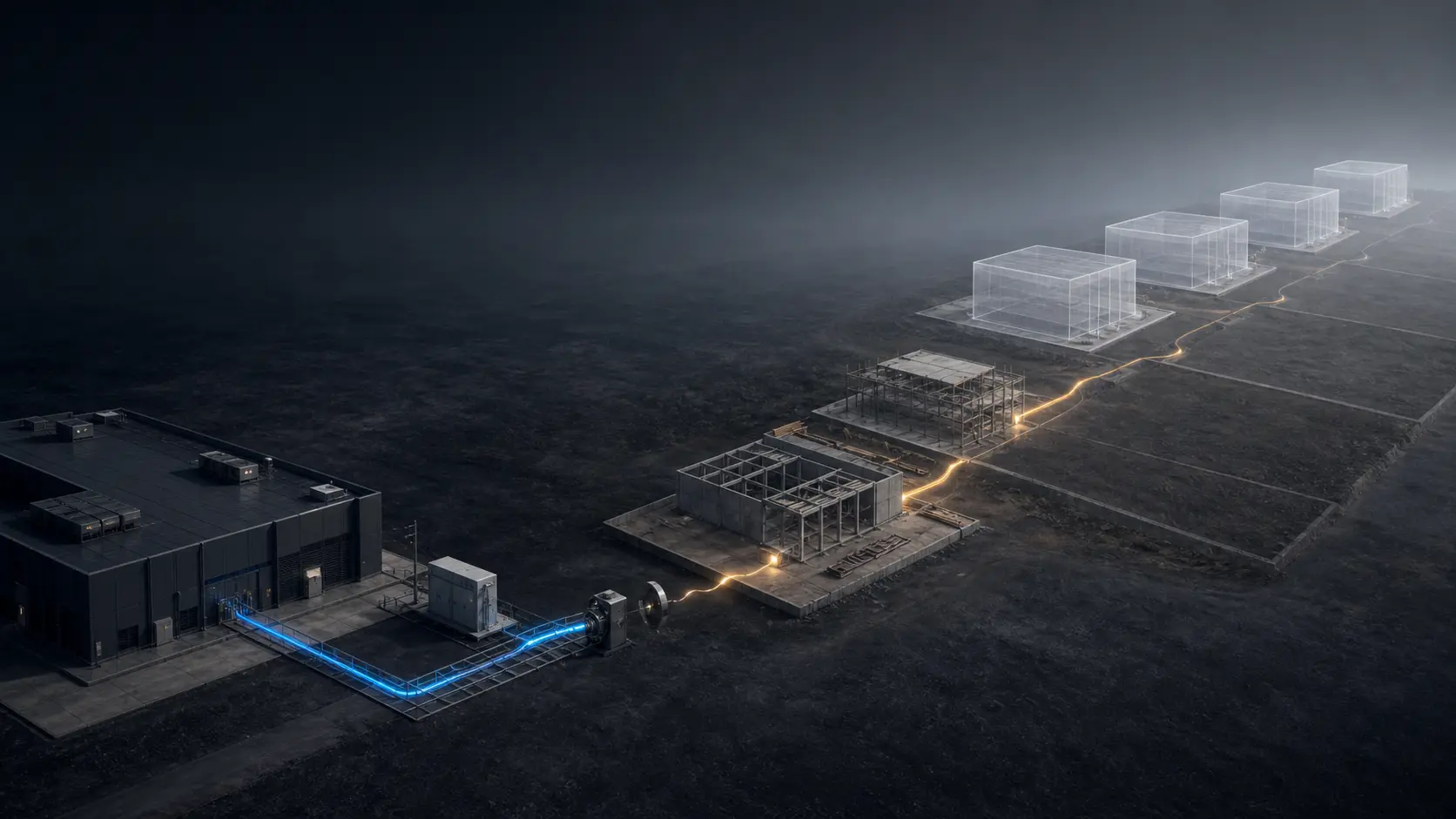
That qualification matters more than the sum. A site can be identified before land is controlled. Land can be controlled before power is deliverable. Power can be reserved before a customer signs. A lease can be signed before construction is financed, and a building can be commissioned before contracted IT load turns into cash receipts.
AIB's 570 MW sits across that entire ladder. It is not one denominator.
A power contract is not a customer contract
CLT-01 is the strongest part of the story. AIB is not beginning with untouched land. It is repurposing an existing site that had operated as an approximately 40 MW bitcoin-hosting facility. The new electric service agreement provides 65,000 kVA of contract demand; company materials round and describe that position as 65 MW.
That is genuine progress. Power access is one of the hardest constraints in the AI data-centre market, and an established grid connection can save time that a greenfield developer does not have.
But utility capacity is not critical IT load. It does not show that high-density halls and cooling systems have been completed, that a tenant has passed credit review, or that invoices have begun.
The 10-Q draws the boundary directly. As of 13 August, AIB had not commissioned any purpose-built AI/HPC capacity and had not generated revenue from a long-term AI/HPC customer contract. It was negotiating with one prospective tenant for a lease covering the whole approximately 65 MW campus. No definitive lease had been signed. Documentation, technical and commercial diligence, credit review and financing remained conditions.
An earlier filing had discussed draft leases covering about 26 MW of utility load—20 MW of IT load—and a non-binding letter of intent for roughly 5 MW more. The later negotiation expanded the contemplated scope. Expansion of a negotiation is not execution of a contract.
The next decisive receipt is therefore not another capacity announcement. It is a signed customer agreement that states how much power is reserved, how utility load converts to billable IT load, what security the tenant provides, and when service can begin.
The old operation stopped before the new one started
On 5 June, AIB de-energized the site's bitcoin-hosting operations after the company judged the contracts uneconomic at prevailing bitcoin and customer hashprice levels. The site remained off at quarter-end and at the 13 August filing date. Development of CLT-01 continued, but independently of the shutdown.
This produces a difficult transition period. The old cash engine is shrinking before the new one has a signed commercial receipt.
Second-quarter revenue fell to $2.9 million from $4.7 million, a 39% decline. Cost of revenue was $3.4 million, so gross profit became a $517,095 loss and gross margin moved from positive 12% to negative 18%. For the first half, $7.8 million of revenue produced only $52,664 of gross profit. Operations used $4.7 million of cash.
Those numbers do not establish the economics of an AI campus. They belong to the legacy hosting business, including the de-energization and utility true-up. They also cannot be ignored. Until a long-term AI/HPC contract starts producing revenue, they describe the operating bridge the balance sheet must carry.
AIB had not adopted a formal abandonment or disposal plan for the site at quarter-end and had recorded no impairment, retirement obligation or restructuring liability for the transition. It warned that later decisions could bring impairment, accelerated depreciation or retirement costs. A successful conversion can avoid some of that burden; delay can make it visible.
The cash is a financing receipt, not a build receipt
AIB ended June with $52.8 million of cash, up from just $15,265 at year-end. The change did not come from the operating site. A June underwritten offering issued 38,333,333 common shares, raised about $63.25 million gross and delivered $59.0 million net. Financing activities supplied $58.4 million in the first half.
The balance sheet is stronger. It also records who supplied the strength: new equity holders.
AIB reported no traditional debt at quarter-end. Yet its filing says the AI/HPC strategy, including CLT-01, will require capital significantly in excess of both current cash and the offering proceeds. The company lists future customer deposits, project or asset debt, equity or equity-linked issuance and cash as possible funding sources.
Each source reallocates risk. A customer prepayment brings commercial validation but may impose delivery remedies. Project debt adds fixed claims and covenants. More equity spreads the project across more shares. Cash preserves flexibility until it is committed to deposits, equipment and construction.
The wrong equation is $52.8 million divided by 570 MW. The useful bridge begins with $59.0 million of net equity proceeds, subtracts the cost of securing and building CLT-01, identifies committed customer and financing receipts, and leaves the other 505 MW outside the funded perimeter until their rights become definitive.
One proposed site also tests related-party control
The 505 MW bucket is not homogeneous. The proposed 75 MW Minnesota campus has a particularly visible control boundary. AIB paid a $1.2 million refundable deposit under a non-binding arrangement to evaluate land owned by an entity linked to Tiger Cloud LLC, a shareholder that the company said beneficially owned about 19.9%.
No purchase, lease or definitive development agreement existed by 13 August. The deposit was recorded as a prepaid asset, not land. AIB also reported a $1.083 million non-interest-bearing loan receivable from a related party and approximately $1.698 million due from related parties.
These disclosures do not establish misconduct. They establish the evidence that matters: whether the deposit is recovered or converted, who approves definitive terms, whether those terms are comparable with alternatives, and which party carries development risk.
A six-state ledger is more useful than a pipeline total
AIB can reduce uncertainty one conversion at a time:
- identify a site;
- obtain definitive land or lease control;
- secure technically deliverable utility power;
- sign a creditworthy customer with deposits or other security;
- finance, build and commission the facility;
- turn billable IT load into cash.
CLT-01 has crossed further than the other projects because its utility agreement is real. It has not crossed the customer, commissioning or revenue boundaries. The additional 505 MW was earlier still.
That is not a verdict that the strategy will fail. A previously powered site, fresh cash and a possible whole-campus tenant can create a faster route than ordinary greenfield development. Management has also disclosed many of the qualifications itself.
The discipline is to keep the nouns attached to their verbs. Identified is not controlled. Utility-contracted is not customer-contracted. Customer-contracted is not commissioned. Commissioned is not fully occupied. And none of them is cash until the customer pays.
Sources
Member Briefing
Deeper Profile Context
Sign in with the right membership level to unlock the full briefing and source notes.
Only for Strategic Circle
Strategic Circle
Open to all readers. Unlock profile briefings after joining and signing in.
Join Strategic CircleOnly for Leadership Alliance
Leadership Alliance
For qualified IP-asset owners and management; sign in to unlock alliance briefings.
Join Leadership Alliance