

- AR is an interactive experience that combines the real world and computer-generated 3D content, overlaying digital information like images, videos and sounds onto it.
- An AR development platform is a software framework that provides the tools and resources necessary for creating AR applications and unlocking the potential of immersive reality technology.
- Some of the leading AR development platforms are Apple’s ARKit, Google’s ARCore, echo3D AR, Unity and Vuforia.
AR applications have spanned commercial industries such as education, communications, medicine, and entertainment. An AR development platform can provide the tools and resources necessary for creating AR applications and unlocking the potential of immersive reality technology. Leveraging a mature platform substantially reduces the barrier to entry versus building from scratch.
What is Augmented Reality?
Augmented Reality (AR) is an interactive experience that combines the real world and computer-generated 3D content, overlaying digital information like images, videos, and sounds onto it. The content can span multiple sensory modalities, including visual, auditory, haptic, somatosensory and olfactory.
AR can also be defined as a system that incorporates three basic features, a combination of real and virtual worlds, real-time interaction, and accurate 3D registration of virtual and real entities. This technology can be experienced through devices such as smartphones, tablets, and AR glasses.
AR transforms the way people interact with their environment by providing additional layers of information, making everyday tasks more engaging and efficient. This experience is seamlessly interwoven with the physical world such that it is perceived as an immersive aspect of the real environment. In this way, AR alters one’s ongoing perception of a real-world environment, whereas virtual reality completely replaces the user’s real-world environment with a simulated one.
The earliest functional AR systems that provided immersive mixed-reality experiences for users were invented in the early 1990s, starting with the Virtual Fixtures system developed at the U.S. Air Force’s Armstrong Laboratory in 1992.
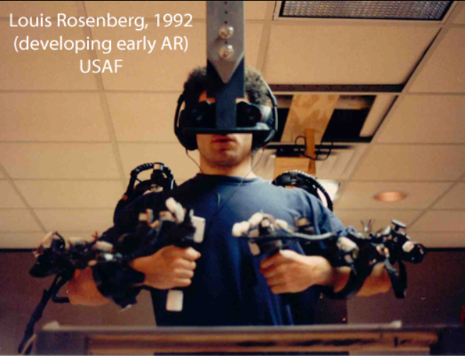
Commercial AR experiences were first introduced in entertainment and gaming businesses. Subsequently, AR applications have spanned commercial industries such as education, communications, medicine, and entertainment.
In retail, AR allows customers to visualise products like furniture in their actual environment before making a purchase. In education, it offers interactive and immersive learning experiences, such as bringing historical events or scientific concepts to life. The healthcare sector uses AR for advanced medical training and to assist during procedures by providing vital information directly overlaid onto the patient’s body. Additionally, AR enhances navigation by offering real-time, context-aware directions overlaid on the user’s view of their surroundings.
Also read: When was augmented reality created?
Why does the AR development platform matter?
According to the latest report from Statista, the global AR and VR markets are exploding and are forecast to reach a total of 72.8 billion U.S. dollars by 2024. Given the rapid growth of the AR industry, developers and non-developers alike are leveraging some of the most popular platforms, developer tools and software development kits (SDKs) to create exciting AR applications and experiences.
An AR development platform is a software framework that provides the tools and resources necessary for creating AR applications and unlocking the potential of immersive reality technology. These platforms typically offer features such as motion tracking, environmental understanding, and integration with hardware sensors, allowing developers to overlay digital content in the real world seamlessly and interactively.
The choice of an AR development platform is essential because it serves as the backbone for creating, deploying, and managing AR applications. A good platform streamlines the development process by providing robust tools, libraries, and frameworks, allowing developers to focus on innovation and user experience rather than technical hurdles. It ensures compatibility across multiple devices and operating systems, enabling broader audience reach and reducing the need for separate development efforts.
Advanced features offered by these platforms, such as motion tracking, environmental understanding, and image recognition, are crucial for crafting realistic and interactive AR experiences. Performance optimisation is another critical aspect, as AR applications demand high-performance rendering and efficient resource management to run smoothly on various devices.
Support and community around established AR platforms provide valuable resources, troubleshooting help, and updates, which keep developers informed about the latest advancements in AR technology. The scalability and flexibility of these platforms allow developers to handle different levels of complexity and various types of AR experiences, ensuring that applications can evolve and grow over time.
Integration capabilities with other technologies like AI, IoT, and cloud services enable the creation of sophisticated, connected AR experiences, enhancing functionality and broadening use cases. Ultimately, the platform chosen directly impacts the quality of the user experience, ensuring accurate tracking, smooth interactions, and realistic rendering, all of which contribute to a more engaging and immersive AR environment for users.
Also read: 10 AR/VR tech companies shaping digital interactions
5 leading AR development platform
Leveraging a mature platform substantially reduces the barrier to entry versus building from scratch. Here’s a look at some of the leading AR development platforms. The chosen framework handles critical functionality like 3D rendering, physics simulations, cross-platform deployments, and integration with AR/VR app development SDKs.
1. ARKit
Already at version 4, Apple’s free ARKit is used by iOS developers to build mobile AR apps and games for iPhones, iPads, and other Apple devices. ARKit uses visual inertial odometry technology to identify the dimensions of the surrounding environment and adjust lighting conditions based on the location of 3D entities. It offers image and surface detection as well as entity and facial tracking, all of which allow you to create immersive multiplayer AR games. A product of Apple, ARKit supports development in iOS only.
2. ARCore
Google’s ARCore has many features that help integrate AR elements into the real environment, including motion tracking, surface detection, and lighting estimation, which is also provided free. In particular, it allows 3D entities to be simultaneously rendered on different devices. It supports development in Android, iOS, Unreal, and Unity as well as 3D drawing with Google’s Tilt Brush.
3. echo3D
echoAR is a cloud platform for 3D, AR and VR that provides tools and server-side infrastructure to help developers and companies quickly build and deploy 3D apps and content. With its flexible cloud infrastructure, intuitive content management and system, fast content delivery network, and other functionalities, echoAR provides highly efficient 3D development and delivery processes. It enables developers to build a 3D/AR/VR app backend and allows content creators to easily manage and publish 3D content to their AR/VR app.
4. Unity
Unity is one of the most popular game development tools out there and has been used to create popular games such as Pokémon Go, Hearthstone and Rimworld. With its C# scripting API, built-in Visual Studio integration and powerful animation tools, Unity is one of the top choices for game developers, designers and artists.
5. Vuforia
A popular AR SDK, Vuforia deploys computer vision technology to recognise and track 3D entities in real-time. It allows developers the ability to create both marker-based and markerless AR experiences and one of its highlight features is its support of persistent entities. Vuforia provides an API for multiple programming languages and supports native development for iOS, Android, UPW, and Unity. The Vuforia SDK is owned by PTC and is offered for free (with limited functionality) and as part of paid subscriptions.