
Summary
- What it says: Zx Online is an old Dhaka ISP brand with a divisional BTRC license, real APNIC number resources, and a public promise of enterprise-grade fiber.
- Main topic: Regional ISP economics; Peering and transit; Wholesale access economics; Local support labour
- Context: market / company research report / Bangladesh
The price of cheap broadband is paid after the bill is collected
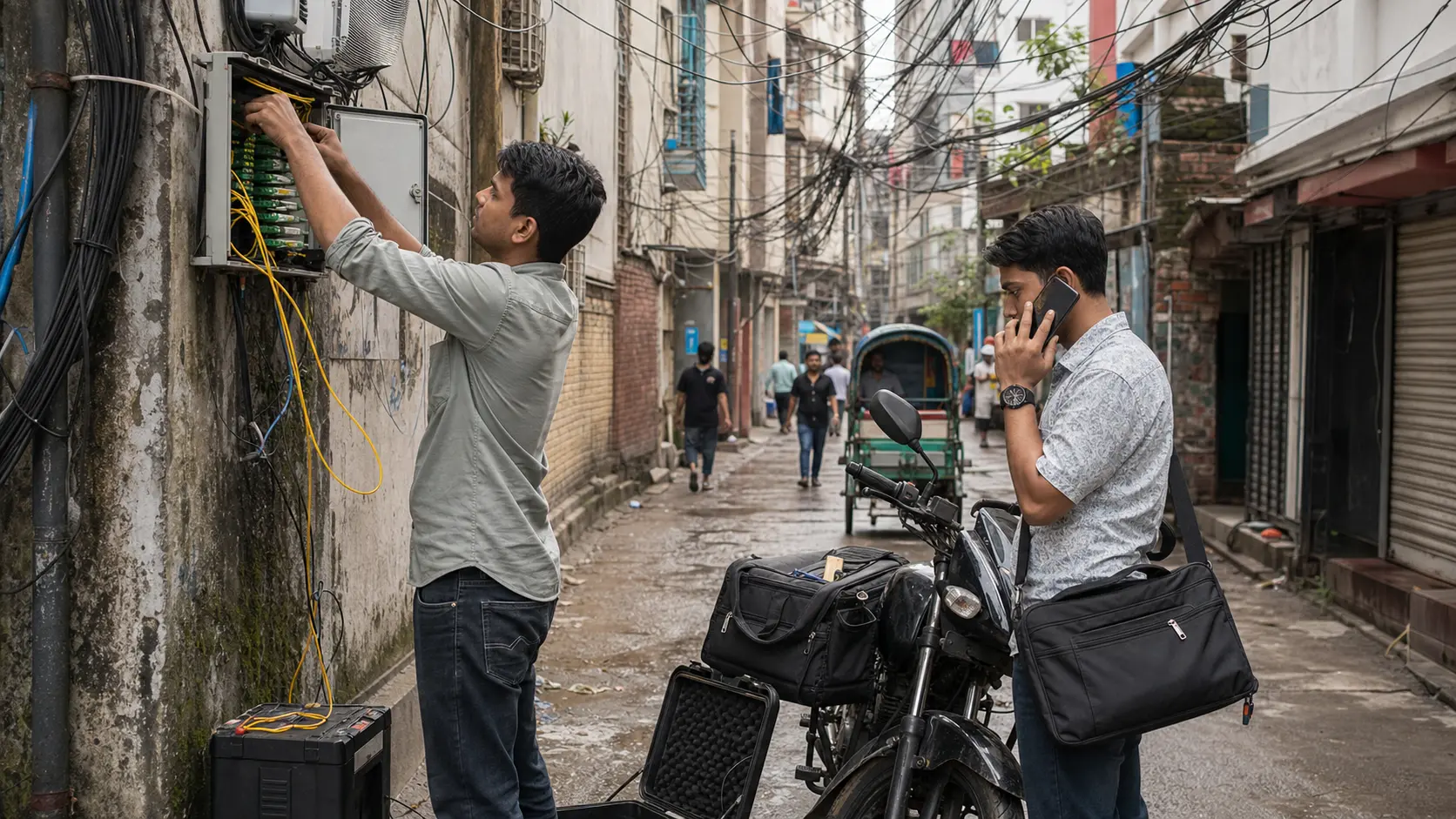
The most important fact about Zx Online is not that it has an autonomous system number or an old license. It is that it sells internet access in a market where the customer has been taught to expect more bandwidth for roughly the same monthly bill. Bangladesh has spent the last five years trying to make fixed broadband affordable enough to spread beyond elite urban households. That policy direction is good for demand, but hard on a small access provider's cash account.
Every extra megabit that keeps a Dhaka household happy still has to cross an upstream contract, a local fiber plant, a powered switch, a support desk, a collector's ledger, and the evening peak.
Zx Online is a useful case because the public record is neither empty nor rich. The company's own website at https://zxonlineltd.com/ says it is a BTRC divisional-licensed ISP, founded in 2008, serving residential users, small businesses, corporate offices, and larger organizations from Dhaka. It sells home fiber, SME business access, corporate connectivity, and dedicated internet access. It promises 99.9 percent uptime in one place and describes a 99.99 percent service-availability target in another. It says it runs a fiber-optic network with boosted YouTube, Facebook, and BDIX local-content performance. It also says it offers business customers full-duplex 1 Gbps uplink infrastructure, dedicated bandwidth, public IP addresses, and a round-the-clock NOC.
Those claims are commercially meaningful because Zx Online is not only a name on a package leaflet. ISPAB's public member verification page at https://ispab.org/member/zx-online-limited lists ZX Online Limited, representative S. M. Zulfiquer Haider, membership G-074, BTRC license type Divisional, establishment date 2008-07-15, license number BTRC/LL/ISP-Central Zone (49) ZX/2008-44, trade license, BIN, TIN, phone, and the current website. A BTRC divisional ISP license list hosted on BTRC's public file service also lists ZX Online Limited in Dhaka Division at 102 Aziz Co-operative Super Market, Shahbagh, Dhaka-1000, under the same Central Zone license number dated 22-07-2008. APNIC RDAP at https://rdap.apnic.net/autnum/58889 adds the routed-network identity: AS58889, name ZOL-BD, description Zx Online Ltd, country Bangladesh, registration on 2013-04-08, and a Green Road, Dhaka contact history.
That is the positive side of the record. The harder side is the shape of the business. A provider can be old, licensed, and routed, yet still be economically fragile if the retail price is too low, upstream capacity is too concentrated, cash collection is irregular, power backup is expensive, and its public proof does not keep up with its enterprise promises. Zx Online's own PeeringDB page at https://www.peeringdb.com/net/11121 lists the organization and AS58889 but shows no public exchange-point connections and no public facility connections. BGP.tools at https://bgp.tools/as/58889 sees two originated IPv4 /24s, no visible IPv6, and two upstreams: Exabyte Ltd and Windstream Communication Limited. IPinfo at https://ipinfo.io/AS58889 classifies the network as a consumer ISP with 512 IPv4 addresses, no IPv6 addresses in that public view, and a day-night activity pattern. APNIC's organization record at https://rdap.apnic.net/entity/ORG-ZOL1-AP shows larger historic resources, including 103.19.252.0/22, 45.64.136.0/22, and 2401:1980::/32. The gap between resources held and routes visibly originated is not necessarily a problem, but it is a question about how much of the network is active, how much is reserved, and how much customer growth can be supported without a visible change in routing.
The fairest reading is that Zx Online is a real Dhaka access operator whose public durability depends less on hidden scale than on local execution. It has to sell a low-priced, high-expectation service while controlling avoidable costs. It must turn BDIX and content-cache economics into lower international bandwidth use. It must keep enough upstream diversity to survive supplier failures without buying more resilience than customers will pay for. It must power routers and access switches through a grid that can still surprise operators.
It must repair fiber in dense neighborhoods where a single cable cut or building access problem can spoil a month's margin. It must collect small household bills with discipline. And if it wants enterprise credibility, it must prove that its business-grade service is more than retail broadband with a stronger adjective.
The identity is old, but the addresses tell a migration story
Zx Online's age is a commercial asset. In a market crowded with thousands of licensed and semi-visible providers, a 2008 license date says the company has survived several broadband eras: early cable and LAN-style local access, the fiber transition, the growth of BDIX/local content, the arrival of mass mobile broadband, the government's One Country, One Rate tariff policy, and the recent push to reduce wholesale internet costs. Survival does not prove profitability, but it does prove continuity.
The public identity is still untidy in a way that matters for enterprise due diligence. The official website says ZX Online Limited is headquartered in Mohammadpur, Dhaka, and gives House# 9, Main Road, Mohammadi Housing Ltd., Dhaka as its contact address. ISPAB's member directory also surfaces the Green Road/Panthapath identity through its member listings and the verified member page gives the license and representative details. APNIC RDAP records for the ASN and organization repeatedly point to 68/4, Green Road, Dhaka-1205. The BTRC divisional license PDF lists the older 102 Aziz Co-operative Super Market, Shahbagh address.
This is not unusual for a long-lived Dhaka ISP. Offices move, branches appear, and regulatory records lag operating reality. But it changes the due-diligence question from "does this company exist?" to "which address is the current operating center, which is the registered or historic address, and where are customers actually supported?"
For a residential customer, that may be a small issue. If the technician arrives and the line is stable, the customer cares less about the exact registered address. For a bank, clinic, factory, campus, or corporate office buying dedicated service, address and contact precision matter. A dedicated internet buyer wants a signed service agreement, a clear escalation path, a responsible NOC contact, and contact records that do not bounce. APNIC's IRT-ZOL-BD contact at https://rdap.apnic.net/entity/IRT-ZOL-BD carries a May 2026 remark that support@zxonlineltd.com is invalid. That remark should not be read as proof that customers cannot reach Zx Online through phone or other channels. The company's website lists hotline and sales numbers, and ISPAB lists chairman contact details. But the APNIC abuse-contact remark is still relevant. Internet operations depend on reachable abuse, routing, and technical contacts. If a routed network wants business trust, its public contact hygiene should be clean.
The company also has a pre-2026 web identity that appears in older ISP lists as zxonlinebd.com. The current public website is zxonlineltd.com. The old domain appears in legacy Bangladesh ISP lists, BDIX FTP lists, and DNS traces for unrelated customer domains. Again, this is not inherently negative. Old domains are common in long-running access businesses. The question is whether the brand migration is fully controlled. A clean public identity lowers customer friction. A mixed public identity can still work for local households but creates risk for enterprise procurement, support, billing, and abuse handling.
Zx Online's biggest identity strength is the consistency of the legal-network thread. The company name appears in ISPAB, BTRC license records, APNIC RDAP, PeeringDB, BGP.tools, IPinfo, IPGeolocation, and TheIpAPI. This is stronger than a local provider that has only a Facebook page and a package flyer. Its weakness is that the public record does not provide modern audited revenue, subscriber count, churn, route policy, PoP list, NOC capacity, enterprise references, or a current map of the access footprint. The article's economic judgment therefore has to be conservative. Zx Online is credible enough to study as a real ISP.
It is not publicly documented enough to underwrite as a large or highly resilient carrier.
Bangladesh's tariff bargain narrows the room for error
Bangladesh's broadband policy has created a bargain that looks simple to users and complicated to operators. The user sees more affordable fixed internet. The operator sees a retail price reference that can only work if wholesale, transport, power, repair, and collection costs fall or productivity improves. That is the core squeeze in Zx Online's case.
The 2021 tariff structure is the historical anchor. New Age reported BTRC's fixed ceilings for retail broadband at Tk 500 for 5 Mbps, Tk 800 for 10 Mbps, and Tk 1,200 for 20 Mbps, alongside wholesale slabs for IIGs and NTTN operators. The same report at https://www.newagebd.net/article/146155/bulk-bandwidth-price-set-for-isps explained why retail control alone was not enough: ISPs blamed high IIG and NTTN charges for weak compliance, so the regulator moved to set upstream and transport rates too. The Financial Express reported in 2022 at https://today.thefinancialexpress.com.bd/first-page/zonal-isps-have-to-buy-bandwidth-from-iig-service-providers-1650648435 that thana and upazila ISPs would have to buy bandwidth from IIG service providers, while ISPAB warned that 400 ISPs in that category could face higher rural costs because IIG capacity was expensive and not available everywhere.
The important point is not the exact 2021 price. It is the direction of policy. The retail market is not a free-price market where every local ISP can simply pass through higher power, rent, NTTN, or support cost. A provider such as Zx Online must compete in a public expectation band shaped by the regulator and by aggressive market advertising. A household sees Tk 500 to Tk 1,200 as a broadband reference, then sees many commercial offers promising far more than 20 Mbps at or near that range.
A provider that tries to charge a premium has to justify it with local reliability, lower latency, better support, BDIX/cache performance, public IP options, or enterprise-grade service.
The pressure did not end with the 2021 slabs. The Daily Star reported at https://www.thedailystar.net/news/bangladesh/news/broadband-tariffs-set-drop-20pc-3792836 that BTRC had managed to lower the bandwidth price purchased by ISPs from IIGs by 15 to 25 percent after finding international-price declines and uneven treatment among ITC/IIG operators. The same article said internet bandwidth consumption tripled to 6,036 Gbps between September 2021 and September 2024, raising transmission costs charged by NTTNs. It quoted an ISP executive warning that staff salaries, electricity, and space rent had not been reduced, and that NTTN pricing remained a problem. The Business Standard later reported at https://www.tbsnews.net/bangladesh/telecom/internet-price-drop-20-isp-iig-levels-july-1143381 that internet prices at the ISP and IIG levels would be reduced by 20 percent from July 2025, with consumer reductions expected afterward.
For a small ISP, a wholesale price cut is useful but not automatically transformative. If Zx Online's upstream bandwidth bill falls, the saving helps only if it is not immediately consumed by higher customer usage, port upgrades, customer-support load, or last-mile maintenance. A 20 percent cut on one line item does not reduce every cost line. The technician still has to travel. The switch still needs electricity. The rooftop or building cabinet still needs backup power. Fiber still breaks. Customers still delay monthly payments. Imported equipment still has foreign-currency exposure.
A cheap plan becomes profitable only when the provider can spread fixed costs over dense customers, push heavy traffic to local peering and caches, and keep the international bandwidth commitment low enough to match retail revenue.
Recent tariff chatter makes that risk sharper. Views Bangladesh reported at https://viewsbangladesh.com/btrc-sets-new-internet-prices/ that BTRC approved a plan allowing Sam Online to offer 30 Mbps at Tk 500, 100 Mbps at Tk 1,000, and 250 Mbps at Tk 3,000, with a maximum shared contention ratio of 1:8. That report appears to concern a specific approved package structure, not proof that every ISP must immediately sell those tiers. But it shows where the market conversation is moving: more bandwidth inside familiar price bands, plus explicit contention discipline. If that becomes the norm, the small provider's escape route is not a higher headline price. It is cost control, service quality, and better traffic economics.
Demand is large, but fixed broadband is still a local-density business
Bangladesh has enough demand to keep local ISPs alive. BTRC's internet subscriber page at https://btrc.gov.bd/pages/static-pages/6922e0a3933eb65569e27f59 reported 119.12 million mobile internet subscriptions, 14.95 million ISP and PSTN subscriptions, and 134.07 million total internet subscriptions in May 2026. BTRC notes that an internet subscriber means a subscription that accessed the internet at least once in the preceding 90 days, and that ISP/PSTN data is updated quarterly because there are many ISP operators and low monthly churn in fixed subscriptions. The official number says two things at once. Fixed access is a minority of internet subscriptions, but almost 15 million fixed or ISP/PSTN subscriptions are enough to sustain a very large local-access industry.
The BTRC broadband connectivity report hosted at https://objectstorage.ap-dcc-gazipur-1.oraclecloud15.com/n/axvjbnqprylg/b/V2Ministry/o/office-btrc/2024/12/2553c9a48743467faaa8b420c2e6ecb5.pdf gives the industry texture. It says that, as of October 2024, Bangladesh had 13.74 million ISP and PSTN users, up from 12.49 million in October 2023, an annual growth rate of 10 percent. It reports total fiber deployment of 173,845 km, total network bandwidth of 6,600 Gbps, and fixed-broadband traffic growing from 7,340 PB in 2019 to 13,271 PB in 2022. It also says Bangladesh had 2,715 ISPs, that the fixed broadband minimum had been raised to 20 Mbps, and that the August 2024 fixed broadband speed was about 48 Mbps down and 47 Mbps up, ranking around 99th globally.
Those numbers explain the opportunity. Zx Online does not need to own the whole country to matter. Dhaka alone has enough dense neighborhoods, apartment buildings, shops, offices, clinics, schools, and small factories to support a local operator if it can win buildings and keep support responsive. The company's website explicitly positions it across homes, SMEs, corporate offices, banks, hospitals, factories, and campuses. That is the right demand map. Residential customers give volume. SMEs and offices give more stable invoices. Dedicated internet gives margin if priced correctly.
Public IPs and business support give a reason to stay with a smaller provider rather than defaulting to a national brand.
The same numbers also explain the risk. With 2,715 ISPs in the official broadband report, fixed broadband is not simply a national carrier contest. It is a dense local fight where multiple providers chase the same buildings, and where mobile/fixed-wireless alternatives keep improving. The report's fixed-wireless section argues that FWA is faster to deploy than fiber and can be more cost-effective in areas where FTTH is expensive. That does not kill fiber in Dhaka. Fiber remains better for stable high-capacity service, gaming, business reliability, and multi-user households. But FWA changes bargaining power.
If a household can choose a mobile operator's home broadband box, a local fiber provider must be better on installation, stability, latency, local content, support, or price.
Local density is the difference between a good plan and a bad balance sheet. A fiber line down one road becomes profitable when many apartments and shops share the same feeder, the same support team, the same billing routine, and the same local reputation. It becomes weak when the operator has to maintain long thin routes for scattered customers who pay late or churn when a neighbor offers an extra 20 Mbps. Zx Online's public sources do not show subscriber density by neighborhood.
The website's Mohammadpur address, old Shahbagh record, Green Road APNIC address, and public branch/social traces suggest a Dhaka-centered operator rather than a broad national access footprint. That is not a weakness if managed honestly. In this market, being dense and reliable in a few neighborhoods may be more valuable than claiming a wide footprint that is expensive to support.
BDIX and caches are the margin, but public peering proof is incomplete
Bangladesh local broadband economics cannot be read without local traffic. A household that watches YouTube, Facebook, local streaming libraries, gaming updates, and BDIX-hosted content is not consuming the same cost mix as a household whose every bit crosses paid international transit. Local exchange and cache performance turn a cheap plan from impossible to plausible. This is why Zx Online's website emphasizes boosted YouTube, Facebook, and BDIX local content performance.
The BDIX/local-cache story has two parts. The first is technical and economic: keeping traffic local lowers international bandwidth exposure and improves user experience. If Zx Online can deliver popular content through local caches, local exchange paths, or upstream partners with strong caching, the customer experiences a faster service while the provider avoids paying for every bit as expensive international capacity. That supports the retail bargain. A 20 Mbps or 30 Mbps household plan can feel more generous if the heaviest destinations are local or cached.
The second part is proof. Zx Online's PeeringDB network record does not list any public exchange-point connections or facilities. That does not mean the company lacks local traffic paths. PeeringDB is operator-maintained and incomplete for many smaller networks. A provider may receive BDIX value through an upstream, private interconnection, cache handoff, reseller arrangement, or an unlisted local route. But from the outside, the distinction matters. A direct BDIX or ISPAB-NIX connection is a stronger proof of control than a website claim or a downstream benefit delivered through someone else's port.
The local exchange environment is real. PeeringDB's ISPAB-NIX page at https://www.peeringdb.com/ix/3903 describes a Dhaka internet exchange operated by Bangladesh Internet Service Provider Internet Exchange Trust, with 112 peers, 115 connections, 83 open peers, total listed capacity of 1.5T, 64 percent with IPv6, and a note that ISPAB-NIX received a BTRC National Internet Exchange license on September 7, 2020. PCH's ISPAB-NIX page at https://www.pch.net/ixp/details/2305 also lists the exchange in Dhaka and shows a large roster of Bangladesh participants. This makes local-exchange economics central to Bangladesh access competition even where a specific provider's port is not public.
For Zx Online, the commercial question is therefore not simply "does it have BDIX?" It is "how directly does it control local traffic savings, and who captures the benefit?" If Zx Online buys upstream capacity from providers that already have strong BDIX, GGC, Facebook, or other cache relationships, Zx can still sell a good retail experience. But the margin then depends on upstream terms. If Zx has direct local exchange and cache arrangements that are not listed in PeeringDB, the public record understates its control.
If the BDIX claim is mostly marketing language inherited from the broader Dhaka broadband market, the company is more exposed to international and upstream cost.
This matters during peak hours. The household does not experience "wholesale bandwidth" as a cost line. It experiences buffering at 10 p.m., high gaming latency, poor video calls, or slow cloud uploads. A local ISP can survive cheap prices when peak-hour local content is cheap, international capacity is planned, and contention is managed. It starts to lose trust when it sells high headline speeds but underbuys upstream capacity. The public BGP view of two originated /24s does not reveal capacity, contention, or cache hit ratio. It only tells us Zx Online is visible on the public internet in a modest way.
The unit economics remain inside the traffic mix.
The routed footprint is real, modest, and partly latent
Zx Online has better number-resource evidence than many neighborhood brands. APNIC RDAP identifies AS58889 as active and tied to Zx Online Ltd. The organization record shows a local internet registry identity, older IPv4 allocations, and an IPv6 /32. The company is not just riding entirely under someone else's AS in the public record.
Current route views are more modest. BGP.tools shows AS58889 originating 45.64.136.0/24 and 45.64.138.0/24, with valid RPKI labels in that view, two upstreams, and no IPv6 prefixes. IPinfo shows the same two IPv4 ranges, 512 IPv4 addresses, zero IPv6 addresses, and no downstreams. IPGeolocation's AS58889 page at https://ipgeolocation.io/browse/asn/AS58889 similarly lists two IPv4 routes and zero IPv6 routes. TheIpAPI at https://theipapi.com/asn/58889 also identifies AS58889 as ZOL-BD, Zx Online Ltd, with two IPv4 prefixes. These are third-party route views, not the registry of record, but they are consistent about the public routing surface.
APNIC's organization record widens the picture. It lists 103.19.252.0/22, 45.64.136.0/22, and 2401:1980::/32 under Zx Online. That suggests Zx Online has more assigned resource potential than the current visible BGP origin table implies. There are several possible explanations. Some space may be unused, reserved, delegated, temporarily not originated, filtered, moved to more-specific records, or visible only from collectors not reflected in the public route tools used here.
The 103.19.252.0/22 block is particularly interesting because RDAP for individual /24s currently shows some more-specific records with other descriptors while still linking back through Zx Online administrative and abuse contacts. That should not be converted into a dramatic claim. It should be treated as a due-diligence topic: how are the older resources used today, and who has operational responsibility for them?
The lack of public IPv6 origination is a missed proof point. Bangladesh's country-level IPv6 capability remains lower than leading Asia-Pacific markets. APNIC Labs country data at https://data1.labs.apnic.net/v6stats/v6economy/BD.json showed Bangladesh around the high-teens for raw capability in late June 2026, depending on the exact metric and smoothing window. Zx Online's APNIC record includes 2401:1980::/32, but BGP.tools, IPinfo, IPGeolocation, and TheIpAPI do not show a current IPv6 route for AS58889. For a residential ISP, lack of visible IPv6 is not a near-term commercial death sentence if customers mostly care about streaming and messaging. For a provider claiming advanced enterprise service and modern network quality, IPv6 deployment is a credibility signal. It also reduces future pressure on scarce IPv4.
The upstream map is concentrated. BGP.tools and IPinfo both show Windstream Communication Limited and Exabyte Ltd as upstream or peer relationships in their public views. That does not mean there are only two contractual suppliers in every part of the business, but it does mean the public internet path appears dependent on two visible Bangladesh networks. Concentration can be rational. A small ISP does not need five upstreams if two are reliable, local, and priced well. Extra suppliers add cost and complexity.
But the resilience claim becomes harder when the website says "multiple international submarine cable links" and "auto-failover" while public route views show a narrow upstream set and no public exchange ports. The company may receive submarine diversity indirectly through upstreams. The customer will care whether that indirect diversity actually survives a fault.
There is also a useful positive signal in IPinfo's measurement. Its page describes a consumer-ISP day/night rhythm and includes a recent traceroute from the IPinfo ProbeNet in Dhaka to 45.64.138.10, reaching the AS in a few hops on June 18, 2026. That is not a subscriber count or quality audit. It does suggest the routed network is reachable from Dhaka in a way consistent with a local eyeball access network. APNIC Labs' Bangladesh AS population estimate at https://stats.labs.apnic.net/cgi-bin/aspopjson?c=BD listed AS58889 with roughly 4,124 modeled users, rank 716, and 4,572 samples when fetched during research. That is modeled population, not a direct customer number. Still, it supports the idea of a small but real user base rather than a purely dormant route holder.
Enterprise language is where the evidence bar rises
Zx Online's website is written for enterprise credibility. It speaks of dedicated fiber-optic solutions, banking, hospitals, factories, financial institutions, healthcare providers, manufacturing units, educational campuses, 1:1 bandwidth, legally binding SLA, redundancy, proactive monitoring, and a four-hour maximum repair target. That is the right commercial direction if home broadband margins are thin. The small ISP that stays only in household retail has little room for error. The small ISP that can add business circuits, public IPs, dedicated bandwidth, and managed support has a better chance of protecting margin.
The question is whether the public proof matches the enterprise language. A business buyer needs evidence of service boundaries, not only service names. Dedicated Internet Access should specify whether the access loop is owned or leased, what uptime means, what the committed information rate is, how contention is avoided, whether the public IP is assigned directly, how DDoS incidents are handled, what upstream diversity exists, how restoration is measured, and which penalties apply.
A bank or factory cares about the entire path: building entry, last-mile fiber, local aggregation, backhaul, upstream handoff, local exchange, international capacity, router support, billing, and emergency contact.
The public record gives only part of that answer. Zx Online can point to a long license history, ISPAB membership, APNIC resources, and AS58889. It can point to phone and email contacts. It can point to its website's service descriptions. It cannot, from public materials reviewed here, point to a public SLA template, public route policy, public enterprise references, public PoP list, current public network map, or audited customer base. ISPAB's verified member page even says no PoP offices are found in that listing.
That may simply reflect incomplete member data, but a provider selling enterprise resilience should want public infrastructure proof to be easier.
Enterprise service also changes the cost base. A household line may tolerate a support window, best-effort repair, and shared contention if the bill is low. A dedicated business service needs priority support and spare capacity. If a provider promises four-hour restoration, it needs technicians, spares, transport, access permissions, monitoring, and vendor relationships. These costs are not proportional to subscriber count. They are fixed commitments. If Zx Online has enough business customers, those commitments can be efficient. If business demand is thin, enterprise claims can become a cost center attached to a residential revenue base.
The strongest commercial path for Zx Online is a hybrid one. It can use its residential footprint to build local presence and recurring cash. It can use SME and dedicated service to protect margin. It can use public IPs, low-latency local traffic, and local support to differentiate from larger providers that may feel less personal to a building or small office. It can use upstreams with better BDIX and international capacity to avoid building every interconnection itself. But that hybrid only works if the company prices support honestly. A Tk 500 or Tk 800 household expectation cannot subsidize unlimited enterprise responsiveness.
The provider must know which customers deserve priority, and those customers must pay enough for it.
Power and outage risk turn resilience into a cash cost
Bangladesh broadband reliability is not only an internet-routing question. It is also a power and civil-infrastructure question. A local ISP's network lives in racks, cabinets, rooftops, building basements, poles, ducts, and rented offices. When the grid fails, backup power becomes service quality. When a cable burns or is cut, route diversity becomes service quality. When national connectivity is disrupted, local providers take the customer complaints even if the root cause is outside their own network.
The July 2024 unrest showed how severe country-level connectivity risk can become. OONI's Bangladesh report at https://ooni.org/post/2025-bangladesh-report/ documented a five-day nationwide internet connectivity shutdown between 18 and 23 July 2024, visible across OONI data, Cloudflare Radar, IODA, and Google traffic signals. That event should not be attributed to Zx Online. It was a national event. But it matters for every ISP's customer relationship. A household or business does not always separate local ISP responsibility from national reachability. The local provider becomes the human face of a disruption it may not control.
There are also physical and upstream disruptions. The Business Standard reported at https://www.tbsnews.net/bangladesh/fire-set-cables-mohakhali-causes-power-outage-nearby-data-centres-cuts-broadband-internet that a July 2024 cable fire in Mohakhali caused power outage at nearby data centers and cut broadband internet capacity by 30 percent. SubTel Forum reported at https://subtelforum.com/bangladesh-smw-5-repairs-trigger-80-hour-disruption/ that 2026 SMW-5 maintenance could slow or partially disrupt Bangladesh internet for around 80 hours, with backup via SEA-ME-WE-4. Again, these are not Zx-specific failures. They show the operating environment in which Zx's uptime claims must be delivered.
Power costs are tightening as well. Data Center Dynamics reported at https://www.datacenterdynamics.com/en/news/bangladesh-telcos-warn-of-network-shutdowns-amid-oil-shortage-crisis/ that Bangladeshi mobile operators warned of network shutdown risks amid fuel pressure, with AMTOB asking the government to prioritize network operators. Fixed ISPs are not the same as mobile operators, but the same logic applies at smaller scale. If grid reliability weakens or diesel backup becomes harder, local network uptime becomes a cash expense. The Daily Star reported at https://www.thedailystar.net/news/bangladesh/news/berc-mulling-least-139-power-price-hike-4181726 that BERC was considering a retail electricity tariff increase, while TBS reported electricity tariff increases taking effect in June 2026. Higher electricity and backup costs reduce the value of retail tariff cuts unless the provider can raise ARPU or improve efficiency.
For Zx Online, this turns "99.9 percent SLA" into a question of battery minutes, generator access, route diversity, and technician availability. A 99.9 percent monthly uptime target allows roughly 43 minutes of downtime in a 30-day month. In a dense Dhaka access network, one fiber cut, one building power problem, one upstream congestion episode, or one poorly communicated maintenance window can consume that allowance. Selling a serious SLA is possible, but it requires more than marketing language.
It requires a costed operating model: which nodes have UPS, which have generator backup, which routes are diverse, which customers get proactive alerts, and which failures trigger credits.
The economics are harsh because resilience is lumpy. A small provider can buy a little more upstream capacity, but it cannot buy half a field technician at 2 a.m. for one customer. It can improve a few aggregation sites, but each battery, inverter, switch, and enclosure has a real cash cost. It can diversify upstreams, but every extra circuit has minimum commitments. The retail market rewards low prices and visible speed, while resilience costs are often invisible until failure. Zx Online's challenge is to decide where resilience earns revenue and where it only protects reputation.
The household collection problem is as important as the upstream bill
Cheap broadband economics often get discussed as bandwidth cost, but collection discipline can matter just as much. A local ISP sells hundreds or thousands of small monthly promises. The customer may pay by mobile wallet, online portal, cash collection, bank transfer, or local office visit. The provider's margin depends on payment timing, disconnection discipline, renewal reminders, refunds, router deposits, installation charges, and the ability to avoid disputes. A customer who pays ten days late every month has different cash timing from a customer on automatic payment, even if both pay the same nominal tariff.
Zx Online's public website gives phone and support contacts but does not expose a detailed payment portal in the text reviewed here. That is not fatal. Many local ISPs operate payment flows that are clear to customers but not obvious to outside researchers. The economic issue is that household broadband demand in Dhaka is price-sensitive and support-sensitive at the same time. Customers want low monthly bills, quick installation, fast Facebook/YouTube/BDIX performance, playable gaming latency, and fast repair. They may tolerate informal billing if service is good, but informal billing increases operator workload and dispute risk.
Field repair compounds the problem. A local fiber customer has several failure points outside the provider's core router: drop cable, building entry, splitter, ONU, Wi-Fi router, power adapter, roof equipment, cable bend, and neighborhood cable damage. Some complaints are real network faults. Some are Wi-Fi problems inside a flat. Some are caused by customer equipment. A provider that sends a technician for every Wi-Fi issue burns margin. A provider that refuses too many visits burns reputation. The correct answer is process: remote diagnostics, clear router policy, scripted support, paid replacement terms, and technician routing.
This is where a small provider can beat a large one. Local knowledge matters. A technician who knows the building, the caretaker, the cable route, and the chronic power problem can fix service faster than a distant call center. The company website's claim of 24/7 NOC and expert support could be valuable if it is backed by field discipline. The same claim becomes expensive if every household expects instant service at a low retail price. Zx Online's public social footprint does not provide enough customer testimony to judge support quality.
Facebook search finds a public group for Zx Online Limited, branch pages such as Uttara and Hazaribag, and scattered old mentions in gaming/community contexts. Those are evidence of local public presence, not proof of quality.
The absence of a large public complaint trail cuts both ways. It may mean service is locally adequate and customers do not complain publicly. It may mean customer discussion happens in closed groups, WhatsApp, phone calls, building groups, or offline networks. It may mean the footprint is small. It may mean the brand has not maintained a modern social support presence. Market chatter can guide questions but should not become a fact claim. The customer evidence that would settle the issue would be modern review data, ticket resolution times, churn rates, outage notices, and building-level retention.
Supplier dependence decides who keeps the savings
Zx Online's upstream view is the hinge between low retail price and durable cash. BGP.tools and IPinfo both identify Windstream Communication Limited and Exabyte Ltd in the public upstream/peer view. These are not merely technical names. They are economic suppliers. They influence international reachability, local routing, route stability, latency, congestion, and how quickly problems are escalated.
Supplier dependence is not automatically bad. A small ISP should not own everything. The efficient model is to own the customer relationship and the local access plant where local control matters, then buy upstream and transport from providers with better scale. Windstream and Exabyte may give Zx Online better capacity economics than it could obtain alone. If those suppliers have strong local exchange, cache, and international arrangements, Zx can sell a better customer experience without building a large core network.
But the supplier contract determines who captures the wholesale squeeze. If BTRC lowers IIG prices, the saving can move through the chain in several ways. It can lower Zx Online's cost. It can be absorbed by an upstream that has its own cost pressure. It can be passed to customers through higher bandwidth at the same price. It can fund better contention ratios. It can disappear into electricity, wages, rent, and repairs. The Daily Star's reporting on tariff reductions captures this tension: international and IIG prices may fall, but NTTN, staff, electricity, and space costs do not necessarily fall with them.
The public route table also suggests limited downstream leverage. IPinfo shows no downstreams for AS58889. BGP.tools does not present Zx Online as a visible transit hub. That points to an access ISP, not a wholesale carrier. Access ISPs have less bargaining power than operators with many downstreams or large enterprise traffic. Their leverage comes from density and payment reliability. If Zx can aggregate enough high-quality demand in Dhaka, it can negotiate better supplier terms. If demand is scattered or late-paying, suppliers keep the stronger hand.
Supplier concentration also affects outage blame. If a Zx customer loses service because an upstream path fails, the customer still calls Zx. Zx must have enough monitoring and escalation discipline to identify whether the fault is local drop, aggregation, upstream, local exchange, or international path. A small ISP that cannot isolate faults wastes technician time and damages customer trust. The website's NOC language is therefore central. The company is selling not only bits, but fault ownership.
The facts that would improve the supplier reading are straightforward: public upstream capacity commitments, transport diversity, direct exchange memberships, a looking glass, route policy, maintenance notices, and a statement explaining how local-content traffic is delivered. None of these require exposing sensitive customer data. They are normal trust signals for a provider that wants enterprise credibility. In their absence, the economic model must be read as dependent on a narrow visible supplier stack.
The strongest case for Zx Online
The bullish case begins with continuity. A provider that appears in a 2008 BTRC license, a 2013 APNIC ASN, a current ISPAB member page, current APNIC RDAP, current BGP views, and a live website has survived long enough to matter. Many small access names appear and disappear. Zx Online has maintained institutional traces across several waves of Bangladesh broadband policy.
The second strength is local market fit. Dhaka still has demand for providers that can be close to customers. National scale is not the only route to value. A Dhaka ISP can make money by being known in its buildings, keeping technicians responsive, managing payment relationships, and providing business connectivity to nearby offices. Zx Online's website positions exactly that mix: home fiber for households, SME business service, corporate solutions, and dedicated internet for mission-critical users.
The third strength is resource legitimacy. AS58889, APNIC organization records, IPv4 allocations, and an IPv6 allocation make Zx Online more technically legible than a pure reseller brand. Even if only two IPv4 /24s are visibly originated today, the existence of older portable resources and an AS gives the company a durable control surface. It can improve route visibility, deploy IPv6, publish route policy, and clarify abuse/contact details without starting from zero.
The fourth strength is the direction of wholesale policy. If BTRC's wholesale squeeze actually reduces IIG and ISP-level costs and eventually addresses NTTN friction, a disciplined local ISP can gain breathing room. Zx Online does not need a dramatic ARPU increase if it can lower per-subscriber bandwidth cost, keep local traffic local, and add profitable business customers. The market's cheap-broadband demand is real. The question is whether Zx can serve it efficiently.
The fifth strength is that enterprise service could protect the margin. Dedicated internet, public IPs, corporate connectivity, and business support are plausible products for a small Dhaka ISP with a long operating history. Larger operators may have scale, but smaller providers can sometimes offer faster local response and more flexible arrangements. If Zx Online has genuine relationships with banks, hospitals, factories, campuses, or local businesses, those accounts could make the access network more durable than residential price competition alone.
The strongest case against it
The bearish case starts with public proof. Zx Online's website makes strong claims, but public route and interconnection evidence is modest. PeeringDB lists no public exchange or facility connections for AS58889. Current public BGP views show only two IPv4 /24s and no IPv6 route. APNIC contact hygiene includes an invalid-support-email remark on the abuse/contact record. ISPAB's member page has no PoP offices listed. None of these points proves operational weakness by itself. Together they mean outsiders cannot verify the scale of the network promised by the sales copy.
The second risk is price compression. Bangladesh's retail broadband market increasingly expects high speeds at familiar prices. If customers get 30 Mbps, 50 Mbps, or 100 Mbps offers near old low-price bands, a small ISP has to buy capacity, maintain quality, and handle support without the pricing freedom a premium niche would enjoy. Cheap demand is not the same as profitable demand.
The third risk is cost mismatch. Wholesale bandwidth may fall, but power, rent, technician wages, imported hardware, batteries, routers, and field repair do not necessarily fall. The Daily Star's tariff article captured the industry complaint that electricity and space costs remain. A provider with limited scale has fewer ways to absorb those costs. Zx Online's website promises strong uptime and support; those promises are expensive if not matched by high-margin customers.
The fourth risk is supplier dependence. A visible upstream set centered on Windstream and Exabyte may be perfectly adequate for a small access ISP, but it leaves the public reader unable to verify the website's redundancy language. If Zx's local and international path quality depends mainly on upstreams, the company must negotiate well and monitor well. Otherwise, it sells reliability while others control too much of the service path.
The fifth risk is customer evidence. Public social and review signals are thin. There are old Facebook and community traces, but not a robust modern evidence base of customer satisfaction, outage handling, or business references. In local broadband, reputation is often private and hyperlocal. That makes it commercially important but hard to evaluate from public records.
What would change the judgement
Several facts would materially improve confidence in Zx Online. The first is a current service map: neighborhoods served directly, locations served through partners, and business-service availability. The second is a public statement on network architecture: upstreams, local exchange or cache arrangements, backhaul diversity, and how BDIX/local content performance is delivered. The third is an updated PeeringDB or public network page showing direct exchange, facility, or route policy details if they exist.
The fourth is contact hygiene. APNIC abuse and technical contacts should be reachable, current, and aligned with the company's operating support channels. A clean abuse contact is a low-cost trust signal. The fifth is IPv6 deployment evidence. Zx Online holds an IPv6 /32 in APNIC records, but current public route views do not show IPv6 origination. Bringing IPv6 into visible production would strengthen the modern-network claim.
The sixth is customer proof. Modern reviews, ticket-resolution metrics, public outage notices, building references, and enterprise case studies would reveal whether Zx Online's local support is a strength or a cost burden. The seventh is unit-economics evidence: approximate subscriber scale, share of residential versus SME versus dedicated internet revenue, average payment timing, churn, and the percentage of traffic served locally. Even broad ranges would help.
The eighth is supplier resilience. If Zx can show that Windstream and Exabyte are part of a broader redundancy plan, or that the company has private local exchange/cache paths not listed publicly, the risk reading improves. If future route views remain narrow while the website keeps making stronger reliability claims, the discount should remain.
Evidence register
The company identity and service claims come first from Zx Online's official website, https://zxonlineltd.com/, which supports the BTRC divisional-license claim, 2008 operating history, Mohammadpur/Dhaka positioning, home fiber, SME, corporate, dedicated internet, NOC, BDIX/local-content, public IP, SLA, and contact claims. ISPAB's verified member page, https://ispab.org/member/zx-online-limited, supports the G-074 membership, representative name, divisional license type, establishment date, BTRC license number, trade license, BIN, TIN, and website. The BTRC divisional ISP license PDF, https://objectstorage.ap-dcc-gazipur-1.oraclecloud15.com/n/axvjbnqprylg/b/V2Ministry/o/office-btrc/2024/12/f2749e03fbdb496bbdd1b780afcf3f90.pdf, supports the older Dhaka Division license listing and license number.
The network-resource evidence comes from APNIC RDAP for AS58889 at https://rdap.apnic.net/autnum/58889, APNIC's Zx Online organization record at https://rdap.apnic.net/entity/ORG-ZOL1-AP, APNIC RDAP for 45.64.136.0/24 at https://rdap.apnic.net/ip/45.64.136.0, APNIC RDAP for 45.64.138.0/24 at https://rdap.apnic.net/ip/45.64.138.0, and the APNIC abuse/contact record at https://rdap.apnic.net/entity/IRT-ZOL-BD. Public route and measurement context comes from BGP.tools at https://bgp.tools/as/58889, IPinfo at https://ipinfo.io/AS58889, IPGeolocation at https://ipgeolocation.io/browse/asn/AS58889, TheIpAPI at https://theipapi.com/asn/58889, and APNIC Labs' Bangladesh AS population estimate at https://stats.labs.apnic.net/cgi-bin/aspopjson?c=BD. PeeringDB's Zx Online record, https://www.peeringdb.com/net/11121, supports the AS58889 network listing, RIR status, website, and absence of public IX or facility rows in that database.
The local-exchange and market context comes from PeeringDB's ISPAB-NIX page at https://www.peeringdb.com/ix/3903 and PCH's ISPAB-NIX page at https://www.pch.net/ixp/details/2305. BTRC's internet subscriber page, https://btrc.gov.bd/pages/static-pages/6922e0a3933eb65569e27f59, supports the May 2026 mobile, ISP/PSTN, and total internet subscription counts and BTRC's definition of an internet subscription. The BTRC broadband connectivity report at https://objectstorage.ap-dcc-gazipur-1.oraclecloud15.com/n/axvjbnqprylg/b/V2Ministry/o/office-btrc/2024/12/2553c9a48743467faaa8b420c2e6ecb5.pdf supports the October 2024 fixed-broadband subscriber, fiber-deployment, bandwidth, traffic, ISP-count, speed, and FWA context.
The tariff and wholesale-pressure context comes from New Age's wholesale broadband price report, https://www.newagebd.net/article/146155/bulk-bandwidth-price-set-for-isps, The Financial Express report on zonal ISPs buying from IIGs, https://today.thefinancialexpress.com.bd/first-page/zonal-isps-have-to-buy-bandwidth-from-iig-service-providers-1650648435, The Daily Star's broadband tariff reduction report, https://www.thedailystar.net/news/bangladesh/news/broadband-tariffs-set-drop-20pc-3792836, The Business Standard report on 20 percent ISP/IIG reductions, https://www.tbsnews.net/bangladesh/telecom/internet-price-drop-20-isp-iig-levels-july-1143381, and Views Bangladesh's 2026 report on a specific approved high-speed tariff plan, https://viewsbangladesh.com/btrc-sets-new-internet-prices/.
The resilience and operating-risk context comes from OONI's Bangladesh shutdown analysis, https://ooni.org/post/2025-bangladesh-report/, The Business Standard's Mohakhali cable-fire report, https://www.tbsnews.net/bangladesh/fire-set-cables-mohakhali-causes-power-outage-nearby-data-centres-cuts-broadband-internet, SubTel Forum's SMW-5 maintenance report, https://subtelforum.com/bangladesh-smw-5-repairs-trigger-80-hour-disruption/, Data Center Dynamics' Bangladesh telecom fuel-risk report, https://www.datacenterdynamics.com/en/news/bangladesh-telcos-warn-of-network-shutdowns-amid-oil-shortage-crisis/, and The Daily Star's BERC electricity-tariff report, https://www.thedailystar.net/news/bangladesh/news/berc-mulling-least-139-power-price-hike-4181726.
Customer and social signals are thin. Public traces include the Facebook group at https://www.facebook.com/groups/2010271539032925/, the Uttara branch page at https://www.facebook.com/ZxonlineUttara/, the Hazaribag branch page at https://www.facebook.com/zxahsan.hzrb/, and old community mentions such as https://www.facebook.com/groups/csgobd/posts/999547830182293/. These support public presence and local chatter, not verified service quality. ZoomInfo's page at https://www.zoominfo.com/c/zx-online-ltd/358431087 and Craft's page at https://craft.co/zx-online provide secondary company-description context, but they are not used for hard network or license claims.
The narrow conclusion
Zx Online should be read as a real, long-running Dhaka ISP whose value sits in local execution rather than visible national scale. It has the pieces needed to be credible: a 2008 license trail, ISPAB membership, APNIC resources, AS58889, a live website, and a business mix that understands the limits of home broadband margin. It also has the weaknesses that define many small access operators: limited public route visibility, no public PeeringDB exchange or facility rows, incomplete customer evidence, contact-hygiene questions, and a market where retail expectations are moving faster than every cost line can fall.
The investment case, if this were an investable company, would not be "Bangladesh broadband demand is rising, therefore Zx Online wins." Demand alone is not enough. The case would be: Zx Online can densify its Dhaka footprint, keep a reliable local field team, use BDIX/cache economics to lower international cost, buy upstream capacity well from Windstream, Exabyte, or other suppliers, collect household bills on time, and sell enough SME/dedicated service to fund resilience.
The bear case is the mirror image: retail tariffs compress, customers demand more bandwidth, power and repair costs rise, supplier savings do not fully pass through, and enterprise claims remain harder to prove than residential demand.
The facts that would change the judgment are practical, not glamorous. Show current customer density. Show direct or indirect local exchange economics. Clean the APNIC contact record. Publish a service map. Make IPv6 visible. Publish business-service terms. Provide evidence of repair speed. If those facts improve, Zx Online looks like a durable neighborhood-and-business access operator in a market that still needs local fiber. If they do not, it remains a credible but thinly documented ISP trying to turn cheap broadband demand into cash in a country where the customer price falls faster than the cost of keeping the lights on.