
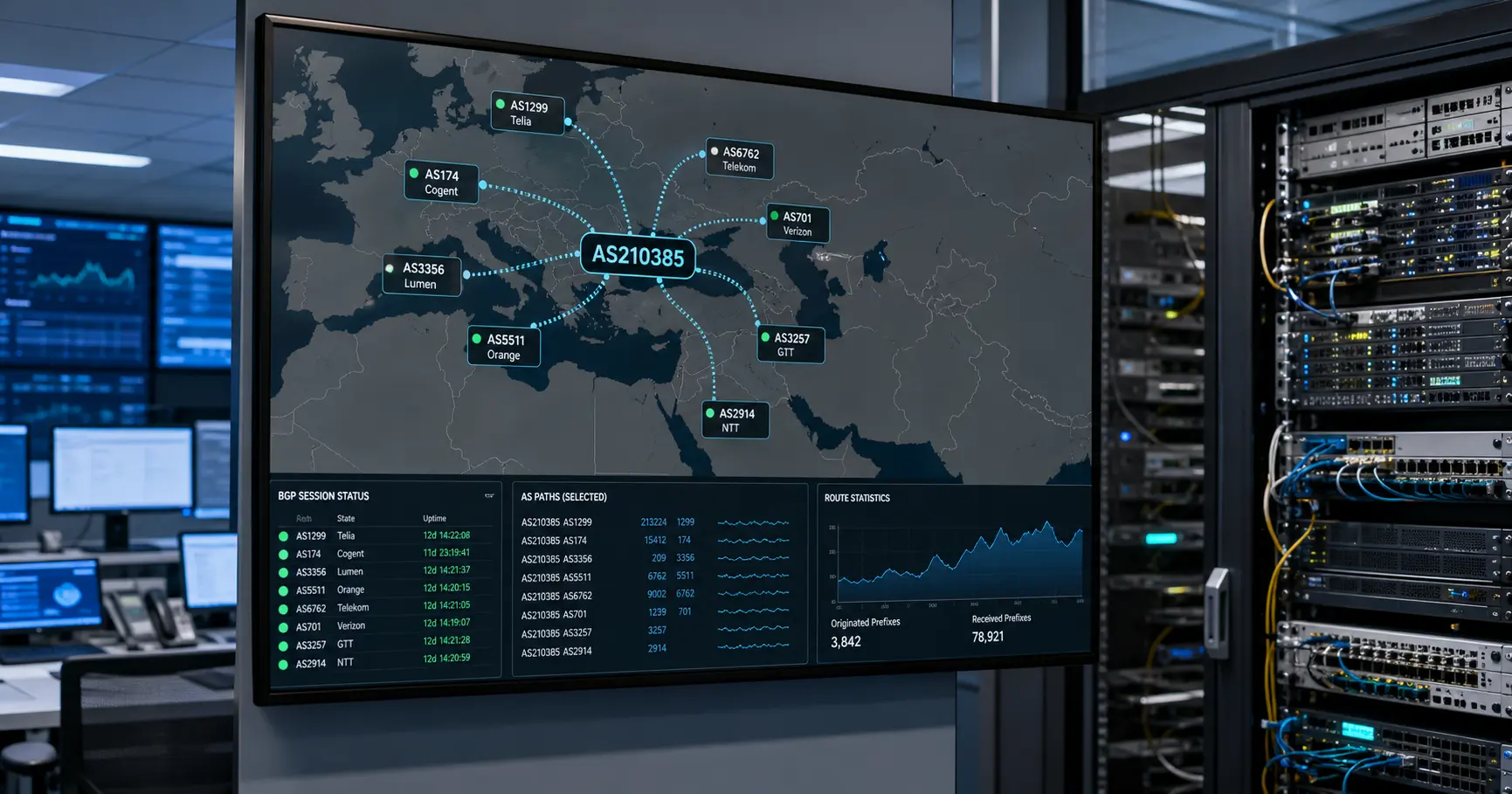
Windhoos B.V. controls AS210385, a publicly visible autonomous system in the RIPE region that originates IPv4 and IPv6 prefixes and peers with other networks. No corporate website, executives, or commercial model is documented, so the profile rests solely on registry and routing evidence. Analysts must treat it as a registry-attributable routing node whose true scale and intent are unknown; watchpoints include registry record changes, routing footprint shifts, and eventual corporate disclosure.
Windhoos B.V.
Windhoos B.V. is a Dutch private limited company that holds Autonomous System AS210385 and originates IPv4 and IPv6 prefixes visible in public routing platforms. Its business purpose, customer base, and management structure are not publicly documented, leaving only registry and BGP monitoring data as the basis for assessment. This opacity makes the entity a monitorable but not fully assessable routing node whose unexplained changes could indicate operational or security incidents.
Why It Matters
If Windhoos B.V. misconfigures, withdraws, or hijacks its announced prefixes, downstream services could experience connectivity disruption. The entity's opaque nature means that any unexplained routing change becomes a potential indicator of operational or security events, affecting threat assessments for networks relying on its routes.
What Public Sources Show
Windhoos B.V. is a Dutch private limited company (besloten vennootschap) that holds Autonomous System AS210385, a publicly visible internet routing identifier within the RIPE NCC service region. Its only public footprint consists of registry records and BGP announcements; no corporate website, customer list, or management team has been disclosed.
This opacity turns the entity into a monitorable but not fully assessable routing node, where any unexplained change in its network behaviour could signal an operational or security incident.
The entity matters because it controls a routable autonomous system whose prefix announcements can influence internet reachability for any network that learns its routes. A misconfiguration, prefix hijack, or sudden withdrawal could disrupt downstream connectivity. For analysts, its routing footprint is a dependency-mapping signal, and unexplained shifts serve as a tripwire for anomalies that may lack other early warnings.
What public sources actually show is narrow but concrete. The RIPE NCC RDAP service for AS210385 names the organisation and links it to the organisation handle ORG-WB94-RIPE. RIPEstat confirms the ASN's registration in the RIPE region. BGP.Tools shows that AS210385 originates IPv4 and IPv6 prefixes and maintains active peerings, establishing an observable routing presence beyond a passive registry entry.
The RDAP record also exposes a telephone contact, but no email, website, or administrative address is listed.
Windhoos B.V.'s operating surface is defined by control over these internet number resources. Changes to the RDAP record—organisation name, handle, or contact details—or to the set of announced prefixes directly alter what the internet sees of this entity. The company could expand or contract its routing footprint by adding or withdrawing prefixes, or by establishing new peerings.
The only publicly identified communication channel is a telephone number, and no operational contact or abuse handler has been published.
Several watchpoints would change the assessment. Any modification to the AS210385 registry record could indicate a transfer of ownership, an administrative error, or a hijack. New prefix announcements, withdrawals, or changes in AS_PATH may reflect a shift in business operations, peering strategy, or a security compromise.
The appearance of a company website, a PeeringDB entry, or a RIPE policy document would clarify whether this is a transit provider, a hosting firm, or an enterprise network, and would allow a fuller risk evaluation.
The evidence boundary is significant. No corporate website, financial filings, or press releases have been located. The company's jurisdiction and incorporation details beyond the "B.V." suffix are not independently confirmed. No executives or staff members are publicly linked to the entity. The exact prefix inventory and peer list are not fixed; they depend on real‑time BGP monitoring and may change without notice.
All assessments are therefore contingent on the continued accuracy of registry and routing observations.
For now, Windhoos B.V. is best understood as a registry‑attributable routing node whose true scale, customer base, and operational intent remain publicly undocumented. Analysts should monitor its BGP footprint and registry records for changes, while treating its anonymity as a variable that magnifies the information value of every observable adjustment.
Operating Surface
Windhoos B.V. serves as the registered holder and operator of AS210385, as confirmed by RIPE NCC RDAP records and BGP monitoring tools such as BGP.Tools. The company originates prefixes and maintains BGP peerings, but no commercial service or corporate narrative has been disclosed, so its operating role is limited to registry-visible internet routing.
Analysts track Windhoos B.V. because it controls a publicly routable autonomous system whose prefix announcements can influence internet reachability for downstream networks. Monitoring its registry and routing behaviour is essential for dependency mapping, anomaly detection, and incident attribution, especially given the absence of corporate disclosures that would clarify its intent or stability.
Watchpoints
Windhoos B.V. represents a classic opaque autonomous system operator: its registry-grounded identity is certain, but its operational context is absent. For dependency mapping, it must be treated as a node with uncertain intent. Any routing anomaly from AS210385 should be escalated due to the lack of corroborating corporate information.
Registry record changes, prefix/AS_PATH shifts, and the appearance of corporate disclosures (website, PeeringDB entry) are the primary observables that would change the intelligence assessment. A sudden expansion of prefixes or peerings could indicate growth or change in business model, while a withdrawal might signal an incident.
The most significant gaps are the absence of a corporate website, business model documentation, customer base, management names, and independent verification of the company's legal registration beyond the registry-provided 'B.V.' designation. A full RIPE entity entity page for ORG-WB94-RIPE has not been directly retrieved; only inferred from RDAP.
Sources
- Registry RDAP / WHOIS record - public-source identity and registry context for Windhoos B.V..
- RIPE registry record - RIPEstat provides a public overview page for AS210385, supporting that the ASN exists in RIPE-observed internet number resource data.
- bgp.tools - BGP.Tools identifies AS210385 as Windhoos B.V. and shows public routing context such as prefixes and peers for the ASN.
At A Glance
- Name: Windhoos B.V.
- Base:
What It Does
- public operating records
- official service pages
- documented relationships updates
Why it matters
- If Windhoos B.V. misconfigures, withdraws, or hijacks its announced prefixes, downstream services could experience connectivity disruption. The entity's opaque nature means that any unexplained routing change becomes a potential indicator of operational or security events, affecting threat assessments for networks relying on its routes.
- Operational criticality: Medium
- Time Horizon: Next quarter
What To Watch
- official company sources
- public registries
- operator-published records
Member Briefing
Deeper Profile Context
Sign in with the right membership level to unlock the full briefing and source notes.
Only for Strategic Circle
Strategic Circle
Open to all readers. Unlock profile briefings after joining and signing in.
Join Strategic CircleOnly for Leadership Alliance
Leadership Alliance
For qualified IP-asset owners and management; sign in to unlock alliance briefings.
Join Leadership AllianceSnapshot
Category
InstitutionWindhoos B.V. serves as the registered holder and operator of AS210385, as confirmed by RIPE NCC RDAP records and BGP monitoring tools such as BGP.Tools. The company originates prefixes and maintains BGP peerings, but no commercial service or corporate narrative has been disclosed, so its operating role is limited to registry-visible internet routing.
Content Type
ProfilePrimary Domain
InfrastructureImpact
MediumIf Windhoos B.V. misconfigures, withdraws, or hijacks its announced prefixes, downstream services could experience connectivity disruption. The entity's opaque nature means that any unexplained routing change becomes a potential indicator of operational or security events, affecting threat assessments for networks relying on its routes.
Confidence
High confidence (95%)Confidence score guide
Several public sources